
Services
About
Service Areas


AC making strange noises what they mean is one of the most common questions Roseville homeowners ask when their cooling system starts acting up — and for good reason. Modern air conditioners are designed to run quietly in the background. When yours starts banging, hissing, screeching, or rattling, it's sending you a clear signal that something is wrong.
Here's a quick breakdown of the most common AC noises and what they typically indicate:
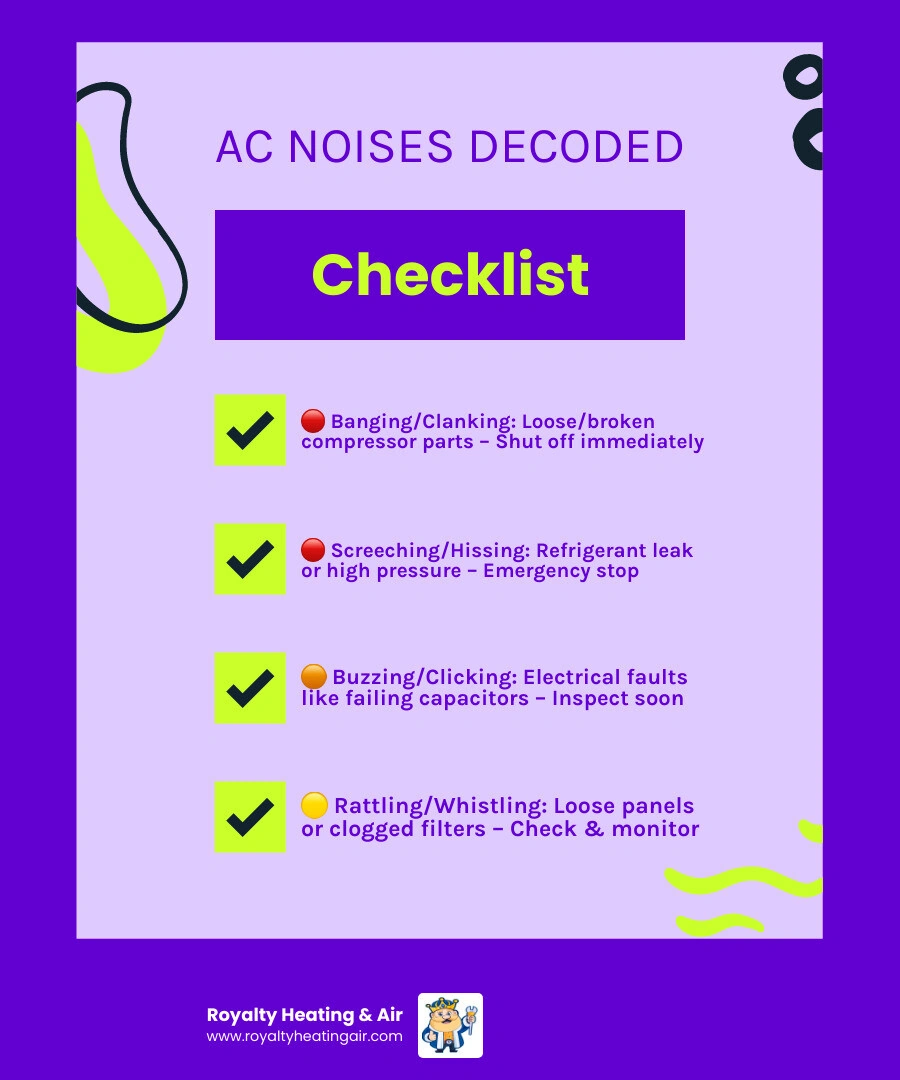
• Banging / Clanking — Most Likely Cause: Loose or broken part inside compressor or blower — Urgency: 🔴 High — shut off immediately
• Screeching / Squealing — Most Likely Cause: High compressor pressure or worn motor bearings — Urgency: 🔴 High — shut off immediately
• Hissing / Screaming — Most Likely Cause: Refrigerant leak or dangerous internal pressure — Urgency: 🔴 High — shut off immediately
• Grinding — Most Likely Cause: Worn motor bearings or mechanical wear — Urgency: 🔴 High — stop use now
• Buzzing — Most Likely Cause: Electrical fault, failing capacitor, or frozen coils — Urgency: 🟠 Moderate — inspect soon
• Persistent Clicking — Most Likely Cause: Faulty thermostat, contactor, or capacitor — Urgency: 🟠 Moderate — call a pro
• Rattling — Most Likely Cause: Loose panels, debris in outdoor unit, loose hardware — Urgency: 🟡 Low-Moderate — check and monitor
• Whistling — Most Likely Cause: Clogged air filter or restricted airflow — Urgency: 🟡 Low — check filter first
• Gurgling / Bubbling — Most Likely Cause: Clogged condensate drain or refrigerant leak — Urgency: 🟠 Moderate — inspect soon
The bottom line: some noises are minor, some are urgent, and a few mean you should shut your system off right now. The sections below will walk you through each one clearly.
Roseville summers push AC systems hard. Heat, dust, and pollen can accelerate wear on components — which means a small noise that starts in April can turn into a full breakdown by July if ignored. Catching these sounds early is the difference between a quick fix and an expensive repair.
When we talk about an ac making strange noises what they mean, we are essentially looking at a diagnostic roadmap. Modern AC systems, especially high-efficiency variable-speed units, are engineered to operate at decibel levels as low as 19dB—softer than a whisper. Because they are designed for silence, any new sound is your system "communicating" a specific mechanical or electrical struggle.
Most noises fall into one of three categories:
1. Mechanical Failure: Parts that have come loose, lost lubrication, or reached the end of their lifespan.
2. Electrical Faults: Components like capacitors or contactors that are struggling to send or receive power.
3. Airflow Issues: Restrictions caused by dirt, debris, or ductwork problems.
It is important to note that the location of the sound matters. A noise coming from your indoor air handler usually points to the blower motor or evaporator coils, while sounds from the outdoor unit often involve the compressor or condenser fan. If you use a specialized system, you might find that why ductless AC is making unusual sounds differs slightly from a central air setup, often involving plastic expansion or condensate issues. Similarly, homeowners should understand what causes strange noises in heat pump system units, as these systems have reversing valves that can make unique clicking or "whooshing" sounds during defrost cycles.
There are some sounds that act like an "alarm bell" for your home’s safety and the system's survival. If you hear these, do not "wait and see." Turn the system off at the thermostat and the breaker immediately.
If your outdoor unit sounds like it is hosting a construction site or a drum solo, you likely have a mechanical emergency. Banging and clanking are almost never minor. These sounds usually indicate that a metal part has come loose or broken entirely.
Inside your compressor—the "heart" of the system—there are several moving parts:
• Connecting Rods: If these break, they can thrash around the sealed casing.
• Crankshafts: A broken crankshaft will cause heavy, rhythmic thumping.
• Pistons: Worn piston pins can cause a metallic clatter.
Because the compressor is a sealed unit, these internal components cannot be repaired individually. Running a system that is banging is like driving a car with a broken engine rod; the loose part acts like shrapnel, destroying everything else inside. Furthermore, if you are wondering why is AC making a grinding noise, it is often due to motor bearings that have completely lost their lubrication. If you wait until the grinding stops on its own, you will likely be replacing the entire motor rather than just the bearings.
Hissing is often the sound of air or gas escaping where it shouldn't. A persistent hissing sound usually points to a refrigerant leak in the copper lines or the evaporator coils. Refrigerant is a pressurized chemical, and leaks are not just bad for your cooling—they have a negative environmental impact and can cause respiratory issues if inhaled in high concentrations.
However, if that hiss turns into a high-pitched screaming or whistling, it is a sign of dangerously high internal pressure within the compressor. This is often caused by a failing expansion valve or a major blockage in the refrigerant lines. This is a "Code Red" situation. EPA regulations require certified professionals to handle refrigerant, so never attempt to patch these lines yourself.
Not every noise requires a service van in your driveway immediately. Some sounds are "maintenance cries" that you can address with a few simple checks.
First, check your air filter. A dirty filter is the root of many HVAC evils. When air can't pull through the filter, the motor has to work twice as hard, often leading to humming or thumping. If you find your system is noisy and you're also wondering what causes AC to blow weak air, a clogged filter is the #1 suspect. Replace your filter every 1–3 months to keep the system "breathing" easily.
Next, head outside. Turn off the power to the unit and check for debris. In Roseville, wind can blow twigs, dried leaves, or even small pebbles into the top of the condenser. If these hit the fan blades, they create a "thwapping" sound, similar to playing cards in bicycle spokes. Carefully remove any visible debris and ensure there is at least two feet of clear space around the unit.
Buzzing and clicking are often electrical in nature.
• Buzzing: This can mean a few things. If it's coming from the outdoor unit, a contactor relay (the switch that tells the unit to turn on) might be failing or "chattering." It could also indicate a failing capacitor, which is like a small battery that gives the motor the "kick" it needs to start. If the indoor unit is buzzing, you might actually have frozen evaporator coils due to restricted airflow.
• Clicking: A single click when the system starts or stops is perfectly normal—that’s just the electrical components engaging. However, persistent, rapid clicking usually means the thermostat is trying to communicate with the unit, but a relay or control board isn't responding.
If your system is struggling with airflow, you might notice the AC making high-pitched whistling sound. This "tea kettle" effect happens when air is being forced through a gap that is too small, such as a slightly dislodged filter or a leaky duct.
Rattling is frequently caused by the constant vibration of the unit loosening hardware over time. Check the exterior panels of your indoor and outdoor units. If a screw has vibrated loose, the metal panel will "chatter" against the frame. A quick turn of a screwdriver can often solve this "scary" noise.
If the rattling sounds like it’s coming from under the unit, check the isolation feet. These are the rubber pads the unit sits on to absorb vibration. If they have cracked or flattened over the years, the vibration will transfer directly into your home's structure, causing a low-frequency rumble.
No. A loud banging noise is a sign of a mechanical failure, usually a loose or broken part inside the compressor or blower assembly. Continuing to run the system can cause "catastrophic damage," where a repairable issue turns into a total system replacement. Shut it down immediately and call for a professional inspection.
If your AC clicks but refuses to start, it is likely an electrical communication issue. The thermostat is sending the signal to "go," but the capacitor (the starter) or the contactor (the switch) is failing to engage the motor. This is a common repair for HVAC professionals but should not be ignored, as it can eventually damage your compressor.
Absolutely. High winds can blow debris into the fan housing, and extreme heat can cause metal components and ductwork to expand and contract, leading to popping or rattling sounds. However, if the rattling persists after the weather calms down, it is likely a loose panel or a fan blade that has moved out of alignment.
At Royalty Heating & Air, we believe your home should be a "Symphony of Silence." When your ac making strange noises what they mean starts to feel like a mystery, these sounds are early warning signs designed to save you from total system failure. Whether it’s a simple filter change or a complex compressor issue, addressing it early protects your comfort and your wallet.
We are proud to serve our neighbors in Loomis, Rocklin, Roseville, Lincoln, and Granite Bay. Beyond keeping your home cool, we are dedicated to our community through our partnership with the MackAttack Foundation, where we support foster babies and sponsor family adoptions. We believe in building strong families and reliable home systems.
Don't let a scary noise ruin your peace of mind. Regular preventative maintenance is the best way to extend your system's lifespan and catch those "audio clues" before they become emergencies. Schedule your professional air conditioning service with us today, and let's get your AC back to its quiet, efficient self.
