
Services
About
Service Areas


Adding cooling without ductwork options compared side by side is one of the most common questions homeowners face — especially those living in older homes built before central air became standard.
Here is a quick overview of your main options:
• Ductless Mini-Split — SEER Rating: 16-28+ — Best For: Whole-home or zoned cooling, year-round use
• High-Velocity Small-Duct — SEER Rating: 14-18 — Best For: Historic homes needing central-air feel
• Window AC Unit — SEER Rating: 10-15 — Best For: Single rooms, renters, budget cooling
• Portable AC — SEER Rating: 8-12 — Best For: Temporary or flexible cooling needs
• Through-the-Wall (PTAC) — SEER Rating: 12-16 — Best For: Permanent single-room use
• Evaporative Cooler — SEER Rating: N/A — Best For: Dry climates only
If your home in Roseville was built without ductwork, you are not stuck. Millions of older homes face this exact challenge every summer. The good news is that in April 2026, you have more practical, efficient options than ever before.
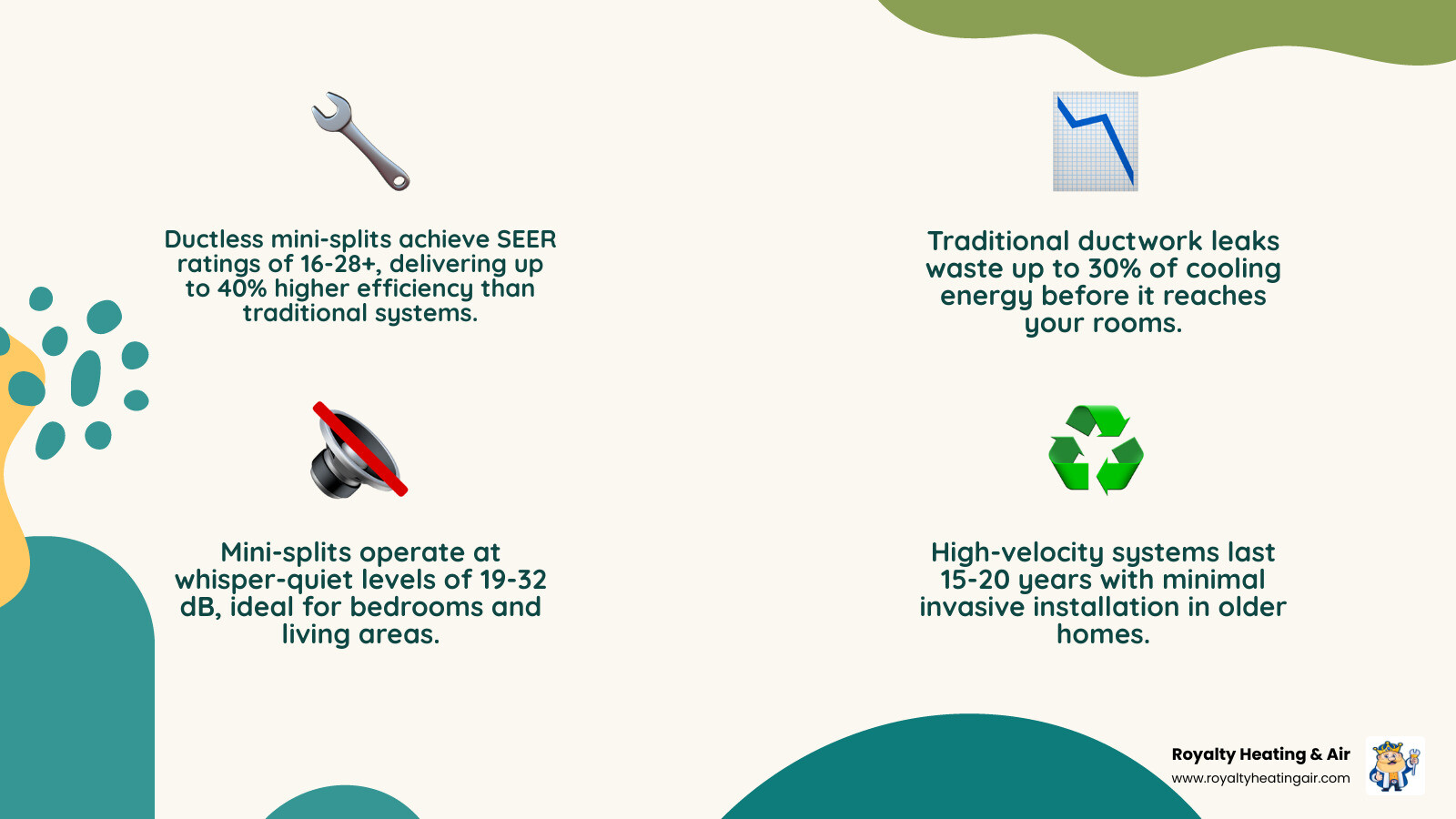
Traditional ductwork comes with a hidden cost most homeowners do not think about: up to 30% of your cooling power can disappear through duct leaks before the air even reaches your room. Ductless systems sidestep that problem entirely. Whether your priority is energy savings, preserving original plaster walls, or simply staying cool without a major renovation, the right solution depends on your home, your budget, and how you live.
This guide breaks down every realistic path so you can make a confident, informed decision.
When we look at adding cooling without ductwork options compared, we aren't just looking at how cold a room gets. We have to consider the long-term lifespan, the noise levels that might interrupt your sleep, and the overall efficiency of the system. In our local area—from the historic streets of Loomis to the newer additions in Rocklin—homeowners are looking for solutions that last.
Mini-splits are often considered the "gold standard" for non-ducted homes. They consist of an outdoor compressor linked to one or more indoor air handlers by a small conduit. Because they don't rely on bulky vents, they avoid the 20-30% energy loss associated with traditional duct systems. Mini Split Systems can last 15 to 20 years or more with proper maintenance, making them a permanent home investment.
These systems use an specialized air handler and flexible, 2-inch mini-ducts that can be snaked through existing wall cavities. They provide a "central air" feel without the need for major demolition. While they are excellent at dehumidification, they generally have lower SEER ratings (14-18) than high-end mini-splits.
These are the "band-aid" fixes. Window units are loud (50-60 decibels) and pose security risks, while portable units are often the least efficient. Single-hose portable models can actually reduce effective cooling power by up to 40% because they create negative pressure, pulling hot outdoor air back into the house through cracks and gaps.
Commonly seen in hotels, PTAC units are permanent installations that require cutting a large hole in an exterior wall. They are effective for single rooms but lack the whole-home integration of more modern systems.
Also known as swamp coolers, these work by evaporating water to cool the air. While they use significantly less electricity, they only work in very dry climates. In the Sacramento Valley, where humidity can fluctuate, they often struggle to provide consistent comfort during the peak of summer.
Efficiency is where the modern Heat Pumps used in ductless systems really shine. Most modern mini-splits utilize inverter technology, which acts like cruise control for your cooling. Instead of the system turning fully on and fully off (which wastes a lot of energy), the compressor modulates its speed to match the exact cooling demand of the room.
When adding cooling without ductwork options compared for energy savings, the SEER2 ratings tell the story. High-efficiency mini-splits can reach ratings of 28 or even higher. Compare that to a standard window unit at 10-12 SEER, and you can see why Ductless Heating Orangevale CA is becoming a popular choice for those looking to slash their utility bills. By eliminating ductwork, you're not just saving space; you're ensuring that 100% of the air you pay to cool actually stays in your living space.
We know that for many residents in Ductless Heating Granite Bay, the "look" of the system is just as important as the temperature.
• Wall-Mounted Air Handlers: These are the most common. Modern units are sleek, white, and designed to blend into the upper part of a wall.
• Ceiling Cassettes: These units sit flush with the ceiling, with only the grille visible. They are perfect for a clean, minimalist look.
• Floor-Mounted Units: Similar in appearance to a radiator, these sit low on the wall and are ideal for rooms with vaulted ceilings or limited wall space.
• Concealed Ducted Solutions: If you have a small amount of space in a closet or attic, a "mini-duct" setup can hide the equipment entirely, leaving only small, discrete vents in the ceiling.
The real "secret sauce" of the mini-split is zoned cooling. In a traditional home, you have one thermostat. If you want the bedroom cool at night, you have to cool the entire house, including the kitchen and laundry room. This is inherently wasteful.
Zoned cooling through Ductless Heating Antelope CA allows you to set different temperatures for different rooms. You can keep your home office at a crisp 72 degrees while the guest room stays at 78. This targeted approach can lead to a 40% reduction in energy consumption. It also puts an end to "thermostat wars," as every family member can control the climate in their own space. For larger homes, Ductless Heating Galt systems can connect up to eight indoor units to a single outdoor condenser, providing a comprehensive whole-home solution without a single foot of traditional ductwork.
Older homes—especially those built before 1940—were designed to "breathe" through radiators and open windows. These homes often feature plaster and lath walls, which are notoriously difficult and messy to cut into for traditional ducts.
When we work in areas like Ductless Heating Lincoln CA, our goal is minimal structural disruption. A mini-split installation only requires a small, three-inch hole for the refrigerant lines. This preserves the architectural integrity of your home while bringing it into the 21st century.
Before any installation, we perform a Manual J load calculation. This isn't just "eyeballing" the square footage; it accounts for your home's insulation, window types, and even which direction your house faces. We also evaluate your electrical panel. Older homes may need an upgrade to handle the dedicated circuits required for modern HVAC equipment. In many Ductless Heating Carmichael CA homes, we see "hybrid" setups where homeowners keep their beautiful vintage radiators for winter heat but use mini-splits for summer cooling and "shoulder season" heating.
Comfort is about more than just the number on the thermostat; it's about how the air feels. In the Sacramento Valley, humidity can make a 90-degree day feel much worse. High-velocity systems and mini-splits excel here because they run for longer cycles at lower speeds, which allows the coils to pull more moisture out of the air. High-velocity systems, in particular, remove about 30% more moisture than conventional AC.
Indoor air quality is another major factor when adding cooling without ductwork options compared. Traditional ducts are often breeding grounds for dust, pet dander, and mold. Ductless units feature multi-stage filtration that can capture up to 99.9% of allergens. If you find yourself needing Ductless AC Repair Elk Grove CA, it’s often due to a clogged filter or a drainage issue—both of which are easily preventable with regular maintenance.
Furthermore, these systems are whisper-quiet. While a window unit might roar at 60 decibels, a mini-split indoor unit typically operates between 19 and 32 decibels. That is literally quieter than a whisper or rustling leaves.
Absolutely. Modern mini-split heat pumps are designed for year-round comfort. While older heat pumps struggled when temperatures dropped, 2026-era technology can maintain full heating output even when it is 5°F outside. For our local climate, including Ductless Heating Lodi, a cold-climate mini-split is more than capable of being your primary heat source.
Yes! Under the Inflation Reduction Act, the Section 25C federal tax credit is a major incentive. Homeowners can claim a 30% credit for qualifying heat pump equipment and installation, up to a maximum of $2,000 per year. When combined with local utility rebates, which can range from $500 to $2,000, the transition to energy-efficient cooling is more accessible than ever. Always look for Energy Star-certified units to maximize these savings.
One of the best things about going ductless is the speed. A full central air retrofit could take a week and leave your home covered in plaster dust. A typical multi-zone mini-split installation usually takes just 1 to 2 days. The process is non-invasive, involving professional vacuum testing of the lines to ensure no leaks and the installation of attractive line set covers to protect the exterior of your home.
At Royalty Heating & Air, we believe that every homeowner deserves a comfortable sanctuary, regardless of when their home was built. We are proud to serve the Roseville community, including our neighbors in Loomis, Rocklin, Lincoln, and Granite Bay. Our commitment goes beyond HVAC; through our partnership with the MackAttack Foundation, we support foster babies and sponsor family adoptions, helping to build stronger families in the communities where we work.
Choosing the right system involves adding cooling without ductwork options compared based on your specific floor plan and lifestyle goals. Whether you want the invisible vents of a high-velocity system or the ultra-efficient zoning of a mini-split, we are here to guide you.
Don't spend another summer "toughing it out" with loud, inefficient window units. Schedule your consultation for a Mini Split System with us today and discover how modern technology can transform your home’s comfort while preserving its unique character.

