
Services
About
Service Areas


Understanding exactly What a Bad Thermostat Actually Looks Like: Symptoms Beyond a Blank Screen is a critical first step when your cooling system starts acting erratically in the middle of a late-summer heatwave. Your air conditioner might be turning on and off every three minutes, or maybe it runs constantly without ever actually cooling the house down. When temperatures regularly exceed 100 degrees in Roseville and the wider Sacramento Valley, this kind of erratic behavior causes immediate dread. In our years serving local homeowners, our team at Royalty Heating & Air regularly sees customers naturally assume the worst: the heavy machinery has failed, the compressor is dead, and a massive replacement project is looming on the horizon.
That panic is completely understandable. As families prepare for the back-to-school transition, a malfunctioning cooling system in peak summer heat is a serious comfort and safety issue. However, before you assume the worst about your air conditioning systems, you have to consider how the equipment operates. The heavy machinery outside relies entirely on the small plastic box on your hallway wall to tell it what to do. If that control center is sending faulty signals, the outdoor unit will behave erratically, perfectly mimicking a catastrophic mechanical failure.
Understanding this distinction is the dividing line between panic and a practical solution. Isolating these subtle control failures from actual mechanical breakdowns is a fundamental part of professional AC repair in Roseville. While a completely dead screen is an obvious sign of trouble, our technicians often find that the most damaging thermostat failures are completely invisible. The screen still lights up, the buttons still click, but the internal sensors have quietly lost their grip on reality. By learning to spot these hidden symptoms, you can protect your equipment from unnecessary wear and save yourself from premature replacement anxiety.
To understand why a simple control failure looks like a major mechanical disaster, it helps to look at how your HVAC system is structured. Think of your thermostat as the brain of the operation and your air conditioning compressor as the muscle. The muscle does all the heavy lifting, but it is completely blind. It only turns on when the brain tells it to, and it only stops when the brain says the job is done.
Most digital thermostats are built to last roughly 10 to 15 years. Over that time, the internal components—specifically the tiny temperature sensors called thermistors—begin to degrade. This degradation is often exposed by August late-summer wear, when the system has been running for months and the ambient heat in the house tests the limits of the aging sensors. While you might already know why your thermostat screen might go blank due to power issues or tripped safety switches, a degraded sensor is a completely different kind of problem. The power is fine, but the communication is broken.
When the brain loses its ability to accurately measure the room, it starts sending chaotic commands to the muscle. The compressor outside is simply following orders, starting and stopping based on the flawed data it receives.
• The Thermostat (Brain) — Role in the System: Senses temperature and sends low-voltage signals to start or stop equipment. — What Failure Looks Like: Wrong temperature readings, failure to send signals, rapid on/off commands.
• The AC Compressor (Muscle) — Role in the System: Pressurizes refrigerant to remove heat from the indoor air. — What Failure Looks Like: Loud grinding noises, hard start failures, hot air blowing from vents.
Because the muscle is the part making all the noise and using all the electricity, homeowners naturally blame it for the erratic behavior. But replacing a perfectly good air conditioner because of a failing thermostat is an incredibly expensive mistake. Recognizing the signs of a failing sensor is the key to preventing that error.
One of the most frustrating symptoms of a failing control unit is what industry professionals call "sensor drift." This creates temperature ghosts—situations where the thermostat genuinely believes the room is one temperature, while reality is completely different. For example, you might be sweating in your living room, but the thermostat proudly displays that it has successfully cooled the house to 72 degrees.
Sensor drift happens slowly. Inside your thermostat is a small component called a thermistor, which changes its electrical resistance based on the surrounding air temperature. Over a decade of use, dust buildup, microscopic corrosion, and general component fatigue cause this thermistor to lose its calibration. It stops measuring the air accurately and starts reporting ghost temperatures to the control board.
This is particularly dangerous during peak August heat. When the outdoor temperatures are pushing past 100 degrees, accurate sensing is absolutely critical for managing your indoor comfort and keeping your utility costs under control. If your thermostat is reading five degrees cooler than reality, your air conditioner will shut off prematurely, leaving your home dangerously hot and humid. Conversely, ghost temperature readings triggering short-cycling can cause the system to start and stop frantically as the sensor bounces between incorrect measurements.
Catching sensor drift early can save you from weeks of miserable indoor temperatures. Here is what you should look for if you suspect your thermostat is chasing temperature ghosts:
• The physical comfort test: There is a highly noticeable disparity between what the thermostat display says and how the actual room feels to you.
• The secondary thermometer check: Taping a standard glass indoor thermometer to the wall right next to your thermostat reveals a multi-degree difference after sitting for 15 minutes.
• Premature shutoffs: The air conditioning system shuts off completely while the house still feels uncomfortably warm and humid.
• Unexplained temperature swings: The displayed indoor temperature jumps up or down by two or three degrees in a matter of seconds, which is physically impossible for the actual air in the room.
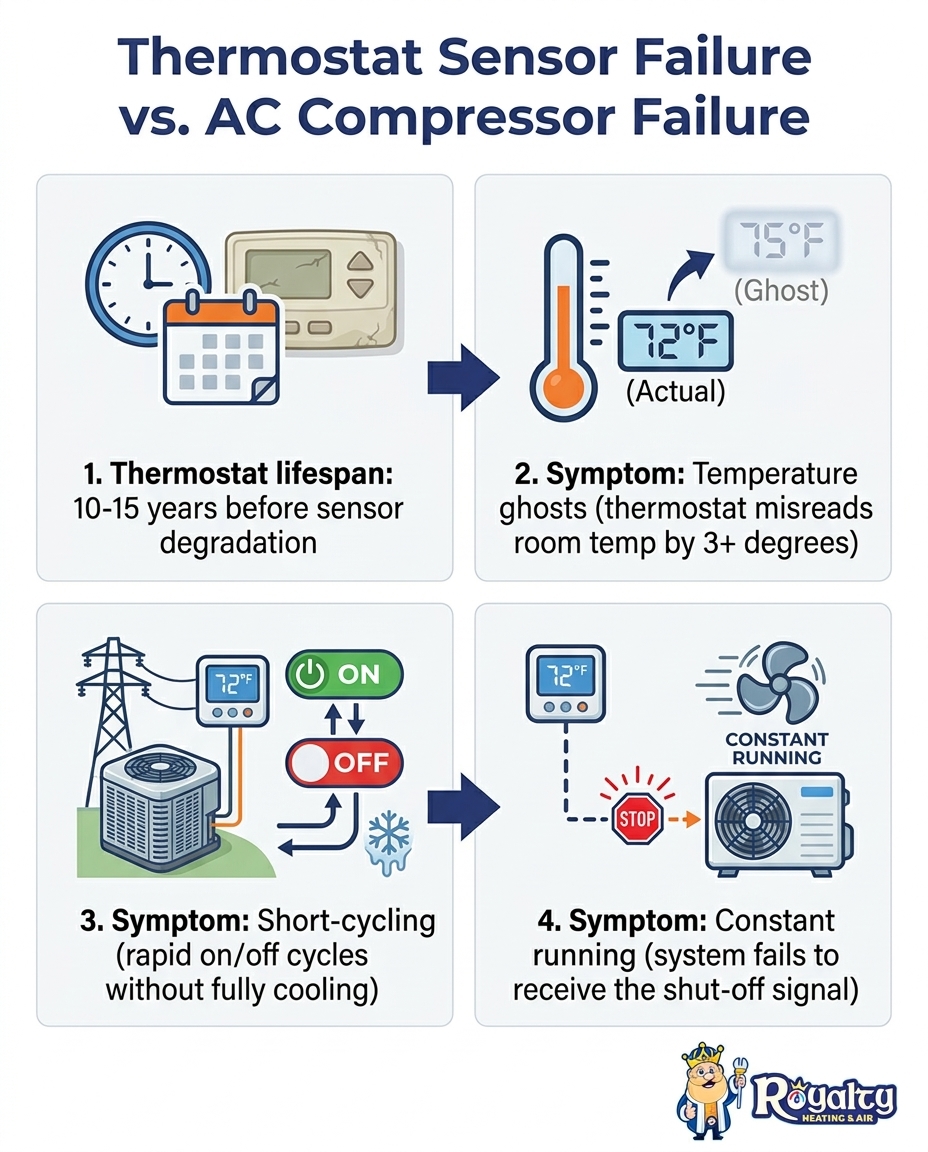
While temperature ghosts make your home uncomfortable, short-cycling actually damages your equipment. Short-cycling occurs when your cooling system turns on, runs for only a few minutes, shuts off before completing a full cooling cycle, and then immediately turns back on again. It is one of the most destructive things that can happen to an air conditioner, and our technicians find it is very frequently caused by a failing thermostat.
When ghost temperature readings triggering short-cycling occur, the thermostat is essentially stuttering. It sends a "cool" command, the AC turns on, and then the flawed sensor suddenly registers a massive temperature drop that hasn't actually happened. It immediately sends a "stop" command. A minute later, the sensor realizes its mistake, registers the real heat in the room, and demands cooling again. In our experience performing AC repair in Roseville, this rapid on-and-off sequence takes a massive toll on the mechanical components outside.
Here is exactly how a failing thermostat damages your compressor during a short-cycle loop:
1. Massive electrical draw: An air conditioner uses the most electricity during the first few seconds of startup. Starting the system ten times an hour instead of two times an hour skyrockets your energy bills and overheats the electrical components.
2. Lack of oil circulation: The compressor relies on refrigerant to carry lubricating oil through the system. If the system only runs for two minutes at a time, the oil never fully circulates, leaving the compressor grinding without proper lubrication.
3. Incomplete moisture removal: An AC needs to run for at least 15 minutes to pull humidity out of the air. Short-cycling leaves your home feeling clammy and damp, even if the air feels slightly cooler.
4. Accelerated mechanical fatigue: The constant starting and stopping wears out contactors, capacitors, and fan motors years before their expected lifespan.
Because the outdoor unit is making strange noises and starting and stopping erratically, homeowners assume the AC itself is broken. In reality, the heavy equipment is just a victim of a bad control signal. Having a professional check your thermostat during routine AC maintenance is the best way to catch these sensor issues before they destroy your compressor.
On the opposite end of the spectrum from short-cycling is the system that simply refuses to turn off. You might wake up in the middle of the night freezing, check the thermostat, and see that the house is 65 degrees even though you set it to 75. The air conditioner is running constantly, but the thermostat refuses to send the shut-off command.
This "always on" symptom usually stems from one of two control failures. The first is severe sensor drift in the opposite direction—the thermostat thinks the room is 85 degrees no matter how cold it actually gets, so it just keeps demanding more cooling. The second potential cause is a stuck mechanical relay inside the thermostat itself. When the relay fuses closed, the low-voltage signal to the outdoor unit is permanently engaged, forcing the compressor to run continuously.
The consequences of a system that won't shut down go beyond shockingly high energy bills. When an air conditioner runs for hours on end without a break, it pulls too much moisture out of the air and drops the temperature of the indoor evaporator coil too low. Eventually, the condensation on the coil freezes into a solid block of ice, blocking airflow entirely and potentially damaging the indoor blower motor. This kind of August late-summer wear is incredibly common when aging thermostats finally give out under the strain of continuous operation.
It is also important to note that a bad control unit doesn't care what season it is. If your thermostat has a stuck relay or a drifting sensor now, those same control failures will eventually plague your heating equipment when the seasons change, causing your furnace to short-cycle or run constantly when winter arrives.
When you are facing a hot house, a constantly running AC, or a system that starts and stops every three minutes, the urge to panic is strong. But replacing an entire air conditioning unit because of a bad thermostat is an incredibly expensive and unnecessary mistake. This is exactly why thorough, precision diagnostics are so important.
Working with our team at Royalty Heating & Air means you benefit from a precision diagnostic process designed to isolate the exact point of failure. Instead of just guessing that an old AC needs replacing, our trained professionals will test the actual communication between the brain and the muscle. This involves using specialized multimeters to test the low-voltage electrical output at the thermostat sub-base, verifying sensor calibration, and checking the control board at the indoor unit to ensure signals are being sent and received correctly.
It is highly recommended that homeowners avoid DIY electrical testing. Modern HVAC systems use delicate control boards that can easily be shorted out by a misplaced multimeter probe. A simple mistake while trying to test thermostat wires can instantly destroy the main control board in your furnace or air handler, turning a minor control issue into a major repair bill. By relying on professional diagnostics, homeowners in Roseville CA can pinpoint simple control failures safely, saving themselves from unnecessary panic and expensive premature equipment replacements.
A broken thermostat often results in the system not responding to setting changes, clicking without the AC turning on, or reading incorrect room temperatures. If the AC runs fine but at the wrong times, or if ghost temperature readings triggering short-cycling are occurring, it's likely the thermostat. A professional can quickly test the low-voltage wires to confirm if the thermostat is sending the correct signals to the equipment.
Yes, if the internal sensor is failing or dirty, it may falsely read that the room has reached the target temperature, shutting the AC off prematurely, only to turn it back on moments later. This rapid on-and-off cycling is highly damaging to the compressor. Replacing a degraded thermostat is often the easiest way to cure a short-cycling air conditioner.
Beyond a blank screen, symptoms include uneven cooling, the AC running constantly, short-cycling, or a complete failure to trigger the heating or cooling equipment. The thermostat loses its ability to accurately measure the room or properly route low-voltage electricity. This forces the mechanical equipment to operate erratically, mimicking a major breakdown.
Tape a reliable glass thermometer next to the thermostat. If after 15 minutes the readings differ by more than a degree or two, the sensor is likely drifting or failing. You might also notice that your home feels significantly hotter or colder than the temperature displayed on the screen, indicating the sensor has lost its calibration.
Absolutely. By causing the AC to overwork, run constantly, or short-cycle, a faulty thermostat forces the system to consume significantly more electricity. An air conditioner uses the most power during startup, so a thermostat that triggers constant restarting will cause a massive spike in your monthly utility costs.
Dealing with erratic cooling issues doesn't have to mean your entire air conditioner is dying. Subtle symptoms like temperature ghosts, short-cycling, and constant running are very often the result of a failing thermostat sending bad signals to perfectly healthy equipment. Recognizing that these control issues mimic major mechanical failures is the first step toward getting the right fix.
You don't have to live with the anxiety of wondering if your compressor is going to survive the rest of the season. A clear, professional explanation of your system's behavior provides true peace of mind. Before the August late-summer wear takes a further toll on your heavy equipment, have your system evaluated by a local expert. Getting a precision diagnosis ensures you only fix what is actually broken, keeping your home comfortable without unnecessary expenses.
