
Services
About
Service Areas


Finding the best air filter for your home is one of the simplest things you can do to protect your family's health — and your HVAC system. According to the EPA, indoor air can be 2 to 5 times more polluted than the air outside. Dust, pollen, pet dander, mold spores, smoke, and VOCs build up indoors every single day, often without any visible sign.
Here's a quick look at the top air filter options by need:
• General dust and pollen — Best Filter Type: 1-inch pleated HVAC filter — Key Rating to Look For: MERV 8–11
• Allergies and pet dander — Best Filter Type: Thicker media filter or purifier — Key Rating to Look For: MERV 13 / True HEPA
• Smoke and VOCs — Best Filter Type: HEPA + activated carbon purifier — Key Rating to Look For: CADR 200+ CFM
• Whole-home coverage — Best Filter Type: 4–5 inch media cabinet filter — Key Rating to Look For: MERV 11–13
• Single room or bedroom — Best Filter Type: Standalone air purifier — Key Rating to Look For: 4.8+ ACH for room size
Most homeowners don't give their air filter much thought — it's tucked away in a return vent or a basement closet, quietly doing its job. But choosing the wrong filter (or skipping replacements) can mean dirtier air, higher energy bills, and a shorter lifespan for your HVAC system.
Whether you're dealing with allergy season in Roseville, wildfire smoke drifting in from nearby hills, or just trying to keep pet hair from coating every surface, the right filter makes a real difference. This guide breaks down every major option — from basic 1-inch HVAC filters to whole-home media cabinets and standalone air purifiers — so you can find the right fit for your space and your budget.
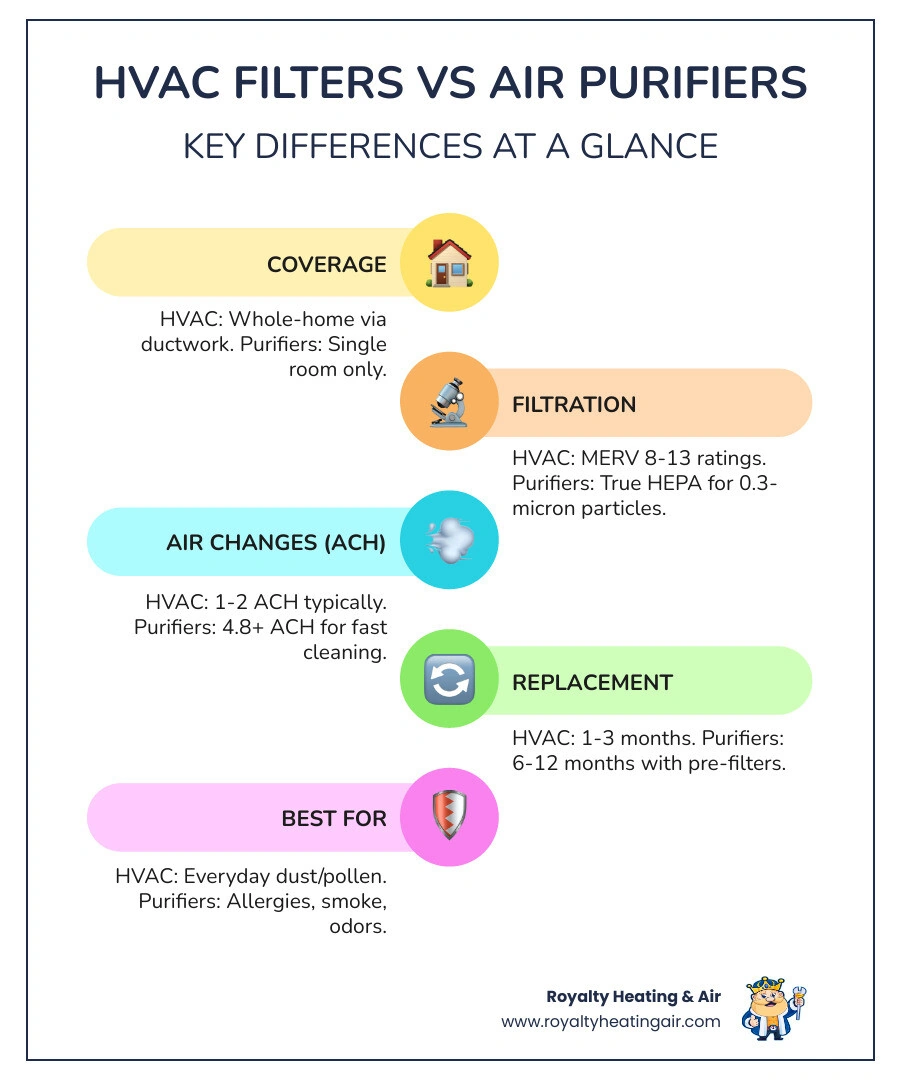
The best choice depends on five things: your HVAC system, your room size, your main air-quality problem, your filter slot size, and how much airflow your equipment can handle.
For whole-home systems, the biggest concern is usually balancing filtration with airflow. For room purifiers, the biggest concern is matching the unit's cleaning power to the space.
A few quick terms matter here:
• CADR stands for Clean Air Delivery Rate and tells you how much filtered air a purifier delivers
• ACH means Air Changes per Hour, or how many times the purifier can clean the room's air in an hour
• MERV, MPR, and FPR rate HVAC filter performance
• HEPA refers to a very high-efficiency particle standard used in many standalone purifiers
As a rule of thumb, EPA guidance and purifier testing both point toward roughly 4.8 ACH as a strong target for effective room cleaning. If smoke is a concern, higher is even better.
HVAC furnace filters and portable purifiers are not the same tool.
HVAC filters sit inside your forced-air heating and cooling system. Their first job is to protect the equipment from dust and debris. A better filter can also improve whole-home air quality because every time the blower runs, some particles are captured from air moving through the ductwork.
Standalone purifiers clean the air in one room at a time. They are usually the better choice for:
• Bedrooms
• Nurseries
• Home offices
• Living rooms
• Areas hit hardest by smoke or odors
If you have a ducted system in Loomis, Rocklin, Roseville, Lincoln, or Granite Bay, a whole-home filter upgrade can help throughout the house. If one family member has allergies or sleeps with pets, a bedroom purifier often gives faster relief where it matters most.
During wildfire season, many homes benefit from a combined strategy: a properly matched HVAC filter plus one or more portable HEPA purifiers in the rooms you use most.
These ratings can feel like alphabet soup, but the basics are simple.
• MERV is the standard developed by ASHRAE for HVAC filters
• MPR is a brand-specific particle rating used on some filters
• FPR is a retail rating system used by some home improvement stores
• HEPA is a separate high-efficiency standard mostly used in air purifiers
In general, higher numbers mean better particle capture.
For HVAC filters:
• MERV 1-4: very basic dust protection
• MERV 5-8: better for pollen, dust mites, and larger particles
• MERV 8-11: a practical sweet spot for many homes
• MERV 13: stronger capture for finer particles, including some smoke and bacteria-sized particles, but not every system can handle it in a 1-inch filter
For purifiers:
• True HEPA is designed to capture 99.97% of particles at 0.3 microns
• That includes many fine airborne particles such as smoke, pollen fragments, and other tiny pollutants
Important note: HEPA is excellent for particles, but it does not remove gases or smells by itself. For odors and VOCs, you want activated carbon too.
Start with the pollutant you care about most.
• Dust and pollen: MERV 8-11 HVAC filter or a small purifier
• Pet dander: MERV 11-13 media filter or HEPA purifier
• Wildfire smoke: HEPA purifier with strong CADR
• Cooking odors and VOCs: purifier with substantial activated carbon
• Mold spores: good filtration plus moisture control
• Dust mites: better filtration, regular cleaning, and humidity management
A filter cannot fix humidity problems. If a home feels muggy, musty, or sticky, filtration alone is not enough. Moisture control, ventilation, and sometimes dehumidification are part of the solution too. For more on healthier indoor air, visit Healthy Home Air.
If your system uses a standard 1-inch slot, you need to be careful. A good filter should clean the air without turning your blower into an athlete running uphill.
For many homes, a pleated 1-inch filter is the best starting point. It offers much better capture than a cheap flat fiberglass filter, but not every high-rated model is automatically better.
For seasonal timing and replacement reminders, our Spring Air Filter Replacement Guide is a helpful next read.
For most standard residential systems, we recommend thinking in tiers:
1. Best for most homes: MERV 8 pleated filter
2. Best for moderate allergies and pets: MERV 11 pleated filter
3. Best only if your system can handle it: MERV 13 pleated filter
Why this ranking?
• MERV 8 usually gives the safest airflow balance
• MERV 11 can improve capture of finer dust, pollen, and dander
• MERV 13 can be effective, and MERV 13 1-inch filters are often top-rated in consumer testing, but they are not ideal for every HVAC system
If your main goal is basic air cleanliness and equipment protection, skip the bargain-bin fiberglass panel and choose a snug-fitting pleated filter instead. Fit matters more than many homeowners realize. A high-rated filter with gaps around the frame can let air bypass the media entirely.
This is where homeowners get tripped up.
A higher-rated 1-inch filter can help if:
• Your blower and duct system are designed for the extra resistance
• Your return duct is adequately sized
• You have allergy concerns and need stronger particle capture
• The filter is changed on time
It can hurt if:
• The system already struggles with airflow
• The filter gets loaded with dust and is left in too long
• The evaporator coil is prone to freezing
• Static pressure is already high
Too much restriction can reduce comfort, strain the blower, lower efficiency, and in cooling season even contribute to coil freeze-up. In the worst cases, poor airflow can shorten equipment life. That is why we never recommend choosing the most aggressive 1-inch filter just because the package sounds impressive.
If you are unsure, start conservative and read our guide on AC Filter Replacement.
The most common mistakes are surprisingly avoidable:
• Buying the wrong size
• Installing the airflow arrow backward
• Leaving gaps around the frame
• Using washable filters that do not seal well
• Forgetting the return grille filter if your home uses one
• Waiting until the filter looks like it survived a dust storm
Set reminders. Check more often if you have pets, remodeling dust, or smoke exposure. And remember: the "best" filter is the one your system can actually breathe through.
If your system can accept a 4-inch or 5-inch media filter, or if a media cabinet can be added, this is often the best whole-home upgrade.
Research consistently shows thicker filters have two major benefits:
• Better particle capture
• Less frequent replacement
They also have more surface area, which usually means lower resistance to airflow than a highly restrictive 1-inch filter of similar efficiency.
Learn more about whole-home options at Whole House Air Filtration Rocklin.
For many homeowners, the sweet spot is a 4-inch or 5-inch media filter in the MERV 11 to MERV 13 range.
That setup can offer:
• Better dust and pollen capture than standard 1-inch filters
• Lower static pressure than many 1-inch high-MERV filters
• Longer service life, often around annual replacement depending on conditions
• Better whole-home performance during allergy season and wildfire events
This is often the smartest answer when homeowners ask us for the best air filter for your home without sacrificing HVAC performance.
Here is the simple comparison:
• 1-inch pleated filter — Best For: Standard systems — Pros: Easy to find, simple to replace — Cons: Limited surface area, can restrict airflow at higher ratings
• 4-5 inch media filter — Best For: Whole-home filtration — Pros: Better capture, longer life, lower resistance — Cons: May require cabinet retrofit
• HEPA add-on system — Best For: Advanced particle control — Pros: Extremely high efficiency — Cons: Usually too restrictive for standard blowers without special design
A quick clarification: many homeowners say "fiberglass filter" when they mean any HVAC filter. Basic flat fiberglass filters mostly protect equipment from large debris. Pleated media filters do much more for indoor air quality.
HEPA add-on systems can be effective, but true HEPA is so dense that standard residential HVAC blowers usually need a specially designed setup or assisted fan. It is not a casual swap.
If odor control is important, look for a carbon stage in addition to particle filtration.
A whole-home air cleaner makes sense if:
• Multiple people in the house have allergies
• You have several pets
• Dust builds up quickly across many rooms
• You want filtration every time the HVAC fan runs
• Wildfire smoke is a recurring issue in our area
It can also help keep internal system components and ducts cleaner over time, especially when paired with proper maintenance. For related reading, see Remove Pollutants From Homes Ductwork.
Portable purifiers shine when you want fast results in a specific room. Their performance depends on three big things:
• CADR
• Room size
• Noise level at useful fan speeds
Always check whether the purifier's claimed room size reflects high ACH or a very low one. A giant coverage claim is not helpful if the unit only gives one or two air changes per hour.
For broader solutions, explore our Indoor Air Quality Services.
For smaller spaces, prioritize:
• Quiet operation
• Sleep mode
• True HEPA filtration
• Low-light controls
• CADR matched to room size
A purifier that is whisper-quiet on paper but only effective on turbo is not really quiet where it counts. For bedrooms, we like units sized to achieve about 4.8 to 5 ACH at a fan speed people will actually use overnight.
A practical example from current testing: some well-performing bedroom units can deliver about 5 ACH in rooms around the mid-300-square-foot range, making them a strong fit for larger bedrooms or offices.
Large spaces need real airflow, not marketing poetry.
For living rooms and open-concept areas, look for:
• High CADR
• Verified performance data
• Manageable sound levels
• Energy-efficient operation
• CARB certification if the unit includes optional ionizing features
Recent tested examples in the market show a wide spread:
• Some compact DIY-style or fan-based units can reach PM1 CADR above 300 cfm
• Large premium room purifiers can exceed 500 cfm CADR and support about 5 ACH in spaces close to 700 square feet
For smoke events, more air movement is usually better. If your living room opens into the kitchen and hallway, size up rather than down.
Different pollutants need different tools:
• Allergies: True HEPA and enough ACH
• Pets: HEPA plus a washable pre-filter for hair
• Smoke: HEPA plus strong airflow
• Odors and VOCs: activated carbon in meaningful quantity
• Wildfire particles: HEPA, sealed design, high CADR
One standout budget-friendly option for smoke and particles is the DIY Corsi-Rosenthal box. Built from box fans and high-quality filters, it can move a lot of clean air for the money. It is not always the prettiest thing in the living room, but neither is a cloud of smoke.
For more ideas on improving comfort and air cleanliness throughout the house, read Healthy Home Air.
Even the best filter stops being the best when it is overdue for replacement.
Maintenance affects:
• Airflow
• Filtration
• Noise
• Energy use
• Equipment health
If you want a broader indoor air quality plan, our article on IAQ Services You Didn't Know You Needed is worth bookmarking.
General replacement timing looks like this:
• 1-inch HVAC filters: about every 90 days
• 1-inch filters with pets, allergies, or heavy HVAC use: more often
• 4-5 inch media filters: often around once a year
• Purifier pre-filters: clean as directed
• Purifier HEPA filters: commonly every 6 to 12 months, depending on use and pollution load
Check more frequently during:
• Peak allergy season
• Wildfire smoke season
• Home renovations
• High-shedding pet periods
If you need help identifying hidden triggers inside the home, see Remove Hidden Allergens From Indoor Air.
When comparing products, these labels matter most:
• AHAM Verified CADR for purifier performance
• Energy Star for efficient operation
• CARB certification to confirm ozone emissions stay within allowed limits
• True HEPA for strong particle removal
Also pay attention to:
• Noise ratings in dBA
• Replacement schedule
• Whether app controls are actually useful
• Wattage if the unit will run all day
Smart features are nice, but they are not a substitute for airflow. We would rather have a boring purifier that cleans the room well than a flashy one that sends cheerful phone notifications while dust continues its world tour.
For homeowners in our service area around Roseville and nearby communities, the key regional issue is not metric sizing or foreign furnace standards. It is seasonal dust, pollen, and periodic wildfire smoke.
A few local tips:
• During smoke season, run your HVAC fan as recommended for your system and use a purifier in main living areas
• In dry dusty periods, check filters more often
• In homes with humidity concerns, remember filtration does not replace moisture control
• Heat pump and furnace systems both need airflow-friendly filter choices
If your home feels damp or smells musty, focus on dehumidification and ventilation along with filtration.
Yes, it can if the system is not designed for it, especially with 1-inch filters.
The real issue is static pressure. A filter that is too restrictive makes the blower work harder and reduces airflow. That can lead to comfort problems, efficiency loss, and equipment strain. In cooling mode, poor airflow can even contribute to frozen coils.
That does not mean high-MERV filters are always bad. It means they must be matched to the system. This is one reason whole-home media cabinets are often a better upgrade than simply stuffing a super-dense 1-inch filter into an older return slot.
For more guidance, see HVAC Air Purification.
It depends on your goal.
Upgrade your HVAC filter if you want:
• Whole-home background filtration
• Cleaner ducts and equipment
• Air cleaning whenever the system fan runs
Choose a standalone purifier if you want:
• Faster cleaning in one room
• Better smoke response in bedrooms or living spaces
• True HEPA performance without stressing the HVAC system
In many homes, the best answer is both: a properly selected HVAC filter plus one or two portable purifiers in the rooms you use most.
The filter may not be the only problem.
Persistent dust can come from:
• Duct leakage
• An undersized return
• Air bypass around the filter
• Dirty ducts
• Poor sealing around doors or windows
• Outdoor smoke or dust infiltration
• Humidity issues that make particles cling to surfaces
If your home still feels stuffy or dusty, a full indoor air quality evaluation can help identify the real cause. Learn more at Indoor Air Quality Services Roseville.
The best air filter for your home is the one that matches your system, your space, and the air problems you actually have. For some households, that is a quality 1-inch pleated filter. For others, it is a 4-inch or 5-inch media cabinet upgrade. And for bedrooms, nurseries, and smoke-prone spaces, a standalone HEPA purifier may be the real hero.
The goal is simple: cleaner air without sacrificing safe airflow.
If you live in Roseville, Rocklin, Lincoln, Loomis, or Granite Bay and want help choosing the right whole-home filtration setup, our team at Royalty Heating & Air can help you improve comfort, reduce airborne particles, and protect your HVAC system for the long haul. For more information, visit More info about indoor air quality services.

