
Services
About
Service Areas


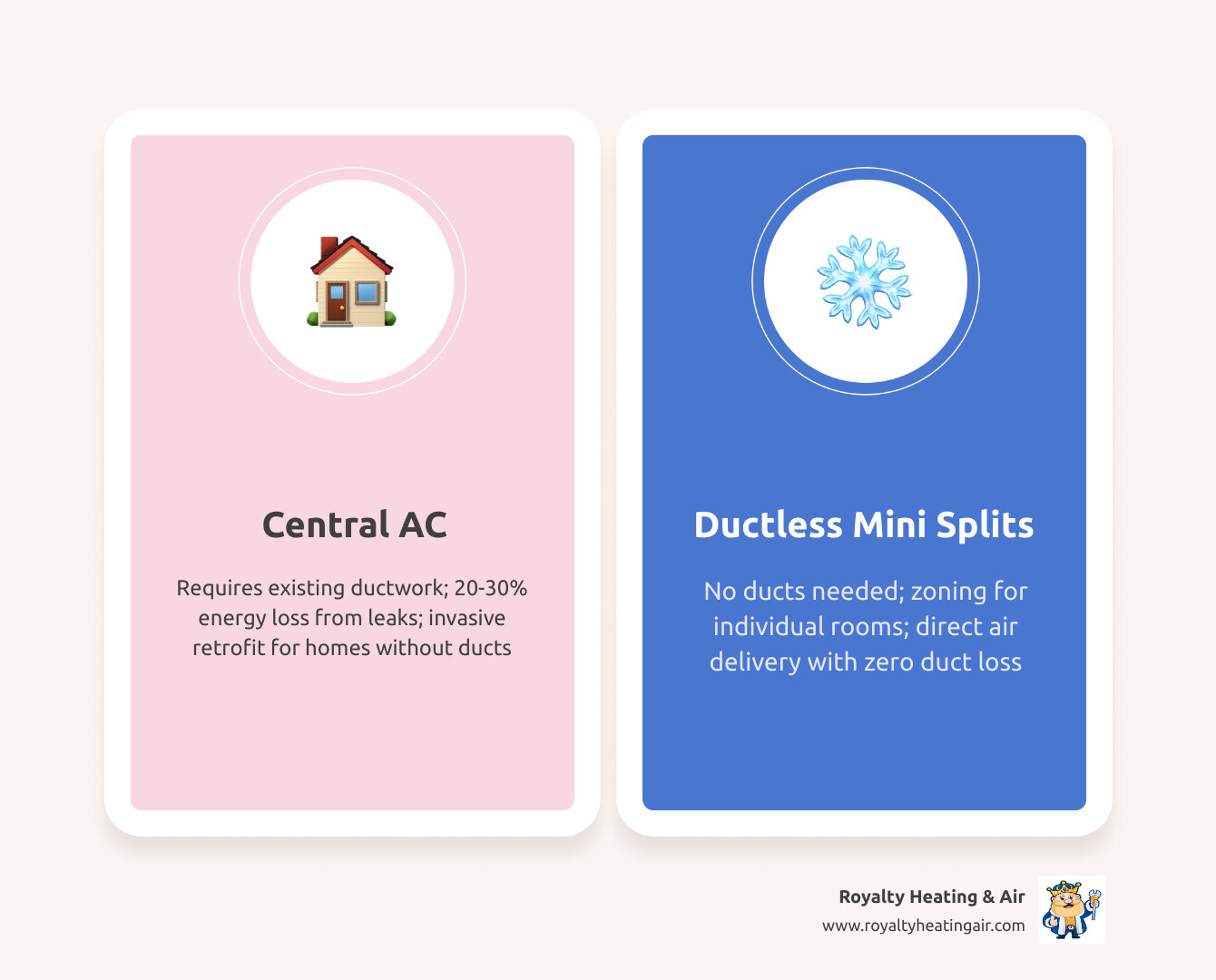
The central ac vs ductless mini split comparison comes down to a few key factors: whether your home already has ductwork, how many rooms you need to cool, and how much control you want over your comfort.
Here is a quick breakdown to help you decide:
• Requires ductwork — Central AC: Yes — Ductless Mini Split: No
• SEER2 efficiency range — Central AC: Up to 21-26 — Ductless Mini Split: Up to 33-42
• Energy loss through ducts — Central AC: Up to 30% — Ductless Mini Split: None
• Zoning control — Central AC: Limited (add-on cost) — Ductless Mini Split: Built-in, room by room
• Best for — Central AC: Homes with existing, well-sealed ducts — Ductless Mini Split: Homes without ducts, additions, problem rooms
• Heating capability — Central AC: Needs separate furnace or heat pump — Ductless Mini Split: Built-in heat pump on most models
• Typical lifespan — Central AC: 15-20 years — Ductless Mini Split: 15-25+ years
• Noise level (indoor) — Central AC: Moderate — Ductless Mini Split: 19-26 dB (whisper quiet)
Most Roseville homeowners searching for the right cooling system run into the same problem: contractors push whatever system they install most, making it hard to get a straight answer. The truth is, neither system is universally better. The right choice depends on your home's layout, your existing infrastructure, and how you actually use your space day to day.
In this guide, we break down exactly how each system works, where each one wins, and which scenarios point clearly toward one option over the other.

When we look at the core of the central ac vs ductless mini split comparison, both systems share a common goal: removing heat from your home. They both use a closed-loop refrigeration cycle, where refrigerant absorbs indoor heat and releases it outdoors. However, the way they deliver that relief to your living room or bedroom is fundamentally different.
Air Conditioning in its traditional central form relies on a single indoor air handler connected to a network of ducts. It’s an "all-or-nothing" approach—when the thermostat clicks on, the system pushes air through every branch of the home.
In contrast, a Mini Split is a "point-of-use" system. It consists of an outdoor compressor linked to one or more indoor units via slim refrigerant lines. These lines only require a small, three-inch hole in your wall, eliminating the need for bulky metal or flexible ducting.
Efficiency is where the gap truly widens in 2026. Efficiency is measured by SEER2 (Seasonal Energy Efficiency Ratio 2). While a high-efficiency central unit might reach a respectable 21 to 26 SEER2, top-tier ductless systems are now achieving staggering ratings between 33 and 42 SEER2.
The secret lies in inverter technology. Traditional central units often operate like a light switch—they are either 100% on or completely off. This leads to frequent cycling and temperature swings. Ductless systems use variable-speed inverter compressors that act more like a gas pedal, "sipping" just enough energy to maintain a perfect temperature without the constant stop-and-start waste.
One of the most significant advantages of a ductless system is built-in zoning. In a traditional ducted home, you often have one thermostat controlling the entire house. This leads to the classic "thermostat wars"—the upstairs is sweltering while the basement feels like a meat locker.
Because each indoor mini-split head has its own independent thermostat, you can choose to cool only the rooms you are actually using. If you spend your day in a home office in Rocklin or Loomis, you can keep that room at a crisp 72 degrees while allowing the rest of the house to drift higher, saving a significant amount on your monthly utility bills.
Furthermore, most mini-splits are actually Heat Pumps. This means they can reverse the cooling cycle to provide targeted warmth during our chilly California winters. This targeted approach is the ultimate form of energy conservation.
Indoor Air Quality is a major concern for families in the Roseville and Granite Bay areas, especially during pollen season or when wildfire smoke lingers in the valley.
Central systems have the advantage of being able to accommodate high-MERV or even HEPA-grade filters that "scrub" the air for the entire home as it circulates. However, this only works if you invest in regular Duct Services. If your ducts are dirty or leaky, they can actually become a source of allergens, circulating dust, pet dander, and even mold spores throughout your home.
Ductless mini-splits offer multi-stage filtration within each indoor unit. Because there are no ducts to collect debris, the air delivered is often cleaner at the source. Many modern units also include specialized ionizers or carbon filters to help with odor and humidity control. For a single room or a home addition, the localized filtration of a mini-split is hard to beat.
Every cooling solution has its trade-offs. Central AC remains the "gold standard" for many homeowners because of its invisibility. All the "guts" of the system—the coils, the fans, and the ducts—are hidden behind walls or in the attic. This provides a uniform aesthetic that many traditional buyers prefer, which can help maintain a home's resale value in established neighborhoods.
However, central systems can be noisy. You’ve likely heard the "whoosh" of air through the vents or the loud thud when the air handler kicks on in the closet.
Ductless mini-splits, on the other hand, are remarkably quiet. Most indoor units operate at 19 to 26 decibels. To put that in perspective, that is quieter than a whisper or a rustling leaf. You can sleep soundly in a Rocklin bedroom without the background roar of a furnace fan.
Pros of Central AC:
• Uniformity: Keeps the entire home at one consistent temperature.
• Aesthetics: No equipment visible in the living spaces.
• Resale: Often expected by buyers in traditional suburban homes.
• Air Filtration: Can handle whole-home air purification systems.
Pros of Ductless Mini Splits:
• Efficiency: No energy loss through ductwork (which can be as high as 30%).
• Zoning: Complete control over individual room temperatures.
• Flexibility: Perfect for historic homes, room additions, or slab-on-grade construction where ducts can't be installed.
• Heating: Provides high-efficiency Heating without needing a separate furnace.
The installation process is a major differentiator in the central ac vs ductless mini split comparison. If you are building a new home or already have healthy ductwork, central AC is a straightforward replacement. However, if you are looking to add cooling to an older home in Roseville that currently lacks ducts, the cost and disruption of retrofitting can be massive. Installing new ductwork can sometimes cost as much as the AC unit itself!
Ductless systems are much less invasive. A professional installation usually involves a single day of work and a small hole for the refrigerant lines. We use "line hides"—decorative covers—on the exterior of the home to keep the installation looking clean and professional.
Maintenance for both systems is vital for longevity. For central units, you must change your filters every 1 to 3 months and keep up with Duct Services to ensure no leaks are wasting your money.
For a Mini Split, the homeowner's main job is to pop out the mesh filters and rinse them every 2 to 4 weeks. Because these units handle air directly, keeping the filters clean is the best way to ensure the system lasts its full 20 to 25-year lifespan. We also recommend a professional deep cleaning of the indoor blower wheels once a year to prevent dust buildup.
Ductless mini-splits are the clear winner here. Retrofitting a home with ducts involves tearing into ceilings and walls, which is invasive and expensive. Ductless flexibility allows us to provide modern Air Conditioning to historic homes or room additions without a major renovation.
Absolutely. Modern mini-splits are world-class heaters. Using a reversing valve, they pull heat from the outside air—even when it's cold—and move it indoors. They are often much cheaper to run than electric baseboard heaters or older gas furnaces, providing year-round comfort with one single system.
According to the Department of Energy, the average home loses 20% to 30% of its conditioned air through leaky or poorly insulated ductwork. This is like buying a gallon of milk and pouring a third of it down the drain before you even get home. Ductless systems eliminate this waste entirely by delivering air directly to the room.
At Royalty Heating & Air, we believe that choosing between central AC and a ductless mini-split shouldn't be a guessing game. Whether you live in Roseville, Rocklin, Lincoln, Loomis, or Granite Bay, your home has unique needs that require a tailored approach.
We aren't just here to install equipment; we are here to serve our community. Our partnership with the MackAttack Foundation allows us to support foster babies and sponsor family adoptions, meaning every service call helps a local family in need.
If you are tired of uneven temperatures or skyrocketing energy bills, we can help you find the perfect balance. Check out our Blog for more tips on home comfort, or Schedule your personalized home comfort assessment today to see which system is truly right for your sanctuary.

