
Services
About
Service Areas


Central air vs mini split for the sacramento area homes is one of the most common questions homeowners face when summer temperatures climb past 100°F in the Sacramento Valley. Here is a quick breakdown to help you decide:
• Best for — Central Air: Larger homes with existing ductwork — Ductless Mini-Split: Homes without ducts or needing zoned control
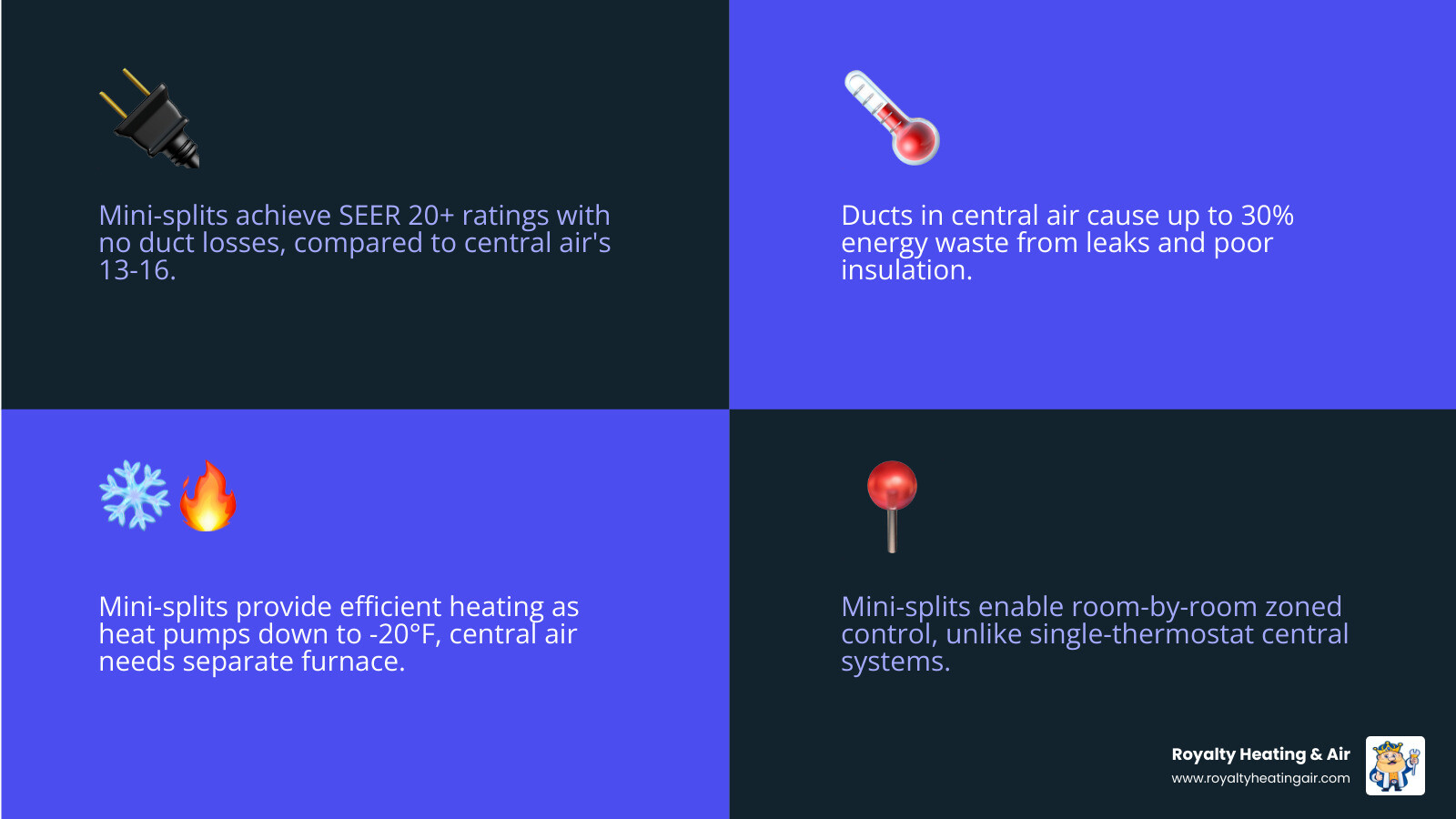
• Energy efficiency — Central Air: SEER 13-16 (older systems lose up to 30% through ducts) — Ductless Mini-Split: SEER 20+ with no duct losses
• Installation — Central Air: Less invasive if ducts exist; costly to add new ductwork — Ductless Mini-Split: Requires only a 3-inch wall opening
• Heating included? — Central Air: Cooling only (needs separate furnace) — Ductless Mini-Split: Yes - efficient heat pump down to -20°F
• Zoned control — Central Air: Limited (one thermostat) — Ductless Mini-Split: Yes - room by room
• Upfront cost — Central Air: Lower if ducts already exist — Ductless Mini-Split: Higher upfront, but strong rebates available
• Wildfire smoke filtration — Central Air: Depends on filter type — Ductless Mini-Split: Many models include multi-stage filtration
Sacramento summers are no joke. Record temperatures in Sacramento County have reached 116°F, and with California electricity rates among the highest in the nation, your choice of cooling system has a real impact on your comfort and your monthly bills. Whether you live in a 1950s Craftsman bungalow in East Sacramento or a newer build in Rocklin, the right system depends on your home's layout, existing infrastructure, and how you use your living spaces.
This guide from Royalty Heating & Air walks you through everything you need to know to make a confident decision for your home in 2026.
When we talk about Air Conditioning in the Sacramento Valley, we are essentially looking at two different ways to move heat. Both systems use a refrigerant cycle, involving an outdoor condenser and indoor components, but the way they deliver that cool air to your living room is fundamentally different.
A central air system is the "traditional" choice for many. It uses one large outdoor unit and a central indoor air handler (often part of your furnace). It pushes chilled air through a network of hidden ducts and out through floor or ceiling vents. It’s a "whole-home" approach where one thermostat dictates the temperature for every room.
On the other hand, a Mini Split system skips the ductwork entirely. It consists of an outdoor compressor connected to one or more indoor air-handling units by a small conduit. Each indoor unit is mounted directly in the room it cools, allowing you to turn off the AC in the guest room while keeping the master bedroom at a crisp 68°F.
• Distribution — Central Air: Ducts and Vents — Mini-Split: Direct Air Handlers
• Thermostats — Central Air: Usually One — Mini-Split: One per Indoor Unit
• SEER2 Ratings — Central Air: Typically 13–18 — Mini-Split: Typically 20–30+
• Space Required — Central Air: Attic/Crawlspace for ducts — Mini-Split: 3-inch wall hole
Sacramento’s climate is unique. We deal with "Delta Breezes" that provide relief at night, but our days are characterized by intense, dry heat. In April 2026, as we look at the increasing frequency of triple-digit heat waves, the resilience of your HVAC system is paramount.
Both systems are capable of keeping you cool, but they handle extreme heat differently. Modern mini-splits utilize a Heat Pump design with inverter technology. Unlike traditional systems that are either "100% on" or "off," inverter-driven compressors can ramp up or down gradually. This is like having a dimmer switch for your cooling rather than a standard on/off light switch, which leads to massive energy conservation during those 116°F afternoons.
Efficiency isn't just about the machine; it’s about the delivery. One of the biggest drawbacks of central air is "duct loss." Research shows that typical ductwork can lose up to 30% of its energy through leaks, holes, or poor insulation. If your ducts are running through a scorching 130°F attic, that cooled air is warming up before it ever reaches your vents.
This is why many homeowners invest in Ductwork Cleaning Roseville CA and sealing to mitigate these losses. However, a mini-split bypasses this problem entirely. Because there are no ducts, there is 0% duct loss. When you combine that with SEER ratings that often exceed 25, the impact on high California electricity bills can be a 25% to 40% reduction in monthly cooling costs. If you do stick with a ducted system, regular Duct Cleaning Roseville is essential to maintain airflow and prevent your system from overworking in the summer sun.
We often focus on the heat, but year-round comfort requires a plan for our chilly, rainy winters. A ductless system provides Ductless Heating Granite Bay CA using a reverse refrigerant cycle. It extracts ambient heat from the outside air—even when it's cold—and brings it indoors.
Modern Mini Split Installation Rocklin CA projects often feature units capable of heating efficiently even when temperatures drop well below freezing. For Sacramento’s mild winters, these heat pumps are often 2 to 4 times more efficient than electric resistance heaters or older gas furnaces.
Your home's "bones" often dictate the best choice. In Locations Sacramento, we have a beautiful mix of historic homes and modern developments.
If you are looking at a Mini Split Replacement Fair Oaks CA, you might be doing so because your home lacks the attic or crawlspace clearance for bulky 12-inch ducts. Forcing a central system into a home not designed for it can require lowering ceilings or cutting into original crown molding—an "open-heart surgery" most homeowners want to avoid.
For those in historic districts, Mini Split AC Roseville CA is often the only viable way to modernize without violating preservation guidelines. Because the system only requires a 3-inch hole for the refrigerant lines and electrical conduit, we can preserve the architectural aesthetics of a 1920s home while providing 2026-level comfort.
Whether we are serving Locations Roseville CA or the older neighborhoods of Midtown, the "no-duct" solution allows for a much faster installation—often completed in a single day—compared to the weeks required for a full ductwork retrofit.
Zoning is the "killer feature" of ductless technology. In Locations Rocklin CA, many two-story homes suffer from the "upstairs-is-an-oven" syndrome. A central system struggles to balance these temperatures.
With a mini-split, you have room-by-room control. You can keep your home office cool during the day without wasting money cooling the guest rooms. If a unit in one room ever has an issue, you only need Mini Split Repair Carmichael CA for that specific head, rather than losing cooling for the entire house.
In Sacramento, air quality is a major concern due to wildfire smoke. Central air systems allow for high-MERV filters that scrub the air for the whole house. However, many modern mini-split units now come with multi-stage filtration and even ionizers to catch smoke particles and allergens.
Maintenance is straightforward for both. For central systems, you change a filter every 2 months. For mini-splits, you simply rinse the reusable filters every few weeks. If you notice a drop in performance, timely Mini Split Repair Rocklin CA or Ductless AC Repair Loomis CA ensures the system hits its 15–20 year lifespan.
Regarding home value, central air is a standard expectation for many buyers. However, in 2026, the high efficiency and "whisper-quiet" operation (often as low as 19 decibels) of mini-splits are becoming highly sought-after features for energy-conscious Californians.
Central air systems can be equipped with thicker HEPA-grade filters that provide superior whole-home filtration. However, mini-splits are "sealed" systems, meaning they don't have leaky ducts in the attic that might pull in smoky air. For the best results during fire season, we recommend mini-splits with advanced multi-stage filtration.
Yes! Under the Inflation Reduction Act, federal tax credits can cover up to 30% of the cost (max $2,000 to $3,200 depending on the unit) for qualifying high-efficiency heat pumps. Local utility providers like SMUD also frequently offer rebates for switching from gas to electric heat pump technology.
There is a massive difference. Most central air handlers are located in a closet or attic and can be quite loud when they kick on. Indoor mini-split units operate at about 19–25 decibels—roughly the sound of rustling leaves. This makes them the "gold standard" for bedrooms and home offices.
At Royalty Heating & Air, we believe your home should be your sanctuary, regardless of how high the Mercury climbs. Our team is proud to serve the Roseville community, not just by providing expert HVAC consultations, but by giving back through our partnership with the MackAttack Foundation, which supports foster babies and sponsors family adoptions.
Whether you are looking for the uniform cooling of central air or the high-efficiency, zoned control of a ductless system, we are here to help you navigate the 2026 HVAC landscape. Don't let another Sacramento summer catch you off guard.
Schedule your Sacramento mini-split consultation with us today and experience the difference that a tailored cooling solution can make for your family.

