
Services
About
Service Areas


August late-summer peak heat is settling in, and as back-to-school routines kick off, the laundry pile seems never-ending. You might be asking yourself, "Does a clogged dryer vent really affect my home's cooling efficiency?" The short answer is yes. In our experience at Royalty Heating & Air, we routinely see that when your dryer runs constantly to keep up with school uniforms and sports gear, a blocked exhaust traps intense heat and humidity inside your home. This unexpected internal heat load forces your air conditioner to work significantly harder just to maintain a baseline temperature. If your house feels sticky despite the thermostat running non-stop, the problem might not be your cooling equipment at all—it could be hidden internal heat sources sabotaging your comfort.
To get the most out of your air conditioning systems, it is critical to address both your cooling equipment and your home's overall ventilation. When you are ready to ensure peak performance, booking AC maintenance in Roseville is the smartest next step.
To understand why a laundry appliance impacts your cooling system, you have to look at your home as a sealed envelope. Your HVAC system is carefully sized to handle a specific amount of heat—both from the sun beating down on your roof and from normal daily activities inside. This calculation assumes that appliances generating massive amounts of heat and moisture, like your dryer or your kitchen stove, are properly venting that exhaust outdoors.
When a dryer vent becomes restricted with lint buildup or crushed transition hoses, that exhaust has nowhere to go. Instead of pushing the hot, moist air outside, the pressure forces it back into your laundry room and, eventually, throughout the rest of your house. During the height of August late-summer peak heat, your air conditioner is already working near its maximum capacity. Introducing a continuous stream of appliance heat into the home's envelope completely disrupts the balance, leading to a home that feels incredibly uncomfortable even when the AC is running continuously.
When we talk about the heat coming from a failing exhaust vent, we are actually dealing with two distinct scientific problems: sensible heat and latent heat. Both of these forces work together to destroy your indoor comfort, but they attack your cooling system in entirely different ways.
Sensible heat is the raw temperature you can feel and measure with a standard thermometer. The exhaust air leaving a standard residential clothes dryer can easily reach up to 130 degrees Fahrenheit. If that air cannot escape through the exterior wall vent, it radiates directly into your laundry room, drastically raising the ambient temperature. Your air conditioner's thermostat registers this spike and triggers the cooling cycle to compensate.
Latent heat, on the other hand, is the hidden energy trapped within moisture. A typical load of wet laundry contains roughly half a gallon of water. As the dryer tumbles the clothes, it doesn't make the water disappear; it turns that liquid water into a hot vapor. If the vent is blocked, that half-gallon of vaporized water is pumped directly into your home's air supply. This massive influx of humidity makes the air feel heavy, sticky, and far hotter than the thermostat actually reads.
• Sensible Heat — What It Is: Measurable temperature changes in the air. — The Source in Your Dryer: The heating element pushing 130°F exhaust air. — Impact on Your Home: Directly raises the indoor temperature, triggering longer AC cycles.
• Latent Heat — What It Is: Energy stored in airborne moisture (humidity). — The Source in Your Dryer: 0.5 gallons of water vaporized per laundry load. — Impact on Your Home: Makes the air feel sticky and forces the AC to dehumidify constantly.
Understanding the difference between these two heat types is critical because it explains why a simple fan or lowering the thermostat won't solve the problem. Until you remove both the raw heat and the airborne moisture, your home will remain uncomfortable.
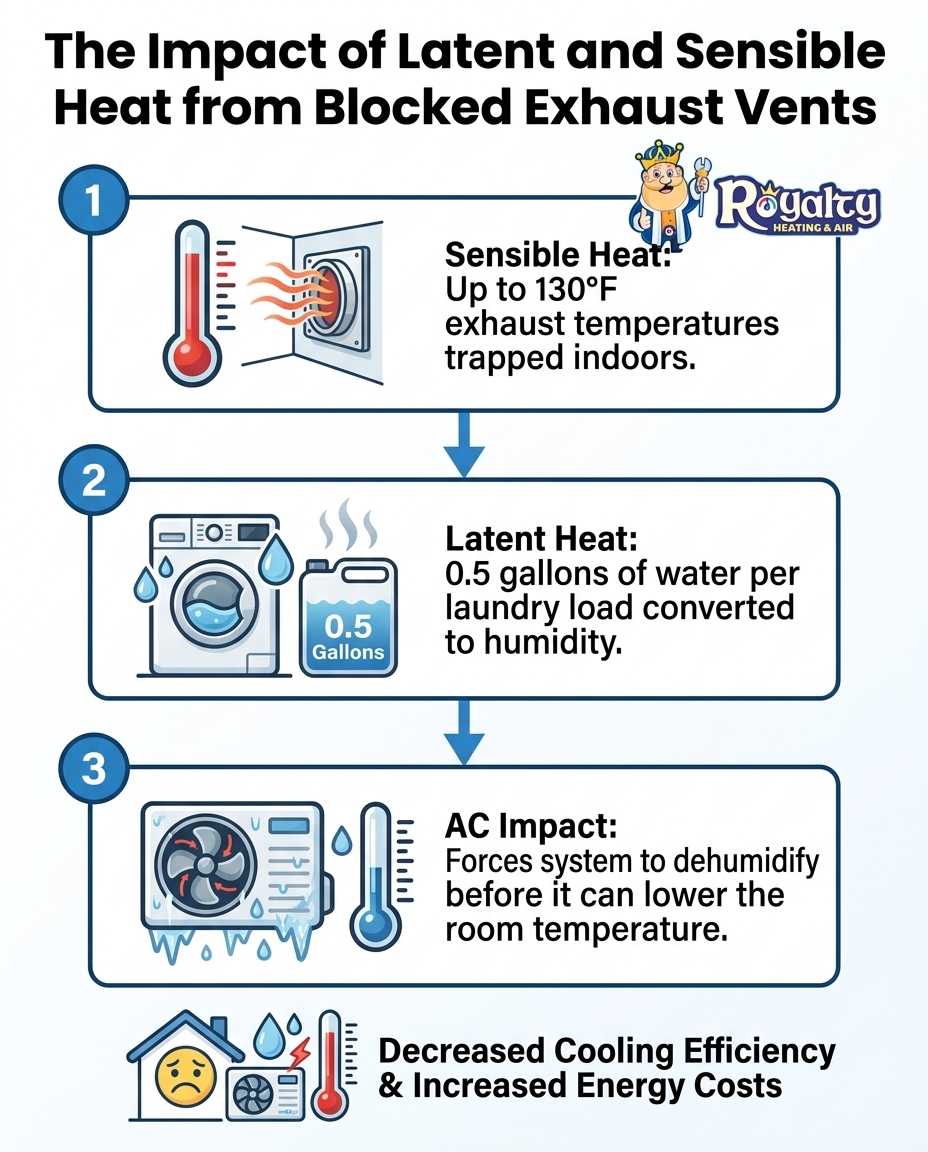
Most homeowners don't realize that an air conditioner has two jobs: it cools the air, but it also dehumidifies it. In fact, an AC unit cannot effectively lower the temperature of a room until it has removed the excess moisture from the air. When a blocked exhaust vent pumps half a gallon of vaporized water into your home per laundry load, you are forcing your cooling system to prioritize dehumidification over actual cooling.
Here is how the cycle breaks down. Warm, moist air is pulled into your return vents and passes over the freezing cold evaporator coil inside your indoor unit. When the warm air hits the cold metal, the moisture condenses into water droplets, which drip into a drain pan and flow outside. If the air is thick with trapped laundry humidity, the evaporator coil spends an enormous amount of its energy just extracting that water. The air blowing out of your supply vents might feel slightly cool, but it won't be cold enough to drop the temperature in the house quickly.
With summer temperatures regularly exceeding 100°F in Roseville CA, our technicians know firsthand that the intense heat leaves zero margin for error. Your air conditioner is already battling the extreme outdoor climate; any internal heat load from a failing dryer exhaust can completely overwhelm the system's ability to keep up. The result is an air conditioner that runs for hours on end without ever satisfying the thermostat.
This constant, extended cycling puts severe wear and tear on your compressor and blower motor. Over time, the strain of fighting excessive indoor humidity can lead to premature mechanical failure. A pattern we see often is homeowners assuming their aging system is failing and immediately searching for AC repair, only for our diagnostic team to discover that the equipment is functioning perfectly—it is simply losing a tug-of-war against the laundry room.
Because the symptoms of a restricted exhaust vent closely mimic the symptoms of a failing air conditioner, it is important to know exactly what to look for. Diagnosing the root cause early can save you from unnecessary energy waste and keep your home comfortable during the August late-summer peak heat.
If you suspect that your cooling issues are stemming from the laundry room rather than the HVAC unit, we recommend keeping an eye out for these distinct warning signs:
• Extended drying cycles: A dryer works by passing hot, dry air over wet clothes to absorb moisture, then venting that wet air outside. If the vent is blocked, the dryer is just tumbling clothes in a hot, humid box. If towels or jeans take two or three full cycles to dry, your exhaust is severely restricted.
• A sweltering laundry room: Walk into your laundry area while the machine has been running for twenty minutes. If the room feels like a sauna—noticeably hotter and more humid than the adjacent hallway—exhaust heat is leaking into your home's envelope.
• Excessive lint accumulation: Look behind the appliance and inspect the outdoor exhaust hood. If you see heavy lint buildup around the connections, or if the flapper valve on the exterior wall is glued shut with debris, airflow is dangerously compromised.
• Sticky indoor air during cooling cycles: If your air conditioner is running constantly but your skin feels clammy and the house feels sticky, the system is struggling to overcome a massive latent heat load.
Spotting the signs your dryer vent is clogged early allows you to address the ventilation issue before it takes a permanent toll on your cooling equipment's lifespan.
When a home fails to cool properly, the instinct is often to schedule a basic AC tune-up. While regular maintenance is absolutely critical, a standard check-up that only looks at refrigerant levels and electrical connections will entirely miss hidden airflow and ventilation issues. True cooling efficiency requires looking beyond the metal box in your backyard and evaluating the entire home as an interconnected system.
This is where our team's comprehensive home comfort diagnostics at Royalty Heating & Air make a profound difference. Rather than just treating the symptom—a warm house—our experts evaluate the entire home envelope based on years of field experience. We inspect ductwork integrity, measure static pressure, and verify that exhaust systems are not sabotaging your indoor air quality or cooling performance. Proper airflow is the foundation of efficient cooling and heating; without it, even the most advanced, high-efficiency AC unit will underperform.
The value of a whole-home approach becomes obvious when you look at the results. One local homeowner recently reached out to us for a routine home check-up. Instead of simply swapping a filter and leaving, our technician performed a complete evaluation, washing all the ducts and grates to ensure perfectly balanced airflow throughout every room. The homeowner noted the service was fabulous and thorough, highlighting exactly why looking at the broader picture matters to our team.
By investing in professional duct and vent services, you ensure that your home's exhaust systems are working in harmony with your air conditioner, rather than actively fighting against it. A comprehensive diagnostic report pinpoints the true cause of inefficiency, saving you money on monthly utility bills and preventing unnecessary wear on your equipment.
Yes, restricted airflow forces up to 130-degree exhaust heat back into the laundry room and surrounding areas. Because the hot air cannot escape through the exterior wall, it radiates through the drywall and open doorways, directly raising the indoor temperature. This sensible heat forces your cooling system to activate more frequently to combat the rising thermostat readings.
Yes, venting inside introduces both severe heat and massive amounts of moisture directly into your living space. While some people attempt this during winter months, doing so drastically reduces AC efficiency during warmer weather and creates significant indoor air quality issues. The excess moisture can also lead to severe condensation problems on windows and walls.
High humidity forces the AC to spend energy removing moisture before it can effectively lower the temperature. This latent heat load means the evaporator coil is working overtime just to wring water out of the air. As a result, you experience longer cooling cycles, higher energy consumption, and a persistent "sticky" feeling indoors even when the unit is running.
Long drying times, hot dryer exteriors, excess lint around the connections, and a faint burning smell are the primary indicators. In the context of home comfort, a noticeably hot and humid laundry room while the appliance is running is a massive red flag that exhaust failure is occurring.
While usually caused by dirty AC filters or low refrigerant, extreme indoor humidity from poor exhaust can contribute to coil condensation and freezing issues. If the evaporator coil is overwhelmed by moisture and airflow across the coil is restricted, the water can freeze before it drains away. Proper airflow across the entire home in Roseville CA is necessary to prevent system strain.
True cooling efficiency requires managing both the external weather and the internal heat and moisture loads generated inside your home. With August late-summer peak heat continuing to push systems to their limits, there is no room for compromised airflow. Do not rely on temporary fixes or risky DIY vent cleanings that can damage delicate ductwork. Instead, secure professional evaluation to verify your system's health. Schedule your comprehensive AC maintenance in Roseville today to ensure your home stays perfectly comfortable all season long.
