
Services
About
Service Areas


Understanding dryer vent cleaning benefits and safety could be one of the most important steps you take to protect your home this year. Most homeowners clean the lint trap and assume that is enough — but the real danger hides deeper in the vent system, silently building up behind your walls.
Here is a quick summary of the key benefits and safety facts:
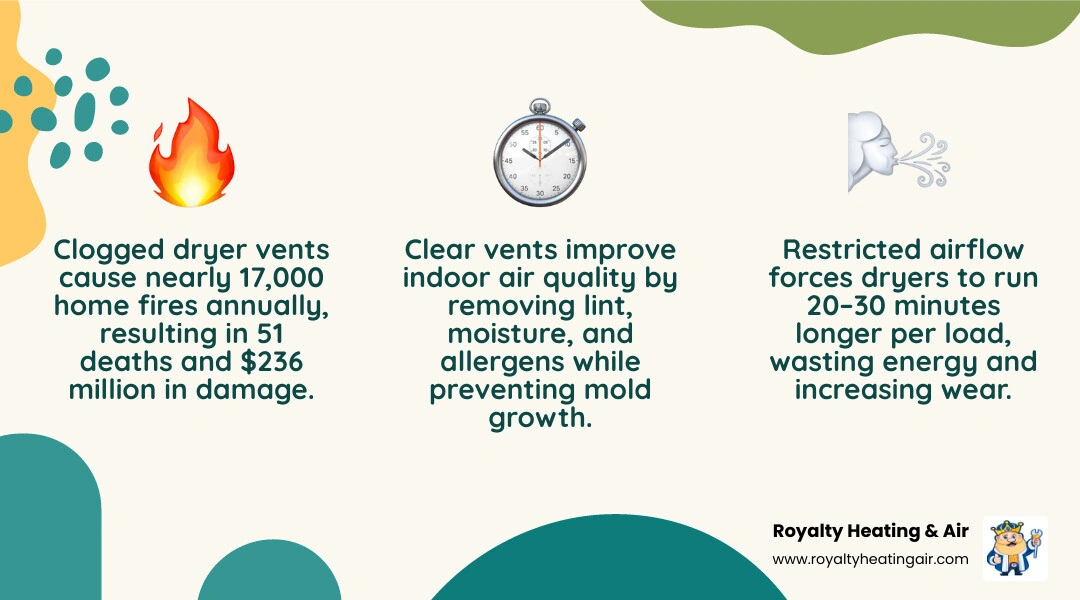
• Fire prevention - Clogged dryer vents are responsible for nearly 17,000 home fires every year in the U.S., causing 51 deaths, 380 injuries, and over $236 million in property damage annually
• Faster drying times - Restricted ducts force dryers to run 20 to 30 minutes longer per load
• Lower energy bills - A clear vent allows your dryer to work efficiently, reducing wasted electricity
• Extended appliance life - Reduced strain on the heating element means your dryer lasts longer
• Better indoor air quality - Removing trapped lint, moisture, and debris cuts allergens and prevents mold growth
• Reduced carbon monoxide risk - For gas dryers, a blocked vent can prevent dangerous exhaust from escaping properly
The U.S. Fire Administration has identified failure to clean as the leading ignition factor in 31% of residential dryer fires. Yet most homeowners never think about the vent line running behind and through their walls until something goes wrong.
In this guide, we break down everything you need to know — from recognizing the warning signs of a clogged vent, to understanding when it is time to call a professional instead of reaching for a DIY brush kit.
When we think of fire hazards in our homes, we often think of candles, stoves, or outdated electrical wiring. However, the humble clothes dryer is one of the most common fire starters in residential properties. The culprit isn’t usually a mechanical failure; it is the silent, steady accumulation of lint.
Lint is composed of tiny, highly combustible fibers shed by our clothes, towels, and bedding during the drying cycle. Because these fibers are dry, light, and loosely packed, they act as perfect tinder. When your dryer vent becomes clogged, it acts like a bottleneck. The hot air generated by your dryer has nowhere to go, causing the internal temperature of the appliance and the ductwork to skyrocket. Under these conditions, a tiny spark from the heating element or static electricity can instantly ignite the trapped lint.
Understanding the Fire Hazards of Neglected Dryer Vent systems is the first step in protecting your household. According to data from the National Fire Protection Association (NFPA) and the U.S. Fire Administration (USFA):
• U.S. fire departments respond to an average of 15,970 fires per year caused by dryers or washing machines.
• Lint-clogged vents are the leading cause in 34% of all dryer fires.
• The Consumer Product Safety Commission (CPSC) estimates roughly 15,500 residential dryer fires annually, resulting in approximately 10 deaths, 310 injuries, and more than $84 million in property damage per year.
This is why implementing proactive Prevent Dryer Fires Maintenance Tips is so critical. When a fire ignites inside a duct run, it can spread with terrifying speed. Because dryer vents often run through wall cavities, crawl spaces, or attics, a fire inside the vent can spread undetected behind your drywall long before your smoke detectors sound. Regularly clearing out this fuel source is the single best way to eliminate this hazard.
While safety is always our number-one priority, investing in regular maintenance also delivers highly practical, everyday rewards. Clearing out your ductwork restores your appliance to its peak operating condition, which has a direct, positive impact on your monthly household budget and daily routine.
When you keep your Clean Dryer Vents free of obstructions, you unlock several major advantages:
• Slashed Utility Bills: A clogged vent acts like a closed damper, restricting airflow. This forces your dryer to work twice as hard to push out hot, moist air. When air flows freely, your dryer runs more efficiently, consuming significantly less electricity or gas.
• Faster Drying Times: Have you noticed that your heavy towel loads now require two full cycles to dry? When vents are clear, moisture is swept away instantly, allowing clothes to dry up to 30% faster.
• Reduced Wear and Tear: Shorter run times mean fewer operating hours for your appliance. Over a year, this saves your dryer’s motor and heating elements from unnecessary stress, preventing premature breakdowns.
To understand the full scope of these advantages, you can refer to our Ultimate Dryer Vent Cleaning Guide, which outlines how routine duct care preserves both your home and your peace of mind.
The health benefits of a clean ventilation system extend far beyond fire prevention. When a dryer vent is clogged, it cannot properly exhaust the gallons of water evaporated from your wet laundry. This trapped moisture creates a warm, humid environment inside the ductwork — a perfect breeding ground for mold, mildew, and bacteria.
As the dryer runs, these spores and allergens can be pushed back into your laundry room and circulate throughout your living spaces. For family members with asthma, allergies, or respiratory sensitivities, this can lead to unexplained flare-ups.
Furthermore, for homes utilizing gas dryers, a blocked vent poses a severe risk of carbon monoxide (CO) poisoning. If the exhaust pathway is obstructed, this odorless, colorless, and potentially lethal gas can back up into your home. Recognizing the Warning Signs of Clogged Dryer Vent lines — such as a warm, humid laundry room or a faint musty smell — is crucial for keeping your family safe from these invisible health threats.
A standard residential dryer is designed to last about 14 years. However, when forced to operate with restricted airflow, that lifespan can be cut in half.
Consider the math: research shows that dryers with restricted ducts run 20 to 30 minutes longer per load than those with clear, clean ducts. For an average household doing just five loads of laundry per week, those extra minutes quickly add up to 100 to 150 extra run hours annually.
This constant overheating strains the heating element, wears out the thermal fuse, and puts immense stress on the drum belt and motor. By scheduling regular cleanings, you prevent these components from burning out prematurely, saving you from expensive repair bills or the need to purchase a new appliance years ahead of schedule.
A very common misconception among homeowners in Roseville, Rocklin, and surrounding areas is that cleaning the lint screen after every load is all the maintenance a dryer needs. While cleaning the screen is an excellent habit, it is only the first line of defense.
The lint trap is designed to catch the majority of airborne fibers, but it is not 100% effective. In fact, the lint trap only catches about 90% to 95% of the lint. The remaining 5% to 10% of fine fibers bypass the screen, slip through the gaps, and enter the internal dryer cabinet and the exterior ductwork. Over time, these fine fibers cling to the moist walls of the vent pipe, building up layer by layer like plaque in an artery.
Here is a quick comparison to help clarify the differences:
• Location — Lint Trap / Screen: Inside the dryer door or top panel — Full Dryer Vent System: The duct running from the back of the dryer to the outside vent hood
• Maintenance Frequency — Lint Trap / Screen: After every single load of laundry — Full Dryer Vent System: At least once per year (professionally)
• DIY Friendly? — Lint Trap / Screen: Yes, takes seconds to pull out and clean — Full Dryer Vent System: Highly recommended for professional service due to complex runs
• Primary Function — Lint Trap / Screen: Catches large debris and majority of clothing fibers — Full Dryer Vent System: Safely exhausts heat, moisture, and fine combustible fibers out of the home
• Risk of Neglect — Lint Trap / Screen: Reduced airflow, lint spilling onto clothes — Full Dryer Vent System: Severe fire hazard, mold growth, carbon monoxide backup, high energy bills
To keep your appliance operating safely, you must always Clean Dryer Lint Trap housings regularly, but this does not replace the need to clear out the entire length of the ductwork running to the exterior of your home.
How do you know when it is time to bring in the experts? While an annual inspection is the standard recommendation for most households, certain signs indicate that your system needs immediate attention.
If you notice any of the following warning signs, do not wait for your annual maintenance date:
• Excessive Heat: The exterior of your dryer feels unusually hot to the touch during a cycle, or your clothes are piping hot (but still damp) when the cycle finishes.
• Burning Smells: You notice a faint, warm, or burning odor in your laundry room while the dryer is running. This is a sign that trapped lint is beginning to scorch.
• Humid Air: Your laundry room feels unusually warm, humid, or smells musty.
• Long Drying Cycles: A single load of laundry takes more than one full cycle to dry completely.
• Visible Debris: You can see lint spilling out of the exterior vent hood opening on the outside of your home.
When you are ready to book a service, we recommend looking for reputable local providers who understand the unique layout of homes in our region. Keep an eye out for Local Dryer Vent Cleaning experts who offer transparent service, and don't forget to check for the Best Dryer Vent Cleaning Coupons to save on your seasonal maintenance.
It can be tempting to purchase a cheap, flexible brush attachment from a home improvement store and attempt to clean your dryer vent yourself. However, DIY vent cleaning carries significant risks that can lead to costly home damage.
Standard residential vent lines are often made of flexible foil or plastic ducting, which is highly fragile. Inserting a stiff brush without the proper training can easily puncture, tear, or completely disconnect the ductwork behind your walls. If a duct disconnects inside a wall cavity, your dryer will begin pumping hot, moist air and highly flammable lint directly into your home's framing, creating a hidden mold and fire nightmare.
Furthermore, every 90-degree bend in your vent pipe acts as a natural collection point for lint. Standard home vacuum cleaners simply do not have the suction power or reach to clean these deep bends.
Professional technicians utilize specialized tools, including commercial-grade rotary brushes and high-velocity negative pressure vacuums, to clean the entire length of the duct safely. We also perform airflow testing before and after the service to verify that your system is breathing perfectly and meets all modern safety standards.
For the vast majority of homes, we recommend scheduling a professional cleaning at least once every 12 months. However, you should consider scheduling a cleaning every 6 months if you have a large family that does laundry daily, own multiple shedding pets, or if your dryer vent run is exceptionally long with multiple 90-degree bends.
The most reliable indicators are clothes taking longer than 45 minutes to dry, the dryer or laundry room becoming excessively hot, musty or burning odors during operation, and a lack of visible exhaust air or lint movement at the exterior vent hood while the dryer is running.
Yes. If you have a gas-powered dryer, the combustion process produces carbon monoxide. A clear, unobstructed vent line is required to safely exhaust these fumes outside. If the vent is clogged with lint, these toxic, odorless gases can back up into your home’s living spaces, posing a severe health hazard to your family.
Keeping your home safe, comfortable, and energy-efficient is a year-round job. While it is easy to forget about the hidden vent line running behind your dryer, regular maintenance is one of the simplest, most effective ways to protect your property and your family from preventable hazards.
At Royalty Heating & Air, we are proud to serve our local communities in Roseville, Loomis, Rocklin, Lincoln, and Granite Bay, CA. We bring professional HVAC expertise to every job, ensuring your ductwork and home systems are operating at peak safety and efficiency. Beyond our commitment to top-tier home comfort, we are deeply passionate about giving back to our community through our partnership with the MackAttack Foundation, which supports foster babies and sponsors local family adoptions.
Don't wait for your dryer to overheat or your energy bills to spike. Protect your home and enjoy faster, safer laundry days. Schedule professional duct services today with our friendly team.

