
Services
About
Service Areas


Emergency HVAC repair tips for the Sacramento area homeowners can mean the difference between a stressful afternoon and a genuine health crisis — especially when outdoor temperatures are pushing past 100°F.
Here's a quick-reference guide to act fast and stay fast:
1. Check the basics first - Verify thermostat settings, replace batteries, and check your circuit breaker for a tripped switch.
2. Inspect your air filter - A clogged filter is responsible for roughly 40% of HVAC emergencies and takes seconds to check.
3. Look and listen - Ice on coils, water pooling, burning smells, or loud banging all signal a true emergency.
4. Know when to evacuate - If you smell rotten eggs or sulfur, leave immediately and call 911 from outside.
5. Call a 24/7 HVAC professional - Don't wait for business hours. Sacramento's heat doesn't follow a schedule.
6. Manage comfort while you wait - Close blinds, run fans, stay hydrated, and move vulnerable family members to a cooler space.
Sacramento summers routinely push past 110°F. When an air conditioner fails in that kind of heat, a home can become dangerous within hours — not days. Indoor temperatures can climb past 90°F surprisingly fast, putting children, elderly residents, and pets at serious risk. This isn't just an inconvenience. It's a safety issue.
The same goes for winter. Sacramento's Delta breeze and Tule fog create a penetrating cold that can catch homeowners off guard when a furnace quietly stops working overnight. Whether it's July or January, knowing exactly what to do in the first 30 minutes of an HVAC failure makes a real difference.
This guide walks you through everything — from identifying a true emergency to staying safe while you wait for help.
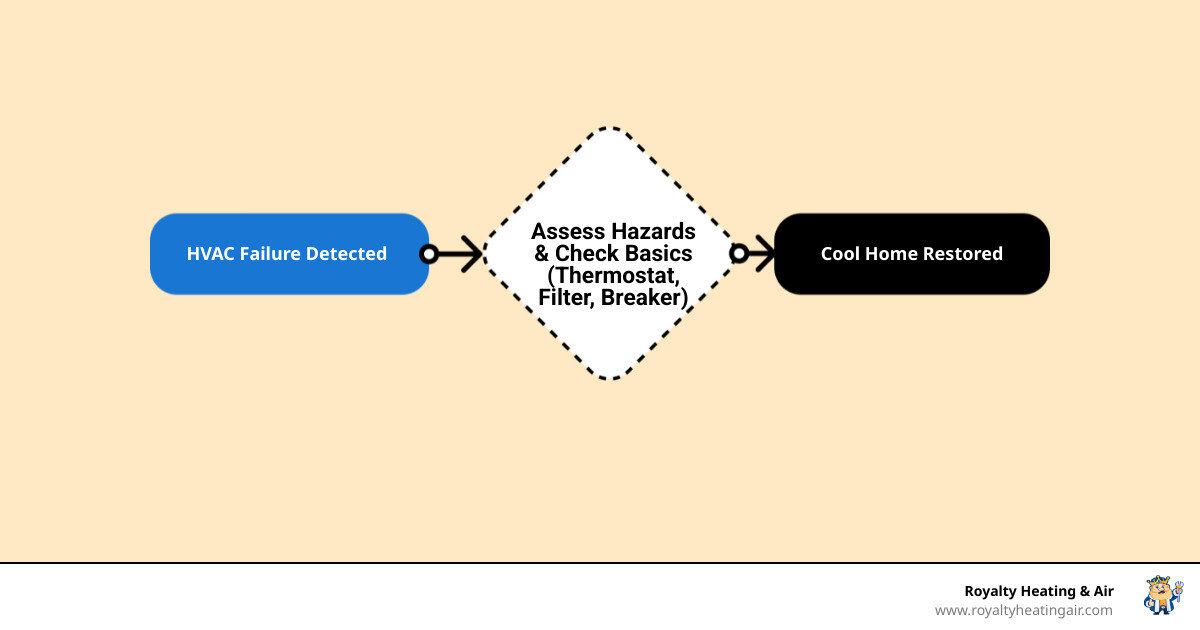
In the Central Valley, we are no strangers to the "triple-digit" club. When the forecast calls for 110°F, your air conditioner isn't just a luxury; it is life-sustaining equipment. A true HVAC emergency is defined as any situation that threatens the health of your family, the safety of your property, or the structural integrity of your system.
For many of our neighbors in Roseville and the surrounding areas, a total loss of cooling during a heatwave is the most common emergency. If you have infants, seniors, or family members with chronic health conditions, a house that hits 90°F indoors is a high-priority crisis. However, emergencies aren't always about the temperature. Sometimes, the system itself becomes a hazard.
If you notice your indoor evaporator coil is encased in a block of ice, or if you see water pooling around your furnace, your system is in distress. For a deeper look at what qualifies for immediate attention, check out our Emergency HVAC Repair Roseville CA Guide.
How do you know if you should call for help right now or if it can wait until Monday morning? Look for these "red flag" symptoms:
• Burning Odors: If you smell electrical burning, ozone, or melting plastic, shut the system off at the breaker immediately. This could indicate a seized motor or fried wiring.
• Loud Banging or Screeching: Metal-on-metal sounds usually mean a fan blade has come loose or a motor bearing has failed. Ignoring this can turn a simple repair into a total system replacement.
• Short Cycling: If the unit turns on and off every three minutes, it is under immense stress. This "rapid-fire" operation can burn out your compressor—the most expensive part of the unit.
• Total Cooling Loss: If the fan is blowing but the air is room temperature, you may have a refrigerant leak or a failed capacitor. In 100-degree weather, this requires an immediate AC Repair Sacramento visit.
• Carbon Monoxide Alerts: If your CO detector goes off, do not ignore it. This is a life-threatening emergency often caused by a cracked heat exchanger in your furnace.
Safety is our absolute priority. If you smell "rotten eggs" or sulfur near your heating unit, you likely have a natural gas leak. Natural gas is naturally odorless, but utilities add "mercaptan" to give it that distinct, unpleasant smell so you can detect leaks.
If you suspect a gas leak:
1. Evacuate immediately. Grab your pets and get across the street.
2. Do not touch anything. Don't flip light switches, use your phone inside, or start your car in the garage. A single spark can trigger an explosion.
3. Call 911 and the gas company from a safe distance.
For electrical issues, such as a burning smell or sparks, head straight to your electrical panel and flip the HVAC breaker to "Off." This prevents a potential house fire while you wait for a Furnace Repair Sacramento technician to arrive.
Before you panic, take a deep breath. Sometimes the solution is simpler than it seems. We’ve seen many "emergencies" resolved with a fresh pair of batteries or a flipped switch.
Start by checking your thermostat. Is the screen blank? If so, replace the batteries. If it has power, ensure it is set to "Cool" (or "Heat" in winter) and that the temperature setting is at least five degrees below the current room temperature. It sounds simple, but it’s a very common oversight!
Next, check your circuit breakers. Find the switch labeled "AC" or "HVAC" and see if it has tripped to the middle position. Flip it all the way to "Off" and then back to "On." If it trips again immediately, do not reset it a second time. This indicates a serious electrical short that needs a professional Heat Pump Repair Sacramento specialist.
Finally, check your air filter. A filthy filter chokes off airflow, which can cause your system to overheat and shut down or cause the coils to freeze. If you haven't changed it in three months, do it now. A clean filter can often restore a system to life and is a core part of any AC Service Sacramento routine.
Beyond the thermostat and breakers, there are a few more "quick fixes" you can verify:
• The "Furnace Switch": Many homes have a switch near the indoor unit that looks exactly like a light switch. It’s easy to accidentally flip this off while reaching for a holiday decoration or a coat. Ensure it is in the "On" position.
• Vent Obstructions: Make sure your return air grilles and supply vents aren't blocked by furniture, curtains, or dog beds. Poor airflow is a leading cause of system failure.
• Condensate Drain Line: If you see water pooling near your indoor unit, the drain line might be clogged. Many modern systems have a "float switch" that automatically shuts the AC off if the drain pan gets too full to prevent water damage.
• Outdoor Debris: Check your outdoor condenser unit. If it’s buried under leaves, grass clippings, or overgrown shrubs, it can't "breathe." Clear at least two feet of space around it to help it shed heat. This is a simple but effective Heating Service Sacramento tip for year-round efficiency.
While you wait for a technician to arrive at your Locations Sacramento home, your goal is to slow down the temperature rise.
1. Seal the House: Close all curtains and blinds, especially on the sunny side of the house. This blocks radiant heat from entering through the glass.
2. Hydrate: Drink plenty of water. Your body cools itself through evaporation, and you need to stay hydrated to manage the heat.
3. Use Fans Wisely: Ceiling fans don't lower the temperature of a room, but they do create a "wind chill" effect on your skin.
4. Cross-Ventilation: If the temperature drops at night (thanks to our famous Delta Breeze), open windows on opposite sides of the house to pull in the cool air.
5. Know Your Cooling Centers: If the heat becomes unbearable, many local libraries and community centers in the Sacramento area serve as official cooling centers.
Our region has a very specific "weather personality" that puts unique stress on HVAC systems. We deal with extreme heat, bone-dry air, and seasonal shifts that can be quite dramatic.
In the summer, our systems often run for 12 to 18 hours straight to combat 100°F+ days. This constant operation wears down capacitors and motors much faster than in milder climates. In the winter, we face the "Tule fog"—a thick, ground-level fog that keeps temperatures damp and chilly, forcing furnaces to work harder to maintain a comfortable Sacramento CA home.
• Summer — HVAC Stressor: 100°F+ Heatwaves — Impact on System: Continuous run-time leads to motor and capacitor failure.
• Summer/Fall — HVAC Stressor: Wildfire Smoke — Impact on System: Ash and particulates clog filters, straining the blower motor.
• Winter — HVAC Stressor: Tule Fog & Delta Breeze — Impact on System: High humidity and sudden temperature drops strain heat exchangers.
• Spring — HVAC Stressor: Heavy Pollen — Impact on System: Dust and allergens coat outdoor coils, reducing heat transfer.
Wildfire season has also become a major factor for Sacramento homeowners. During smoke events, your HVAC system's air filter is your first line of defense. We recommend using MERV 13 filters during these times to trap fine smoke particles. However, because these filters are denser, they clog faster. If you’re running your system during a smoky week, check that filter every few days to ensure you aren't accidentally causing a breakdown by restricting airflow.
When you call for an emergency repair, the more information you can provide, the faster the technician can get your air blowing cold again.
Before we arrive, please take a moment to:
• Clear the way: Ensure there is a clear path to both your indoor unit (usually in a closet, garage, or attic) and your outdoor condenser.
• Document the symptoms: When did it stop working? Did you hear a specific noise? Was there a strange smell? Knowing that the system made a "loud pop" before dying helps us narrow down the problem instantly.
• Secure your pets: We love your furry family members, but for their safety and ours, please keep them in a separate room or a crate while we are working with tools and high-voltage electricity.
• Find your info: If you have the make, model, and approximate age of the system handy, it helps us ensure we have the right parts on our truck.
Our technicians arrive in fully stocked "mobile warehouses." We carry the most common failing parts—like capacitors, contactors, and fan motors—so we can often fix the problem on the very first visit.
Communication is key to a successful repair. When your technician finishes their diagnostic, don't be afraid to ask:
1. What exactly failed and why? Understanding if a part failed due to age or a secondary issue (like a dirty coil) helps you plan for the future.
2. What are my repair options? Sometimes there is a "patch" to get you through the night and a "permanent fix" that ensures long-term reliability.
3. Is this part under warranty? Many systems have 5- or 10-year parts warranties that can save you a significant amount.
4. What is the estimated remaining lifespan of my system? If your unit is 15-20 years old, it might be time to start thinking about a replacement rather than pouring money into frequent repairs.
5. How can I prevent this from happening again? A good technician will give you specific advice for your home’s setup.
The best emergency is the one that never happens. Roughly 70% of HVAC breakdowns occur during the first major heatwave or cold snap of the year because the system hasn't been "warmed up" for the season.
Annual tune-ups are like oil changes for your home. During a professional inspection, we clean the coils, check refrigerant levels, tighten electrical connections, and lubricate moving parts. This doesn't just prevent breakdowns; it also keeps your system running at peak efficiency, which lowers your monthly utility bills.
There are also many local and federal incentives to help you keep your home efficient. Organizations like SMUD and PG&E often offer rebates for high-efficiency upgrades or smart thermostats. Programs like TECH Clean California and Federal tax credits can also offset the cost of upgrading to modern, energy-efficient heat pumps. Investing in duct sealing is another excellent way to ensure that 35% of your conditioned air isn't leaking into your attic before it ever reaches your living room.
If you smell gas (rotten eggs), evacuate immediately, do not use any electronics, and call 911 from outside. If you smell burning plastic or a "fishy" electrical odor, turn off the HVAC system at the thermostat and the circuit breaker immediately. This usually indicates an electrical component is overheating or melting, which is a fire hazard. Do not turn the system back on until a professional has inspected it.
Keep all windows and blinds closed to trap the existing cool air. Use portable fans to create a breeze, and stay hydrated with cold water. If you have vulnerable family members, consider moving to a neighbor's house, a local mall, or a public library. You can also take a cool shower or use damp towels on your neck and wrists to lower your body temperature.
Yes! Sacramento area homeowners have access to several programs. SMUD offers significant rebates for switching to high-efficiency heat pumps. There are also Federal tax credits available under the Inflation Reduction Act for energy-efficient home improvements. We can help you navigate these options to find the best incentives for your specific upgrade.
At Royalty Heating & Air, we believe that home comfort is about more than just temperature—it’s about peace of mind. Whether you are in Loomis, Rocklin, Roseville, Lincoln, or Granite Bay, we are here to ensure your family stays safe and comfortable regardless of what the California weather throws our way.
We are also proud to be more than just an HVAC company. Our partnership with the MackAttack Foundation allows us to support foster babies and sponsor family adoptions right here in our community. When you choose us, you are supporting a business that cares deeply about the families we serve.
Don't wait for the next 110-degree afternoon to find out if your system is up to the task. Schedule your professional HVAC service today and let us help you stay ahead of the heat.
