
Services
About
Service Areas


The thermostat clicks, the blower kicks on, but the air coming from your vents feels barely cooler than the room itself. When your cooling system struggles to keep up with the afternoon heat, looking at options comparisons for homeowners becomes the critical next step. To help you navigate this decision, we provide expert air conditioning services and reliable AC repair in Roseville to restore your comfort.
Addressing the frustration of a home that refuses to cool down during peak heat often begins at the control panel. You might notice the thermostat isn't responding, or the temperature reading continues to climb despite the system running continuously. Sometimes, the solution is straightforward. For example, during a scorching July heat wave last year, our Royalty Heating & Air technicians helped a homeowner who had a long-standing problem with their thermostat. Our team solved the issue on-site, and the customer signed up for yearly maintenance. However, when simple troubleshooting no longer works and repairs become frequent, recurring failures usually signal the need for a full system replacement.
This brings you to a major decision point: choosing between an air-source heat pump vs. traditional central AC. For decades, the standard approach was a split central air conditioner paired with a gas furnace. Today, modern air-source heat pumps offer a compelling alternative, handling heavy cooling loads efficiently from a single unit.
When evaluating these systems, it helps to take an objective, technical approach. Rather than relying on generic advice, you need to understand exactly how each option performs during the heavy demands of the summer cooling season. By comparing their mechanical capabilities, energy efficiency ratings, and installation requirements, you can make an informed choice that aligns with your home's infrastructure and your long-term comfort goals.
To evaluate your replacement options accurately, you first need to understand how heat transfer actually works. A common misconception is that air conditioners "create" cold air. In reality, they remove heat from inside your home and dump it outside.
During the summer cooling season, thermal energy constantly infiltrates your home through the roof, windows, and walls. Your HVAC system must run long enough to absorb this heat and transport it outdoors. When a system begins to fail, you will often notice signs of mechanical strain. If you hear your AC making a high-pitched whistling sound, grinding noises, or heavy rattling, it indicates that the compressor or blower motor is failing to transfer heat effectively.
Both traditional air conditioners and heat pumps use the exact same refrigeration cycle to cool your home. The process relies on a chemical refrigerant that circulates between an indoor evaporator coil and an outdoor condenser unit.
• Absorption: Warm indoor air blows over the cold indoor coil. The liquid refrigerant absorbs the heat and turns into a low-pressure gas.
• Compression: This gas travels outside to the compressor, which squeezes it into a high-pressure, high-temperature gas.
• Release: The outdoor fan blows ambient air over the hot condenser coils, releasing the captured heat into the outside air. The refrigerant turns back into a liquid and returns indoors.
In a heat pump, a specialized component called a reversing valve literally reverses the flow of refrigerant, allowing the system to absorb heat from outside and bring it indoors during cooler months. However, during the summer, the reversing valve stays in the cooling position, making the heat pump act identically to a standard AC. Modern versions of both systems often utilize high-efficiency variable-speed compressors. Unlike older models that only run at 100% capacity or turn off completely, variable-speed units can adjust their output in tiny increments. This allows them to manage heavy cooling loads with incredible precision, running at lower speeds to dehumidify the air while saving energy.
When looking at an air-source heat pump vs. traditional central AC, the standard split system remains a highly popular choice for good reason. It is familiar, reliable, and designed specifically to tackle heavy cooling loads without the added complexity of cold-weather heating components.
A traditional central air conditioning system is split into two primary locations. The outdoor cabinet houses the compressor, the condenser coil, and the condenser fan. The indoor cabinet—usually shared with your furnace in the attic, garage, or a closet—houses the evaporator coil and the blower motor. Because these systems are purpose-built for cooling, their internal mechanics are straightforward. There is no reversing valve and no defrost control board, which means there are fewer moving parts involved in the cooling process.
Traditional central AC units are engineered for endurance. During prolonged heat waves, these systems can run for hours on end to maintain indoor comfort. Because the technology has been refined over decades, a properly sized and well-maintained central AC provides highly predictable performance. You know exactly what you are getting: a dedicated cooling machine that forces thermal energy out of your living space.
A standard central AC system typically lasts 12 to 15 years when subjected to heavy summer workloads, provided it receives annual maintenance. In our years of providing HVAC replacements across Roseville, we've found that sticking with a traditional AC often makes the most sense if your home's existing infrastructure is already set up for it. If you have a relatively new, highly efficient gas furnace that doesn't need replacing, pairing it with a new central AC is usually the most cost-effective route. You utilize your existing infrastructure while upgrading your cooling capacity with modern, energy-efficient technology.
One of the most common questions homeowners ask during the summer cooling season is whether a heat pump can actually keep up with severe temperatures. The short answer is yes. Because a heat pump in cooling mode operates identically to a standard air conditioner, it cools exactly as well as a central AC of the same tonnage.
With the 100+ degree summer heat typical of the Roseville area, your cooling system is pushed to its absolute limits. Our team at Royalty Heating & Air frequently assures homeowners that heat pumps are built to handle these extremes. The compressor, condenser coils, and refrigerant lines are engineered to dissipate heat into the outdoor air even when the ambient temperature is scorching. The technology does not lose cooling efficiency just because it also has the ability to heat your home later in the year.
Running a heat pump continuously during peak summer months comes with specific operational traits.
• The Pros: Because many modern heat pumps feature inverter-driven, variable-speed compressors, they excel at running continuously at lower capacities. This provides superior humidity control and eliminates the hot and cold spots associated with systems that constantly cycle on and off.
• The Cons: Because a heat pump operates year-round (cooling in summer, heating in winter), it accrues more total run hours per year than a standalone AC. This means routine maintenance is absolutely non-negotiable, as the system never truly gets an off-season.
Under heavy load, proper sizing is everything. If a heat pump is undersized, it will run constantly at maximum capacity and still fail to cool your home. If it is oversized, it will short-cycle, shutting off before it has a chance to properly dehumidify the indoor air. A precise Manual J load calculation is required to ensure the heat pump you choose matches your home's exact thermal envelope.
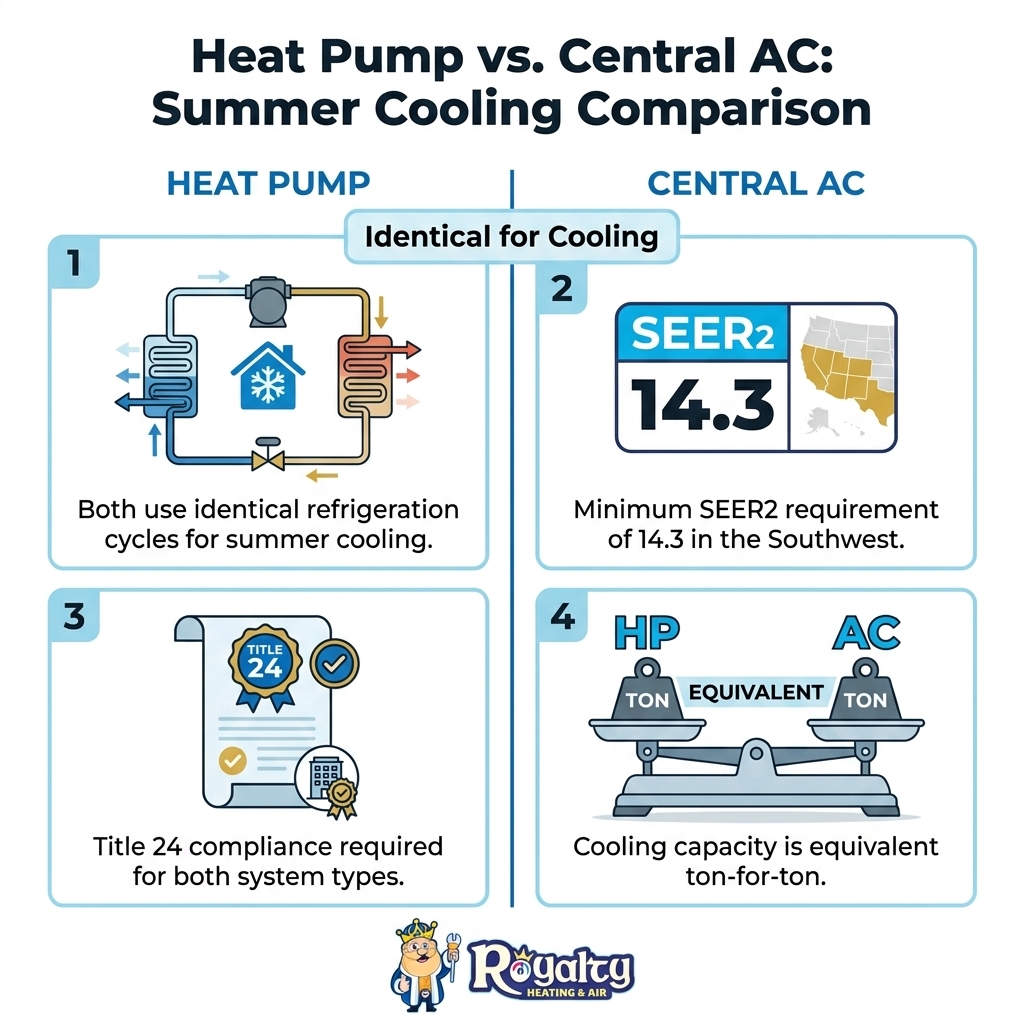
When comparing an air-source heat pump vs. traditional central AC, you will inevitably encounter efficiency ratings. Understanding how these numbers work is vital for predicting your future energy consumption.
1. Define the SEER2 Metric: SEER2 stands for Seasonal Energy Efficiency Ratio 2. It measures the total cooling output of a system over a typical cooling season divided by the total electrical energy input. The "2" indicates the updated testing standards implemented recently, which use higher static pressure conditions to better reflect real-world ductwork and airflow restrictions.
2. Check the Regional Minimums: The Department of Energy strictly regulates HVAC efficiency. For the Southwest region, the federally mandated minimum SEER2 rating for new cooling systems is 14.3. Any system you install—whether a heat pump or a central AC—must meet or exceed this baseline.
3. Compare Operational Energy Consumption: Higher SEER2 ratings directly impact your monthly energy bills. A system rated at 18 SEER2 will consume significantly less electricity to produce the same amount of cooling as a 14.3 SEER2 system. If you plan to stay in your home for many years, investing in a higher SEER2 rating often pays for itself through lower utility costs during the hottest months.
4. Commit to Routine Upkeep: A high SEER2 rating is only a baseline. If your coils get dirty or your filters clog, your 18 SEER2 system might operate at a 12 SEER2 efficiency level. Scheduling routine HVAC maintenance is required to maintain these efficiency ratings over the lifespan of the equipment.
Selecting the right equipment is only half the battle. The quality of the installation dictates how well that equipment will actually perform during the summer cooling season. In California, strict building codes ensure that new systems operate as efficiently as possible.
California Title 24 building energy efficiency standards impact all new HVAC installations. These regulations are designed to reduce energy consumption across the state, and compliance is mandatory. When you replace your cooling system, the installation must be tested and verified by an independent, third-party HERS (Home Energy Rating System) rater.
• Ductwork Leakage: The technician must seal your existing ductwork to ensure that no more than a specific percentage of conditioned air escapes into unconditioned spaces like your attic.
• Airflow Verification: The system must move a minimum number of cubic feet of air per minute (CFM) across the indoor coil to prevent freezing and ensure efficient heat transfer.
• Refrigerant Charge: The installer must prove that the exact right amount of refrigerant is in the system. Too much or too little charge severely degrades cooling performance.
Installing modern variable-speed systems involves complex wiring, precise airflow calibration, and advanced thermostat integration. During a peak July heat wave last summer, one of our customers noticed their system was struggling to keep up. After a thorough diagnostic by our Royalty Heating & Air technicians, the equipment was repaired and is now running like new, delivering exceptional comfort. When investing in a brand-new installation, you want that same level of technical precision from day one. A technically sound installation quote should explicitly list Title 24 compliance, duct testing, and a detailed scope of work.
As you weigh an air-source heat pump vs. traditional central AC, our primary advice at Royalty Heating & Air is to synthesize the technical facts. In cooling mode, there is a strict technical parity between the two. A 3-ton heat pump and a 3-ton central air conditioner will remove the exact same amount of heat from your home.
Your comparison framework should focus on your specific needs. Look closely at the contractor quotes: compare the equipment specifications, verify the SEER2 ratings, and ensure the installation scope includes all mandatory testing. If your existing gas furnace is relatively new, a traditional AC might be the most logical choice. If your entire system is aging and you want to electrify your heating while upgrading your cooling, a heat pump is an exceptional investment.
Ultimately, the best choice depends on your existing infrastructure and long-term efficiency goals. Regardless of the system you choose, working with a team that provides 24/7 emergency service availability ensures that your investment is protected long after the installation day. Having a reliable repair network guarantees that your home remains comfortable through every intense heat wave.
Yes, a heat pump cools exactly as well as a central air conditioner of the same size and efficiency rating. During the summer, a heat pump uses the exact same refrigeration cycle as a standard AC to remove heat from your home. The only difference is that a heat pump has a reversing valve that allows it to provide heating during cooler months.
There are no significant cooling disadvantages to using a heat pump in the summer. However, because heat pumps run year-round for both heating and cooling, they accumulate more total operating hours annually than a standalone AC unit. This means you must be highly diligent about changing filters and scheduling annual maintenance to prevent wear and tear.
Neither system is inherently more efficient at cooling than the other; efficiency is determined by the system's SEER2 rating. A 16 SEER2 heat pump and a 16 SEER2 central air conditioner will consume roughly the same amount of electricity to cool your home. You can find high-efficiency models in both equipment categories.
The SEER2 rating directly impacts how much electricity your system uses to produce cold air. A higher SEER2 rating means the system requires less electrical power to remove heat from your home. Upgrading from an old 10 SEER unit to a new 16 or 18 SEER2 system can noticeably reduce your monthly energy bills during peak summer months.
Title 24 requires that new HVAC installations meet specific energy efficiency standards, which usually involves third-party HERS testing. This testing verifies that your ductwork is properly sealed, your system has adequate airflow, and the refrigerant charge is exact. These regulations ensure your new system operates at its advertised efficiency.
A thermostat can fail during a heat wave due to dead batteries, tripped circuit breakers, or internal wiring issues. Sometimes, the problem isn't the thermostat itself, but a safety switch inside the AC unit that shuts the system down to prevent damage. If replacing the batteries doesn't resolve the issue, professional diagnostics are usually required.
