
Services
About
Service Areas


At Royalty Heating & Air, we often hear from homeowners whose evaporative cooler pads are calcifying faster than they can replace them, leaving their homes stiflingly hot when they need relief the most. Understanding exactly how Roseville's hard water affects evaporative coolers vs traditional ACs is a critical step for homeowners trying to maintain consistent comfort without constantly battling mineral buildup. Many people assume that the dry heat of the Sacramento Valley makes an evaporative system—often called a swamp cooler—the perfect, energy-efficient solution for summer cooling. While the climate is certainly dry enough, our field experience shows that this assumption ignores a massive local variable: the water supply.
During the peak July dry summer cooling season, your system has to run constantly just to keep the indoor temperature bearable. That continuous operation means water quality becomes the single biggest factor in your system's lifespan. You are left facing a difficult decision we help customers navigate every season: do the initial energy savings of an evaporative cooler actually outweigh the ongoing, frustrating, and messy maintenance costs caused by aggressive mineral scale? To make the right choice for your home, you have to look at how different cooling systems interact with the water flowing from your tap.
For more information on modern cooling solutions and how they operate, explore our comprehensive guide to Air Conditioning.
To understand why your cooling equipment struggles, you first have to understand what is actually flowing through your pipes. Roseville and the greater Sacramento Valley rely on a municipal water supply that frequently blends surface water with groundwater, especially during the peak summer months when demand spikes. This blending process introduces high levels of naturally occurring minerals into the water, primarily calcium and magnesium.
Hard water is simply water that contains a high concentration of these dissolved minerals. While perfectly safe for drinking, hard water is notoriously harsh on home appliances. When this mineral-heavy water is exposed to air and begins to evaporate, it leaves the heavy minerals behind. These minerals quickly crystalize and form calcium carbonate—a hard, crusty, white scale that clings to almost any surface it touches.
At Royalty Heating & Air, our local expertise comes from years of tracking Roseville's specific municipal water reports and seeing exactly how those mineral concentrations translate to HVAC wear and tear in the field. We know that any appliance relying on continuous water flow is going to face a severe scaling problem. This is why routine AC maintenance in Roseville requires a specialized approach that takes our unique regional environmental factors into account.
Water hardness is typically measured in parts per million (PPM) or grains per gallon (GPG). When water hardness exceeds 7 GPG, it is classified as hard. During the summer, as water tables fluctuate and groundwater blending increases, the mineral concentration in your tap water can spike. For a system that uses a closed loop, this does not matter. But for an open-water cooling system, every single drop of water that evaporates leaves a microscopic layer of rock behind. In our daily service calls, we see how over just a few weeks of heavy use, those microscopic layers build into thick, impenetrable crusts that choke the life out of your equipment.
An evaporative cooler operates on a very simple, ancient principle: pulling hot, dry air through water-saturated pads. As the dry air passes through the wet media, the water absorbs heat and evaporates, instantly dropping the temperature of the air before it is blown into your home. It is an incredibly effective cooling method in arid environments, but it comes with a massive thirst.
Our technicians know all too well that during the intense, dry heat of the Sacramento Valley, an evaporative cooler is forced to run constantly. To keep up with the cooling demand, a standard residential swamp cooler can consume anywhere from 3 to 15 gallons of water every single hour. Over a 10-hour cooling cycle on a hot July day, your system might evaporate over 100 gallons of water.
The chemical reality is unavoidable. Pure H2O evaporates into the air to cool your home, but the heavy calcium and magnesium minerals cannot evaporate. They are left behind on the cooling pads, the water distribution tubes, and the internal reservoir. Because the dry summer cooling season demands non-stop operation, this rapid concentration of minerals turns soft, porous cooling pads into solid, calcified blocks in record time.
The process of scale formation happens rapidly through a specific sequence of events we observe constantly in local units:
1. Continuous water flow: The internal pump pushes municipal hard water up to the distribution tubes, cascading it down over the porous cooling pads.
2. Rapid evaporation: The blower motor pulls hot outside air through the pads, causing the pure water molecules to instantly vaporize and cool the air.
3. Mineral deposition: The dissolved calcium and magnesium are left behind, bonding tightly to the fibers of the cooling pads.
4. Accelerated scaling: As the pads become crusted with minerals, they lose their ability to hold water evenly, causing dry spots, reduced cooling efficiency, and even faster scaling on the remaining wet areas.
The Problem: When calcium carbonate takes over your evaporative cooler, the immediate casualty is airflow. Calcified pads become rigid and blocked. Instead of pulling air smoothly through saturated fibers, the blower motor has to fight against a wall of crusty minerals. This severe airflow restriction forces the motor to work significantly harder, drawing more electricity and running hotter, which drastically shortens its lifespan. Meanwhile, your home stays warm because the system can no longer move enough cooled air through the ductwork.
The Cause: The root cause is the continuous evaporation of hard water. In areas with soft water, a set of evaporative cooling pads might easily last an entire season or more. However, in Roseville and the greater Sacramento Valley, our maintenance crews see the reality of high mineral content: homeowners often find themselves scraping out ruined pads halfway through the summer. The scale doesn't just stop at the pads, either. It clogs the narrow water distribution tubes at the top of the unit, creating dry spots on the pads that allow hot, uncooled air to blow directly into the house. It also accumulates in the bottom water pan, eventually getting sucked into the water pump and destroying the impeller.
The Solution: Maintaining an evaporative cooler in a hard water zone requires constant vigilance. Homeowners must commit to frequent pad replacements, regular draining of the water pan to reduce mineral concentration, and manual scraping of scale from internal components. These compounding labor and parts costs often completely erase the anticipated energy savings that made the swamp cooler appealing in the first place. If your system is struggling to keep up with the summer heat and you are tired of the constant upkeep, our professional Roseville AC repair services can help diagnose the extent of the scaling damage and recommend a more sustainable path forward.
If the constant battle against mineral scale sounds exhausting, it is important to understand how traditional air conditioning completely sidesteps this problem. Unlike evaporative coolers, a traditional central AC system does not use water to cool the air. Instead, it relies on a closed-loop refrigerant cycle.
Inside a traditional AC, a chemical refrigerant travels between the indoor evaporator coil and the outdoor condenser coil. The cold refrigerant absorbs heat from your indoor air, travels outside, and releases that heat into the outdoor air. Because the system is entirely sealed, the refrigerant never evaporates away, and more importantly, the cooling process never interacts with your municipal water supply.
From our perspective as local HVAC professionals, this closed-loop design offers a massive advantage during the dry summer cooling season. While a traditional AC unit will consume more electricity than a swamp cooler, its maintenance lifecycle is highly predictable and completely unaffected by local water hardness. You never have to worry about replacing calcified pads, cleaning out a scaled-up water pan, or replacing a burnt-out water pump. The system simply runs, providing set-it-and-forget-it reliability that makes it a far superior long-term investment for consistent indoor comfort.
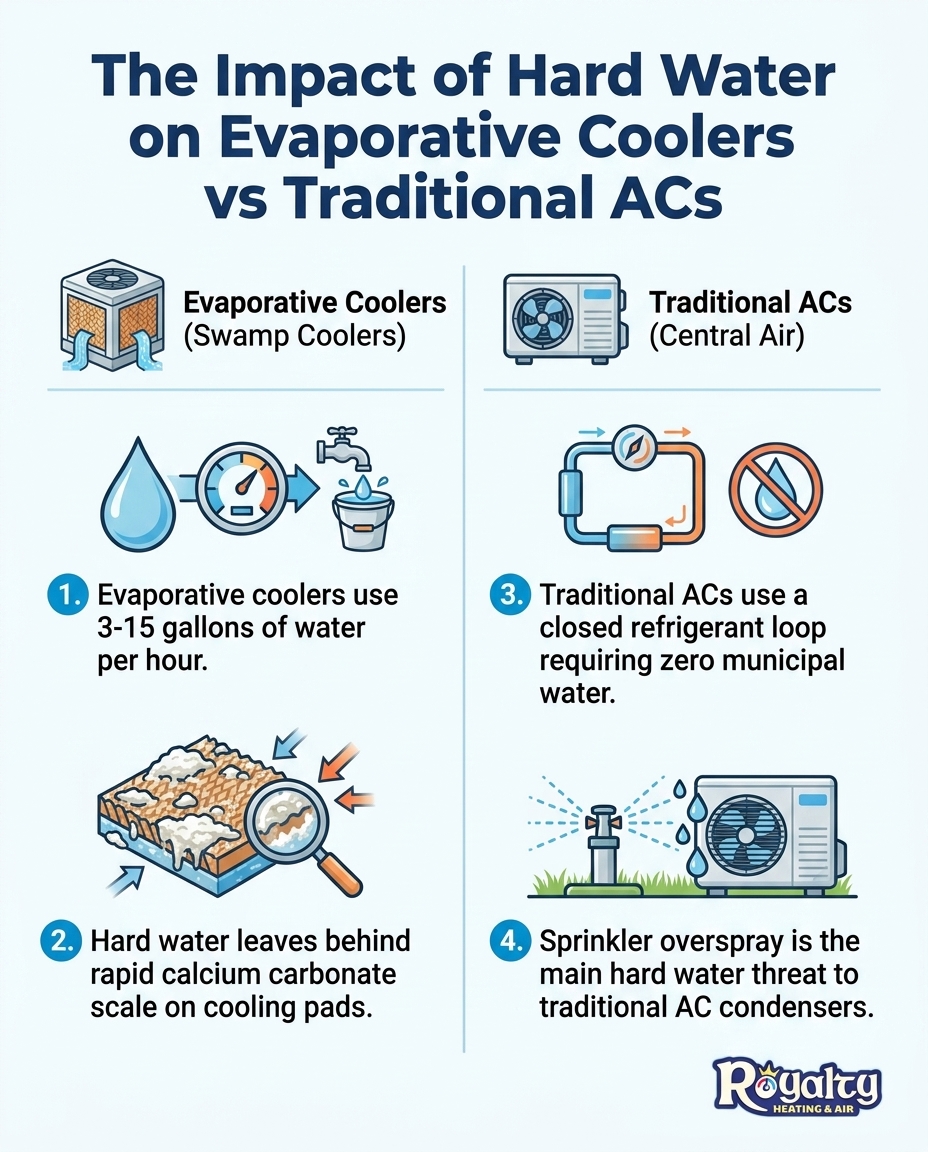
While the internal cooling process of a traditional AC is completely safe from municipal water issues, we have to acknowledge one specific edge case where hard water can still cause trouble. The external condenser unit—the large metal box sitting outside your home—relies on thousands of delicate aluminum fins to release heat. If hard water is repeatedly sprayed onto this unit, those fins can suffer.
The most common culprit is a misaligned lawn sprinkler. If a sprinkler head hits the outdoor unit every morning, the water will evaporate in the sun, depositing calcium scale directly onto the condenser coils. Over time, this external scale buildup restricts the airflow needed to exhaust heat from your home. This forces the compressor to work harder, reduces the overall efficiency of the system, and can even cause strange operational noises, such as a high-pitched whistling sound from your AC as air struggles to squeeze through the blocked fins.
During a recent July heatwave, one of our Roseville customers scheduled routine AC service after noticing their system was struggling to maintain temperature. Our technician discovered that the system was mechanically sound, but the exterior coils had been heavily coated in mineral scale from a nearby lawn sprinkler. Our team member safely chemically cleaned the delicate aluminum fins, restoring optimal airflow, and the customer noted they would rely on Royalty Heating & Air for all future HVAC needs. It is a perfect example of how environmental factors outside the equipment itself can impact performance in Roseville and the greater Sacramento Valley.
• Adjust your landscaping irrigation: Keep sprinkler heads directed away from the HVAC unit. Ensure there is at least a three-foot dry clearance zone around the condenser.
• Monitor for white residue: Check the metal fins on your outdoor unit periodically. If you see a chalky white buildup, hard water is hitting the system.
• Schedule professional cleanings: Never use a pressure washer or stiff brush on condenser fins, as they bend easily. Schedule professional coil cleanings with our team to remove any external environmental buildup safely.
When our team sits down with homeowners to decide how to cool their homes, we always look past the monthly electrical bill and consider the total cost of ownership. The trade-off is clear: evaporative coolers offer lower electrical costs, but they demand constant, messy, and frequent maintenance when operating in hard water zones. Traditional ACs use more electricity, but they offer unparalleled reliability with maintenance limited to predictable, seasonal tune-ups.
If you are tired of scraping calcium scale, replacing degraded pads multiple times a summer, and dealing with a house that feels humid and warm, it may be time to rethink your cooling infrastructure. Upgrading to a closed-loop system is an investment in hassle-free summer comfort.
• Cooling Mechanism — Evaporative (Swamp) Cooler: Open water evaporation — Traditional Air Conditioner: Closed-loop refrigerant
• Water Usage — Evaporative (Swamp) Cooler: 3 to 15 gallons per hour — Traditional Air Conditioner: Zero municipal water used
• Impact of Hard Water — Evaporative (Swamp) Cooler: Severe scaling on pads, tubes, and pumps — Traditional Air Conditioner: Unaffected (unless hit by sprinklers)
• Maintenance Frequency — Evaporative (Swamp) Cooler: High (frequent pad changes, scale removal) — Traditional Air Conditioner: Low (predictable annual tune-ups)
• Long-Term Reliability — Evaporative (Swamp) Cooler: Decreases rapidly as scale builds up — Traditional Air Conditioner: Consistent and highly predictable
For homeowners ready to leave the swamp cooler behind, exploring traditional AC installation with our seasoned installers is the best way to guarantee a cool, comfortable home regardless of what is in the municipal water supply.
Hard water rapidly deposits calcium and magnesium minerals onto the internal components of a swamp cooler as the water evaporates. This creates a thick, crusty scale that blocks airflow through the cooling pads and clogs the water distribution tubes. Over a short period, this buildup forces the blower motor to overwork, significantly reducing the system's ability to cool your home.
Your pads get crusty quickly because the high heat in Roseville and the greater Sacramento Valley forces your cooler to evaporate massive amounts of water every day. As pure water turns to vapor, all the dissolved minerals from the municipal water supply are left behind on the pad fibers. Because the system runs constantly during the summer, these microscopic mineral deposits compound rapidly into a solid crust.
In areas with significant water hardness, our technicians typically recommend changing your swamp cooler pads two to three times per cooling season to maintain proper airflow. If you notice your home isn't getting as cool as it used to, or if the airflow from your vents feels weak, it is usually a sign that the pads have calcified and need immediate replacement.
Hard water does not affect the internal cooling process of a traditional air conditioner because it uses a sealed refrigerant loop rather than municipal water. However, as we often see in the field, hard water can damage the external outdoor condenser unit if lawn sprinklers repeatedly spray it. The water will evaporate on the warm aluminum fins, leaving behind a layer of calcium scale that restricts airflow and reduces efficiency.
A swamp cooler can be highly energy-efficient in California's dry climates, but it often falls short when local water hardness is factored in. The ongoing labor and material costs of battling mineral scale, replacing pads, and repairing pumps frequently make traditional ACs a more reliable and less frustrating choice for homeowners who want consistent, low-maintenance comfort.
You should never attempt to scrape or pressure-wash calcium buildup off your outdoor AC unit, as the aluminum condenser fins are incredibly fragile and will bend, destroying the unit's efficiency. The safest method is to hire a licensed HVAC professional from our team who can apply a specialized, foaming chemical coil cleaner designed to dissolve the minerals without damaging the delicate metal.
You do not have to spend every dry summer cooling season fighting a losing battle against calcium buildup and degrading swamp cooler pads. While evaporative cooling has its place, the reality of local municipal water quality means that traditional, closed-loop air conditioning often provides a much more reliable and frustration-free experience. If you are tired of the constant maintenance and inconsistent temperatures, professional guidance can help you evaluate your current setup. Reach out to our team at Royalty Heating & Air to discuss your options, compare the long-term benefits, and schedule an assessment to find the perfect cooling solution for your home.
