
Services
About
Service Areas


Editor’s note (updated 2026): the federal 25C Energy Efficient Home Improvement Credit described below ended December 31, 2025 and is no longer available for new purchases. Contact us about current utility and state rebates that may still apply.
Federal tax credits for heat pump upgrades were available to homeowners through December 31, 2025, under the Inflation Reduction Act's Energy Efficient Home Improvement Credit (Section 25C). If you installed a qualifying heat pump by that deadline, you can still claim the credit when you file your 2025 tax return — and the deadline to file (or extend) is October 15, 2026.
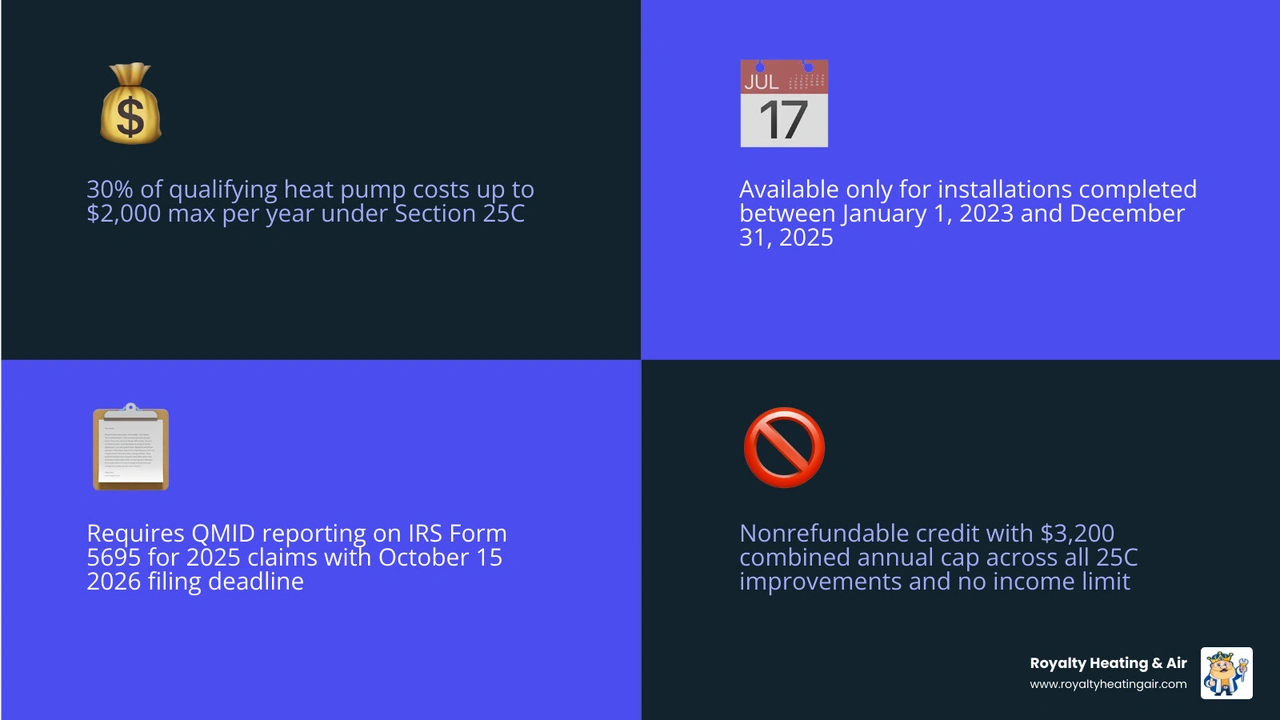
Here is a quick summary of what the credit offered:
• Credit rate — Amount: 30% of qualifying costs
• Maximum credit for heat pumps — Amount: $2,000 per year
• Combined annual cap (all 25C improvements) — Amount: $3,200
• Credit type — Amount: Nonrefundable
• Qualifying period — Amount: January 1, 2023 – December 31, 2025
• New 2025 requirement — Amount: Qualified Manufacturer ID (QMID) on Form 5695
• Available for new 2026 installations? — Amount: No
The credit is nonrefundable, meaning it can reduce your federal tax bill to zero but cannot generate a refund beyond what you owe. There is no income limit to qualify, and there is no lifetime cap — homeowners could claim the maximum credit each year through 2025.
If you are a Roseville homeowner who completed a heat pump installation in 2025 and have not yet filed your taxes, you are likely still eligible to claim up to $2,000. This guide walks you through everything you need to know — from eligibility and efficiency requirements to exactly how to file.
When navigating federal tax incentives for HVAC upgrades, it is vital to understand that the IRS categorized heat pumps under two distinct sections of the tax code: Section 25C and Section 25D. Each section targeted different technologies, carried unique structural rules, and offered different financial limits.
We often help homeowners evaluate these options when discussing their home comfort needs. If you want to understand how these systems function before diving into the tax code, our Professional Heat Pump Guide Roseville CA provides an excellent foundation.
Section 25C was the workhorse for standard residential upgrades. It applied directly to air-source heat pumps and heat pump water heaters. Under this section, homeowners could claim a tax credit equal to 30% of the total purchase and installation costs, capped at a maximum of $2,000 per year.
A critical detail of Section 25C is that it was strictly nonrefundable and did not allow for any carryforward. If your tax liability for the year was $1,500, and you qualified for a $2,000 heat pump credit, your tax bill would drop to $0, but the remaining $500 of the credit would be permanently lost. It could not be refunded to you as cash, nor could it be applied to your taxes in 2026. Furthermore, Section 25C was limited exclusively to existing homes used as primary residences.
Section 25D, on the other hand, governed geothermal heat pump installations. Geothermal systems rely on the stable temperature of the earth rather than the outdoor air to heat and cool your home. Because these installations are highly complex, the federal government structured Section 25D with much more generous terms.
Under Section 25D, homeowners could claim a 30% credit on the entire cost of the geothermal system, including labor and ground-loop installation, with no upper dollar limit. Unlike Section 25C, Section 25D allows for carryforward. If your tax credit exceeds your tax liability in the year of installation, you can roll the remaining credit over to reduce your taxes in subsequent years. Additionally, Section 25D applied to both primary residences and newly constructed or secondary homes.
• Credit Percentage — Section 25C (Air-Source Heat Pumps): 30% of total installed cost — Section 25D (Geothermal Heat Pumps): 30% of total installed cost
• Maximum Annual Limit — Section 25C (Air-Source Heat Pumps): $2,000 — Section 25D (Geothermal Heat Pumps): No limit
• Carryforward Allowed? — Section 25C (Air-Source Heat Pumps): No (unused credit expires) — Section 25D (Geothermal Heat Pumps): Yes (can be rolled over to future years)
• Eligible Property Types — Section 25C (Air-Source Heat Pumps): Existing primary residences only — Section 25D (Geothermal Heat Pumps): Primary & secondary homes (new construction or existing)
• Labor Costs Covered? — Section 25C (Air-Source Heat Pumps): Yes — Section 25D (Geothermal Heat Pumps): Yes
• Expiration Date — Section 25C (Air-Source Heat Pumps): Dec. 31, 2025 — Section 25D (Geothermal Heat Pumps): Active through 2032 (phases down in 2033–2034)
To claim the Section 25C credit for a system installed during the 2025 tax year, the equipment must meet strict performance criteria set by the Consortium for Energy Efficiency (CEE). The IRS did not allow you to claim the credit for just any standard heat pump; the system had to represent the upper tier of energy efficiency.
We always emphasize the importance of matching components properly. For a split system (which features both an indoor air handler and an outdoor condenser), both units must be certified by the manufacturer as a matched pair to achieve the rated efficiencies. If you are planning an installation or verifying a past project, our Heat Pump Installation Roseville CA Guide details how we ensure every system meets these rigorous standards.
For air-source heat pumps installed in 2025, the equipment must meet or exceed the highest non-advanced efficiency tier established by the CEE as of the beginning of the year the system was placed in service. This is where technical ratings like SEER2, EER2, and HSPF2 come into play.
• SEER2 (Seasonal Energy Efficiency Ratio 2): Measures cooling efficiency. Split ducted systems must meet a SEER2 rating of 15.2 or above, while non-ducted (mini-split) systems must reach at least 16.0.
• EER2 (Energy Efficiency Ratio 2): Measures cooling efficiency at a constant outdoor temperature of 95°F. Split ducted systems must achieve an EER2 of 10.0 or higher.
• HSPF2 (Heating Seasonal Performance Factor 2): Measures heating efficiency over a typical heating season. Split ducted systems must meet an HSPF2 of 7.2 or higher.
• COP (Coefficient of Performance): For cold-climate performance, systems must show a COP of at least 1.75 at 5°F.
To simplify this for taxpayers, manufacturers issue official certification statements. Additionally, for any system placed in service in 2025, the taxpayer must report a four-digit Qualified Manufacturer ID (QMID) or Product Identification Number (PIN) on Form 5695. This code confirms that the system was produced by a qualified manufacturer who registered the equipment directly with the IRS. You can cross-reference eligible models in our Best Heat Pump Roseville CA Guide.
Eligibility for the Section 25C credit hinges heavily on how the property is used and who owns it:
• Principal Residences: The heat pump must have been installed in an existing home located in the United States that you own and use as your primary residence.
• Second Homes: Second homes, vacation homes, and properties used exclusively for recreational purposes do not qualify for the Section 25C credit (though they may qualify for Section 25D geothermal upgrades).
• Renters: While renters could theoretically claim the credit for certain portable or tenant-installed energy-efficient equipment, major structural HVAC upgrades like central heat pumps are almost always paid for by landlords.
• Landlord Exclusion: Landlords who do not live in the property cannot claim the Section 25C credit. If you own a rental property in Lincoln or Rocklin and upgraded its HVAC system, you cannot use this credit to offset your tax liability.
• Business Use Proration: If you use your primary residence partially for business (for example, if you have a dedicated home office), you must prorate the credit. If your home office occupies 20% of your home, and the heat pump heats the entire house, you must reduce the qualifying expenses by 20% before calculating your tax credit. If the business use of the home is greater than 80%, no credit is allowed under Section 25C.
If you had to replace an older, failing system in a qualifying home, our Heat Pump Replacement Lincoln CA Guide can help you understand the physical replacement process while you work out the tax details.
Calculating the tax credit is straightforward, but you must account for any other home energy improvements you made during the same tax year. The Section 25C credit allows you to claim 30% of the qualified purchase and installation costs for a heat pump, capped at an annual limit of $2,000.
However, Section 25C also features an overall combined annual cap of $3,200. This means you could claim the full $2,000 for your heat pump and still have up to $1,200 available to claim for other qualifying improvements made in 2025, such as:
• Exterior doors (30% of costs, up to $250 per door, $500 total)
• Exterior windows and skylights (30% of costs, up to $600 total)
• Insulation and air sealing (30% of costs, up to $1,200 total)
• Home energy audits (30% of costs, up to $150 total)
Before you calculate your 30% credit, you must subtract any state rebates, utility incentives, or manufacturer promotions from the total cost of the project. The federal tax credit can only be calculated on your actual, net out-of-pocket expenses.
For example, if your total heat pump installation cost was $8,000, and you received a $1,500 instant state rebate, your net qualifying cost is $6,500. Calculating 30% of $6,500 yields $1,950. Since this is below the $2,000 cap, you can claim the full $1,950. If you did not receive a rebate, 30% of $8,000 would be $2,400, but your credit would be capped at the $2,000 maximum.
To claim your credit during the 2026 tax filing season for a system installed in 2025, follow these steps:
1. Gather Documentation: Locate your itemized installation invoice, proof of payment, the manufacturer's certification statement, and the four-digit QMID/PIN.
2. Complete IRS Form 5695: Use Part II (Nonbusiness Energy Property) of Form 5695, Residential Energy Credits.
3. Enter Expenses: Enter your net heat pump expenses on the line designated for residential energy property (typically Line 29a for heat pumps).
4. Apply the QMID: Ensure you write the manufacturer's QMID code in the designated box. Without this code, the IRS may disallow the credit.
5. Calculate the Credit: Multiply your qualifying expenses by 30%, apply the $2,000 cap, and factor in any other home improvements to ensure you do not exceed the $3,200 combined limit.
6. Transfer to Form 1040: Transfer the final credit amount from Form 5695 to Schedule 3 (Nonrefundable Credits) of your Form 1040.
If you filed for an extension on your 2025 taxes, you have until October 15, 2026, to submit these forms. If you are in Rocklin and need to review how a physical replacement is structured to match these steps, see our Heat Pump Replacement Rocklin Guide.
Even though the federal Section 25C tax credit expired on December 31, 2025, homeowners in our local service areas—including Roseville, Rocklin, Loomis, Lincoln, and Granite Bay—still have access to excellent financial incentives in 2026. Transitioning to a heat pump remains highly practical and affordable thanks to state-level programs, utility rebates, and federal initiatives that do not rely on tax filings.
HEEHRA is a federally funded, state-administered program designed to help low- and moderate-income households transition to clean electric energy. Unlike tax credits, HEEHRA provides point-of-sale rebates, meaning the discount is applied directly to your invoice at the time of purchase.
• Low-Income Households (under 80% of Area Median Income): Can qualify for up to 100% of the heat pump installation cost, capped at $8,000.
• Moderate-Income Households (80% to 150% of Area Median Income): Can qualify for up to 50% of the installation cost, capped at $8,000.
• Additional Upgrades: HEEHRA also offers up to $4,000 for electric panel upgrades and up to $2,500 for improved electrical wiring, making it much easier to prepare older homes for modern HVAC equipment.
TECH Clean California is a statewide initiative designed to accelerate the adoption of clean space heating and cooling. This program works directly through enrolled contractors to offer substantial rebates on heat pump installations. By choosing an approved contractor, homeowners can receive instant discounts on their installation invoice.
Our local utility providers continue to support energy efficiency through robust rebate structures:
• Roseville Electric: Offers generous rebates for Roseville residential customers who upgrade from older air conditioners or gas furnaces to high-efficiency heat pumps.
• PG&E: Provides rebates for customers across Placer County who install qualified energy-efficient heat pump systems.
By combining these local utility rebates with program incentives like TECH Clean California, you can still significantly reduce your net installation costs. If you are looking for cost-effective options, our Affordable Heat Pump Roseville CA Guide is a great resource to explore how we keep these systems within reach.
Yes. If your qualifying heat pump was installed and fully operational (placed in service) on or before December 31, 2025, you are fully eligible to claim the Section 25C credit. You will claim this credit when you file your 2025 federal income tax return.
If you filed for a tax extension for your 2025 returns, you have until the extension deadline of October 15, 2026, to submit IRS Form 5695 alongside your Form 1040. Make sure you have your installation receipts, manufacturer certification, and the required QMID code ready for your tax preparer. If you are located in Loomis and need assistance finding a system that fits your home's layout, check out our Heat Pump Replacement Loomis CA Guide.
No. The federal Section 25C Energy Efficient Home Improvement Credit officially expired on December 31, 2025. Any air-source heat pump installed on or after January 1, 2026, is not eligible for this federal tax credit.
However, Section 25D for geothermal heat pumps remains active through 2032. If you are installing a standard air-source system in 2026, you should focus on point-of-sale rebates like HEEHRA, TECH Clean California, and local utility incentives from Roseville Electric or PG&E to offset your costs. Working with an experienced local provider is key; you can find more details in our Heat Pump Company Lincoln CA Guide.
Any state rebate, utility incentive, or manufacturer discount received at the time of purchase must be subtracted from the total cost of the heat pump project before you calculate your federal tax credit. The IRS requires the 30% credit to be calculated solely on your actual out-of-pocket expenses.
For example, if your total project cost was $7,000 and you received a $1,000 rebate from Roseville Electric, your net qualifying cost is $6,000. Your 30% tax credit is calculated as 30% of $6,000, which equals $1,800. If you need a reliable team to help you navigate these efficiency requirements and install your system correctly, our Heat Pump Company Roseville CA Guide highlights what to look for in a local partner.
Navigating the transition to energy-efficient home comfort doesn't have to be complicated. At Royalty Heating & Air, we provide top-tier heating and air conditioning services across Roseville, Rocklin, Loomis, Lincoln, and Granite Bay.
Beyond our dedication to exceptional indoor comfort and system performance, we are deeply committed to our community. Through our partnership with the MackAttack Foundation, we proudly support foster babies and sponsor family adoptions, ensuring that our work brings warmth and comfort both inside and outside your home.
If you are ready to explore high-efficiency heating and cooling options, we invite you to learn more about our professional Royalty Heating & Air Heat Pump Services and let us help you maximize your home's comfort and efficiency.

