
Services
About
Service Areas


Bigger isn't better when it comes to HVAC equipment, and the hidden danger of oversized air conditioners in well-insulated homes is a reality many homeowners discover the hard way. In our years of serving Roseville families at Royalty Heating & Air, we see this scenario play out every back-to-school season. During the punishing late-summer August heat, it is completely natural to panic when an aging cooling system finally fails. When the house is sweltering and you are desperate for relief, the psychological temptation is to buy the largest capacity unit available. The thought process makes sense on the surface: if a three-ton unit struggled to keep the house cool, a four-ton unit will surely freeze you out and never break down again. However, our technicians can tell you firsthand that this is one of the most persistent and costly myths in the home improvement industry.
Air conditioning is not just about blowing cold air into a room; it is a delicate, continuous balance of airflow, temperature drop, and moisture removal. When you install a system that is too powerful for your home's square footage and thermal envelope, you disrupt this balance entirely. Instead of creating a crisp, comfortable living space, an oversized unit creates an uncomfortable, clammy environment that leaves you feeling sticky even when the thermostat says the room is cool. The core thesis is simple: in modern homes, an oversized air conditioner is actually a downgrade in comfort.
If you are looking for reliable air conditioning services or need professional AC installation in Roseville, understanding the science of home cooling is your first line of defense against a costly mistake.
The Problem: Older homes were notoriously drafty. They had single-pane windows, minimal attic insulation, and countless tiny gaps around doors and baseboards. In these older houses, an oversized air conditioner's flaws were sometimes masked by the constant exchange of indoor and outdoor air. Today, strict energy-efficient building codes have fundamentally changed how houses breathe. Modern construction techniques make homes nearly airtight to prevent energy loss, which is fantastic for your utility bills but creates a unique challenge for your HVAC system.
The Cause: Because modern homes are tightly sealed, the moisture generated by daily indoor activities has nowhere to go. Every time you boil a pot of pasta, take a hot shower, run the dishwasher, or even just breathe, you are adding significant amounts of water vapor into the air. While Roseville, CA has a famously hot, dry climate, the tightly sealed nature of modern homes traps this indoor humidity, creating a humid micro-climate inside the house that requires active moisture management. If you upgrade your insulation or install high-efficiency windows while replacing your AC, you drastically reduce the amount of heat entering the home. This fundamentally lowers your required cooling load.
The Solution: Your air conditioner must be precisely matched to this new, highly efficient environment. We see the effects of mismatched systems frequently. For example, we met a homeowner at a local home show who had been dealing with a long-standing problem with their thermostat. When our technician, Clayton, visited their Roseville house, he thoroughly assessed and solved the thermostat issue—but the root cause was actually related to how the home's tight thermal envelope was interacting with the cooling system's run cycles. To fix these issues, the system must run long enough to handle both the temperature and the trapped moisture.
Airtight homes retain cool air much longer than drafty homes, which is the exact goal of good insulation. However, they also trap latent heat—better known as humidity. Without proper ventilation or adequately sized AC run times, your indoor air quality and overall comfort will rapidly suffer. You end up living in a sealed plastic bag where the air is cold, but the humidity is trapped inside with you.
To understand why an oversized unit fails to keep you comfortable, you have to understand the two distinct types of cooling an air conditioner performs every time it turns on. True comfort requires both of these processes to happen simultaneously.
Sensible cooling is the measurable drop in air temperature. This is the cooling you can easily understand and track—it is exactly what your thermostat reads. When your house is 80°F and you set the thermostat to 72°F, the system provides sensible cooling to bridge that eight-degree gap.
Latent cooling, on the other hand, is the extraction of moisture from the air. Your air conditioner removes humidity by passing warm indoor air over a freezing cold evaporator coil. The moisture in the air condenses on the cold metal (just like water droplets forming on the outside of a cold glass of iced tea on a summer day) and drips safely away through a drain line.
The profound discomfort of an oversized system happens when the sensible temperature is met, but the latent heat remains untouched. This is exactly why you might find yourself in a situation where the thermostat reads 72°F but the indoor air feels humid and clammy. You are experiencing sensible cooling without latent cooling.
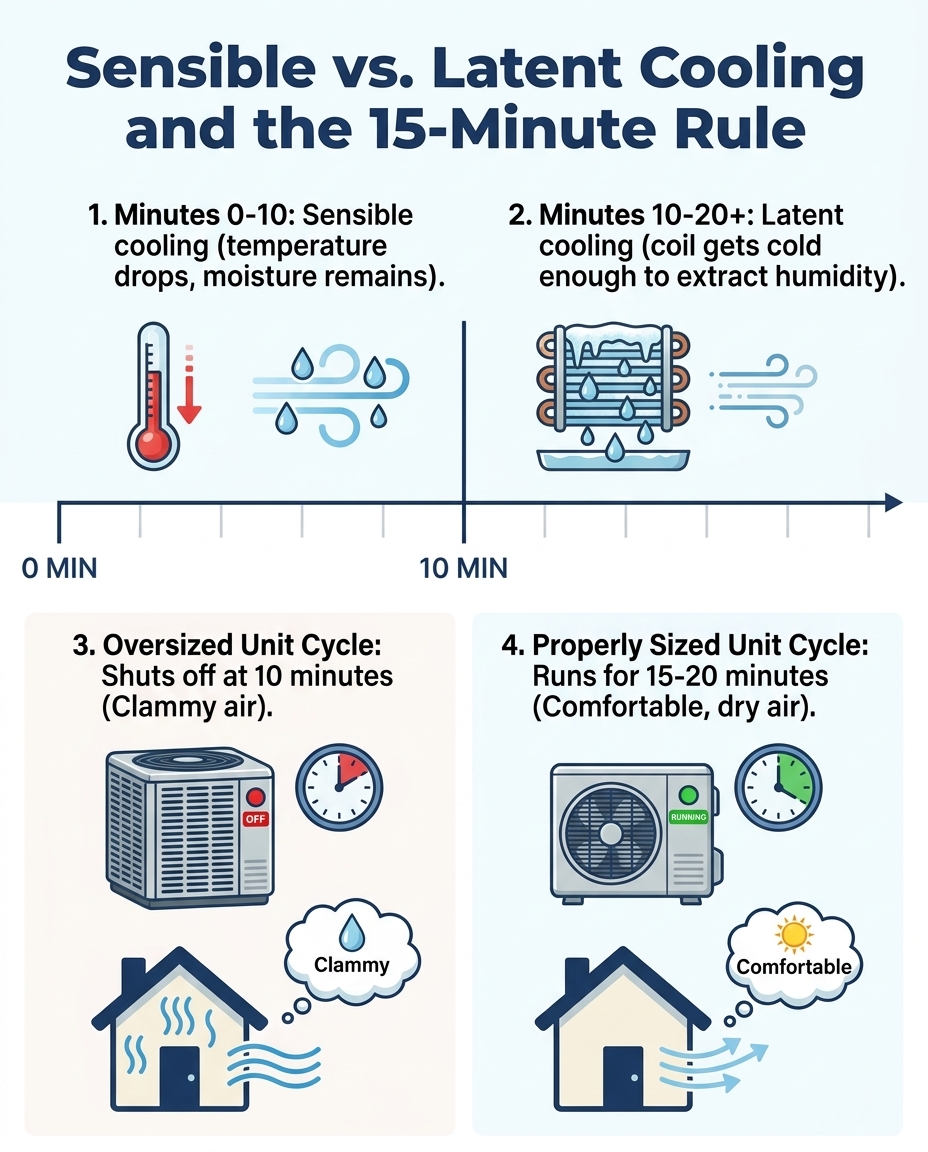
• Sensible Cooling — What It Actually Does: Lowers the physical air temperature. — How You Notice It: The thermostat number drops. — Required Run Time: Happens immediately (Minutes 1-10).
• Latent Cooling — What It Actually Does: Removes trapped indoor moisture. — How You Notice It: The air feels crisp and dry. — Required Run Time: Requires sustained operation (Minutes 10-20+).
When you install an air conditioner that has too much cooling capacity for your home, you trigger a mechanical failure in the dehumidification process. The system simply cools the air too fast. Here is a step-by-step breakdown of how our team typically sees this mechanical failure occur:
1. The massive blast of cold air: An oversized unit pushes an enormous volume of freezing air into your living space the moment it turns on.
2. The premature shutdown: Because the unit is so powerful, it satisfies the thermostat's sensible temperature setting in just 5 to 10 minutes. The thermostat senses that the room has reached 72°F and abruptly shuts the system off.
3. The missed condensation window: An evaporator coil needs 15 to 20 minutes of continuous operation to get cold enough to effectively extract moisture. Because the oversized unit shut off at the 10-minute mark, the condensation process never fully began.
4. The clammy aftermath: The air is now cold, but all the humidity from cooking, breathing, and showering is still floating in the room.
This rapid on-and-off process is known in the industry as short-cycling. If you want to dive deeper into the mechanical wear and tear this causes, you can read more about why your AC unit is short cycling. Beyond just leaving your home feeling sticky, short-cycling has severe secondary impacts. It causes massive increases in your energy bills because air conditioners draw the most electricity during the startup phase. It also drastically accelerates wear and tear on your compressor, leading to premature breakdowns that our late-summer repair crews see all too often.
The initial minutes of any cooling cycle only drop the sensible temperature. Moisture extraction peaks only after the system has run long enough for condensation to form steadily on the coils. If your system cannot run for at least 15 minutes at a time on a hot afternoon, it is fundamentally incapable of drying out your air.
If you recently moved into a new house or had your system replaced by a contractor who didn't do the proper math, you might be living with an oversized unit right now. Identifying the problem early can save you from years of discomfort and massive utility bills. Here are the most common symptoms our Royalty Heating & Air technicians see in the field that indicate your air conditioner is too large for your home's thermal envelope:
• Rapid on/off cycles: Listen to your system. If your AC turns on, blasts air like a jet engine, and shuts off entirely in less than 10 minutes, it is short-cycling.
• A clammy, sticky feeling indoors: As we discussed, if your thermostat reads 72°F but the indoor air feels humid and clammy, your system is failing to perform latent cooling.
• Uneven cooling across different rooms: Oversized units cool the area immediately surrounding the thermostat almost instantly. The system shuts down before that cold air has a chance to circulate to distant bedrooms or upstairs areas, leaving hot spots throughout the house.
• Unusually high energy bills: Air conditioners require a massive surge of electricity to turn on the compressor. If your system is starting up six times an hour instead of two or three times, your power meter is spinning out of control.
• Frequent breakdowns: Constant starting and stopping puts immense strain on capacitors, contactors, and the compressor itself. If you are constantly calling for AC repair services on relatively new equipment, improper sizing is a likely culprit.
The only way to guarantee that your home receives the exact right amount of sensible and latent cooling is to perform a Manual J load calculation. This is the professional, scientific solution to sizing issues, and it is the exact opposite of the "bigger is better" myth.
A Manual J load calculation is a detailed mathematical formula used to determine the exact thermal envelope of your home. It goes far beyond simply looking at the square footage. A proper calculation considers the height of your ceilings, the number and direction of your windows, the quality of your attic insulation, the color of your roof, and even the number of people living in the house. In our experience working in the Roseville area, factoring in solar heat gain through west-facing windows during intense August afternoons is critical to getting the math right.
You should always be wary of contractors who rely on outdated "rules of thumb" (like assigning one ton of cooling for every 500 square feet) or those who simply look at the label on your broken unit and offer to install the exact same size or larger without measuring. At Royalty Heating & Air, we focus heavily on precise load calculations to ensure perfectly sized installations. We prioritize your long-term comfort and moisture control over upselling you on larger, unnecessary equipment that will only cause you headaches down the road. Furthermore, installing a properly sized, high-efficiency system may even qualify you for general utility incentive programs or federal tax credits (always verify current programs with your utility provider or a tax professional). Once the right system is installed, scheduling routine AC maintenance ensures that it continues to hit those optimal 15-to-20-minute run cycles efficiently year after year.
Skipping the math always leads to poorly sized units, clammy living spaces, and wasted energy. Professional comfort engineering means matching the equipment exactly to the home's specific thermal envelope. When the math is done correctly, your system runs just long enough to drop the temperature, strip the humidity, and leave your home feeling perfectly crisp.
What happens if my AC is too big for my house?
An oversized AC will cool your home too quickly and shut off before it has time to remove humidity from the air. This rapid on-and-off process, known as short-cycling, leaves your home feeling cold but clammy. Over time, it also causes severe wear and tear on your compressor and drives up your monthly energy bills.
Why does my house feel clammy even with the AC on?
Your house feels clammy because the air conditioner is not running long enough to extract latent heat, which is indoor humidity. An AC coil needs about 15 to 20 minutes of continuous running to gather condensation and drain moisture away. If your system shuts off in 10 minutes, the moisture stays trapped inside your rooms.
Does an oversized AC use more electricity?
Yes, an oversized AC uses significantly more electricity than a properly sized unit. Air conditioners draw the most power during their initial startup phase. Because an oversized unit turns on and off constantly throughout the day, it draws that massive startup power far more often, causing your utility bills to spike.
How long should an air conditioner run during a normal cycle?
During a typical hot summer afternoon, a properly sized air conditioner should run for about 15 to 20 minutes per cycle. This duration is long enough to lower the sensible temperature of the room while giving the evaporator coil enough time to pull excess humidity out of the air.
Can I fix an oversized AC by setting the thermostat lower?
Lowering the thermostat will force the oversized unit to run slightly longer, which may extract a bit more moisture, but it is not a permanent fix. You will end up freezing your family by dropping the temperature to an uncomfortable level, and your energy bills will skyrocket from the excessive cooling demands.
Resisting the urge to buy the biggest unit on the market is the smartest move you can make for your home's comfort. By relying on precise load calculations rather than guesswork, you ensure your system runs long enough to provide the mechanical dehumidification your home needs. Proper sizing is the ultimate key to true, lasting comfort.
