
Services
About
Service Areas


How community values translate to better home comfort is one of the most overlooked forces shaping how warm or cool your house actually feels — and how much you pay to keep it that way.
Here is a quick look at how it works:
• Sense of belonging — How It Improves Home Comfort: Aligns your thermostat habits with efficient local norms
• Social trust — How It Improves Home Comfort: Encourages shared energy-saving behaviors across neighbors
• Place identity — How It Improves Home Comfort: Motivates temperature choices that match your climate
• Community engagement — How It Improves Home Comfort: Opens access to group HVAC upgrades and local programs
• Shared norms — How It Improves Home Comfort: Reduces energy waste through unconscious behavioral alignment
Most homeowners in Roseville focus on equipment — the right furnace, the right air conditioner, the right thermostat. Those things matter. But research shows something surprising: the community you live in quietly shapes the temperature you set your home to, often more powerfully than a rebate check or an energy bill ever could.
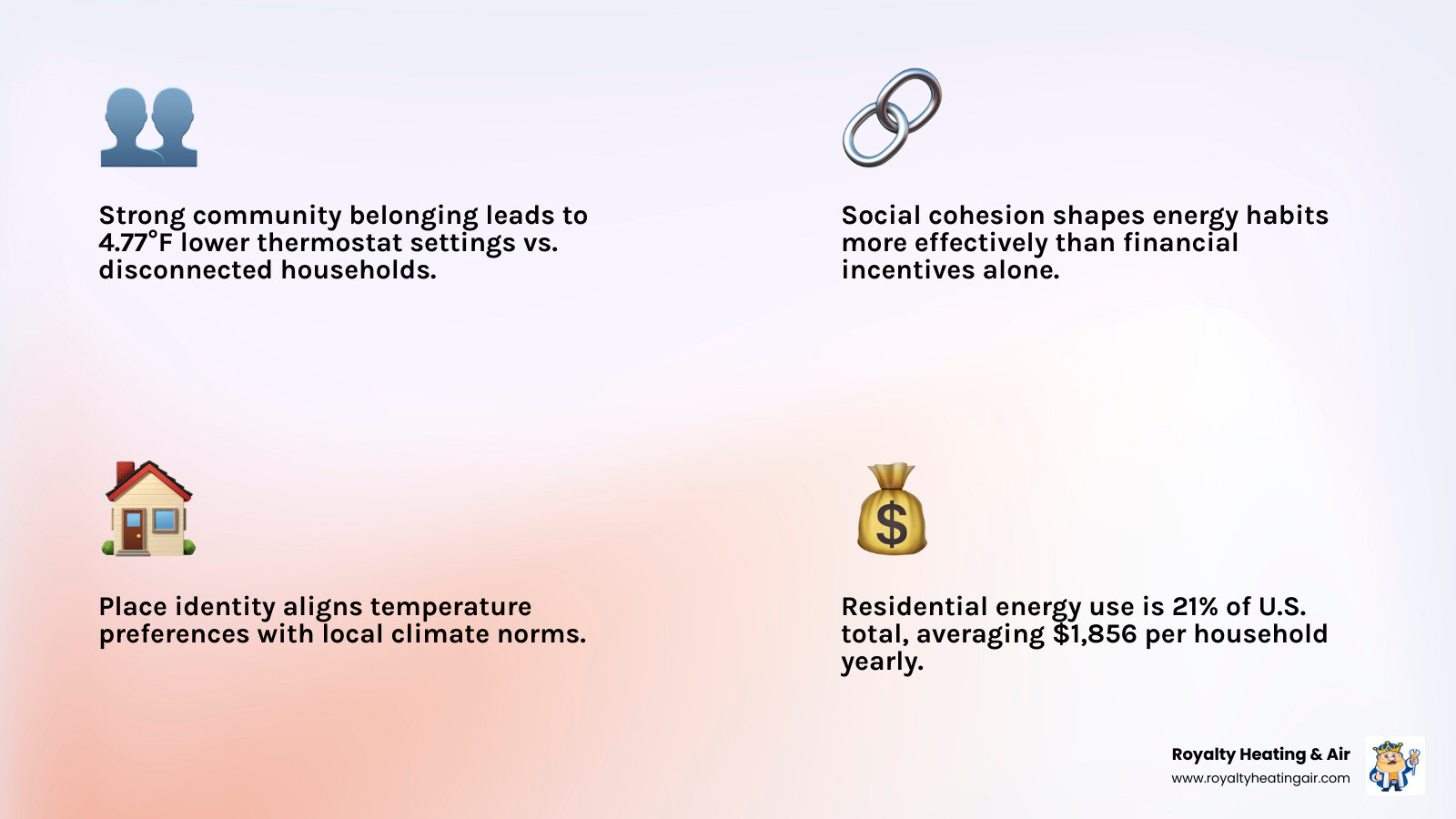
A large U.S. study of over 2,000 participants found that people who feel a strong sense of belonging to their community set home temperatures up to 4.77°F lower than those who feel disconnected — even when living in the same climate. That kind of difference adds up fast on an annual utility bill.
Residential energy use accounts for 21% of all U.S. energy consumption, costing households roughly $1,856 per year on average. The choices you make at your thermostat are not made in a vacuum. They are shaped by habit, memory, and the people around you — whether you realize it or not.
As we move through April 2026, we are learning more about why some of us are "always cold" and others are "always hot." It turns out, your comfort settings in Roseville or Rocklin today were likely decided decades ago in your childhood living room. This is a psychological process called thermal habituation.
Research indicates that childhood home temperatures are a massive predictor of adult thermostat settings. In technical terms, there is a regression coefficient of b = 0.45 (p < 0.001). In plain English? For every degree warmer your childhood home was kept, you are significantly more likely to prefer a warmer home as an adult. We don't just inherit our parents' height or eye color; we inherit their "comfort zone."
These familial habits create a baseline for energy consumption. If you grew up in a household where the heater was always blasting, you might find yourself reaching for the thermostat even when a sweater would do. Understanding these deep-seated habits is the first step toward optimizing your home's efficiency. To ensure your system can keep up with these lifelong preferences without breaking the bank, consistent upkeep is vital. You can discover more info about maintenance plans to keep your baseline comfort affordable.
Habit formation is a powerful thing. When we are children, our bodies adapt to the thermal environment our parents provide. If your childhood home was kept at a crisp 68°F, your adult body likely perceives that as the "correct" temperature. This isn't just a mental preference; it's a physiological expectation.
These adult preferences drive our daily energy consumption. When we feel "uncomfortable," it is often because our current environment doesn't match our historical habituation. However, while these childhood experiences set the foundation, they aren't the final word. As we will see, the community we choose to live in can actually help us "re-train" our comfort levels for the better.
So, how does moving to a place like Granite Bay or Loomis change your relationship with your furnace? The answer lies in a concept called "community fit." This describes how well an individual’s personal values and behaviors align with those of their local neighbors.
Community fit acts as a social "thermostat." When we feel a high sense of belonging, we unconsciously begin to adapt our behaviors to match the local norms. This includes how we use our energy. If you live in a community that values sustainability and resilience, you are more likely to adopt those same values in your own home practices.
• Thermostat Adjustment — High Community Fit: Aligns with local climate norms — Low Community Fit: Driven purely by childhood habits
• Energy Consumption — High Community Fit: Generally lower and more efficient — Low Community Fit: Often higher due to habituation
• Social Adaptation — High Community Fit: High; mirrors neighborly efficiency — Low Community Fit: Low; ignores local conservation efforts
• Place Identity — High Community Fit: Strong connection to local environment — Low Community Fit: Feels like an "outsider" to the climate
Psychologists have found a significant "three-way interaction" (b = 0.01) between childhood habits, the local climate, and community fit. Essentially, community fit is the "moderator." It has the power to override your childhood habituation.
If you have a high community fit, you are more likely to adjust your home temperature to match what is considered "normal" or "responsible" in your area. This psychological mechanism is tied to residential satisfaction. When we feel we belong, we want to participate in the "invisible infrastructure" of our neighborhood—the shared effort to keep the grid stable and the environment healthy. To bridge the gap between your personal habits and your community’s values, more info about professional HVAC services can help you find the right technological balance.
This effect is most visible when the weather gets tough. In regions with cold winters, individuals with high community fit maintain significantly lower home temperatures (a slope of 0.29) compared to those with low fit (a slope of 0.66).
In our neck of the woods, where we deal with both chilly winter mornings and scorching summer afternoons, this adaptation is crucial. Those who feel connected to the Roseville or Lincoln area are more likely to "lean into" the local climate rather than fighting it with excessive heating or cooling. By aligning with local norms, you don't just save energy; you find a deeper sense of comfort that comes from being in sync with your surroundings. You can read our customer reviews to see how your neighbors are finding this balance.
For years, utility companies and government agencies have tried to change how we use energy through financial incentives or "social norm" feedback (those letters that tell you how much more energy you use than your neighbor). Surprisingly, these often fail. Why? Because a small rebate or a "shaming" letter doesn't address our deep-seated thermal habits.
Community fit offers a better mechanism because it isn't about a one-time check; it's about a permanent shift in identity. When you value your community, you want to be efficient. Research has shown that high community fit can result in a 4.77°F difference in thermostat settings. That is a massive shift that no financial incentive has been able to consistently replicate.
When we leverage these local norms, the financial benefits follow naturally. Lowering your home temperature by just 7–10°F for eight hours a day can save a household up to 10% on annual utility costs. On a national scale, if every household aligned their behaviors with these community-driven norms, it could save $19.27 billion annually.
In Roseville, where we take pride in our local identity, these savings are a direct byproduct of our shared values. By choosing to be a "good neighbor" to the energy grid, you are putting money back into your own pocket. To see how you can maximize these community-aligned savings, check our latest promotions for high-efficiency upgrades.
As we look toward the future of urban planning in California, the focus is shifting. It’s not just about building efficient houses; it’s about building inclusive communities. When we create spaces that foster social engagement—like community gardens, shared parks, and local events—we are actually improving home comfort.
Stronger social ties lead to better "caring practices." In a connected community, home comfort isn't just about a machine in the backyard; it's about how we care for our families and our neighbors. This social dimension of the residential environment is often underestimated, but it is the "invisible infrastructure" that makes a house feel like a home.
How do we build this fit? It starts with localized campaigns and community-building initiatives. When neighbors participate in "Get to Know Your Neighbor" days or volunteer for local clean-up projects, they build the trust necessary for behavioral alignment.
Inclusive design in our neighborhoods—ensuring that shared spaces are accessible and welcoming—encourages people to spend time together. This social cohesion reduces anxiety and depression, which in turn makes us more resilient to environmental stresses like heatwaves. If you are looking to move into one of these thriving areas, you can view our service locations to see where we provide support.
Smart Home Technology (SHT) is another piece of the puzzle. However, research suggests that SHT only works when it is designed with cultural awareness. In the U.S., our "energy culture" is shifting toward a "comfort economy," where the home is seen as a sanctuary.
For SHT to truly promote sustainability, it must align with these values. A smart thermostat shouldn't just be a cold piece of tech; it should be a tool that helps us nurture our household. By integrating these technologies into our daily lives with a focus on "care," we can transition to more sustainable energy use without sacrificing the "home-like" feel we crave. To learn more about how we integrate these values into our work, learn about our company.
Community fit is the degree to which your personal values and behaviors match those of your local neighborhood. In terms of home heating, it means that if you feel a strong bond with your community, you are more likely to unconsciously adopt the energy-saving habits and temperature norms that are common in your area, leading to better efficiency.
Your body "learns" what comfort feels like when you are young. If you grew up in a very warm home, you are statistically likely to keep your own home warmer as an adult. This "thermal habituation" can lead to higher energy bills if your baseline preference is significantly higher than the local climate requires.
Yes! While it sounds indirect, community-building fosters a sense of belonging. This "community fit" has been shown to encourage residents to align their thermostat settings with more efficient local norms. People who feel connected to their neighbors often use less energy because they share a collective identity that values local resilience and grid stability.
At Royalty Heating & Air, we believe that how community values translate to better home comfort is the heart of what we do. We don't just see ourselves as a service provider in Roseville, Rocklin, and Lincoln; we see ourselves as a member of your community.
Our commitment to these values goes beyond HVAC repairs. Through our partnership with the MackAttack Foundation, we are proud to support foster babies and sponsor family adoptions. We believe that a truly comfortable home is one filled with love, belonging, and a sense of security. When we work on your air conditioner or furnace, we aren't just adjusting a machine—we are helping you create a sanctuary that reflects the best of our local spirit.
By fostering community fit and supporting our neighbors, we can all enjoy better comfort, lower bills, and a stronger future together. If you'd like to see how we're making a difference beyond the thermostat, we invite you to learn more about our Community Involvement.

