
Services
About
Service Areas


Your air conditioner has been running nonstop for months, but suddenly the house still feels warm. Or worse, you step outside and hear a strange, heavy humming noise coming from the condenser unit, but the fan blades aren't moving at all. These are the frustrating, uncomfortable signs of an air conditioning system struggling to keep up with the heat. When you face this exact scenario, understanding how we diagnose a failing AC capacitor before it leaves you stranded can mean the difference between a quick, proactive fix and a catastrophic compressor failure.
If you want to keep your system running reliably, it is always best to catch these hidden threats early with professional intervention.
By the time late August arrives, your cooling system has already endured hundreds of hours of intense operation. This late August / end-of-season cooling period puts immense thermal stress on every mechanical and electrical component inside your outdoor unit. Most homeowners only realize there is a problem when the system stops blowing cold air completely. However, the components inside the metal cabinet do not usually fail instantly. They degrade slowly over time, quietly losing their efficiency and structural integrity under the relentless summer sun.
The common progression of wear:
• Initial heat exposure: The system runs longer cycles to combat high outdoor temperatures.
• Internal temperature rise: Electrical components inside the condenser cabinet begin to retain heat.
• Subtle degradation: Parts like the capacitor begin to lose their ability to store and discharge energy efficiently.
• System strain: Motors work harder to compensate for the weakened electrical support.
This is where the technician's role becomes critical. Performing a comprehensive diagnostic assessment allows us to catch this subtle degradation before it triggers a sudden, complete breakdown. Instead of waiting for the day your house reaches 85 degrees inside, a trained eye can spot the early warning signs hidden deep within the system.
To understand why these failures happen so frequently late in the season, you first need to understand the function of a dual run capacitor. Think of this component as a massive, heavy-duty battery. Its primary job is to store electrical energy and deliver a powerful jolt to jumpstart the compressor and the condenser fan motors. Air conditioning motors require a significant amount of torque to start spinning, especially when they are pushing pressurized refrigerant. The capacitor provides that necessary boost, and then continues to supply a steady stream of power to keep the motors running smoothly.
When you live in an area that experiences extreme ambient heat, the outdoor condenser unit struggles to cool down between cycles. In Roseville CA, sustained 95-100+ degree August heat creates severe ambient conditions that accelerate capacitor wear. The metal cabinet sits in direct sunlight, baking the internal components. Because the air conditioner is running almost continuously to keep your home comfortable, the electrical parts never get a chance to rest and shed their retained heat.
The cumulative effect of thermal load:
• Morning: The system starts cycling, generating normal operating heat.
• Afternoon peak: Ambient temperatures soar, trapping heat inside the condenser cabinet.
• Evening: The system continues running to cool the house down, preventing the internal parts from returning to a baseline temperature.
This continuous strain drastically increases the risk of end-of-season electrical failures. The intense thermal load breaks down the internal materials of the capacitor much faster than normal operation would. This is exactly why scheduling professional AC repair in Roseville at the first sign of trouble is so crucial for the longevity of your equipment.
• Early Summer (Moderate Heat) — Capacitor Environment: Adequate cooling time between cycles — Impact on Component Lifespan: Normal wear and tear, long lifespan expected
• Late Summer (Extreme Heat) — Capacitor Environment: Continuous thermal stress, no resting period — Impact on Component Lifespan: Accelerated degradation, high risk of premature failure
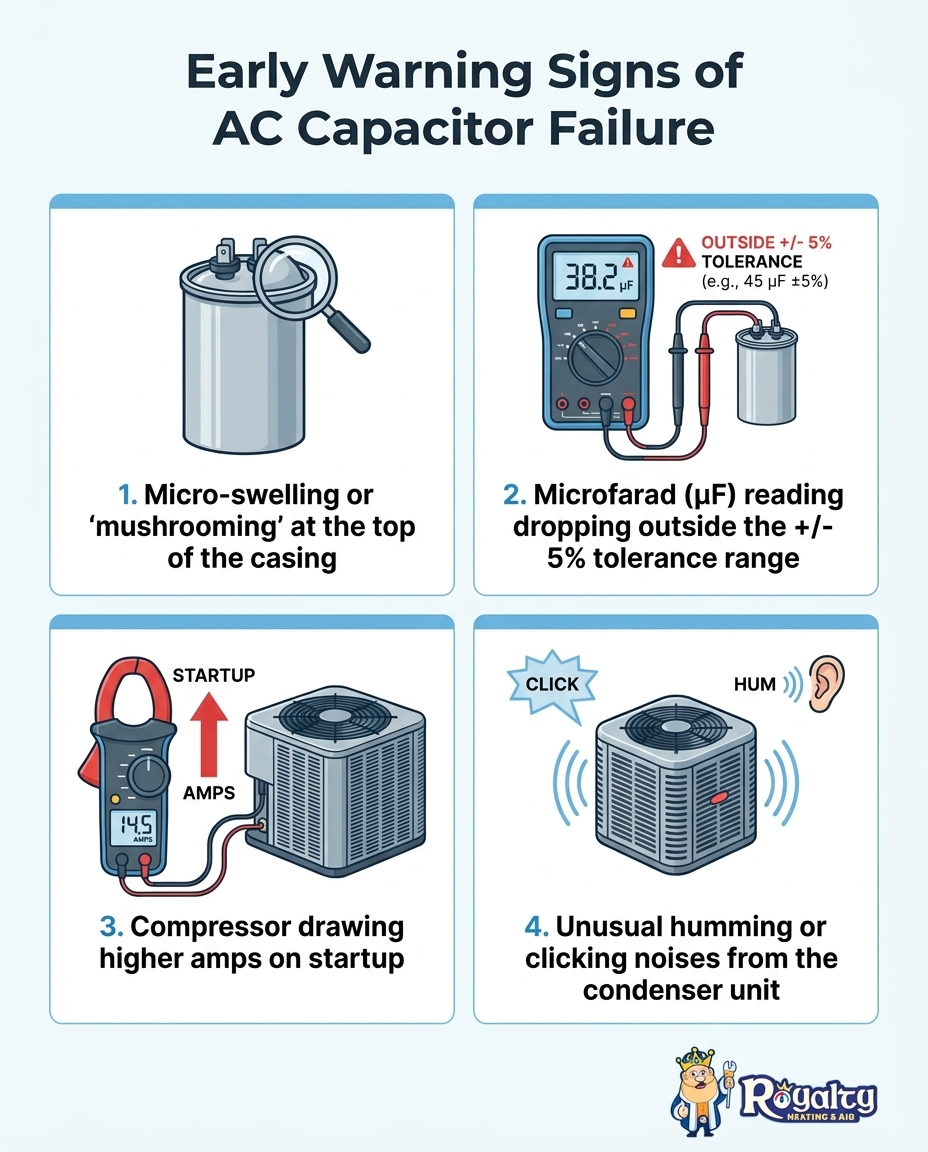
When our technicians open up a condenser unit during late August / end-of-season cooling, the first step is always a thorough visual inspection. We are looking for physical signs of degradation that indicate a component is on its way out. The most common and definitive visual cue for a failing capacitor is a phenomenon known as "micro-swelling" or "mushrooming."
To understand why micro-swelling happens, you have to look at the internal makeup of the capacitor. Inside the cylindrical metal casing, layers of metallic foil and insulating film are suspended in a special dielectric fluid. This fluid is designed to help manage the heat generated by the continuous flow of electricity. However, it has its limits.
What happens during extreme thermal stress:
• Fluid expansion: As the internal temperature of the capacitor exceeds its design limits, the dielectric fluid begins to heat up and expand.
• Pressure buildup: Because the metal casing is completely sealed, the expanding fluid creates immense pressure inside the cylinder.
• Physical distortion: The pressure has to go somewhere. The top of the capacitor, where the electrical terminals are located, is the weakest point of the casing.
When this pressure pushes upward, it causes the top of the casing to bulge outward slightly. This is the micro-swelling or mushrooming effect. Even slight bulging is a definitive visual indicator that the component's structural integrity is compromised. Once a capacitor begins to swell, it is only a matter of time before it fails completely. Catching this physical change early is a core part of comprehensive air conditioning services, allowing us to remove the compromised part before it bursts or shorts out.
While visual inspections are incredibly important, they only tell half the story. Sometimes a capacitor looks perfectly fine on the outside, but it is failing internally. This is why we always follow up our visual checks with precise electrical diagnostics. We measure a capacitor's health against strict manufacturer specifications to determine if it is still capable of doing its job.
Capacitors are rated by their capacitance, which is measured in microfarads (µF). Every dual run capacitor has a specific rating printed on its label, indicating exactly how much energy it should store and deliver. Healthy capacitors must operate within a strict tolerance range, typically +/- 5% or 6% of their printed rating. If a capacitor is rated for 45/5 µF, it must consistently test within that tight window.
Our professional testing process:
• Safe discharge: Technicians safely discharge any stored energy from the capacitor to prevent electrical shock.
• Multimeter testing: We use specialized multimeters designed specifically for HVAC diagnostics to test the exact capacitance reading of both the compressor side and the fan side.
• Comparing results: We compare the actual reading against the manufacturer's required tolerance range.
If we find a microfarad (µF) drop outside the standard tolerance range, the component is failing—even if the air conditioner is still technically running and blowing cold air at that exact moment. A weak capacitor will cause the system to work much harder than it should, which is often the hidden reason why an AC circuit breaker keeps tripping during the hottest part of the day.
Important Safety Warning: Never attempt DIY testing on an AC capacitor. These components store high voltage and can deliver a dangerous, potentially lethal electrical shock even when the main power to the unit is turned off. Handling and testing capacitors requires licensed professional training and specialized tools.
You might wonder why a technician would recommend replacing a part if the air conditioner is currently still cooling your home. The answer lies in the destructive domino effect that a weak capacitor has on the rest of your system. Ignoring a degrading component is a massive risk that usually leads to a much larger, more complex breakdown.
The relationship between the capacitor and the compressor motor is critical. The compressor is the heart of your AC system, responsible for pumping refrigerant through the lines. It is a heavy, powerful motor that requires a massive surge of energy to start spinning from a dead stop. When you have a microfarad (µF) drop outside the standard tolerance range, the capacitor cannot deliver that necessary surge of energy.
Because the weak capacitor fails to provide the required boost, the compressor motor is forced to struggle to get up to speed. To overcome this lack of support, the compressor draws higher amps directly from your home's electrical grid. This condition is known as a "hard start."
The consequences of a hard start include:
• Severe overheating: The increased electrical current generates excessive heat inside the compressor windings.
• Wire degradation: The wires and terminals connected to the compressor can become scorched or melted from the heat.
• Mechanical wear: The physical struggle to start puts immense mechanical strain on the internal moving parts of the compressor.
This increased amp draw leads to unnecessary wear on the system's most expensive component. If allowed to continue, a weak capacitor will eventually burn out the compressor motor entirely. By catching the issue early through proactive diagnostics, we prevent a minor electrical repair from turning into a major system failure. This is why scheduling prompt AC repair in Rocklin or your local area is the smartest way to protect your investment.
We believe that true comfort comes from reliability, which is why we focus heavily on preventative diagnostics. Waiting for a breakdown in the middle of a heatwave is stressful, uncomfortable, and entirely avoidable. Our diagnostic process during routine maintenance is designed to be thorough, detail-oriented, and fully transparent.
Working with our team means you get proactive, detail-oriented technicians who catch subtle signs to save customers from being stranded without AC. We do not just change the filter and walk away; we inspect, test, and verify every critical component inside your condenser unit.
One homeowner in Roseville CA recently reached out because their system needed a late-summer tune-up before the weather shifted into autumn. Our technician, Chris, performed a comprehensive system check, taking the time to explain each diagnostic step along the way. By the end of the visit, the system was fully tuned up by a knowledgeable technician, and the homeowner had a clear understanding of their equipment's health.
The value of proactive maintenance:
• Clear communication: We explain exactly what we are testing and why it matters for your system's performance.
• Data-driven decisions: We show you the microfarad readings on the multimeter so you understand exactly why a part needs attention.
• Long-term reliability: Catching these subtle signs ensures the system runs like new through the rest of the season.
Contrasting reactive repairs—where you wait for the system to fail completely—with proactive routine AC maintenance shows exactly why regular check-ups are so valuable. By testing the electrical tolerances and visually inspecting for micro-swelling, we keep your home cool and your system protected.
Yes, an air conditioner can sometimes temporarily run with a weak or failing capacitor, but it will struggle significantly. The system will draw higher electrical amps to compensate for the lack of starting power, which leads to severe overheating. Continuing to run the system in this state will eventually cause the compressor motor to burn out entirely.
A failing AC capacitor often produces a distinct, heavy humming or buzzing sound from the outdoor condenser unit. You may also hear a clicking noise as the system tries and fails to engage the motors. If you hear these sounds but the fan blades are not spinning, turn the system off immediately to prevent further damage.
The most obvious sign of a blown capacitor is that your air conditioner stops blowing cold air because the outdoor compressor will not turn on. Visually, a blown or failing capacitor often exhibits "micro-swelling" or mushrooming, where the top of the metal casing bulges outward. A professional technician will confirm it is blown by testing the microfarad reading with a multimeter.
Extreme heat is the primary cause of AC capacitor failure, especially during continuous end-of-season cooling cycles. The constant thermal stress causes the internal dielectric fluid to expand, degrading the component's structural integrity. Age, power surges, and general wear and tear also contribute to a capacitor losing its ability to hold a charge.
A technician will recommend replacing a capacitor if electrical testing shows it has dropped outside its standard microfarad tolerance range (usually +/- 5%). Even if the system is still running, a weak capacitor forces the expensive compressor motor to work much harder and run hotter. Replacing it proactively prevents a minor issue from causing a catastrophic compressor failure.
No, it is never safe to test an AC capacitor yourself. These components act like massive batteries and store high voltage that can deliver a severe, potentially lethal shock even after the main power to the unit is turned off. Testing and replacing capacitors requires specialized tools, safe discharge procedures, and licensed professional training.
Understanding exactly what physical signs, like micro-swelling, and electrical readings prompt a professional to replace a capacitor proves that this is a necessary preventative step. Catching these hidden issues early is the best way to avoid being stranded without AC during the hottest days of the year. If your system has been working overtime this summer, schedule a professional diagnostic check today to ensure your equipment remains reliable and efficient.
