
Services
About
Service Areas


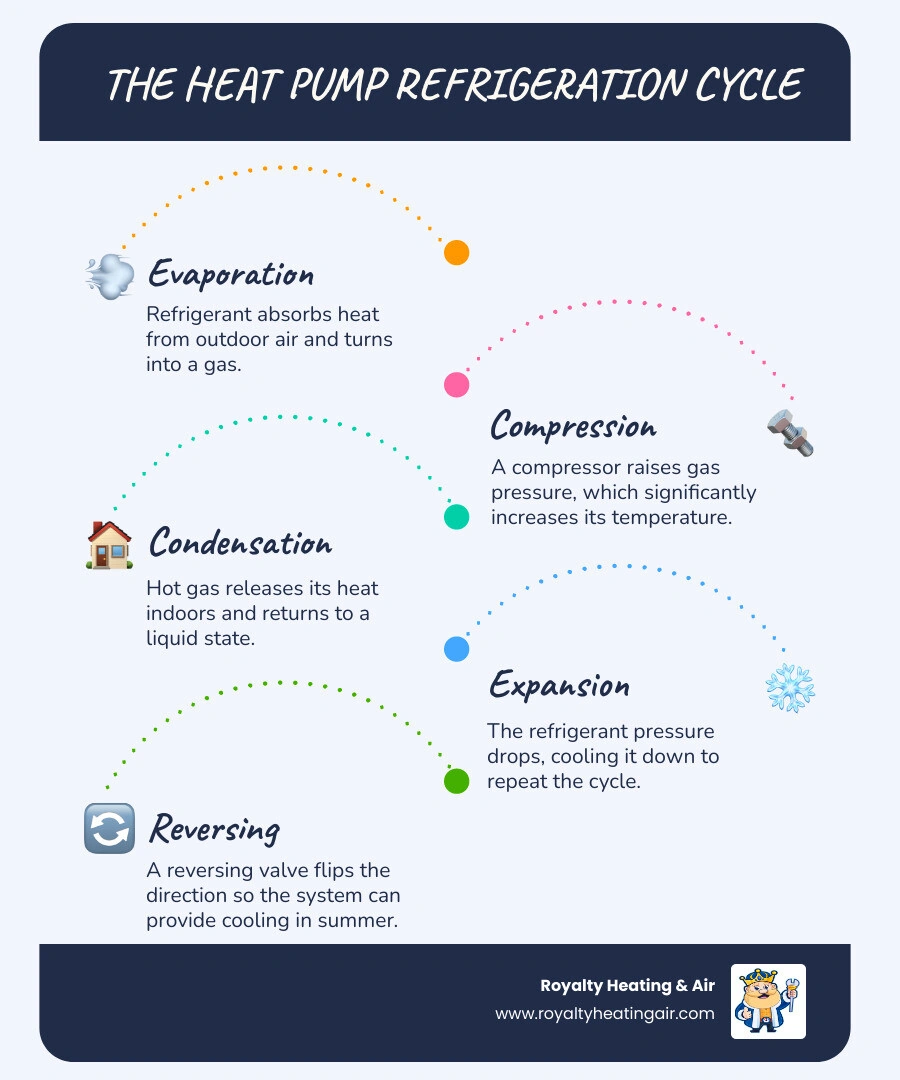
How does a heat pump work? A heat pump moves existing heat from one place to another instead of generating heat from scratch. In winter, it pulls heat energy from the outdoor air and transfers it inside your home. In summer, it reverses that process, pushing indoor heat outside to cool your space. It does this using a refrigerant that cycles through four stages: evaporation, compression, condensation, and expansion.
Here's a quick summary:
1. Evaporation - Refrigerant absorbs heat from outside air and turns into a gas
2. Compression - A compressor raises the gas pressure, which increases its temperature
3. Condensation - The hot gas releases its heat indoors and returns to a liquid
4. Expansion - The refrigerant pressure drops, cooling it down to repeat the cycle
5. Reversing - A reversing valve flips the direction so the same system can cool your home in summer
Because a heat pump moves heat rather than creating it, it can deliver up to 4 units of heating energy for every 1 unit of electricity it consumes. That makes it 3 to 5 times more efficient than a gas boiler and far more efficient than standard electric resistance heating.
For homeowners in Roseville dealing with hot summers and chilly winters, that kind of year-round versatility matters. A single system handles both seasons, and with today's cold-climate models capable of operating in temperatures as low as -22°F, the old concern about heat pumps struggling in the cold is largely a thing of the past.
If you've been relying on a gas furnace or a traditional central air system, understanding how heat pump technology actually works is the first step toward making a smarter, more energy-efficient choice for your home.
If you are a homeowner in Roseville, Rocklin, or Loomis, you likely know that our climate demands a lot from an HVAC system. We see triple-digit summer afternoons and winter nights that occasionally dip toward the freezing mark. Traditional systems often tackle these extremes using two separate machines: an air conditioner for the heat and a gas furnace for the cold.
However, a Heat Pump changes that dynamic entirely. Instead of burning natural gas to create fire and heat, a heat pump uses all-electric operation to move thermal energy. This "heat movement" is the secret to its massive efficiency. In the HVAC world, we often say it is much easier to move something that already exists than to build it from scratch.
When you look at a Heat Pump Installation Roseville CA Guide, you'll see that these systems offer year-round versatility. In May 2026, we are seeing more families than ever switch to this technology because it simplifies their home maintenance while providing a more consistent, "even" heat compared to the intense, drying blasts of a gas furnace.
• Energy Source — Heat Pump: Electricity — Traditional Gas Furnace: Natural Gas / Propane
• Operation — Heat Pump: Moves Heat — Traditional Gas Furnace: Generates Heat (Combustion)
• Versatility — Heat Pump: Heating & Cooling in one — Traditional Gas Furnace: Heating only (requires separate AC)
• Efficiency — Heat Pump: 300% - 400% — Traditional Gas Furnace: 80% - 98%
• Carbon Footprint — Heat Pump: Low (Zero on-site emissions) — Traditional Gas Furnace: Moderate to High
To understand how does a heat pump work, we have to look at the refrigeration cycle. This is the same science that keeps your milk cold in the refrigerator, just scaled up to keep your entire house comfortable. The process relies on "phase changes"—the moment a substance turns from a liquid to a gas and back again.
When a liquid evaporates into a gas, it absorbs a massive amount of "latent heat" from its surroundings. When that gas condenses back into a liquid, it releases that heat. By controlling where these phase changes happen using a series of coils and a compressor, we can "pump" heat against its natural inclination (which is to move from hot to cold).
If your system isn't performing these transitions correctly, you might notice a spike in your utility bills or a lack of comfort, which is when you should look into Heat Pump Repair Sacramento to ensure the refrigeration cycle is perfectly balanced.
It sounds like a magic trick: how can a machine find heat in 35°F air to warm a 70°F house? The answer lies in the boiling point of the refrigerant. The fluids used in these systems have incredibly low boiling points—often well below -40°F.
Even on a "freezing" day in Lincoln or Auburn, the outdoor air is still significantly warmer than the super-chilled liquid refrigerant inside the outdoor coils. Because heat naturally flows toward colder areas, the refrigerant "soaks up" the ambient heat from the air, causing it to evaporate into a gas.
Modern cold-climate technology has advanced so far that these systems can extract usable energy even in sub-zero performance scenarios. If you are noticing your system struggling during a cold snap, a professional Heat Pump Service Lincoln CA can verify that your refrigerant levels are optimal for these low-temperature extractions.
The "magic" component that separates a heat pump from a standard air conditioner is the reversing valve. This four-way valve acts like a traffic controller for the refrigerant. When you switch your thermostat from "Heat" to "Cool," the reversing valve flips the flow of the gas.
In cooling mode, the indoor coil becomes the evaporator (absorbing heat from your living room) and the outdoor coil becomes the condenser (rejecting that heat into the backyard). This dual-functionality means you don't need a separate AC unit. As a bonus, the process naturally provides dehumidification, making those muggy May afternoons in Newcastle feel much crisper. If your unit is stuck in one mode, it’s often a sign that the reversing valve needs attention, requiring expert Heat Pump Repair Newcastle CA.
A heat pump is a finely tuned machine with several critical parts working in harmony:
• The Compressor: Often called the "heart" of the system, it squeezes the refrigerant gas, raising its pressure and temperature.
• Heat Exchangers (Coils): These are the copper or aluminum fins where the actual heat transfer happens. The indoor coil is in your air handler, and the outdoor coil is in the cabinet outside.
• The Expansion Valve: This acts like a nozzle, suddenly dropping the pressure of the liquid refrigerant so it can flash-cool and begin the cycle again.
• The Reversing Valve: As mentioned, this allows the system to change directions.
Maintaining these components is vital for longevity. Regular Heat Pump Maintenance Rocklin CA ensures that coils stay clean and the compressor doesn't overwork itself, which can extend the life of your system by years.
Refrigerant is the "hero" of the story. It is the messenger that carries heat back and forth. In the past, the industry used R-22 (Freon), which was hard on the environment. Today, we use more efficient and eco-friendly options.
Systems using R-410A have been the standard for years, but as of 2026, we are seeing a shift toward R-32 and other next-generation refrigerants. These fluids have superior heat absorption properties and a lower Global Warming Potential (GWP). Choosing a system with modern refrigerant not only helps the planet but often results in better heating performance in colder weather. For more details on how these fluids impact your specific system, check out our Heat Pump Service Granite Bay CA Guide.
Not every home in the Sacramento Valley uses the same type of heat pump. Depending on your lot size and energy goals, one of these three might be the right fit:
1. Air-Source Heat Pumps (ASHP): The most common type. They look like a standard AC unit and extract heat from the outside air. They are affordable and perfect for the moderate climates of Roseville and Rocklin.
2. Geothermal (Ground-Source): These systems use a "ground loop" of pipes buried in your yard. Since the earth stays a constant 50-60°F below the frost line, these are incredibly efficient but require a larger upfront investment and space for Heat Pump Installation Loomis.
3. Hybrid (Dual-Fuel) Systems: These pair an electric heat pump with a gas furnace. The system automatically chooses the most efficient fuel source based on the outdoor temperature. They are an excellent "safety net" for homeowners who want the benefits of a heat pump but worry about extreme cold snaps.
When shopping for a new system, you'll encounter a lot of acronyms. Here is what they actually mean for your wallet:
• COP (Coefficient of Performance): This measures real-time efficiency. A COP of 4.0 means for every 1 kW of electricity you pay for, you get 4 kW of heat.
• HSPF2 (Heating Seasonal Performance Factor): This measures how efficiently the unit heats over an entire season. Higher is better!
• SEER2 (Seasonal Energy Efficiency Ratio): This measures cooling efficiency.
Modern units are so efficient that they easily achieve "300% efficiency" ratings. Furthermore, under the Inflation Reduction Act (IRA), many homeowners in our area qualify for significant tax credits—sometimes up to $2,000 or more—for choosing Energy Star certified models. If your old unit is failing, a Heat Pump Replacement Newcastle CA could pay for itself much faster than you think through these incentives and monthly energy savings.
Absolutely. While older models from the 1980s struggled when it got frosty, modern "cold climate" heat pumps are designed with variable-speed inverters that allow them to maintain 100% capacity down to 5°F and continue working down to -22°F. Since it rarely drops below 25°F in the Auburn area, a properly sized heat pump is more than capable of keeping you toasty. A regular Heat Pump Tune Up Auburn CA will ensure the defrost cycle is working correctly so ice doesn't build up on the outdoor coils.
Think of a toaster or a space heater. Those use "resistive heating," which has a 1:1 ratio. You use one watt of power to get one watt of heat. Because a heat pump is just moving heat that the sun already put in the air, it can achieve a 4:1 output ratio. This is why a Heat Pump Replacement Loomis CA often results in a dramatic drop in winter electricity usage compared to old electric baseboard heaters or furnaces.
A well-maintained air-source heat pump typically lasts 15 to 20 years. Geothermal systems can last even longer, with the indoor components lasting 20+ years and the underground loops lasting up to 50 years. The key to hitting that 20-year mark is consistent professional care. We recommend a Heat Pump Service Granite Bay CA visit twice a year—once in the spring and once in the fall—to keep the system running at peak performance.
Understanding how does a heat pump work reveals why this technology is the future of home comfort. By moving heat instead of burning fuel, these systems offer a cleaner, safer, and more efficient way to stay comfortable in the Roseville area.
At Royalty Heating & Air, we take pride in being more than just your local HVAC experts. We believe in building a stronger community, which is why we are proud partners with the MackAttack Foundation. Every time we provide a Heat Pump Maintenance Sacramento service or install a new system, we are supporting foster babies and sponsoring family adoptions.
We serve our neighbors in Loomis, Rocklin, Roseville, Lincoln, and Granite Bay with the highest level of professional care. Whether you need a quick repair or are ready to upgrade to a high-efficiency heat pump, our team is here to ensure your home remains a sanctuary of comfort all year long.

