
Services
About
Service Areas


How dryer vent cleaning improves efficiency comes down to one simple principle: when hot, moist air can flow freely out of your dryer, the machine does its job faster and with less energy. When lint and debris clog that path, your dryer fights against itself — running longer, working harder, and wearing out sooner.
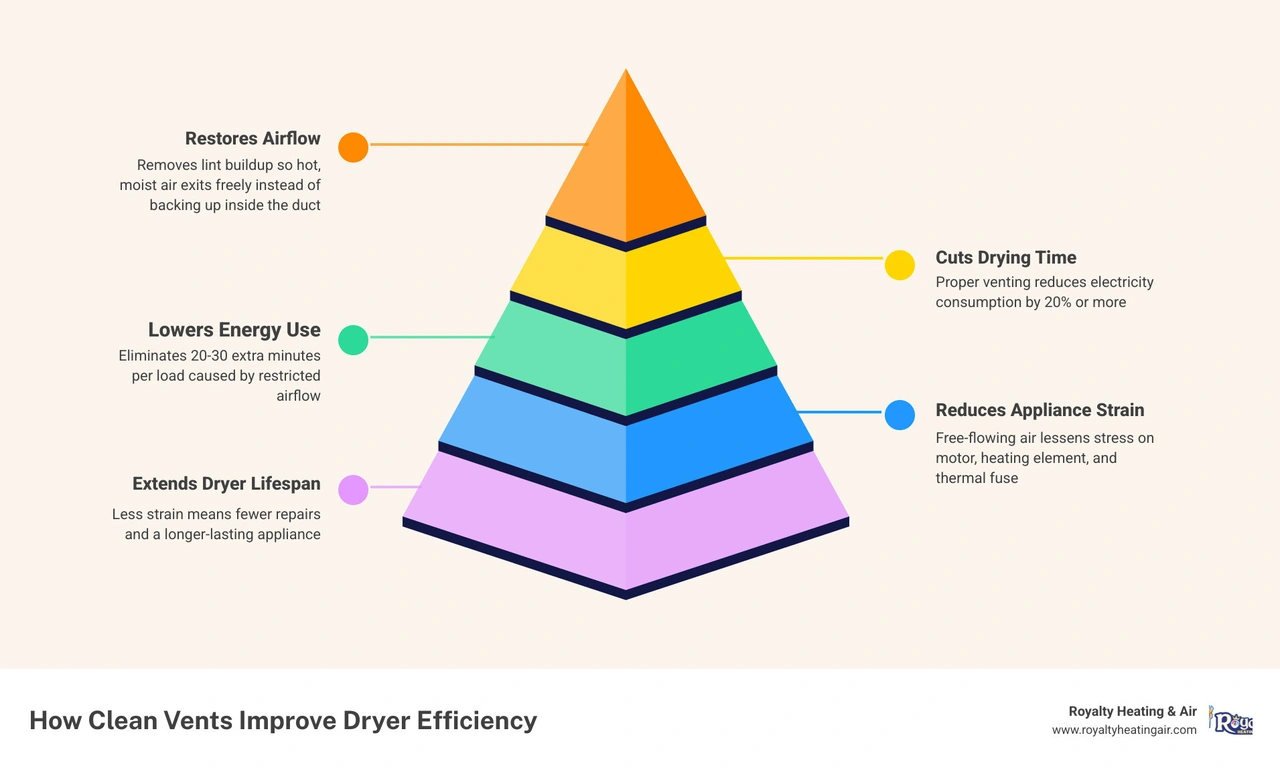
Here is a quick breakdown of how a clean dryer vent improves efficiency:
1. Restores airflow — Removes lint buildup so hot, moist air exits freely instead of backing up inside the duct
2. Cuts drying time — Restricted ducts can add 20 to 30 minutes per load; clearing the vent brings cycle times back to normal
3. Lowers energy use — Properly vented dryers can use 20% or more less electricity than those fighting restricted ductwork
4. Reduces appliance strain — Free-flowing air means less stress on the motor, heating element, and thermal fuse
5. Extends dryer lifespan — Less strain translates directly into fewer repairs and a longer-lasting appliance
Most homeowners clean the lint trap after every load and assume that is enough. It is not. Research shows that 60 to 75% of lint bypasses the trap entirely and accumulates inside the duct line. Over time, that hidden buildup quietly turns every laundry cycle into a longer, costlier, and more dangerous task.
A dryer duct that has not been cleaned in a year or more can force your appliance to log an estimated 150 extra run hours annually — all while raising your utility bill and shortening the life of a machine you depend on every week.
To understand why a clean exhaust line is so crucial, we have to look at the physics of how a modern dryer operates. A clothes dryer is essentially a heat-and-moisture extraction engine. It relies on a delicate balance of heat, mechanical tumbling, and high-volume airflow to carry evaporated water away from your fabrics and out of your home.
When you start a cycle, the blower wheel draws air in, passes it across a heating element (or burner), pushes it through the tumbling drum to absorb moisture, and then expels that damp, hot air through the exhaust duct. If that exhaust path is restricted by lint, the entire system suffers from high static pressure — the scientific term for resistance to airflow within a duct. High static pressure acts like a physical chokehold on your appliance. It forces the blower motor to work harder while simultaneously preventing the wet, humid air from leaving the drum.
Instead of evaporating and escaping, moisture remains trapped in the drum, condensing back onto your clothes. The heating elements continue to draw maximum power, but because the heat cannot transfer correctly out of the system, the appliance runs longer and hotter.
• Airflow Velocity — Clean Dryer Vent System: High (Optimal CFM output) — Clogged Dryer Vent System: Restricted (Low flow, high static pressure)
• Average Drying Time — Clean Dryer Vent System: 35 to 45 minutes per load — Clogged Dryer Vent System: 60 to 90+ minutes per load
• Energy Consumption — Clean Dryer Vent System: Low (Meets or beats baseline specs) — Clogged Dryer Vent System: High (Up to 20% or more extra energy used)
• Internal Operating Temp — Clean Dryer Vent System: Balanced & regulated — Clogged Dryer Vent System: Dangerously high (Triggers thermal limits)
• Component Wear & Tear — Clean Dryer Vent System: Minimal (Standard operational wear) — Clogged Dryer Vent System: Accelerated (High strain on motor & elements)
• Moisture Management — Clean Dryer Vent System: Venting fully to the exterior — Clogged Dryer Vent System: Condensation backing up into drum/walls
It is a common misconception that keeping the mesh lint screen clean is all the maintenance a dryer needs. While executing a Clean Dryer Lint Trap routine after every single load is vital, it only catches a portion of the airborne fibers shed by your clothes.
Because lint is incredibly fine and light, a significant percentage of it slips past the physical barrier of the screen or escapes through the edges of the lint trap housing during operation. This escaped lint enters the internal exhaust fan and is blown directly into the transition hose and the rigid duct line running through your walls or attic.
As damp air travels along the exhaust path, it cools, causing the airborne lint to stick to the moist walls of the duct. Over months of regular use, these microscopic fibers layer on top of one another, forming a thick, felt-like barrier. While the lint trap protects the immediate interior components of your machine, the duct line represents the actual highway to the outside world. If the highway is blocked, the starting line cannot function.
When lint narrows the diameter of your dryer duct, the mechanical consequences are immediate. In testing, dryers with restricted ducts ran 20 to 30 minutes longer per load, directly compounding against the Department of Energy's baseline of 782 kWh per year for a standard electric dryer.
For an average household running five loads of laundry per week, those extra minutes stack up to 150 extra run hours annually. This is not just a minor waste of time; it represents a massive spike in energy consumption.
According to ENERGY STAR guidance, properly vented dryers can use 20% or more less energy than machines fighting restricted, dirty, or noncompliant ductwork. When you clear that restriction, you instantly reduce the running time of the heating elements — which are among the most energy-hungry components in your entire home.
Optimizing your laundry system does not have to be an overwhelming mystery. By following a structured restoration process, you can systematically eliminate airflow blockages, protect your appliance, and ensure your home remains safe.
The first step in restoring efficiency is knowing when your system is crying out for help. Your dryer will tell you when its exhaust path is restricted; you just have to recognize the indicators:
• Extended Drying Cycles: If a single load of standard towels or jeans takes two or three cycles to dry completely, your vent is likely choked with lint.
• Excessively Hot Exterior: While a dryer gets warm, the top and sides of the machine should never feel burning hot to the touch. This indicates heat is trapped inside the cabinet instead of exhausting outdoors.
• Musty Odors: When damp air cannot escape, moisture sits in the line and drum, creating a damp, musty smell on your freshly washed clothes.
• Visible Lint Accumulation: If you notice lint collecting on the wall behind the dryer or around the exterior vent hood on the outside of your house, the duct is overflowing.
Recognizing these symptoms early is critical not just for utility savings, but also for fundamental household safety. For more details on maintaining your system safely, review our Prevent Dryer Fires Maintenance Tips. If left unaddressed, these warning signs can escalate from a minor performance issue into a major hazard, as explained in our guide on How Clogged Dryer Vents Cause House Fires.
Even a perfectly clean vent line will underperform if the physical ductwork is poorly designed or improperly installed. When we inspect homes in Roseville, Rocklin, and the surrounding areas, we look closely at several structural variables:
1. Duct Material: Rigid aluminum or galvanized steel is the gold standard. Flexible plastic or foil transition ducts are highly restrictive, prone to sagging, and represent a major fire hazard because their ridged interiors catch lint easily.
2. Duct Length: Under the International Residential Code, the maximum allowable length for a dryer exhaust duct is 35 feet from the dryer connection to the exterior termination.
3. Bends and Elbows: Every 90-degree bend in your ductwork restricts airflow and reduces your maximum allowed length by 5 feet; a 45-degree bend reduces it by 2.5 feet. If your duct has to make multiple turns to exit your home, lint will naturally settle and compact at those exact turning points.
4. Termination Hoods: The exterior vent cap must have a self-closing backdraft damper to keep pests and cold air out, but it should never feature a fine wire mesh screen, which acts as a magnet for lint clogs.
Once you have identified a clog or want to perform routine maintenance, you must decide how to tackle the cleaning.
While basic DIY kits with flexible nylon rods and drill attachments are widely available, they have distinct limitations. Standard household vacuums do not have the suction power to pull heavy, compacted lint out of long, winding duct runs. Furthermore, if a DIY brush is forced too aggressively around a tight 90-degree bend, the rod can snap, leaving the brush head permanently wedged deep inside your wall cavity.
Professional cleaning, on the other hand, utilizes specialized commercial equipment. Technicians use high-torque rotary brushes combined with negative air pressure machines or industrial-grade HEPA-filtered vacuums. This dual-action process brushes the lint off the duct walls while simultaneously vacuuming it out of your home, ensuring no debris escapes into your indoor living spaces.
For a complete breakdown of the cleaning process, you can read our resources on how to Clean Dryer Vents or explore our Local Dryer Vent Cleaning options. For a deep dive into the technical details, refer to our Ultimate Dryer Vent Cleaning Guide.
When we clear a clogged vent, the benefits extend deep into the mechanical heart of your dryer.
When airflow is restricted, the heating elements (in electric dryers) or burner assemblies (in gas models) must stay energized for much longer periods. This constant thermal load degrades the metal coils of the element, causing them to brittle and eventually snap.
Similarly, the blower motor must work against high static pressure, which increases its operating temperature and degrades its internal bearings. When the motor overheats, it draws more electrical current and can trigger the thermal overload switch.
By restoring proper ventilation, you reduce the physical load on these critical parts. The motor runs cooler, the heating element cycles on and off as designed, and the sensitive thermal safety fuses remain intact. This directly prevents unexpected breakdowns, avoids costly diagnostic fees, and adds years of reliable service to your appliance.
The cleaning process is not complete until you verify that your system’s performance has actually returned to its baseline.
Professionals verify this by using an anemometer to measure the velocity of the air exiting the exterior vent termination. We measure the airflow in cubic feet per minute (CFM) both before and after the service. A dramatic increase in CFM confirms that the static pressure has dropped and the airflow has been successfully restored.
As a homeowner, you can easily verify this improvement by running a timed test load of standard laundry (like a set of cotton towels) and comparing the cycle time to your previous baseline. If your clothes are dry in a single 40-minute cycle instead of a dragged-out 80-minute struggle, you have successfully restored your system's efficiency.
Investing in the health of your dryer vent system pays consistent dividends that show up directly in your monthly household budget and the longevity of your appliances.
The most immediate change you will notice after a professional cleaning is a drop in your monthly utility costs. Because clothes dry faster, your dryer spends less time drawing power from your electrical panel or burning natural gas.
Furthermore, reducing drying times protects your clothing investments. High, trapped heat degrades fabric fibers, causing premature fraying, fading, and loss of elasticity. By allowing your dryer to operate at its designed temperature and cycle length, you preserve the quality of your wardrobe while lowering your electricity bills.
When a dryer vent is neglected, the cost of the resulting damage can quickly escalate. A single service call for a blown thermal fuse or a burned-out heating element can be a frustrating and costly experience. If the blower motor fails due to constant overheating, the repair bill can closely approach the cost of purchasing a brand-new machine.
Regular professional maintenance acts as a proactive shield against these unnecessary expenses. By keeping the exhaust line clear, you eliminate the root cause of component failure, ensuring you get the absolute maximum value out of your appliance before it ever needs to be replaced.
While an annual cleaning is the standard industry recommendation, a calendar-based approach does not fit every household’s unique habits.
Several variables can accelerate lint accumulation in your exhaust system, making more frequent cleanings necessary:
• Household Size and Laundry Volume: A large family running multiple loads of laundry every day will naturally produce far more lint than a single occupant doing one load a week.
• Pet Ownership: Dogs and cats shed fur and dander that cling to clothing. During the drying cycle, this pet hair bypasses the lint screen and binds with the lint inside the duct, forming dense, stubborn blockages.
• Duct Length and Layout: Long vertical runs or ducts with multiple 90-degree bends catch and hold debris much faster than a short, straight, horizontal run exiting an exterior laundry room wall.
• Fabric Types: Heavy cottons, fleece blankets, and down comforters shed substantially more fibers than synthetic materials.
By establishing a regular maintenance baseline, you prevent the gradual decay in performance that often goes unnoticed.
Because lint accumulates slowly over months, many homeowners do not realize their drying cycles have stretched from 45 minutes to over an hour until the system is completely blocked. Proactive, annual cleanings keep your system running at peak performance year-round, ensuring you never pay for wasted energy.
We hear many of the same questions from homeowners across the Placer County and Sacramento regions. Here are direct answers to help you maintain a safe and efficient laundry room.
Yes. When hot, damp exhaust air cannot escape through the vent, the moisture has nowhere to go. It can condense inside the metal ductwork and leak through joints into your walls, ceiling, or floorboards. This trapped humidity creates an ideal breeding ground for mold and mildew, which can damage your home's structural framing and compromise your indoor air quality.
If the cabinet of your dryer is hot to the touch, it means the hot air produced by the heating element is trapped inside the appliance rather than exhausting outside. This is a clear sign of a severe airflow restriction. When this occurs, the dryer’s internal safety switches are forced to cycle repeatedly to prevent complete overheating, which is a major fire hazard. You should stop using the appliance immediately until the vent is inspected and cleaned.
Yes, but specifically for gas-powered dryers. Gas dryers burn natural gas or propane to produce heat, which generates carbon monoxide (CO) as a combustion byproduct. In a properly functioning system, this odorless, colorless, and highly toxic gas is safely vented outside. If the exhaust duct is blocked, these dangerous combustion fumes can back up directly into your laundry room and living spaces, presenting a severe health risk to your family.
At Royalty Heating & Air, we understand that home comfort, safety, and energy efficiency are intimately connected. Whether you are managing a busy household in Roseville, CA, or keeping an eye on your utility bills in Granite Bay, a clean dryer vent is one of the simplest, most effective ways to protect your home.
As a proud local business serving Roseville, Rocklin, Lincoln, Loomis, and Granite Bay, we do more than just service your HVAC and duct systems. Through our unique partnership with the MackAttack Foundation, we dedicate a portion of our work to supporting foster babies and sponsoring family adoptions. When you choose us to care for your home, you are also helping us bring comfort and support to children and families in our local community.
If you are ready to restore your dryer's performance, save on energy bills, and gain peace of mind, we are here to help. Explore our specialized services across Placer and Sacramento counties:
• Schedule expert care with Dryer Vent Cleaning Roseville CA
• Restore your system’s airflow with Dryer Vent Cleaning Rocklin
• Protect your home with Dryer Vent Cleaning Sacramento
• Optimize your appliance with Dryer Vent Cleaning Lincoln
• Keep your home running efficiently with Dryer Vent Cleaning Granite Bay
For comprehensive solutions to improve your home’s indoor air quality and ventilation systems, read More info about duct services and let our dedicated team bring comfort and efficiency back to your home today.

