
Services
About
Service Areas


How old is too old for an HVAC system is one of the most common questions Sacramento-area homeowners face — and the answer depends on the type of equipment you have. Here's a quick breakdown:
• Central Air Conditioner — Typical Lifespan: 15-20 years — Consider Replacement At: 10-15 years
• Gas Furnace — Typical Lifespan: 15-30 years — Consider Replacement At: 15-20 years
• Heat Pump — Typical Lifespan: 10-16 years — Consider Replacement At: 10-12 years
• Boiler — Typical Lifespan: 15-25 years — Consider Replacement At: 15-20 years
• Ductless Mini-Split — Typical Lifespan: 15-20 years — Consider Replacement At: 15 years
If your system is approaching or past these thresholds — especially if it's showing signs of trouble — it's time to take a serious look at replacement.
Nearly one in three homeowners deals with a major HVAC breakdown before their system even reaches its expected lifespan. In Sacramento and the surrounding areas, where summers push AC units hard for months at a time, that number can feel even closer to home. An aging system doesn't just mean discomfort. It means rising energy bills, unexpected repair calls, and in some cases, real safety risks.
The good news? Knowing where your system stands puts you in control — before a breakdown forces the decision for you.
When we talk about the lifespan of an HVAC system, we are looking at a "moving target." No two homes in Roseville or Rocklin are exactly alike, and the way you use your system dictates how long it will last. However, industry data from the Department of Energy and ASHRAE provides us with reliable averages.
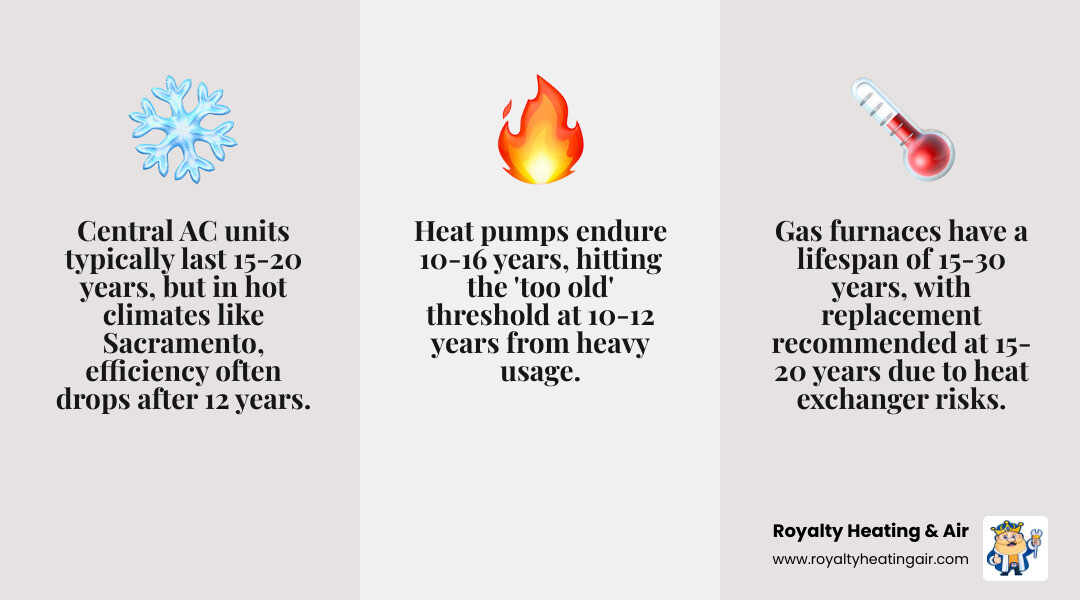
• Central Air Conditioners: Under typical residential loads, these systems usually last 15 to 20 years. However, in our hot California climate, many units begin to see significant efficiency drops after the 12-year mark.
• Gas Furnaces: These are the workhorses of the home. Because they are only used for a few months out of the year in our region, they can last anywhere from 15 to 30 years.
• Heat Pumps: Because a heat pump works year-round to both heat and cool your home, it has a higher "duty cycle" than a standalone AC. This means the compressor runs roughly double the hours of a standard air conditioner, leading to a shorter lifespan of 10 to 16 years.
• Boilers: While less common in newer Sacramento developments, boilers are incredibly durable, often lasting 15 to 25 years, with some cast-iron models pushing even longer.
• Ductless Mini-Splits: These modern systems are remarkably efficient and typically provide reliable comfort for 15 to 20 years.
To understand where your specific unit falls on this timeline, a professional HVAC System Evaluation is the best first step. It allows us to look past the manufacture date and assess the actual mechanical health of your equipment.
Age is more than just a number; it’s a predictor of risk. In the HVAC world, we often refer to the "bathtub curve" of reliability. This engineering concept shows that failure rates are high during the first year (infant mortality), stay low for many years, and then skyrocket as the system enters its final phase.
At 10 years, most manufacturer warranties expire. This is the point where you should start being proactive. Even if the system "still runs," it has likely lost 20% to 30% of its original efficiency. If your 10-year-old unit breaks down during a July heatwave in Lincoln, CA, you have to decide: do you fix a system that is now "out of pocket," or do you invest in the future?
By year 15, most central ACs and heat pumps are on borrowed time. Technology has likely moved two or three generations ahead of your current unit. At this age, parts become harder to find, and the risk of a "cascading failure"—where one old part failing causes others to break—increases significantly.
Very few residential cooling systems effectively climb over the 20-year wall. While a furnace might make it to 25, a 20-year-old AC is almost certainly a liability. It is likely using obsolete refrigerants and costing you hundreds of dollars more in utility bills every year compared to a modern unit. For a deep dive into what to expect during this transition, check out our AC Unit Replacement Complete Guide.
If your air conditioner was installed during the Obama administration, it’s time for a serious conversation. One of the biggest red flags for an AC being "too old" is the use of R-22 refrigerant (often called Freon). Production of R-22 was banned in 2020. If an older unit develops a leak, the cost to recharge it can be astronomical because we are forced to use expensive, recycled supplies.
Furthermore, older units often have SEER (Seasonal Energy Efficiency Ratio) ratings as low as 8 or 10. Modern standards in California now require much higher efficiency, meaning an AC Replacement Lincoln could pay for itself in energy savings over just a few years.
For heating systems, the "too old" threshold is often dictated by safety. The most critical component in a gas furnace is the heat exchanger. Over 15 to 20 years, the metal expands and contracts thousands of times. Eventually, it can develop microscopic cracks.
A cracked heat exchanger is an immediate safety hazard because it can allow carbon monoxide to leak into your home’s air supply. If your furnace is over 15 years old and requires a major repair, we often recommend a Heat Pump Replacement Roseville to move away from gas altogether and improve safety and efficiency.
How do you decide between a repair bill and a brand-new system? We use two primary "math rules" to help our neighbors in Loomis and Granite Bay make the right choice.
1. The $5,000 Rule:Multiply the age of the system by the cost of the repair. If the total is more than $5,000, you should replace it.
• Example A: A $400 repair on a 15-year-old system (400 x 15 = 6,000). Replace.
• Example B: A $200 repair on a 5-year-old system (200 x 5 = 1,000). Repair.
2. The 50% Rule:If the cost of a single repair is more than 50% of the value of a new system, it is time to upgrade. Why spend half the money on a unit that still has old, worn-out parts elsewhere?
Frequent, small repairs—the "slow bleed"—are another sign. If you find yourself calling for Emergency HVAC Repair Roseville CA Guide services more than once a year, you are likely throwing good money after bad. In these cases, even a Furnace Repair Loomis CA might just be a temporary band-aid on a terminal problem.
Sometimes the calendar isn't the only indicator that your system is over the hill. Your home will often tell you when it's time for a change through these common symptoms:
• Rising Utility Bills: If your Sacramento utility bills are creeping up but your usage hasn't changed, your system is working harder (and longer) to achieve the same temperature.
• Uneven Temperatures: Do you have one bedroom that feels like a sauna while the living room is an icebox? This often signals that your system can no longer move air effectively or that the components are losing their "omph."
• Unusual Noises: Grinding, screeching, or banging sounds are the HVAC equivalent of a "check engine" light. They usually point to failing bearings, a dying blower motor, or a compressor on its last legs.
• Humidity Problems: In the summer, your AC’s job is to remove moisture. If your indoor air feels "clammy" or you see fogging on the windows, the system is failing its dehumidification duties.
• Excessive Dust: Leaky, aging ducts can pull in dust from your attic or crawlspace. If you find yourself dusting every other day, your system's integrity may be compromised.
If you notice your unit acting strangely, such as Why Is AC Unit Freezing Up in the middle of summer or your Furnace Blowing Cold Air when you need heat most, these are clear signs that the end is near.
If you decide that your system is indeed "too old," the silver lining is the incredible technology available today. Upgrading to an ENERGY STAR certified system isn't just about being green; it's about comfort and savings.
Modern systems utilize SEER2 standards, which are more rigorous than the old SEER ratings. By moving from a 12-year-old unit to a new high-efficiency model, you can often see 20% to 40% energy savings. Features like variable-speed compressors allow the unit to run at lower speeds for longer periods, providing much more consistent temperatures and better air filtration.
You can also take advantage of modern HVAC Upgrades Granite Bay Tips like smart thermostats and zoned cooling. Plus, under current federal guidelines like the Inflation Reduction Act, many homeowners qualify for significant tax credits when they choose high-efficiency equipment. For a complete walkthrough of the process, see our Home Furnace Installation Ultimate Guide.
Absolutely. In Sacramento, Roseville, and the surrounding valley, our systems face extreme usage intensity. During a July heatwave, your AC might run for 12 to 18 hours a day. This "hard cycling" wears out compressors and fan motors faster than in milder coastal climates. While a unit in a cooler area might last 20 years, a Sacramento unit often reaches its "economic end of life" around 12 to 15 years. This makes regular AC Maintenance Roseville CA Guide even more critical to protecting your investment.
Yes! Think of it like a car—if you never change the oil, the engine won't make it to 100,000 miles. Simple tasks like regular filter changes prevent the system from "suffocating," which protects the blower motor and compressor. Preventative Heater Maintenance ensures that small issues don't turn into catastrophic failures. We highly recommend our Maintenance Plans to keep your system running efficiently for as long as possible.
R-22 (Freon) was the industry standard for decades, but the EPA phased it out because it depletes the ozone layer. As of 2020, it can no longer be produced or imported. This means if your old system has a leak, the "fix" is often more expensive than the unit is worth. If you have an R-22 unit, even a simple AC Tune Up Rocklin CA might reveal that it's time to plan for a replacement rather than risking an expensive emergency recharge.
At Royalty Heating & Air, we believe in providing honest, expert advice to our neighbors in Roseville, Rocklin, Lincoln, Loomis, and Granite Bay. We know that deciding how old is too old for an HVAC system is a big financial choice, and we’re here to help you navigate it with confidence.
Beyond keeping your home comfortable, we are proud to serve our community through our partnership with the MackAttack Foundation. When you choose us, you are supporting a business that actively helps foster babies and sponsors family adoptions. We believe in building a stronger community, one home at a time.
Whether you need a simple tune-up to squeeze a few more years out of your unit or you're ready to explore modern, high-efficiency Services, our team is ready to help. Don't wait for a breakdown to leave you in the heat—give us a call today for a professional evaluation.

