
Services
About
Service Areas


How proper HVAC maintenance prevents mold growth comes down to one core principle: controlling moisture before mold ever gets a foothold. Mold spores are always present in the air around us — they're invisible, naturally occurring, and virtually impossible to eliminate entirely. They only become a problem when they land on a damp surface and find something to feed on. Inside a neglected HVAC system, those conditions are surprisingly easy to meet.
Here's a quick summary of how proper HVAC maintenance stops mold growth:
• Control humidity — Keep indoor relative humidity between 30% and 50% year-round
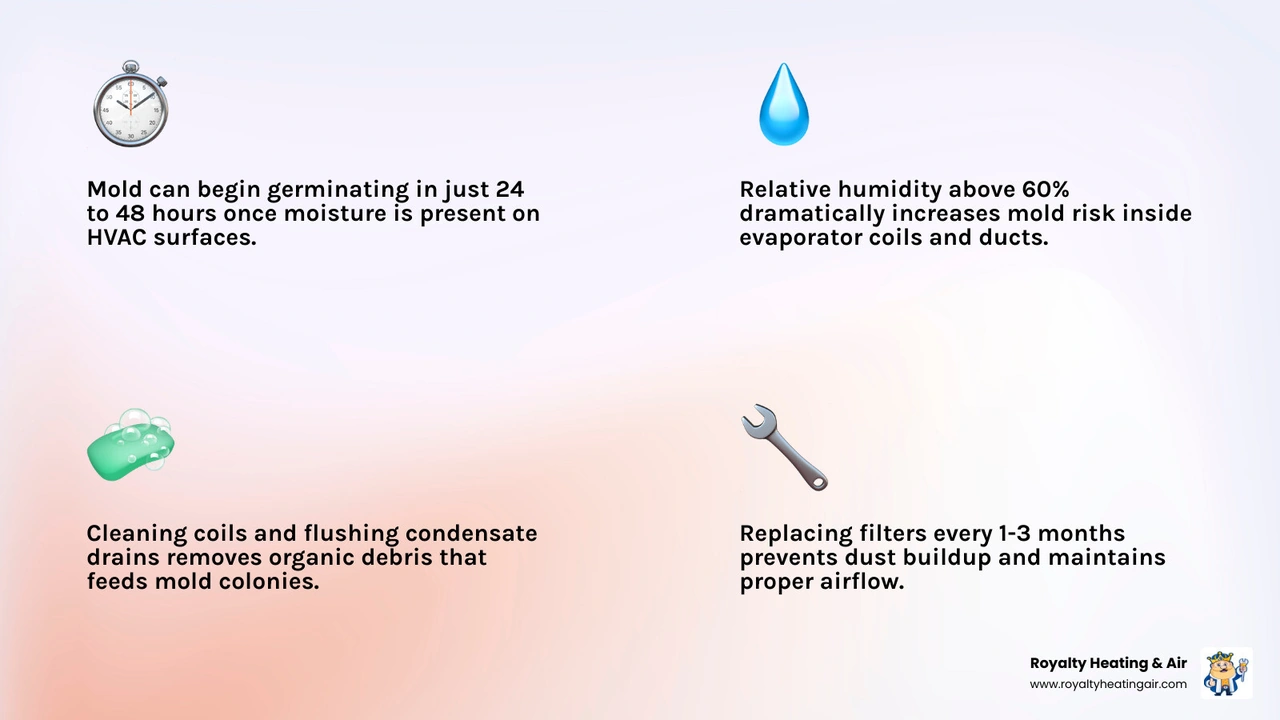
• Change air filters — Replace every 1–3 months to prevent dust buildup that feeds mold spores
• Clean condensate drains — Flush drain lines regularly to prevent standing water in drain pans
• Clean evaporator coils — Remove organic debris that provides a food source for mold
• Seal leaky ductwork — Block humid air from attics and crawlspaces from entering the system
• Schedule professional tune-ups — Twice a year (spring and fall) for thorough inspection and cleaning
• Consider UV germicidal lights — Kill mold spores directly on coils before they can spread
Mold doesn't need much to get started. Research shows it can begin germinating within just 24 to 48 hours of moisture exposure — which means a clogged drain line or a dirty, damp evaporator coil can quietly become a mold problem faster than most homeowners expect. Studies have also found that roughly 20% of buildings across the US, Canada, and Europe show visible signs of dampness, much of it tied to HVAC-related issues that routine maintenance could have prevented.
For homeowners in Roseville, where warm summers push air conditioning systems hard, keeping your HVAC in top shape isn't just about comfort — it's about protecting your family's health and your home's air quality.
To understand how mold takes root, we have to look at the refrigeration cycle. Your air conditioner doesn't just cool the air; it acts as a giant dehumidifier. As warm air from your home passes over the cold evaporator coils, moisture in the air condenses into liquid water—much like the "sweat" on a cold glass of iced tea on a hot July afternoon in Rocklin.
This condensation is normal, but it creates a naturally damp environment. If the system is working correctly, this water drips into a pan and flows out of your home. However, if the airflow is sluggish or the drainage is blocked, that moisture lingers. Combined with the dark interior of your ductwork and a "food source" like household dust, you have a recipe for a mold colony.
The "60% Rule" is a critical benchmark for every homeowner in Granite Bay or Lincoln to remember. Mold typically flourishes in environments where the relative humidity stays above 60%. By keeping your system maintained, you ensure it can effectively pull enough moisture out of the air to keep your home in the safe zone. Taking proactive Steps to Improve IAQ at Home is the best way to keep these levels in check.
• Below 30% — Risk Category: Too Dry — Impact on Mold Growth: Can cause skin irritation and static, but inhibits mold.
• 30% – 50% — Risk Category: Ideal Range — Impact on Mold Growth: Recommended by the EPA for health and mold prevention.
• 50% – 60% — Risk Category: Moderate Risk — Impact on Mold Growth: Mold growth is possible if surfaces remain damp.
• Above 60% — Risk Category: High Risk — Impact on Mold Growth: High probability of rapid mold germination and spread.
You might think of air filters as just a way to keep pet hair out of the machinery, but they are actually your first line of defense against mold. Filters are rated by MERV (Minimum Efficiency Reporting Value). For most residential homes in the Roseville area, we recommend filters with MERV 8–13 ratings. These are dense enough to trap microscopic mold spores without putting too much strain on your blower motor.
When a filter becomes clogged, two things happen that invite mold:
1. Airflow Restriction: The evaporator coil can get too cold because there isn't enough warm air passing over it. This can cause the coil to freeze. When that ice eventually melts, it creates a flood of water that the drain pan might not be able to handle.
2. Nutrient-Rich Dust Mats: A dirty filter becomes a "food mat." Dust is made of organic materials like skin cells, pet dander, and pollen. When a dirty filter gets damp from high humidity, it becomes a literal petri dish where mold can grow and then release spores directly into the air stream.
To keep your air clean, it is essential to Remove Hidden Allergens from Indoor Air by sticking to a strict filter replacement schedule.
The condensate system is the "plumbing" of your HVAC unit. It consists of a drain pan located under the evaporator coils and a PVC line that carries water outside. Because this area is constantly wet, it is the most common place for mold to start.
Over time, algae and mold can form a "slime" inside the drain line, leading to a clog. When the line clogs, water backs up into the drain pan. If the pan isn't sloped correctly or if the water sits for more than 48 hours, mold will begin to grow. A simple DIY tip we often share is to pour a cup of white vinegar down the condensate drain line every few months to kill off early microbial growth. However, for a deep clean, a Duct Sanitization Roseville Guide can provide more thorough professional insights.
Regular maintenance isn't just a "check-up"—it's a deep cleaning process designed to eliminate the variables mold needs to survive. When we perform a seasonal tune-up in Loomis or Lincoln, we aren't just looking for broken parts; we are sanitizing the environment where your air is processed.
The evaporator coil is made of hundreds of tiny aluminum fins. These fins provide a massive amount of surface area for cooling, but they also act as a "dust trap." Even with a good filter, some fine dust will eventually settle on the damp coils.
Professional cleaning involves using specialized, non-corrosive foaming cleansers that penetrate deep between the fins. This removes the organic debris (the "food") and ensures the metal is clean. Clean coils also improve heat transfer efficiency, which means your system doesn't have to run as long to cool your home, reducing the overall time the system stays damp.
In our part of California, the "shoulder seasons"—spring and fall—can be tricky. These are times when the outdoor humidity might be high, but the temperature is mild. Because it isn't "hot" enough for the AC to run a long cycle, the system might "short-cycle" (turn on and off quickly).
Short-cycling is a major mold risk because the system doesn't run long enough to properly dehumidify the air. It might get the house to 72 degrees, but the humidity could still be sitting at 65%. During your spring tune-up, we calibrate your thermostat and check the system's "latent heat" (moisture) removal capacity to ensure you stay dry even when it's not scorching outside. Understanding the Importance of Routine Vent Cleaning during these transitions can also prevent stagnant air pockets from forming.
Sometimes, standard maintenance needs a boost from modern technology, especially in homes that struggle with persistent moisture issues.
One of the most effective tools in our arsenal is the UV-C germicidal light. These lights are installed inside the air handler, positioned to shine directly on the evaporator coil. UV-C light works by disrupting the DNA of microorganisms. When a mold spore or bacterium passes through the light or lands on the illuminated coil, it is rendered unable to reproduce.
This provides 24/7 protection, ensuring that the dampest part of your system remains sterile. It’s an excellent addition to our Indoor Air Quality Services for families with severe allergies or respiratory concerns.
While your AC does dehumidify, it only does so when it is actively cooling. A Whole House Air Purifier and dehumidification system works independently. If the sensors in your home detect that the humidity has risen above 50%—even if the temperature is perfect—the dehumidifier kicks in to pull moisture out of the air. This ensures a consistent, mold-resistant environment regardless of the weather in Granite Bay.
How do you know if mold has already moved in? It’s often a "sneaky bugger," hiding in the dark recesses of your ductwork, but it leaves clues.
The first sign is often felt, not seen. If family members experience sneezing, coughing, watery eyes, or headaches that seem to magically disappear when they leave the house, the HVAC system may be circulating mold spores. For those with asthma, mold in the air can be a significant trigger. You can read more about the Breathing Problems Caused by Dirty Air Ducts to see if your symptoms match common contamination patterns.
If you notice a musty, earthy smell—often called "dirty sock syndrome"—when the air kicks on, that’s a primary indicator of microbial growth on the coils. Visually, keep an eye out for:
• Speckled Patches: Small black, green, or brown spots on the slats of your vent covers.
• Discoloration: Yellowing or damp spots on the drywall immediately surrounding your registers.
• "Furry" Dust: If the dust on your vents looks thick or slightly fuzzy, it may be holding moisture and supporting mold growth.
Your ducts are the "lungs" of your home. If they are leaky, they can actually pull mold into your living space.
In many Roseville and Rocklin homes, ductwork runs through unconditioned attics. In the summer, these attics can reach 130 degrees or more. If there are leaks in your return ducts, they will suck in that hot, humid attic air. When that humid air hits the cool air inside the duct, condensation forms instantly. This "sweating" inside the ducts provides the perfect moisture for mold to grow on the dust settled inside.
By using professional mastic sealants and ensuring the vapor barrier is intact, we prevent this moisture infiltration. Sealed ducts ensure that the only air entering your system is the filtered air from your living room, not the humid, dusty air from your crawlspace. This not only prevents mold but also improves pressure stabilization and energy efficiency. Regular Duct Cleaning Improves Home's Air Quality by removing the "food" source that mold needs to survive.
We recommend checking your filters every month and replacing them at least every 90 days. If you have pets or live in a dusty area like Lincoln, you should change them every 30 to 60 days. A clean filter ensures proper airflow, which prevents the coils from freezing and creating excess moisture.
In many cases, yes. A musty smell usually indicates "dirty sock syndrome," caused by microbial growth on the evaporator coils. A professional tune-up includes a deep cleaning of the coils and the condensate system, which often eliminates the odor at its source. If the smell persists, we may recommend duct sanitization.
The EPA recommends keeping indoor relative humidity between 30% and 50%. In our Northern California climate, staying below 50% is the "gold standard" for preventing mold growth while keeping your home comfortable.
At Royalty Heating & Air, we believe your home should be a sanctuary of clean, healthy air. Understanding how proper HVAC maintenance prevents mold growth is the first step in protecting your property and your family. From Roseville to Granite Bay, our team is dedicated to providing the precision maintenance and advanced air quality solutions you need to breathe easy.
Beyond keeping your home comfortable, we are proud to serve our community through our partnership with the MackAttack Foundation. This allows us to support foster babies and sponsor family adoptions, turning every service call into an opportunity to give back.
If it's been a while since your last inspection, don't wait for a musty smell to tell you there's a problem. Contact us today for expert Indoor Air Quality Services Rocklin and let us help you keep your home mold-free and healthy all year long.
