
Services
About
Service Areas


How to extend the life of your ac in extreme heat is one of the most important things a homeowner can know heading into a brutal summer season. If you live in Roseville, CA, you already know how relentless the heat can get — and your AC feels every degree of it.
Here is a quick summary of the most effective ways to protect your system:
1. Schedule professional maintenance every spring before peak heat arrives
2. Change air filters every 30 days during summer to prevent airflow strain
3. Set your thermostat to 78°F when home and 82°F when away
4. Keep 2 feet of clearance around your outdoor condenser unit
5. Seal duct leaks to stop losing up to 30% of cooled airflow
6. Add or improve attic insulation to cut solar heat absorption by up to 60%
7. Use ceiling fans to allow higher thermostat settings without sacrificing comfort
8. Shade your outdoor unit from direct sunlight to maintain up to 10% more efficiency
9. Watch for warning signs like warm air, ice buildup, or short cycling
10. Consider upgrading if your system is 12–15 years old and struggling
Think of your AC like a car engine. Skip the oil changes and it breaks down early. Push it too hard without upkeep and the damage builds up fast. In extreme heat, an AC unit runs almost constantly — and that nonstop strain takes a serious toll on key components like the compressor. According to industry data, skipping annual maintenance alone can reduce your system's efficiency by up to 15%, and in a hot climate like Roseville's, that gap between a well-maintained unit and a neglected one can mean years of extra life — or an early, expensive replacement.
The good news is that most heat-related AC failures are preventable. Dirt, neglect, and a few bad habits are the real culprits behind the majority of breakdowns — not just age or bad luck.
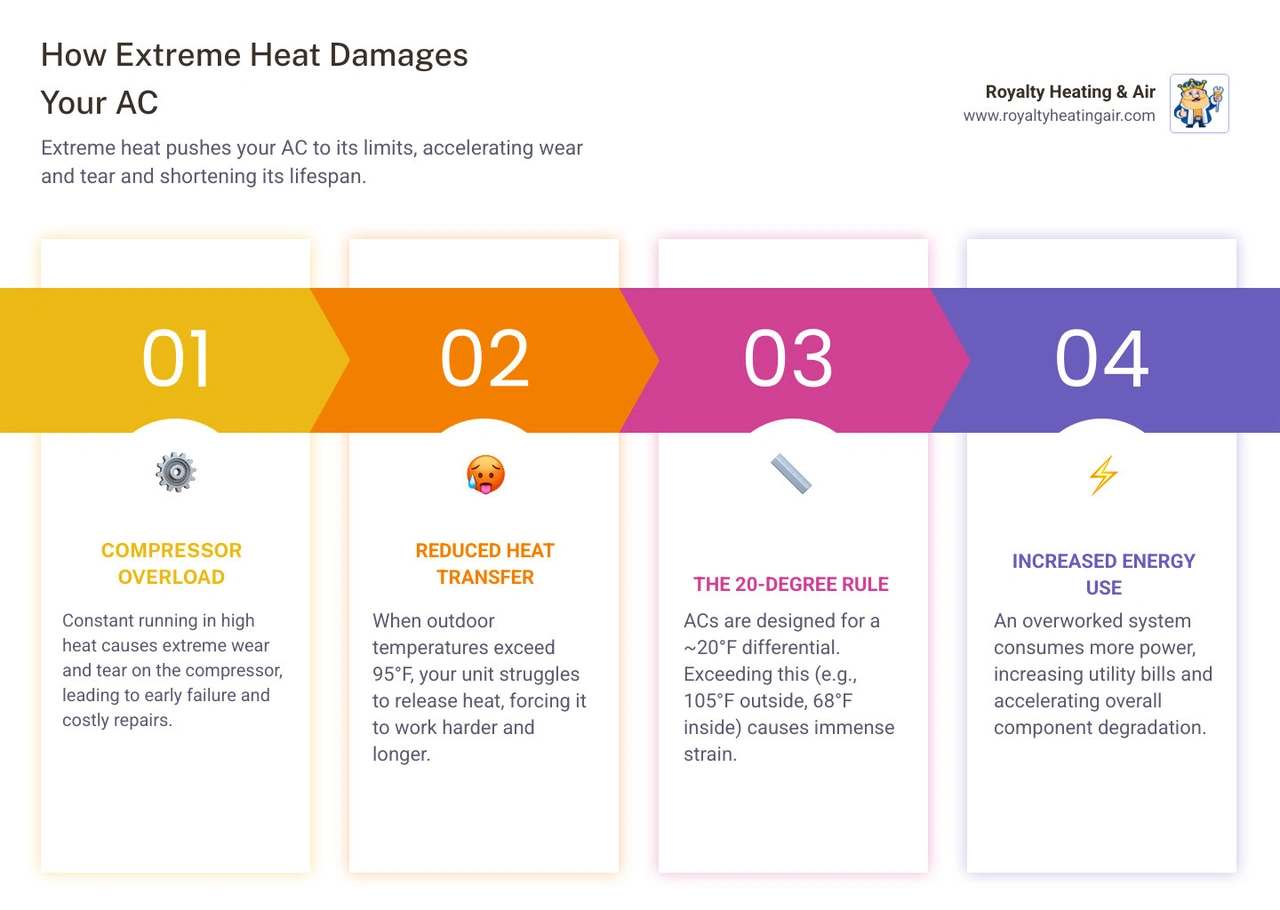
It is currently April 2026, and as we look toward the upcoming summer, understanding the physics of your cooling system is vital. Your air conditioner doesn't actually "create" cold; it moves heat from inside your home to the outside. This process becomes exponentially harder when the outdoor temperature climbs.
When temperatures exceed 95°F, the outdoor unit struggles to release the heat it gathered from your living room. This is due to the "20-degree rule," which suggests that most residential AC systems are designed to maintain a maximum temperature differential of about 20 degrees between the indoors and outdoors. When it’s 105°F in Roseville or Rocklin, asking your AC to keep the house at 68°F is like asking a marathon runner to sprint uphill in a heavy coat.
This constant operation leads to several mechanical stressors:
• Compressor Strain: The compressor is the heart of your system. In extreme heat, it runs longer cycles with less "rest" time, which can lead to overheating.
• Oil Acidity: High heat can cause the lubricating oil in your compressor to burn. When this oil breaks down, it becomes acidic, eating away at the internal components and eventually causing a "burnout" or total compressor failure.
• Heat Transfer Limits: Dirt on the coils acts as an insulator, trapping heat and forcing the system to work overtime. If you've noticed your AC Not Cooling properly, it’s often because the heat exchange process has reached its limit.
Proper system sizing is also a major factor. An undersized unit will run indefinitely without reaching the target temperature, while an oversized unit will "short cycle," turning on and off too quickly, which fails to remove humidity and places immense wear on the starter components. If you're wondering Why AC Unit Is Not Cooling Properly, the extreme outdoor load is likely exposing these underlying sizing or maintenance issues.
To protect your system, we must focus on the most vulnerable parts: the fan motors and the refrigerant lines. Extreme heat can cause fan motors to seize if they aren't properly lubricated, and the increased pressure within the system can turn tiny pinholes into significant refrigerant leaks.
If you find that your Why Is AC Blowing Warm Air, it could be a sign that the refrigerant levels are low or the compressor has tripped its internal overload switch to prevent a fire. Preventing these issues starts with reducing the workload on the machine.
The single most effective strategy for how to extend the life of your ac in extreme heat is professional preventive maintenance. Think of it as a health check-up for your home’s most expensive appliance.
Our team at Royalty Heating & Air recommends a comprehensive tune-up every spring. During these visits, technicians perform a Spring AC Maintenance What Technicians Check routine that includes:
• Coil Cleaning: Removing the "blanket" of dust and pollen from the outdoor condenser coils so heat can escape freely.
• Refrigerant Calibration: Ensuring the levels are exact—not too high and not too low—to prevent compressor damage.
• Electrical Inspection: Tightening connections that can loosen due to the vibration of constant summer running.
For homeowners in Loomis or Granite Bay, following an AC Maintenance Experts Loomis CA Guide and signing up for an AC Maintenance Plan Complete Guide ensures you never miss a service window. Regular maintenance can prevent up to 95% of emergency breakdowns.
Airflow is the lifeblood of your HVAC system. When the air filter is clogged with dust, your blower motor has to work twice as hard to pull air through the house. This leads to overheating and can even cause your evaporator coils to freeze—yes, your AC can actually turn into a block of ice in 100-degree weather if it can't breathe!
• 30-Day Replacement: During the peak of a California heatwave, we suggest checking your filter every 3 weeks and replacing it at least every 30 days.
• MERV Ratings: Be careful with high-MERV filters (11-13). While they clean the air better, they are also harder to push air through. If your system isn't designed for them, you might experience What Causes AC to Blow Weak Air.
• Vents and Registers: Ensure no furniture or drapes are blocking your return or supply vents. You can learn more about Solving Low Airflow Problems from AC Vents and the importance of professional AC Filter Replacement on our blog.
To help your AC survive, you need to turn your home into a fortress against the sun. The less heat that enters your home, the less work your AC has to do.
• Attic Insulation — Potential Energy Savings: Up to 40% — Impact on AC Lifespan: High (Reduces runtime significantly)
• Duct Sealing — Potential Energy Savings: Up to 30% — Impact on AC Lifespan: Medium (Prevents "lost" cooling)
• Smart Thermostat — Potential Energy Savings: Up to 10% — Impact on AC Lifespan: Medium (Optimizes cooling cycles)
• Window Shading — Potential Energy Savings: Up to 15% — Impact on AC Lifespan: Low (Reduces solar gain)
Properly sealed attic insulation is a game-changer. It can prevent up to 40% of heat from escaping through windows and reduce solar heat absorption by as much as 60% during peak cooling periods. If your attic is a furnace, your AC is fighting a losing battle. Checking for and Solving Airflow Issues often reveals that the ductwork in the attic is leaking, losing 30% of your expensive cold air before it ever reaches your bedroom.
For those in our local service areas, our AC Maintenance Loomis CA Complete Guide provides deeper insights into how home sealing impacts your specific climate.
Beyond mechanical fixes, your daily habits play a massive role in how to extend the life of your ac in extreme heat.
1. Thermostat Settings: The U.S. Department of Energy recommends setting your thermostat to 78°F when you are home. For every degree you set it below 78°F, your energy use can increase by about 8%.
2. Smart Thermostats: Upgrading to a smart thermostat allows you to use geofencing and scheduling. This ensures the system isn't "heat-soaking" the house while you're away, but also prevents it from running at full blast all day.
3. The Fan Trick: Use ceiling fans (running counter-clockwise) to create a wind-chill effect. This can make a room feel 4 degrees cooler, allowing you to raise the thermostat without losing comfort.
4. Outdoor Unit Clearance: Your condenser needs to "breathe" to release heat. Keep plants, shrubs, and debris at least 2 feet away from the unit.
5. Shading the Condenser: Putting your AC condenser in direct sunlight reduces its efficiency by as much as 10%. If possible, use a lattice or plant shrubs (at a safe distance) to provide shade during the hottest part of the afternoon.
If you are a resident of Roseville, our AC Maintenance Roseville CA Guide offers localized tips for managing the specific dust and heat challenges of our valley.
When the heat hits triple digits, you need to be an AC detective. Catching a problem early can mean the difference between a simple repair and a total system replacement.
• Short Cycling: If your AC turns on for 5 minutes, shuts off, and then turns back on again 2 minutes later, it is short-cycling. This is incredibly hard on the compressor and is often caused by a frozen coil or a faulty thermostat.
• Unusual Noises: Grinding, squealing, or banging sounds usually indicate a failing motor or a loose belt.
• Ice Buildup: If you see ice on the copper refrigerant lines or the indoor coil, turn the system off immediately! Running it with ice can destroy the compressor.
• Drainage Issues: AC units remove humidity as well as heat. If the condensate line is clogged, you might face water damage or a system shutdown. We have a guide on Troubleshooting AC Drainage Problems to help you clear these common clogs.
If your AC is not cooling, don't just keep lowering the thermostat. That only makes the problem worse. Turn the system off and call for a professional inspection.
In the relatively mild parts of the country, an AC might last 15 to 20 years. However, in the high-heat areas of California like Lincoln and Rocklin, the average lifespan is closer to 10-15 years. The heavy usage cycles and extreme temperature differentials simply wear out the mechanical parts faster. The best way to push toward that 15-year mark is through consistent, annual maintenance.
During extreme heatwaves, the power grid is under immense strain. This can lead to "brownouts" or voltage fluctuations. If your AC doesn't receive the correct voltage, the motors can overheat and burn out. Using a high-quality surge protector designed for HVAC systems can help, as can reducing your usage during peak hours (usually 4 PM to 9 PM) to help stabilize the local grid.
If your system is over 10 years old, uses R-22 refrigerant (which is phased out and very expensive), and requires frequent repairs, it’s time to look at an upgrade. Modern systems have much higher SEER (Seasonal Energy Efficiency Ratio) ratings. Moving from an old SEER 10 unit to a new SEER 18+ unit can cut your cooling costs by nearly 50% and provide much better comfort during extreme heatwaves.
Taking the time to learn how to extend the life of your ac in extreme heat is a smart investment in your home's comfort and your financial peace of mind. By managing airflow, keeping your outdoor unit clear, and scheduling professional tune-ups, you can ensure your system survives the "scorch" of a California summer.
At Royalty Heating & Air, we are proud to serve the communities of Loomis, Rocklin, Roseville, Lincoln, and Granite Bay. We aren't just HVAC experts; we are members of your community. We are especially proud of our partnership with the MackAttack Foundation, which allows us to support foster babies and sponsor family adoptions. When you choose us, you’re supporting a business that gives back to local families.
Don't wait for your AC to fail in the middle of a 110-degree afternoon. Schedule your AC survival tune-up today and let us help you stay cool all summer long!

