
Services
About
Service Areas


Navigating the process of upgrading HVAC systems in Rocklin's historic homes without ruining the aesthetic often feels like an impossible puzzle. You are dealing with an older property that struggles to maintain a comfortable temperature, yet the thought of tearing into original lath-and-plaster walls or cutting through century-old millwork is terrifying. At Royalty Heating & Air, our team sees many homeowners in early Placer County facing this exact stress: balancing the desperate need for modern, reliable climate control against the strict desire to preserve the architectural charm that made them fall in love with the house in the first place.
The critical decision point: The core dilemma comes down to risking your home's historic footprint to accommodate traditional, bulky ductwork, or exploring modern, low-impact alternatives that work around your home's structural limitations. Standard central air systems were simply not designed for houses built before the advent of modern HVAC, forcing a choice between comfort and preservation.
Fortunately, you do not have to sacrifice one for the other. If you are weighing your options, exploring ductless mini split systems or scheduling a professional AC installation in Rocklin with our experienced technicians can provide a clear path forward that respects your property's integrity while delivering the high-efficiency comfort your family needs.
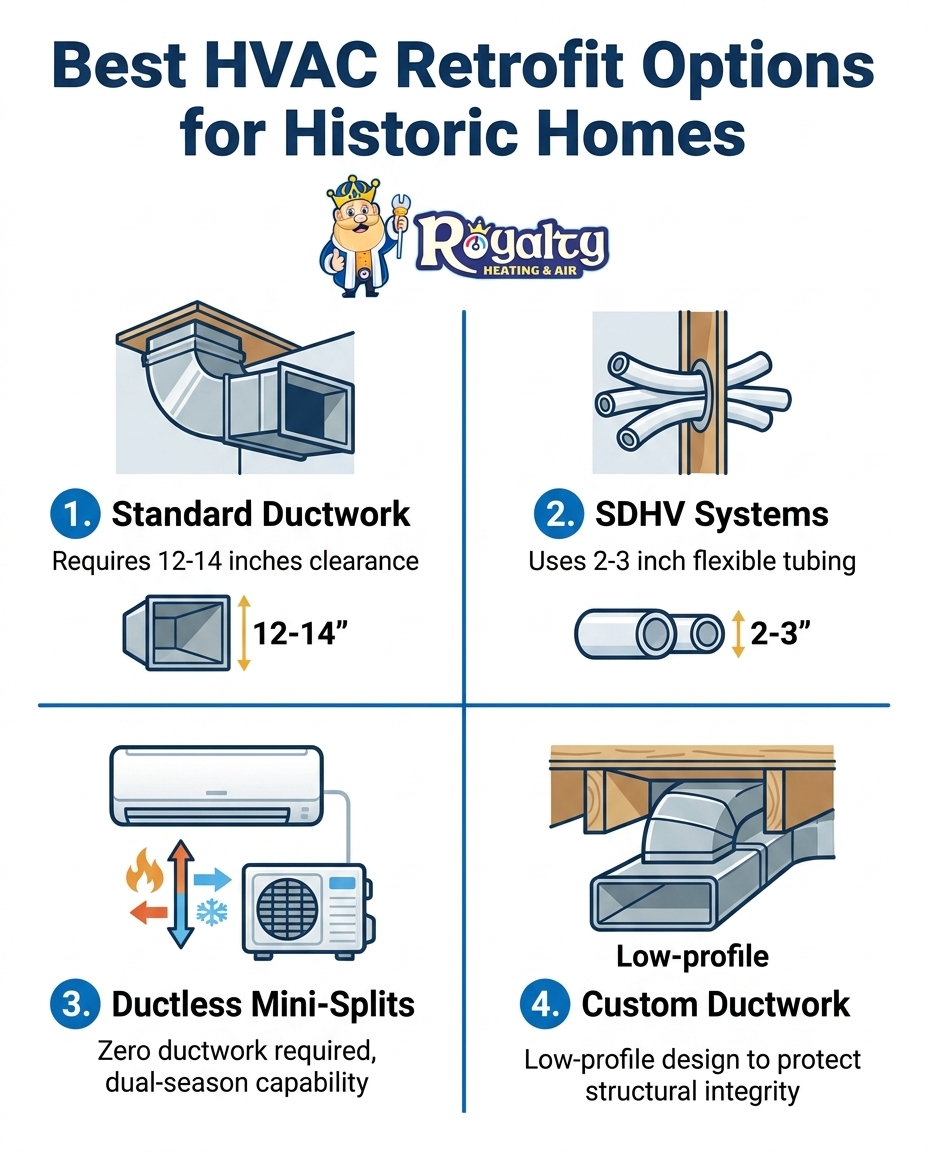
The clearance problem: The primary reason standard HVAC retrofits fail in older regional architecture is a sheer lack of physical space. Traditional forced-air ductwork typically requires 12 to 14 inches of clearance to route the main trunks and branch lines effectively. In modern construction, this space is built into deep attics, wide wall cavities, and expansive crawlspaces. Rocklin historic properties, however, were constructed long before these spatial luxuries became standard.
Foundation and framing limitations: Early Placer County architecture frequently features zero-clearance crawlspaces and solid granite foundations. These structural realities make it physically impossible to run standard ducting beneath the floorboards without extensive, destructive excavation. Similarly, the wall cavities in these older homes are often far too shallow to house standard return and supply drops.
To understand the stark contrast between what modern systems demand and what historic homes provide, consider the following structural differences that our installers navigate daily:
• Main Trunk Clearance — Modern Home Reality: 12–14 inches of open space — Historic Home Reality: Zero-clearance or solid granite foundations
• Wall Cavity Depth — Modern Home Reality: Standard 2x4 or 2x6 framing — Historic Home Reality: Shallow framing, blocked by fire stops
• Wall Materials — Modern Home Reality: Drywall (easily patched) — Historic Home Reality: Fragile lath-and-plaster (prone to cracking)
• Attic Accessibility — Modern Home Reality: High-pitch roofs with deep trusses — Historic Home Reality: Shallow pitches, often converted to living space
Structural vulnerabilities: Attempting to force standard ductwork into an older home often involves cutting into load-bearing walls. In historic properties, the framing techniques used are entirely different from modern platform framing. Altering these load-bearing structures to squeeze in a 10-inch duct can severely compromise the structural integrity of the entire house. The heavy vibrations from power tools and the removal of original studs can cause cascading damage to the surrounding architecture.
Preservation standards: This is exactly why historic preservation standards strongly advise against modifying the original envelope for standard ducts. Cutting into lath-and-plaster walls not only risks structural settling but also destroys the historic fabric of the home. Plaster is notoriously fragile; a single misplaced cut can cause massive sections of the wall to crumble, turning a simple HVAC retrofit into a massive, expensive restoration project.
The timing of your upgrade: The urgency of an HVAC upgrade in an older home is heavily dictated by the shifting seasonal weather. In the Sacramento Valley, the climate creates a very specific window for major home improvements. The intense summer heat demands robust, high-capacity cooling, while the impending winter requires reliable, efficient heating. This makes the transition period critical for homeowners who need to overhaul their climate control systems.
The transition window: Our team highly recommends utilizing the September pre-heating season transition as the ideal time to evaluate and install low-impact heating solutions. During this window, the lingering summer heat is beginning to break, but the freezing overnight temperatures of winter have not yet arrived. This provides a brief, comfortable period where your home can safely undergo an installation process without leaving your family exposed to extreme weather extremes.
The danger of waiting: Waiting too long into the late fall or early winter can lead to rushed decisions. When the first major freeze hits and the old furnace fails, homeowners often panic. Rushed installations in historic properties almost always lead to compromised aesthetics. Contractors working under emergency timelines may take the path of least resistance, running unsightly conduit on the exterior of the house or cutting corners on interior trim work. By planning your upgrade during the early fall window, you ensure our installation team has the time required to meticulously route lines, hide components, and preserve your home's charm before the temperatures drop.
Bypassing traditional constraints: When standard ductwork is out of the question, ductless systems emerge as a primary solution for homes lacking duct space. These low-profile units bypass the need for massive crawlspace or attic clearance entirely. Instead of relying on a centralized network of bulky sheet metal, ductless systems use small refrigerant lines to connect an outdoor compressor directly to individual indoor air handling units.
Strategic placement techniques: The true advantage of a ductless system in a historic home lies in its flexibility. Indoor air handlers do not have to be the traditional high-wall units that clash with vintage wallpaper or crown molding. They can be strategically placed as floor-mounted consoles that blend in with wainscoting, or even recessed ceiling cassettes if the joist space allows. Outdoor compressors can be tucked away behind landscaping or custom fencing, completely hidden from plain sight to preserve the exterior historical facade.
Real-world flexibility: Complex split system installations can provide targeted heating and cooling without compromising the home's historic envelope. For example, during a recent early fall retrofit, our Royalty Heating & Air installation team worked with a local homeowner who required a difficult installation of a 2-ton split system to bypass their older home's structural limitations. The setup required precise heating from a water ceiling-mount unit. Our installers worked late into the evening, carefully collaborating to route the system through the home's unique layout. The whole system was successfully installed and made fully operational without damaging the original architecture.
Long-term reliability: Because these systems operate without ducts, they also eliminate the energy loss associated with leaky ductwork in unconditioned spaces. If you ever run into operational quirks with these advanced systems, knowing the basics of troubleshooting a mini split AC can help you maintain optimal performance year-round.
The centralized alternative: If you want the benefits of centralized air but absolutely refuse to have visible wall units in your historic living spaces, Small-Duct High-Velocity (SDHV) technology is the premier alternative. These systems are specifically engineered for older homes, providing invisible comfort that respects original architectural details.
How SDHV works: Instead of massive rigid metal trunks, SDHV systems utilize flexible tubing that is as small as 2 to 3 inches in diameter. This flexible, insulated tubing can be snaked behind existing walls, threaded through tight ceiling joists, and routed around structural obstacles without destroying original plaster or requiring major demolition. The air is delivered into the room through small, unobtrusive circular outlets that can be painted or finished to match vintage wood grain, making them virtually invisible.
Key benefits of SDHV systems for historic properties:
• Aesthetic preservation: Outlets blend seamlessly into ceilings, floors, or walls without the need for large, unsightly metal grilles.
• Minimal demolition: The 2-inch tubing easily slides down existing stud bays, preserving fragile lath-and-plaster walls.
• Aspiration technology: The high-velocity air creates a gentle mixing effect (aspiration) in the room, eliminating hot and cold spots common in drafty older homes.
• Humidity control: The unique cooling coils in SDHV systems remove up to 30% more moisture from the air than traditional systems, protecting antique wood furniture and original flooring from humidity damage.
Industry alignment: Because of their low-impact nature, these systems closely align with Department of Energy (DOE) guidelines on retrofitting older homes. They offer a way to achieve modern efficiency standards while strictly adhering to historic preservation guidelines, ensuring your home remains authentic while feeling perfectly comfortable.
When out-of-the-box fails: There are times when even flexible tubing or ductless units require a more tailored approach. Generic HVAC approaches often fail in homes with unique millwork, sweeping staircases, and severely limited attic space. When an out-of-the-box solution will not fit the architectural realities of an older home, custom duct design becomes an absolute necessity.
The custom design process: Designing low-profile, custom-fabricated ductwork involves mapping the exact structural voids available in the house. This might mean fabricating flat, rectangular ducts that fit perfectly into a shallow chase, or designing a streamlined plenum that tucks neatly into the corner of a utility closet. The goal is to route the air cleanly through the home without dropping ceilings, building bulky soffits, or causing aesthetic damage to the living areas.
Local architectural expertise: Achieving this level of precision requires a deep understanding of how these homes were originally built. Our team's deep local expertise in Placer County's architectural history allows Royalty Heating & Air to design custom ductwork that respects the home's original aesthetic. Knowing exactly how the floor joists run in a 1920s bungalow or where the solid structural headers are located in a Victorian property ensures that our custom metalwork integrates flawlessly.
The value of precision: Emphasizing the value of professional duct services cannot be overstated. Our expert fabricators can ensure optimal airflow and static pressure, even when the ducts are designed with unusual dimensions to fit a historic footprint. This guarantees that the system operates quietly and efficiently, preserving both the look and the feel of your home.
Consolidating equipment: One of the biggest challenges in historic Rocklin properties is finding the physical space to house the HVAC equipment itself. Older homes rarely have large mechanical rooms. Upgrading to a single modern system that can handle both heating and cooling requirements is a massive advantage for historic properties with limited utility space.
How modern heat pumps excel: Modern heat pumps provide high-efficiency cooling and heating from a single, compact footprint. During the intense Sacramento Valley summer, the heat pump acts exactly like a high-performance air conditioner, pulling heat out of your home. When the extreme temperature swings bring freezing winter nights, the system reverses the process, extracting ambient heat from the outside air and bringing it indoors. This eliminates the need for a separate, bulky gas furnace and a standalone AC unit, freeing up valuable space in tight basements or small utility closets.
Handling the regional climate: Today's cold-climate heat pumps are incredibly robust. They easily handle the extreme temperature swings of the Sacramento Valley, providing consistent, reliable comfort even when the mercury drops near freezing. Because they operate continuously at variable speeds, they also provide superior dehumidification and air filtration compared to older, single-stage furnaces.
Financial incentives: Beyond the space-saving and comfort benefits, upgrading to this high-efficiency technology often comes with financial perks. Federal tax credits may apply to qualifying heat pump installations, and general energy rebates may also be available. Because heat pumps drastically reduce reliance on fossil fuels, many utility companies encourage their installation. We always advise our customers to verify current programs with their local utility provider or a tax professional to take full advantage of available incentives.
Synthesizing the solution: Preserving a home's historic charm does not mean you have to sacrifice modern comfort and efficiency. While the architectural constraints of early Placer County homes present unique challenges, forcing standard, bulky ductwork into fragile spaces is no longer your only option. The technology exists to perfectly balance preservation with performance.
Moving forward with confidence: Clear, low-impact alternative HVAC retrofit options are readily available. Whether you choose the zero-duct flexibility of a mini-split system, the invisible comfort of small-duct high-velocity tubing, or a custom-fabricated duct design tailored to your exact floor plan, your property is in good hands. At Royalty Heating & Air, we encourage homeowners to consult with our local experts who truly understand the delicate balance of architectural preservation and advanced climate control. By planning your upgrade thoughtfully, you can enjoy a perfectly comfortable home while protecting the historic aesthetic you cherish.
What is the best HVAC system for a historic home?
The best system depends heavily on the home's specific structural constraints, but ductless mini-splits and small-duct high-velocity (SDHV) systems are generally the top choices. These systems require little to no ductwork, preserving original walls and ceilings. They provide high-efficiency climate control without the need for destructive renovations.
Can you install central air in a house with no ductwork?
Yes, you can absolutely achieve central cooling in a house without existing ductwork. Small-duct high-velocity systems use flexible 2-inch tubing that can be routed through existing wall cavities to provide centralized air. Alternatively, multi-zone ductless systems can cool the entire home efficiently without using any ducts at all.
How do you hide mini splits in an old house?
Mini-splits can be hidden using strategic placement and alternative unit styles. Instead of the standard high-wall units, you can opt for floor-mounted consoles that blend with wainscoting or recessed ceiling cassettes that sit flush with the ceiling. Outdoor compressors can be concealed behind custom fencing or strategic landscaping.
Can you put ductwork in a house with no crawl space?
Installing standard ductwork in a house with a zero-clearance crawl space is incredibly difficult and often requires custom fabrication. Professional fabricators can design low-profile, flat ducts that route through alternative structural voids, such as shallow ceiling chases or interior closets. However, opting for a ductless system is usually the safest way to bypass the crawl space entirely.
Are small-duct high-velocity systems loud?
No, modern small-duct high-velocity systems are designed to operate very quietly. They utilize sound-attenuating tubing that absorbs the noise of the airflow before it reaches the living space. The gentle mixing of air at the small outlets creates a draft-free, whisper-quiet environment.
Do modern heat pumps provide enough heat for older, poorly insulated homes?
Yes, modern cold-climate heat pumps are engineered to extract heat from the outside air even in freezing temperatures. While improving the home's insulation will maximize efficiency, today's variable-speed heat pumps provide robust, consistent heating that easily handles the winter demands of older properties in the Sacramento Valley.
