
Services
About
Service Areas


HVAC maintenance frequency for Sacramento area homes is something most homeowners don't think about until the AC stops working on a 105°F afternoon — and by then, the damage is already done.
Here's the quick answer most Sacramento homeowners need:
• Central AC — Recommended Maintenance Frequency: Once per year (spring, before cooling season)
• Gas Furnace — Recommended Maintenance Frequency: Once per year (fall, before heating season)
• Heat Pump — Recommended Maintenance Frequency: Twice per year (spring and fall)
• Systems 10+ years old — Recommended Maintenance Frequency: Twice per year minimum
• Homes with pets or near wildfire zones — Recommended Maintenance Frequency: More frequent filter checks (monthly)
Sacramento's climate is genuinely demanding on HVAC equipment. Summers regularly push past 100°F, sometimes for weeks at a stretch. Winters dip into the 30s. Add in agricultural dust, Delta Breeze winds carrying debris, and increasingly frequent wildfire smoke events, and your system is working far harder than the national average.
Research consistently shows that a neglected HVAC system can consume up to 40% more energy than a well-maintained one — and that 85% of HVAC repairs trace directly back to skipped routine service. In Sacramento's climate, those numbers hit harder than in most parts of the country.
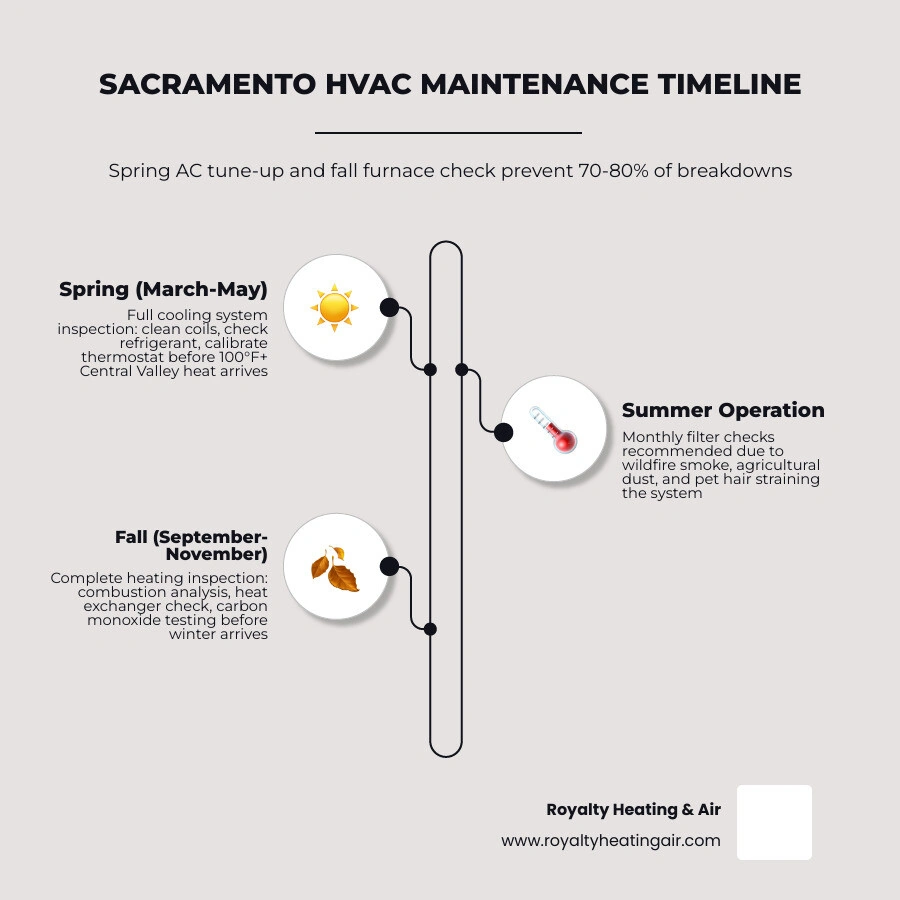
The good news: a straightforward biannual maintenance schedule — spring for cooling, fall for heating — prevents 70% to 80% of potential breakdowns before they happen.
We live in a beautiful part of Northern California, but our weather patterns force our heating and cooling systems to work overtime. In Roseville, Rocklin, and Lincoln, we experience distinct seasonal shifts that put massive physical strain on mechanical equipment.
During our intense summers, air conditioners run continuously for hours on end. When the Delta Breeze kicks in during the late evening, it brings welcome relief, but it also carries agricultural dust, pollen, and outdoor debris directly into our outdoor condenser units. In places like Loomis and Granite Bay, where properties are often larger and surrounded by native oaks and dry brush, the volume of airborne particles is even higher.
Furthermore, the heavy clay soils characteristic of the Sacramento Valley are notorious for shifting. Over time, this natural soil movement can tilt the concrete pads supporting your outdoor condenser, leading to unbalanced fan motors, refrigerant line strain, and premature compressor failure.
Finally, we cannot ignore our modern wildfire seasons. Fine ash and smoke particles can completely clog a high-quality air filter in as little as two weeks during active fires, choking your system's airflow and causing components like the evaporator coil to freeze. This is why seasonal timing is everything. Scheduling Spring AC and HVAC Maintenance for the Sacramento Area ensures your system is thoroughly cleared of winter dust and prepared for the triple-digit heat before the summer rush begins.
While a biannual visit is the gold standard for home care, the exact maintenance requirements depend heavily on the specific mechanical setup in your home. Let's break down how different systems wear down and why having a dedicated AC Maintenance Plan Complete Guide is the best way to keep your home running efficiently.
• Central AC — Primary Energy Source: Electricity — Recommended Service Schedule: Once per year (Spring) — Key Focus Areas: Condenser coils, refrigerant levels, electrical contacts
• Gas Furnace — Primary Energy Source: Natural Gas / Propane — Recommended Service Schedule: Once per year (Fall) — Key Focus Areas: Heat exchanger, burner assembly, carbon monoxide testing
• Heat Pump — Primary Energy Source: Electricity — Recommended Service Schedule: Twice per year (Spring & Fall) — Key Focus Areas: Reversing valve, defrost cycle, dual-mode calibration
• Dual-Fuel System — Primary Energy Source: Gas & Electricity — Recommended Service Schedule: Twice per year — Key Focus Areas: Hybrid controls, burner safety, compressor performance
Different systems experience seasonal wear in unique ways. A traditional split system splits the workload: the air conditioner rests all winter while the furnace rests all summer. However, a heat pump works year-round, switching between heating and cooling modes. Because it never gets a season off, its internal components experience twice the wear and tear, making biannual professional tune-ups absolutely essential.
For standard central air conditioning units, scheduling professional service once a year in the spring is highly recommended. During this visit, technicians focus heavily on cleaning the condenser coils, checking refrigerant levels, and testing electrical connections. Dirty coils can reduce cooling efficiency by up to 40%, forcing your compressor to run hotter and longer than it was designed to.
If you are located in the hotter, sunnier parts of our service area, you can reference our specific local guides to understand how regional environmental factors impact your system:
• AC Maintenance Roseville CA Guide
• AC Maintenance Rocklin CA Guide
• AC Maintenance Granite Bay CA Guide
• AC Maintenance Loomis CA Complete Guide
• 24 Hour AC Maintenance Lincoln CA Complete Guide
Because heat pumps provide both heating and cooling, they require a professional checkup twice a year. Skipping even one seasonal service can lead to a failing reversing valve or an inefficient defrost cycle, leaving you without reliable climate control when the weather shifts.
Gas furnaces operate under high temperatures and combustion pressures, meaning safety is just as important as efficiency. To ensure your system is operating safely, you should schedule a professional furnace tune-up once a year in the early fall.
Our technicians perform a meticulous combustion analysis and inspect the heat exchanger for microscopic cracks. A cracked heat exchanger is a serious safety hazard that can leak deadly carbon monoxide gas into your living spaces.
To keep your furnace running safely and efficiently, explore our comprehensive resources tailored to your specific community:
• Read our Annual Furnace Maintenance Guide for a complete overview of the process.
• For Roseville residents, we offer the Ultimate Furnace Maintenance Roseville CA, Affordable Furnace Maintenance Roseville Guide, Furnace Maintenance Roseville CA Guide, and our 24 Hour Furnace Maintenance Roseville Guide.
• For Rocklin homeowners, see our Residential Furnace Maintenance Rocklin CA Guide, Best Furnace Maintenance Rocklin CA Guide, and Furnace Maintenance Rocklin 24H Guide.
• For those living in Lincoln, we have the Lincoln CA Furnace Maintenance Guide and Heating Maintenance Lincoln CA Guide.
• To learn more about general preventative care, check out our guides on Preventative Heater Maintenance and Home Furnace Maintenance Roseville CA Tips or Affordable Furnace Maintenance Rocklin Tips.
Understanding the difference between a spring cooling tune-up and a fall heating check helps clarify why we don't perform the exact same tasks year-round. Each season requires a different technical focus to keep your home safe and comfortable.

Regular, proactive maintenance is the single best way to protect your home from sudden system failures. If you want to dive deeper into how routine visits save you from emergency repair costs, read our guide on How to Prevent HVAC Emergencies with Maintenance.
Our spring service is designed to maximize heat transfer and electrical efficiency so your air conditioner can easily handle 100°F+ afternoons. To learn more about preparing your system for the spring, read our guide on Spring AC and HVAC Maintenance.
During a spring visit, we perform the following essential tasks:
• Deep Clean the Condenser Coils: We wash away agricultural dust, pollen, and debris that act like an insulating blanket, trapping heat inside your system.
• Verify Refrigerant Charge: We measure the refrigerant levels to ensure there are no leaks. An incorrect charge can destroy your compressor.
• Test the Capacitor and Blower Motor: We check the electrical draw of your system's motor. Weak capacitors are the number-one cause of summer AC breakdowns.
• Flush the Condensate Drain Line: We clear out algae, mold, and dust to prevent water from backing up and damaging your home's ceilings or drywall.
• Calibrate the Thermostat: We verify that your thermostat is reading indoor temperatures accurately and communicating correctly with your cooling unit.
Our fall heating service focuses heavily on mechanical safety, fuel efficiency, and indoor air quality before the winter chill sets in. For a complete look at what our heating inspections entail, check out our guide on the Annual Furnace Inspection.
Our fall service includes:
• Heat Exchanger Inspection: We use specialized cameras to check for cracks, rust, or physical compromises in the metal chambers.
• Burner Assembly Cleaning: We clean the burners to ensure clean combustion and prevent soot buildup.
• Carbon Monoxide Testing: We test the air around your furnace and vents to ensure no harmful gases are escaping into your home.
• Gas Line and Valve Leak Checks: We inspect all fuel connections to ensure there are no gas leaks.
• Safety Control Testing: We test safety limit switches to ensure the system will automatically shut down if it begins to overheat.
As your heating and cooling system ages, its maintenance requirements naturally change. A system's age plays a massive role in how often it should be serviced and what technicians must look for during a visit.
• New Systems (0 to 5 Years Old): Newer systems are highly efficient but still require annual professional service. Manufacturer warranties explicitly require documented annual maintenance to keep your coverage valid. Skipping service can void your parts warranty.
• Mid-Life Units (6 to 10 Years Old): During this stage, components like capacitors, contactors, and fan motors begin to show physical wear. Annual or biannual service during this period helps catch these minor issues before they cause major system failures.
• Older Systems (11 to 15+ Years Old): For older systems, we highly recommend biannual maintenance regardless of system type. Older units have looser mechanical tolerances, worn bearings, and less efficient heat transfer. Regular checkups can add 3 to 5 years to the life of your system, keeping it running safely until you are ready for an upgrade.
To learn more about managing your system's life cycle and choosing the right care plan, check out our HVAC Maintenance Plans Tips Homeowners.
While complex electrical diagnostics, refrigerant handling, and gas line inspections must be left to licensed professionals, there are several simple tasks you can perform to keep your system running smoothly between visits.
To keep your system in top shape between professional visits, follow these simple DIY tips:
1. Check and Change Your Air Filters: This is the single most important task you can do. Check your filters every 30 to 60 days. If you have pets or live in a dusty area, you may need to change them monthly.
2. Clear the Outdoor Condenser Unit: Keep at least two feet of clear space around your outdoor unit. Trim back bushes, remove weeds, and clear away dry leaves or twigs.
3. Keep Your Indoor Vents Unobstructed: Ensure that at least 80% of your home's supply and return vents are open and clear of furniture, rugs, or drapes to maintain proper system airflow.
4. Monitor the Condensate Drain: Periodically check the outdoor drain line to ensure water is dripping freely when your air conditioner is running.
For more helpful tips on caring for your home's comfort systems, read our guide on the Ultimate HVAC Maintenance Granite Bay CA.
Yes. Almost all major HVAC manufacturers (including Carrier, Trane, Lennox, and Goodman) explicitly state in their warranty terms that the equipment must be serviced annually by a licensed professional. If a major component like your compressor or heat exchanger fails, the manufacturer will often require you to provide copies of your professional service records before they will cover the cost of the replacement parts. Keeping a folder with your annual maintenance receipts is the best way to protect your investment.
If you notice any of the following signs, do not wait for your scheduled seasonal tune-up:
• Weak or Reduced Airflow: This can indicate a clogged filter, a failing blower motor, or a leak in your ductwork.
• Strange Noises: Squealing, banging, grinding, or rattling noises point to loose belts, failing bearings, or damaged mechanical parts.
• Short Cycling: If your system turns on and off rapidly without fully cooling or heating your home, it is experiencing mechanical stress.
• Sudden Spike in Utility Bills: A sudden increase in energy costs means your system is working much harder than normal to do its job.
• Uneven Temperatures: Hot or cold spots in different rooms indicate that your system is struggling to distribute air evenly.
During active wildfire events, you should check your air filters every two weeks. Wildfire smoke carries fine ash and microscopic particulates that can clog standard filters incredibly quickly. If the filter becomes completely loaded with ash, it will restrict your system's airflow, which can cause your indoor evaporator coils to freeze or cause your blower motor to overheat and fail.
We highly recommend using pleated filters with a MERV 11 to MERV 13 rating during smoke events, as they are highly effective at capturing fine smoke particles and protecting your indoor air quality.
Staying on top of your HVAC maintenance is the absolute best way to ensure your home remains a comfortable haven all year long. Regular professional tune-ups keep your energy bills low, protect your manufacturer warranties, and prevent up to 90% of unexpected system breakdowns during peak summer and winter weather.
At Royalty Heating & Air, we are proud to provide expert heating and cooling services throughout Roseville, Rocklin, Lincoln, Loomis, and Granite Bay. When you partner with us, you are also helping us support our local community. Through our proud partnership with the MackAttack Foundation, we dedicate a portion of our work to supporting foster babies and sponsoring local family adoptions.
Keep your home comfortable and efficient all year long. Schedule your seasonal service with our comprehensive maintenance plans today!
