
Services
About
Service Areas


How often should you service your HVAC is one of the most common questions homeowners ask — and most people are getting the answer wrong. The short answer: most systems need professional service twice a year — once in the spring before cooling season, and once in the fall before heating season. At a minimum, every system should be serviced at least once per year.
Here's a quick breakdown by system type:
• Central AC — Recommended Service Frequency: Once a year (spring)
• Gas Furnace — Recommended Service Frequency: Once a year (fall)
• Full HVAC System — Recommended Service Frequency: Twice a year (spring + fall)
• Heat Pump — Recommended Service Frequency: Twice a year (spring + fall)
• Older System (10+ years) — Recommended Service Frequency: Twice a year minimum
• High-usage or hot climate — Recommended Service Frequency: Every 6-8 months
Most homeowners don't think about their HVAC system until something goes wrong. By then, a small, preventable issue has often turned into an expensive repair — or worse, a full system failure on the hottest day of the year. Research shows that 85% of HVAC repairs are linked to a lack of regular maintenance, and systems that are skipped on service can use up to 25% more energy than those that are properly tuned.
The good news? Staying ahead of problems is simpler than most people think. A consistent maintenance schedule protects your comfort, your wallet, and the life of your equipment — which, with proper care, can last 15 to 20 years or more.
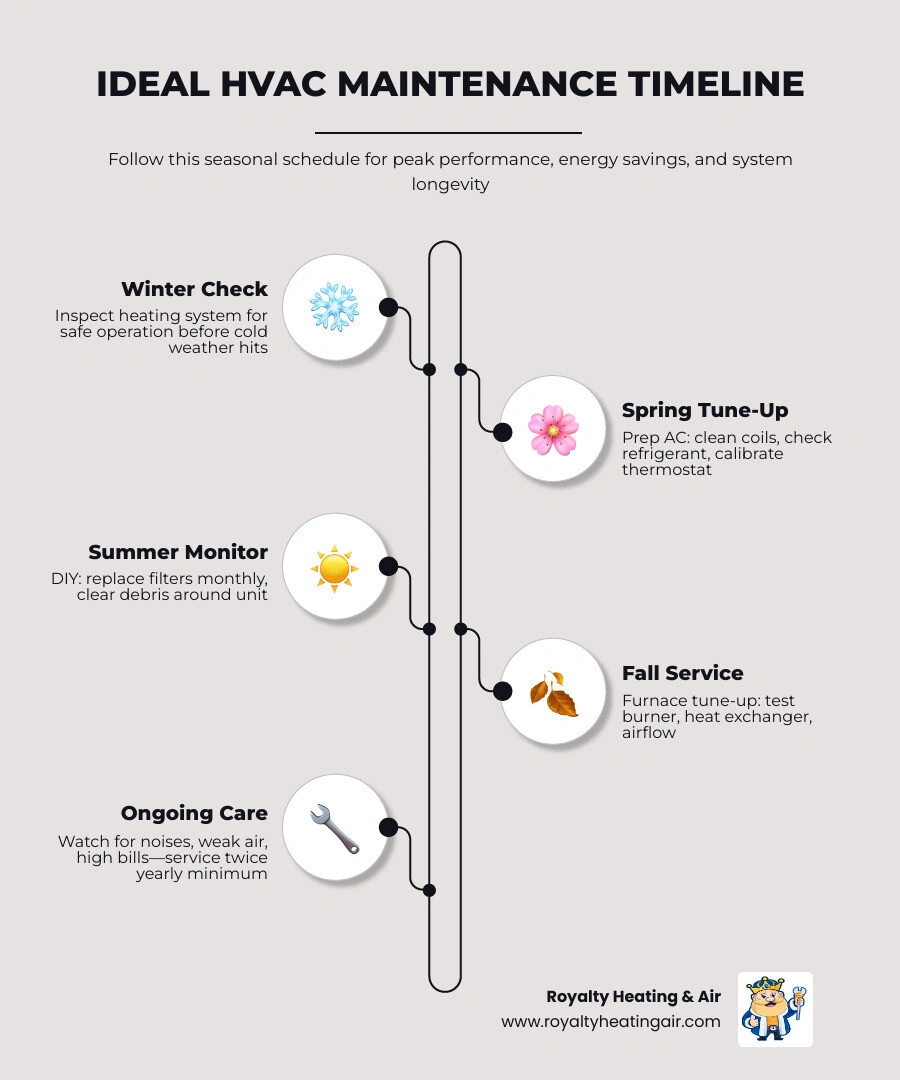
When we talk about the "gold standard" of home care, we are talking about a bi-annual schedule. In the industry, we often see homeowners who treat their HVAC system like a "set it and forget it" appliance. However, your heating and cooling system is more like a vehicle; you wouldn't drive 50,000 miles without an oil change, and you shouldn't run your AC for 2,000 hours without a tune-up.
For most homes in our area, the ideal rhythm is a Spring AC and HVAC Maintenance visit followed by a fall furnace check. This proactive approach ensures that the specific components required for the upcoming season are cleaned, tested, and ready for the heavy lifting ahead. By scheduling during these "shoulder seasons," you avoid the mid-summer or mid-winter rush when technicians are at their busiest.

Geography plays a massive role in how hard your system works. In the Sacramento Valley, our summers aren't just warm; they are punishing. When temperatures in Roseville, Rocklin, and Lincoln regularly climb into the triple digits, your air conditioner may run for 12 to 18 hours a day. This high usage leads to faster mechanical wear and tear than a system in a milder climate.
Furthermore, our region can be quite dusty. Dust is the silent killer of HVAC efficiency. It coats coils, clogs filters, and puts extra strain on the blower motor. Because of these environmental factors, we strongly recommend sticking to the twice-yearly schedule. If you are preparing for the colder months, our Lincoln CA Furnace Maintenance Guide offers specific insights into keeping your heating system reliable when the NorCal dampness sets in.
If your home utilizes a heat pump rather than a traditional furnace and AC combo, your maintenance needs are slightly different. Because a heat pump provides both heating and cooling, it operates year-round without the seasonal "downtime" that other systems enjoy.
Since there is no "off-season" for a heat pump, it accumulates double the wear. For these systems, bi-annual servicing isn't just a suggestion—it’s a necessity. Skipping even one service visit can lead to a significant drop in efficiency and a shorter total lifespan for the unit.
The most immediate benefit homeowners notice after a professional tune-up is the impact on their utility bills. A well-tuned HVAC system can use 10% to 30% less energy than a neglected one. When you consider that heating and cooling account for roughly half of the average home's energy usage, those savings add up quickly.
But the benefits go beyond just monthly savings. Regular maintenance can extend your system's lifespan by 3 to 5 additional years. While a neglected system might fail at the 10-year mark, a well-maintained unit can easily reach 15 or 20 years of service. For more details on the heating side of the equation, check out our Annual Furnace Maintenance Guide.
• Average Lifespan — Maintained System: 15–20+ Years — Neglected System: 10–15 Years
• Energy Efficiency — Maintained System: Peak Performance — Neglected System: 15–25% Efficiency Loss
• Breakdown Risk — Maintained System: Low (70-80% prevented) — Neglected System: High (85% of repairs)
• Air Quality — Maintained System: High (Filtered & Clean) — Neglected System: Low (Dust & Allergen buildup)
Many homeowners are surprised to learn that their manufacturer warranty likely carries a "maintenance clause." Most major HVAC brands require proof of annual professional maintenance to keep the warranty valid. If a major component like a compressor or heat exchanger fails, the manufacturer may ask for service records. If you cannot provide them, they may deny your claim, leaving you responsible for the full cost of the part. Regular servicing is essentially an insurance policy for your equipment's protection.
Your HVAC system is the lungs of your home. As air circulates, it carries dust, pet dander, pollen, and other allergens. Over time, these particles build up inside your ductwork and on the internal components of your unit.
Professional cleaning during a service visit helps manage these pollutants. When combined with regular filter changes, maintenance significantly reduces the triggers for asthma and allergies. To keep the air flowing freely and cleanly, it's also important to understand How Often Should You Clean Vents to prevent dust from recirculating throughout your living spaces.
A professional service visit is much more than a quick "once-over." It is a comprehensive technical inspection designed to optimize every part of the system. A typical visit from our team includes:
• Coil Cleaning: Cleaning the evaporator and condenser coils can improve cooling efficiency by up to 40%.
• Refrigerant Check: We ensure refrigerant levels are correct; low levels force the system to work harder, while leaks can cause environmental damage.
• Electrical Inspection: We tighten all connections and measure voltage and current on motors.
• Lubrication: Moving parts are lubricated to reduce friction and prevent premature wear.
• Thermostat Calibration: Ensuring your thermostat accurately communicates with your unit so you aren't wasting energy.
While AC maintenance focuses on comfort and efficiency, furnace maintenance is a matter of safety. During a fall tune-up, we perform a rigorous inspection of the heat exchanger. Even a tiny crack in a heat exchanger can allow carbon monoxide—an odorless, colorless, and potentially lethal gas—to leak into your home. We also check gas connections, safety shutoffs, and ignition systems to prevent fire hazards and ensure your family stays safe throughout the winter.
Finally, we look at the "big picture" of how your system is performing. We measure static pressure and airflow to ensure that air is moving through your home as intended. If the airflow is restricted, your system will "short cycle," turning on and off too frequently. This not only wastes energy but also puts immense stress on the compressor and blower motor.
While professional service is essential, there are several things you can do as a homeowner to keep things running smoothly between our visits.
The most important task is changing your air filter. Clogged filters are the leading cause of HVAC issues, as they restrict airflow and force the system to strain. We recommend checking your filter every month and replacing it every 1 to 3 months. If you have pets or suffer from allergies, you may need to change it more frequently.
In addition to filters, keep an eye on your outdoor unit. Ensure there is at least a 2-foot clearance of space around the condenser. Trim back any bushes, weeds, or tall grass that might be obstructing airflow. You should also:
• Monthly Visual Checks: Look for any frayed wires or signs of pests (like mice or wasps) nesting in the unit.
• Drain Line Cleaning: Pouring a cup of vinegar down the condensate drain line every few months can help prevent algae clogs and water damage.
• Vent Dusting: Use a vacuum attachment to keep your return and supply grilles free of dust.
Sometimes your system will tell you it needs help before your scheduled appointment. Never ignore these red flags:
1. Strange Noises: Banging, squealing, or rattling often points to a loose belt or a failing motor.
2. Weak Airflow: If air is barely coming out of the vents, you likely have a clogged filter or a blower issue.
3. Rising Bills: A sudden spike in your energy bill without a change in usage usually means efficiency has plummeted.
4. Inconsistent Temperatures: If one room is a sauna while another is an icebox, your system is struggling to balance the load.
Skipping service is a gamble. In the short term, your system will likely continue to run, but it will do so less efficiently, costing you more in monthly utilities. In the long term, you are significantly increasing the risk of a major breakdown. Emergency repairs typically cost 3 to 5 times more than preventive maintenance. Additionally, you risk voiding your manufacturer warranty.
Absolutely. Most homeowners find that maintenance plans pay for themselves through energy savings alone. Beyond the numbers, a plan offers peace of mind. Many plans include priority scheduling and reminders, so you never have to wonder, "When was the last time I had the AC checked?" For a deeper dive into these benefits, see our HVAC Maintenance Plans Tips Homeowners and our AC Maintenance Plan Complete Guide.
The "sweet spot" for our area is early spring (March through May) for your air conditioner and early fall (September through November) for your furnace. Scheduling during these windows ensures your system is ready before the first heat wave or cold snap hits.
At Royalty Heating & Air, we believe that a comfortable home is the foundation of a happy life. Serving the Roseville, Rocklin, Lincoln, Loomis, and Granite Bay communities, we take pride in providing expert HVAC care that you can rely on.
But our mission goes beyond just fixing air conditioners. We are proud partners with the MackAttack Foundation, an organization dedicated to supporting foster babies and sponsoring family adoptions. When you choose us for your home’s comfort, you are also supporting a team that is deeply committed to giving back to the community and helping local families grow.
Don't wait for your system to lose its cool. Whether you need a seasonal tune-up or want to explore our Maintenance Plans, we are here to help. Contact us today to ensure your home remains a sanctuary of comfort all year long.
