
Services
About
Service Areas


Are you putting the final touches on your new home office or fitness studio, only to realize the space feels more like an oven than a comfortable retreat? Converting a garage offers incredibly valuable square footage for your home, but climate control is almost always an afterthought. When evaluating Ductless Mini-Splits vs Window Units for Cooling a Garage Conversion, you are making a crucial decision that impacts not just your daily comfort, but the security and usability of your new space.
The immediate challenge of cooling these non-traditional spaces becomes painfully obvious during temperature spikes. When the intense August late-summer heat sets in, our team at Royalty Heating & Air constantly hears from homeowners whose standard garages have trapped hot air, making them completely unusable for back-to-school homework sessions or evening workouts. Many homeowners look for a quick fix to lower the temperature, but choosing the right cooling hardware requires looking beyond the initial purchase.
Your decision will dictate how loud the room is, how secure your ground-floor windows remain, and how much your monthly utility bills will fluctuate. By weighing the benefits of permanent ductless mini-split systems against temporary window units, you can create a truly livable environment. To ensure the job is done correctly from day one, investing in professional AC installation in Roseville provides the necessary expertise to transform a sweltering garage into a perfectly climate-controlled extension of your home.
Garages are built to house vehicles, not people. Because of this, their structural design fundamentally differs from the rest of your home. To effectively cool a converted space, you must first understand the unique thermal dynamics at play. Standard interior rooms benefit from thick drywall, layered attic insulation, and climate-sealed doors that keep conditioned air inside. Garages typically lack all of these protective barriers, leading to rapid and relentless heat gain.
Roseville's hot, dry late-summer climate turns uninsulated garage spaces into saunas, requiring robust, sustained cooling to maintain a comfortable temperature. When the sun beats down on the exterior walls and roof, the heat easily transfers inside. This environmental challenge is compounded by several structural factors that standard air conditioning services must account for to prevent system failure:
• Radiant Heat Transfer: Concrete floors act as massive thermal batteries. They absorb heat throughout the day and slowly release it into the room, drastically increasing the cooling demand long after the sun goes down.
• Uninsulated Garage Doors: A standard metal garage door offers virtually no thermal resistance. It acts as a giant conductive panel, transferring outside heat directly into your newly converted office or gym.
• Air Infiltration: Garages are rarely airtight. Drafts around the main door and unsealed wall joints allow precious cooled air to escape while drawing in hot, humid air from the outside.
Because of this massive thermal load, temporary cooling solutions often fall short. A unit designed for a heavily insulated bedroom will run constantly in a garage without ever reaching the set temperature. Throughout Roseville residential neighborhoods, our technicians frequently discover that undersized or inefficient cooling systems simply cannot keep up with the sustained thermal demands of a converted garage.
When planning a garage conversion, temperature control is usually the primary focus, but physical safety should be equally prioritized. The method you choose to cool your new space has a direct and significant impact on your home's perimeter security. This is where the differences between cooling systems become a matter of household safety.
The Problem with Temporary Units: Window units require an open, permanently compromised window to operate. Because garages are typically located on the ground floor, this creates an easily accessible target for intrusions. A window unit is essentially resting on the sill, often held in place only by gravity and a few flimsy plastic accordion panels. In our years serving Roseville residential neighborhoods, we have seen firsthand that ground-floor windows are prime targets, and an unsecured air conditioner provides a highly visible point of entry.
The Structural Liability: Beyond the open window, the physical weight and lack of secure mounting make window units a massive liability. An intruder can simply push the unit inward to gain access to the home. If your garage conversion houses expensive home gym equipment, high-end computer monitors, or sensitive office electronics, relying on a window unit leaves valuable property exposed to theft.
The Secure Solution: Ductless mini-splits maintain the physical integrity of your home. The indoor air-handling unit mounts securely high on the wall or ceiling, while the noisy compressor sits safely outside. The only connection between the two is a bundle of refrigerant lines and electrical wires that require a small, 3-inch hole drilled through the wall. This hole is completely sealed and offers zero access to the interior. By choosing a permanent ductless system, you protect your valuable equipment and maintain a fully secure perimeter.
A converted garage is only useful if you can actually concentrate while inside it. Whether you are leading an important video conference for work or trying to focus on a complex yoga routine, the acoustic environment matters. The decibel output of your cooling system will dictate the daily usability of the space.
Window units are notoriously loud. Because all the mechanical components—the compressor, the condenser fan, and the evaporator blower—are housed in a single box sitting right inside your window, you hear every rattle, hum, and vibration.
• Disruptive Decibel Levels: A typical window unit produces between 50 and 60 decibels of operational noise. This is equivalent to having a loud conversation running continuously in the background.
• Vibration Amplification: The vibrating chassis of a window unit often rattles against standard garage framing, amplifying the noise and creating an irritating, low-frequency hum that vibrates through the walls.
• Interrupted Focus: During the intense August late-summer heat, a window unit will run non-stop. This constant mechanical roar makes it incredibly difficult to record audio, take professional phone calls, or enjoy a peaceful workout.
Ductless mini-splits offer a completely different acoustic experience. They operate near-silently indoors because the loudest component—the compressor—is housed outside the home, far away from your workspace. The indoor air handler simply uses a quiet, variable-speed fan to distribute the chilled air. Most modern ductless units operate at whisper-quiet levels, often dropping below 30 decibels. This acoustic comfort is essential for back-to-school workspaces where concentration is required, allowing you to stay cool without shouting over a rattling machine.
When you are cooling a space with high thermal demands, operational efficiency dictates your long-term costs. The initial price tag of the hardware is only a fraction of what you will spend over the system's lifespan. Contrasting the long-term operational efficiency and sustained cooling capacity of both systems reveals a massive performance gap.
Window units utilize older, single-stage compressor technology. They turn on at full blast until the thermostat registers the target temperature, then shut completely off. In a poorly insulated garage, the temperature rises rapidly the moment the unit turns off, causing the system to kick right back on. This constant on-and-off cycling draws massive amounts of electricity and frequently struggles to maintain consistent temperatures, leaving the room with uncomfortable hot and cold spots.
Conversely, modern heat pump solutions and ductless systems utilize variable-speed inverter technology. Instead of constantly turning on and off, the compressor adjusts its speed to provide a steady, precise flow of cooling. The superior air distribution of a wall-mounted or ceiling-cassette system eliminates hot spots entirely. Furthermore, these systems offer built-in heating capabilities, ensuring your garage is comfortable long after the August late-summer heat fades into winter. As an added benefit, we always remind our customers that qualifying heat pump installations may be eligible for general federal tax credits or local utility incentive programs, though you should verify current programs with your utility provider or a tax professional.
To understand the efficiency difference, you must look at the Seasonal Energy Efficiency Ratio (SEER). This metric measures cooling output over a typical cooling season divided by the energy consumed.
Department of Energy data highlights that ductless systems frequently achieve SEER ratings exceeding 20, with some premium models reaching the high 20s or low 30s. Window units, on the other hand, typically hover around a much lower efficiency equivalent, often struggling to match even base-level central air standards. When your system must run continuously to battle the extreme thermal load of a garage, a higher SEER rating translates directly to lower monthly utility bills and a significantly reduced carbon footprint.
Proper system sizing and professional installation are absolute requirements to avoid major performance issues in non-traditional spaces. Garages present unique challenges that standard room-sizing charts simply do not account for. Relying on professional installation expertise ensures proper system sizing for non-traditional spaces, guaranteeing quiet operation and long-term efficiency.
Many homeowners attempt to size their own cooling units based solely on square footage. However, DIY sizing often leads to major operational flaws. If a unit is too small, it will run continuously without ever cooling the room. If a unit is too large, it will "short-cycle"—cooling the air too quickly and shutting off before it has a chance to remove humidity from the air. This improper installation is a leading reason why your mini-split AC keeps shutting down during peak demand or why your garage feels cold but uncomfortably clammy.
The complexity of routing electrical conduit, managing condensation drainage, and running refrigerant lines safely in a converted space requires technical precision. For example, during a previous winter season, our installation crew at Royalty Heating & Air handled a particularly difficult split system installation involving a complex ceiling-mount unit in a non-traditional layout. Because of the challenging structural constraints, the homeowner mentioned other companies hesitated to take on the project. However, our dedicated professional team worked late into the evening to properly route the lines and ensure the entire system operated flawlessly.
This level of technical commitment is essential. Throughout Roseville residential neighborhoods, we see firsthand that the long-term value of relying on experienced technicians for complex mounting setups pays dividends. A professionally installed system guarantees optimal airflow, proper drainage, and maximized lifespan, ensuring your investment is protected for years to come.
To make the best decision for your garage conversion, it helps to view the core differences in a highly scannable, objective framework. Here is how the two cooling methods compare across the most critical categories when battling the August late-summer heat.
• Home Security — Window Air Conditioning Unit: High vulnerability. Requires a permanently open, unsecured ground-floor window. — Ductless Mini-Split System: Fully secure perimeter. Requires only a sealed 3-inch hole through the exterior wall.
• Noise Output — Window Air Conditioning Unit: Disruptive. Produces 50-60 decibels indoors, making video calls and focus difficult. — Ductless Mini-Split System: Whisper-quiet. Indoor air handler operates near-silently while the loud compressor sits outside.
• Energy Efficiency — Window Air Conditioning Unit: Lower standard ratings. Single-stage compressors cause high electricity usage. — Ductless Mini-Split System: Ultra-efficient. Inverter technology frequently achieves 20+ SEER performance.
• Installation — Window Air Conditioning Unit: DIY temporary fix. Blocks natural light and looks unsightly from the exterior. — Ductless Mini-Split System: Permanent professional integration. Clean aesthetic that adds value to the home.
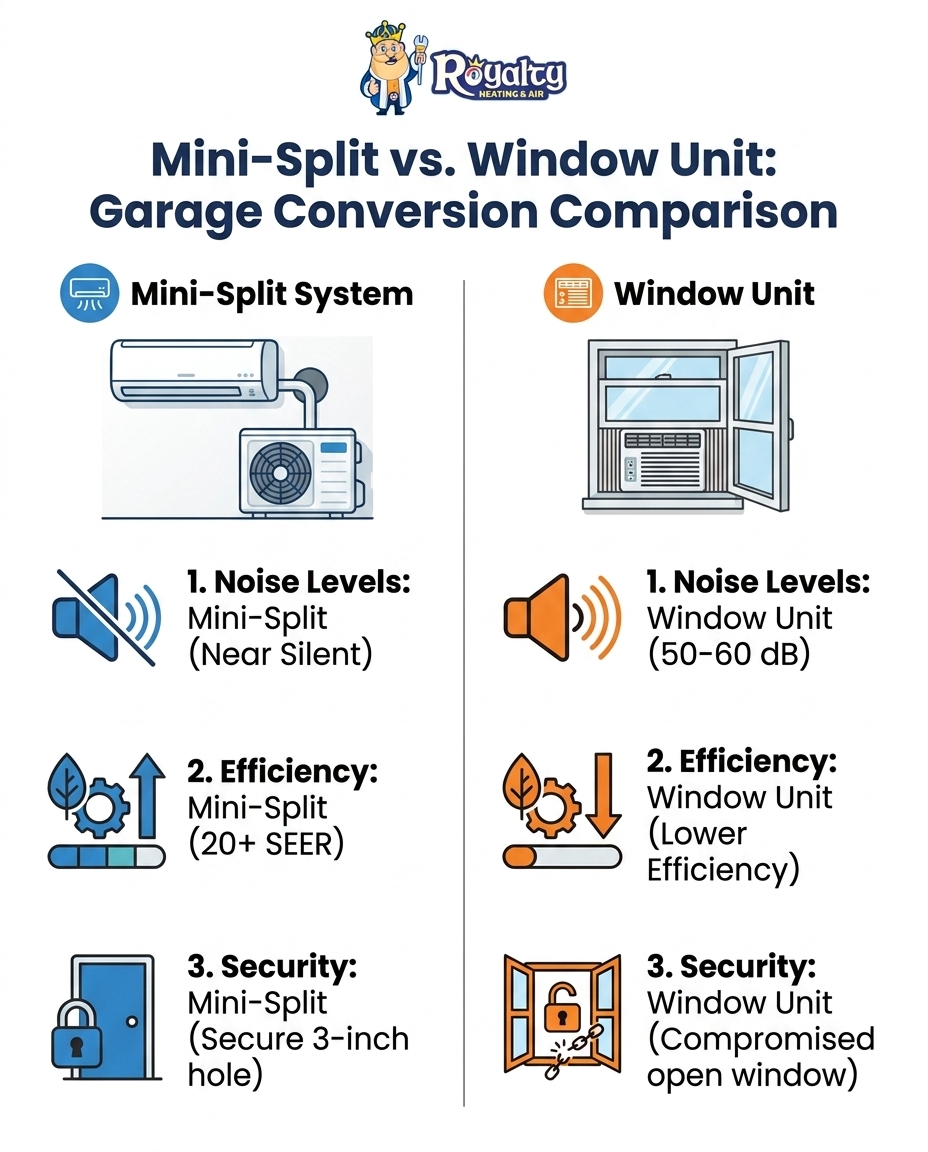
Synthesizing this decision framework makes the choice clear: prioritizing security, noise reduction, and energy efficiency is paramount for any high-value home addition. While a temporary cooling box might seem appealing for a quick weekend fix, it ultimately compromises the safety, acoustics, and comfort of your newly converted space.
Skip the temporary window unit and invest in a permanent solution that matches the quality of your interior upgrades. By choosing a ductless system, you ensure that your home office or fitness studio remains a quiet, secure, and perfectly chilled environment, even during the harshest weather. For homeowners in Roseville residential neighborhoods, we highly recommend scheduling an expert evaluation with our team to properly size your new space and secure your comfort before the heat peaks.
Can a mini split cool a 2 car garage?
Yes, a mini-split can easily cool a standard two-car garage. The key is ensuring the system is properly sized to handle the specific square footage and thermal load of the space. A professional load calculation will determine the exact BTU capacity required to overcome the lack of insulation and maintain a comfortable climate.
Is it cheaper to run a window unit or a mini split?
A mini-split is significantly cheaper to run over the long term. Because ductless systems utilize variable-speed inverter compressors, they adjust their energy usage to precisely match the cooling demand rather than constantly turning on and off. This ultra-efficient operation drastically reduces monthly utility consumption compared to a standard window unit.
What is the best way to cool a garage gym?
A ductless mini-split is the most effective way to cool a garage gym. It provides sustained, powerful cooling to combat the heat generated by intense workouts and high outdoor temperatures. Additionally, the near-silent operation allows you to hear your music or fitness instructions clearly without the disruptive roar of a traditional AC unit.
Are mini splits quieter than window ACs?
Mini-splits are drastically quieter than window air conditioners. In a ductless system, the noisy compressor component is located entirely outside the home. The indoor unit only houses a quiet fan to distribute the chilled air, resulting in whisper-quiet operation that will not disrupt your daily activities.
What is the most secure way to air condition a garage?
The most secure method is installing a permanent ductless heat pump system. Unlike window units that require you to leave a ground-floor window open and vulnerable to intruders, a mini-split only requires a small, easily sealed 3-inch hole through the wall for the conduit, keeping your home's perimeter entirely secure.
How does extreme late-summer heat affect garage cooling requirements?
Late-summer heat waves exponentially increase the thermal load on uninsulated garage spaces. The intense sun heats up the concrete floor and metal garage doors, which then radiate that heat inward for hours. Overcoming this massive heat gain requires a high-efficiency system capable of sustained, powerful cooling without burning out the compressor.
