
Services
About
Service Areas


Before the first bell rings, scheduling a pre-school year HVAC check: why August is the hardest month on your air conditioner is a critical priority for local homeowners. At Royalty Heating & Air, our team has seen firsthand how the late August back-to-school transition brings a surge of new stress to households, right as the summer heat reaches its absolute cumulative peak. Your cooling system has likely been running non-stop since June, making it highly susceptible to sudden, disruptive breakdowns. You are now at a crucial decision point: ignore those progressively longer cooling cycles and hope the unit holds together, or schedule a preventative inspection to catch heat-stressed components before they fail entirely.
For those relying on our professional air conditioning services, taking action during this specific window of time prevents minor wear and tear from escalating into a major mechanical failure.
Most homeowners assume that if their air conditioner survived the initial heat waves of June and July, it is safe for the rest of the year. However, mechanical systems do not reset their wear and tear overnight. Every hour your unit runs, it accumulates thermal and mechanical stress. By the time August arrives, the internal components have endured hundreds of hours of high-temperature operation. The transition back to school routines often means thermostats are programmed differently, doors are opening and closing more frequently in the mornings and afternoons, and the system is forced to adapt to shifting loads while already operating at a deficit.
Understanding the physics of this late-summer heat trap is the first step in protecting your home. A system that appears to be functioning normally on the surface may actually be drawing excessive amperage, struggling with restricted airflow, or operating with degraded electrical parts. Catching these hidden issues now ensures your family remains comfortable during one of the busiest times of the year.
To understand why late summer is so punishing on mechanical equipment, you have to look at the environmental data. In our years of serving the Roseville and Greater Sacramento area, we know that average high temperatures in July and August routinely exceed 90 degrees. This creates a unique cumulative stress environment for local HVAC units that goes far beyond standard operational wear.
Air conditioning systems are engineered to handle heavy loads, but 60 or more consecutive days of extreme heat push them to their maximum design limits. During a normal, mild summer, the cooler nighttime temperatures allow the outdoor compressor and internal motors to fully cool down before the next day's cycle begins. However, during prolonged heat waves, these recovery periods shrink. The ambient temperature remains high well into the evening, meaning the system continues to cycle, and the internal components never return to a true baseline temperature.
This relentless cycle degrades system efficiency over time. The longer the equipment operates under peak thermal stress, the harder it has to work to produce the same amount of cooling. Consider the operational differences between early summer and late summer:
• Coil Cleanliness — Early Summer (June): Freshly cleaned, optimal heat transfer — Late Summer (August): Coated in dust, restricted heat release
• Electrical Load — Early Summer (June): Normal amperage draw on startup — Late Summer (August): High amperage draw due to heat resistance
• Component Temp — Early Summer (June): Full overnight cooldown achieved — Late Summer (August): Retains residual heat overnight
• Run Cycles — Early Summer (June): Short, efficient cooling cycles — Late Summer (August): Extended cycles to reach thermostat setpoint
Because of this cumulative thermal load, a system that worked flawlessly in June may be on the verge of failure by the end of August. Scheduling proactive AC maintenance in Roseville helps mitigate this accumulated stress, resetting the system's baseline before the final, most demanding weeks of the cooling season.
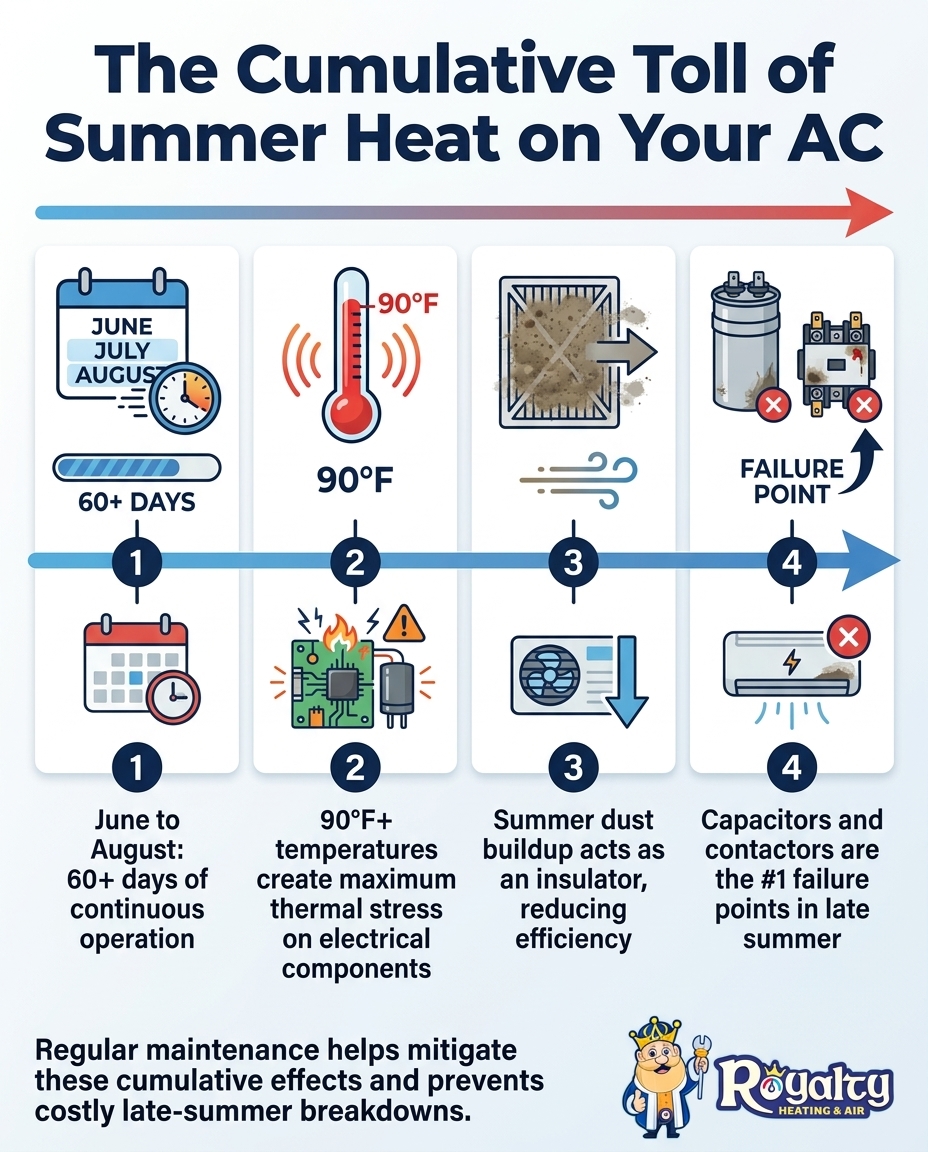
The Problem: As the cooling season drags on, we find that the most vulnerable parts of your system are not necessarily the largest mechanical pieces, but rather the electrical components that manage heavy loads. AC run capacitors and contactors bear the brunt of the cumulative thermal stress. When these parts are forced to operate continuously in triple-digit heat, they begin to degrade, lose their ability to store a charge, or suffer from pitted connections.
The Cause: Every time your air conditioner turns on, it requires a massive jolt of electricity to start the compressor and the fan motors. The capacitor acts as a battery, storing energy to deliver that initial kick, while the contactor acts as a heavy-duty switch that allows high-voltage power to flow to the compressor. After 60-plus days of constant cycling, the internal fluids of a capacitor can begin to boil and expand, causing the casing to bulge. Simultaneously, the constant arcing of electricity across the contactor's metal plates causes them to burn, pit, and eventually weld shut or fail to connect at all. If you have ever wondered why an AC circuit breaker keeps tripping during a heat wave, our technicians frequently discover that a failing capacitor or a shorting contactor is the culprit.
The Solution: Replacing a stressed electrical component before it fails is a fast, straightforward fix. A technician can measure the microfarad reading of a capacitor and replace it the moment it drops below the manufacturer's safe threshold. Waiting for these parts to fail completely, however, is a dangerous gamble. A failed capacitor forces the compressor to try and start without assistance—a condition known as "hard starting"—which can cause catastrophic, irreversible damage to the compressor itself.
Capacitors are highly sensitive to both internal and external heat. Internally, the process of storing and discharging electricity generates friction and heat. Externally, the part is sitting inside a metal cabinet baking in the afternoon sun, often surrounded by 100-degree ambient air. Because the component is running continuously to keep up with the thermostat, it never gets the opportunity to dissipate that heat properly. The dielectric fluid inside breaks down, the internal pressure builds, and the component eventually pops, instantly cutting off the cooling capacity of the entire system.
Beyond electrical degradation, environmental factors play a massive role in late-summer system strain. The dry, dusty conditions typical of late summer in the Greater Sacramento area accelerate the buildup of debris on outdoor equipment. Over the course of June, July, and August, your outdoor condenser coils pull in thousands of cubic feet of air, acting like a giant vacuum for pollen, dirt, lawn clippings, and airborne dust.
This buildup acts as a thick, fuzzy blanket of insulation over the aluminum fins of the condenser coil. The primary job of the outdoor unit is to release the heat that was absorbed from inside your home. When the coils are insulated by dirt, the heat cannot escape efficiently. The system's internal pressure rises, the compressor has to work significantly harder, and the run cycles stretch longer and longer just to achieve the same temperature drop indoors.
These longer run cycles feed directly back into the electrical wear and tear discussed earlier. The longer the system runs to overcome dirty coils, the more thermal stress is placed on the AC run capacitors and contactors. It is a vicious cycle of inefficiency that accelerates mechanical degradation.
This is a pattern our Royalty Heating & Air technicians see frequently in the field. Recently, one local Roseville homeowner reached out in the fall after noticing their HVAC system had accumulated significant buildup on the motor and coils over the long cooling season. By performing a comprehensive system rejuvenation to clean the motor and coils, our technician restored proper airflow and heat transfer, ensuring the home remained comfortable and the family stayed safe. A professional cleaning does more than just make the unit look nice; it fundamentally restores the thermodynamic efficiency of the equipment.
Homeowners do not have to wait for a total breakdown to know their system is in trouble. As the late August back-to-school transition approaches, keeping an eye out for subtle shifts in performance can save you from a major disruption. If you notice any of the following symptoms, it is time to consult with our AC repair services team before the situation worsens:
• Longer cooling cycles: The system takes hours to reach the set temperature on the thermostat, or it runs continuously without ever quite reaching the target. This indicates a severe loss of efficiency or restricted airflow.
• Unusual noises: A loud humming, persistent buzzing, or hard-starting sounds coming from the outdoor unit strongly indicate that electrical components like capacitors or contactors are struggling to manage the load.
• Lukewarm air from vents: The air blowing from your indoor registers isn't as crisp or cold as it was in June. This can signal dirty coils, a failing compressor, or an underlying refrigerant issue.
• Higher energy bills: A sudden, unexplained spike in your utility costs often means the system is working overtime, drawing excessive amperage to compensate for severe wear and tear.
• Frequent short-cycling: The unit turns on and off rapidly without completing a full cooling cycle, which can point to overheating motors or safety switches triggering due to high pressure.
A pre-school year tune-up is highly specific and targeted at the exact components that take the most abuse during the summer. When our licensed technicians perform Rocklin AC maintenance or service units in the surrounding areas, we follow a strict protocol to evaluate the cumulative wear on the system.
Here is what a comprehensive late-summer check entails:
1. Testing electrical components: Technicians use specialized multimeters to measure the exact microfarad output of AC run capacitors and contactors. This scientific measurement catches degradation before a total failure occurs.
2. Inspecting and cleaning condenser coils: The outdoor unit is evaluated for dust and debris buildup. Safe, professional-grade cleaners are used to wash away the summer's accumulation, instantly restoring the unit's ability to transfer heat.
3. Evaluating the blower motor: The indoor fan motor is checked for proper amperage draw, and the blower wheel is inspected for dirt buildup that could be restricting indoor airflow.
4. Checking refrigerant levels: The technician verifies that the system is operating with the correct pressures and subcooling/superheat levels, ensuring it hasn't developed a slow leak during months of heavy use.
5. Tightening electrical connections: The constant vibration of a running unit can shake electrical connections loose over the summer. These are tightened to prevent dangerous arcing and voltage drops.
It is important to note that electrical testing and refrigerant evaluation require specialized training, high-voltage safety protocols, and EPA certification. These steps should never be attempted as a DIY project by a homeowner.
The late August back-to-school transition is stressful enough without adding a home infrastructure failure to the mix. A broken air conditioner during the first weeks of school disrupts sleep schedules, makes homework time miserable, and throws entire family routines into chaos. When the house is 85 degrees inside, nobody is resting well or preparing effectively for the day ahead.
Positioning a late-summer checkup as an investment in peace of mind changes the way you look at home maintenance. It is not just a mechanical necessity; it is a safeguard for your daily life. We at Royalty Heating & Air are dedicated to providing reliable, rapid response service, specifically focused on rescuing local families from late-summer breakdowns just as the busy back-to-school season begins. Our technicians understand that time is of the essence when your routine is on the line.
By scheduling proactively, you take control of the situation. You choose a convenient time for an inspection rather than waiting for an emergency failure on the hottest afternoon of the year. Protecting your equipment now ensures that your family stays focused on the important milestones of the season, rather than worrying about the thermostat.
Your AC is struggling because it has accumulated over 60 days of continuous thermal and mechanical stress. By late summer, outdoor coils are often coated in insulating dust, and internal electrical parts have degraded from the constant heat. This combined wear and tear forces the system to run longer cycles just to maintain the same indoor temperature, drastically reducing its overall efficiency.
An AC capacitor fails in extreme heat because the internal dielectric fluid breaks down and expands under constant high temperatures. Capacitors store energy to start your motors, a process that naturally generates internal heat. When surrounded by 100-degree ambient air and running constantly, the component cannot dissipate this heat, leading to swelling, fluid leaks, and eventual failure.
If an AC runs continuously in extreme heat without proper recovery time, the internal motors and compressor are pushed to their maximum design limits. This continuous operation prevents the system from cooling down, accelerating the wear on bearings, contactors, and capacitors. Over time, this drastically shortens the lifespan of the equipment and increases the risk of a catastrophic compressor failure.
In hot climates where temperatures regularly exceed 90 degrees, an AC should be professionally serviced at least once a year, though we often recommend a secondary mid-season check. The extreme cumulative load placed on systems in these regions causes faster degradation of electrical parts and faster accumulation of debris on coils, making proactive care absolutely essential for reliable operation.
It is never too late to get an AC tune-up in August; in fact, our team considers it one of the most critical times to have your system checked. Because the unit has endured months of heavy use, a late-summer tune-up specifically targets the heat-stressed components that are on the verge of failing. Catching these issues in August prevents unexpected breakdowns during the hottest final weeks of the season.
Yes, a dirty AC coil directly causes your system to run longer cooling cycles. The buildup of dirt, pollen, and debris acts as an insulator, preventing the refrigerant inside the coils from releasing heat into the outdoor air. Because the heat transfer is restricted, the system has to operate for significantly longer periods to achieve the desired temperature drop inside your home.
The late August back-to-school transition should be focused on new schedules and fresh starts, not sweating through the night because of a preventable equipment failure. Catching heat-stressed parts like degraded capacitors and dirty coils now prevents major disruptions and costly emergency repairs later in the month. A clear explanation of your system's health gives you the confidence to navigate the rest of the season without worry.
Do not wait for the system to stop blowing cold air. Schedule your pre-school year AC check with Royalty Heating & Air today to ensure your equipment is operating safely and efficiently. Proactive care is the only way to guarantee your family's comfort and peace of mind through the very end of the cooling season.
