
Services
About
Service Areas


Your thermostat is set to a comfortable 72 degrees, but the indoor temperature keeps climbing, leaving you desperately searching for the real reason your AC is blowing warm air in the late afternoon. It is an incredibly frustrating scenario: the air conditioner was working perfectly all morning, keeping the house cool and crisp, only to start pumping uncomfortably warm air through the vents right when you need cooling the most. For many homeowners experiencing July peak summer in the Sacramento valley, this sudden shift triggers immediate panic.
The immediate confusion is entirely understandable. You are left wondering if the system is simply struggling to overcome the intense outdoor heat, or if a critical component has failed and requires immediate professional replacement. Many people immediately assume they have suffered a massive refrigerant leak or a catastrophic system failure. However, the truth is often much more specific. Rather than a total breakdown, the culprit is frequently a predictable mechanical failure triggered by extreme temperatures.
When sustained 100-plus degree days push residential cooling systems to their absolute limits, the combination of severe environmental stress and electrical fatigue creates the perfect storm for a specific component to fail. Understanding how this happens is the first step toward restoring your home's comfort. If you are dealing with this exact issue, reaching out for professional air conditioning services is the safest way to accurately diagnose the problem.
To understand why your air conditioner fails at this specific time of day, you have to look at the physical environment your outdoor unit operates in. The problem begins with the sheer volume of thermal energy bombarding your home as the day progresses. The cause is a phenomenon known as 4 PM peak solar heat gain. By late afternoon, the sun has been baking your roof, walls, and windows for hours, drastically increasing the thermal load—the amount of heat your AC must remove from the indoor air.
This situation is particularly brutal for west-facing condenser units. These outdoor cabinets sit in direct sunlight, absorbing radiant heat while simultaneously trying to exhaust the heat collected from inside your home. The hotter the outdoor air becomes, the harder it is for the system to release that indoor heat into the atmosphere. The solution requires recognizing these environmental limits and ensuring your system is mechanically sound enough to handle the strain. If your system cannot keep up with this intense thermal load, scheduling AC repair in Roseville ensures your equipment is operating at peak capacity.
Most homeowners do not realize that standard residential air conditioners are typically designed based on ASHRAE (American Society of Heating, Refrigerating and Air-Conditioning Engineers) standards, which often use a maximum outdoor design temperature of around 95 degrees for many regions. When the ambient temperature climbs past this critical threshold, the system's efficiency naturally begins to drop.
The physics of cooling: An air conditioner does not actually "create" cold air; it moves heat from inside your home to the outside. When the outside air is 105 degrees, the compressor has to work exponentially harder to compress the refrigerant and force that heat out. Exceeding these design temperatures forces the system into continuous, non-stop operation, maximizing the electrical strain on every internal component.
When an air conditioner runs continuously during extreme heat, the mechanical strain heavily impacts the system's electrical components. The most common victim of this intense operating environment is the dual run capacitor. Think of an AC capacitor as a massive battery or an energy reservoir. Its job is to provide a powerful jolt of electricity to jump-start the compressor and keep the outdoor fan motor running smoothly.
Continuous 100-plus degree ambient temperatures physically degrade the internal components of these capacitors. Inside the small metal cylinder, a dielectric fluid helps manage the electrical charge and dissipate heat. During July peak summer in the Sacramento valley, the relentless outdoor heat combined with the heat generated by the running motor causes this fluid to expand. Eventually, the capacitor loses its ability to hold a charge, and the top of the cylinder may even physically bulge upward.
Insights drawn directly from Royalty Heating & Air's technicians reveal that this exact mechanical failure is the most frequent late-day emergency service call they receive during extreme heat waves. When the heat-weakened capacitor finally fails, it drops the compressor to protect it from irregular voltage. However, the outdoor fan often continues to run. Because the indoor blower is still pushing air over evaporator coils that are no longer being cooled by compressed refrigerant, the result is actively warm air blowing forcefully through your vents.
When the late afternoon heat hits the Roseville and greater Sacramento area, it is crucial to distinguish between an overwhelmed air conditioner and one with a dead capacitor. Knowing the difference dictates whether you should leave the system running or shut it down immediately to prevent further damage.
If your system is simply struggling to keep up with the extreme thermal load, the air coming out of the vents will still feel cool to the touch, but the indoor temperature on your thermostat might slowly rise by a degree or two. The system will run continuously without lowering the indoor temperature, but it is still actively removing heat and humidity. In contrast, if the compressor has shut down due to a failed capacitor, the air blowing from the vents will be noticeably warm or completely room temperature.
• Vent Air Temperature — System Struggling (Normal Heat Strain): Cool to the touch, but not ice cold — Capacitor Failure (Compressor Shutdown): Actively warm or room temperature
• Indoor Thermostat — System Struggling (Normal Heat Strain): Rises 1-2 degrees above set point — Capacitor Failure (Compressor Shutdown): Rises rapidly, unable to cool at all
• Outdoor Unit Sound — System Struggling (Normal Heat Strain): Both fan and compressor running smoothly — Capacitor Failure (Compressor Shutdown): Fan runs, compressor is silent or humming loudly
• Required Action — System Struggling (Normal Heat Strain): Monitor the system, keep blinds closed — Capacitor Failure (Compressor Shutdown): Turn off at thermostat immediately
One customer noted that when they reached out with unspecified AC and heating needs during a significant weather shift, a technician ensured the job was done right by going out of his way to accurately diagnose the root cause, giving the homeowner absolute confidence in calling the company for all future HVAC needs. If you notice your system exhibiting signs of a mechanical failure, exploring why your AC is running but not cooling can help you make an informed decision about when to switch the thermostat off.
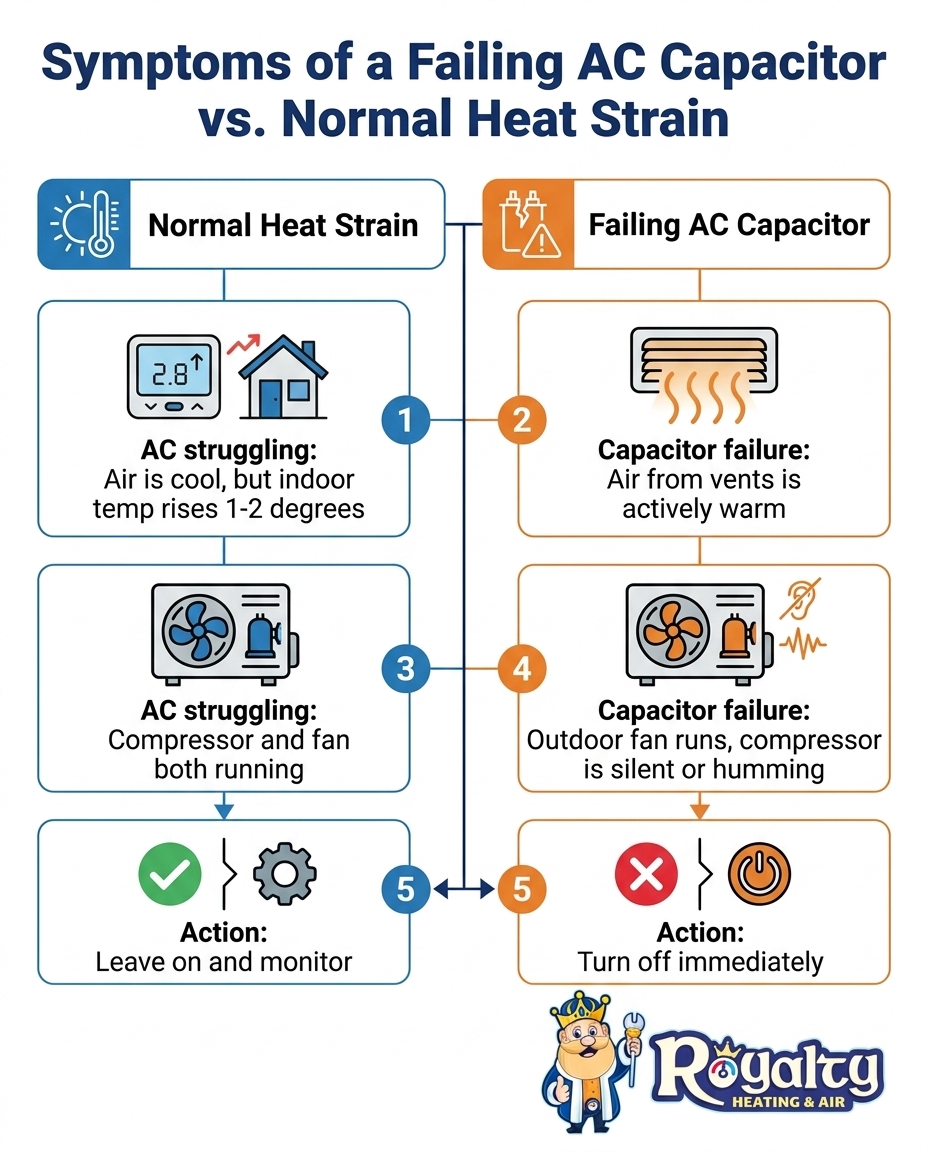
The problem with a failed capacitor is not just the immediate discomfort of a warm house; it is the severe secondary damage that can occur if the system is left running. When the thermostat calls for cooling, the system attempts to start the compressor. Without the necessary electrical jolt from the capacitor, the compressor experiences an extreme spike in electrical current known as Locked Rotor Amps.
The cause of this danger is the continuous, unsuccessful attempt to start a heavy mechanical motor without adequate electrical support. The compressor hums loudly, drawing massive amounts of electricity, which causes the internal windings to overheat rapidly. The solution is immediate intervention: turning the system off at the thermostat the moment you detect warm air during 4 PM peak solar heat gain prevents this dangerous electrical cycle from destroying your equipment.
The compressor is the heart of your air conditioning system and is typically the most expensive component to replace. Fortunately, modern compressors are equipped with an internal thermal overload switch designed to trip and cut power when the unit overheats.
However, if you ignore the warm vents and leave the thermostat set to "cool," the compressor will repeatedly try to start, trip the thermal overload, cool down, and try again. This repetitive stress can eventually fuse the internal wiring, escalating a relatively straightforward capacitor replacement into a catastrophic compressor failure. Prompt attention not only restores your home's comfort quickly but also protects the longevity of the entire HVAC system.
Because capacitor issues involve high-voltage electricity, diagnosing and repairing them requires professional expertise. When another customer's system was not running optimally, a technician helped get the system running like new by thoroughly evaluating these electrical components, restoring like-new performance with excellent customer service. Professional technicians follow strict safety and diagnostic protocols to ensure the system is repaired correctly.
1. Visual and auditory inspection: Technicians first inspect the outdoor unit for signs of a bulging capacitor casing or listen for the distinct humming sound of a struggling compressor.
2. Safe electrical discharge: Capacitors store lethal electrical charges even when the main power to the unit is turned off. Professionals safely discharge this stored energy before handling the component.
3. Microfarad testing under load: Using specialized multimeters, technicians test the capacitor's microfarad readings to determine if it has fallen out of its acceptable tolerance range.
4. Thermal load reduction: While replacing the electrical components, a professional will often clean the condenser coils to improve airflow, significantly reducing the overall thermal load on the unit.
We strongly warn against any DIY electrical work or capacitor replacement. The risks of electrical shock or wiring the dual-run terminals incorrectly are simply too high. Instead, relying on routine AC maintenance allows professionals to identify weak, out-of-tolerance capacitors during the spring, replacing them long before they fail on the hottest day of the year.
The extreme afternoon heat does not isolate itself to a single neighborhood; it affects the entire valley grid simultaneously. When temperatures soar, the electrical and mechanical strain placed on residential cooling systems is a shared regional challenge. While regional microclimates throughout the Roseville and greater Sacramento area can slightly alter exactly when the peak heat hits your specific street, the mechanical strain on your outdoor unit remains identical.
Whether you live in a heavily shaded suburban cul-de-sac or a newer development with minimal tree cover, west-facing condenser units will inevitably face intense solar radiation. This widespread environmental stress emphasizes the importance of relying on a local team that understands these specific regional requirements. A local contractor knows exactly how the valley heat impacts specific HVAC brands and models, allowing them to respond promptly with the right replacement parts stocked on their trucks. If you find yourself dealing with a sudden afternoon breakdown, securing Rocklin AC repair from a team familiar with our local climate ensures your family stays safe and comfortable during severe heat waves.
Dealing with an air conditioner that suddenly blows warm air is stressful, but understanding the root cause brings peace of mind. Afternoon thermal load, 4 PM peak solar heat gain, and heat-stressed capacitors are predictable, solvable challenges. Reassure yourself that noticing warm air coming from your vents does not automatically mean the entire system needs replacing; it is often a localized electrical failure designed to protect the heavier machinery.
The key to managing these extreme temperature spikes is proactive care and prompt professional attention. Do not let a struggling system run itself into the ground. If your home is losing the battle against the afternoon sun, we encourage you to seek a professional inspection to verify the exact cause of the warm air. Taking action today by scheduling AC repair in Roseville will restore your optimal cooling performance and keep your home comfortable all summer long.
Why does my AC stop blowing cold air in the afternoon?
Your AC stops blowing cold air in the afternoon because the intense outdoor heat overwhelms the system, often causing a heat-stressed capacitor to fail. When the capacitor fails, the compressor shuts down to protect itself, but the indoor fan continues to circulate uncooled air through your home. The extreme thermal load of the late afternoon pushes aging electrical components past their breaking point.
How do I know if my AC capacitor is bad?
The most common sign of a bad AC capacitor is warm air blowing from your indoor vents while the outdoor fan is still spinning. You may also hear a distinct, loud humming or buzzing sound coming from the outdoor unit as the compressor tries and fails to start. A professional technician can confirm a bad capacitor by testing its microfarad levels with a specialized multimeter.
Is it normal for my AC to struggle in 100-degree heat?
Yes, it is entirely normal for an air conditioner to struggle when outdoor temperatures exceed 100 degrees. Most residential systems are designed for a maximum outdoor temperature of around 95 degrees, meaning extreme heat forces them to run continuously just to maintain a baseline indoor temperature. As long as the air coming from the vents is still cool, the system is likely just working hard against the thermal load.
Why does my AC blow warm air during the day but cold at night?
If your AC blows warm air during the day but cold at night, the system is likely undersized, suffering from dirty condenser coils, or experiencing early stages of electrical fatigue. During the day, the peak solar heat gain overwhelms the system's ability to transfer heat outdoors. Once the sun sets and ambient temperatures drop, the system can finally catch up and resume normal cooling operations.
Can I test or replace my AC capacitor myself?
No, you should never attempt to test or replace an AC capacitor yourself. Capacitors act like massive batteries and store lethal amounts of high-voltage electricity, even when the main power to the air conditioner is completely turned off at the breaker. Safely discharging and replacing a capacitor requires specialized training, tools, and a licensed professional.
