
Services
About
Service Areas


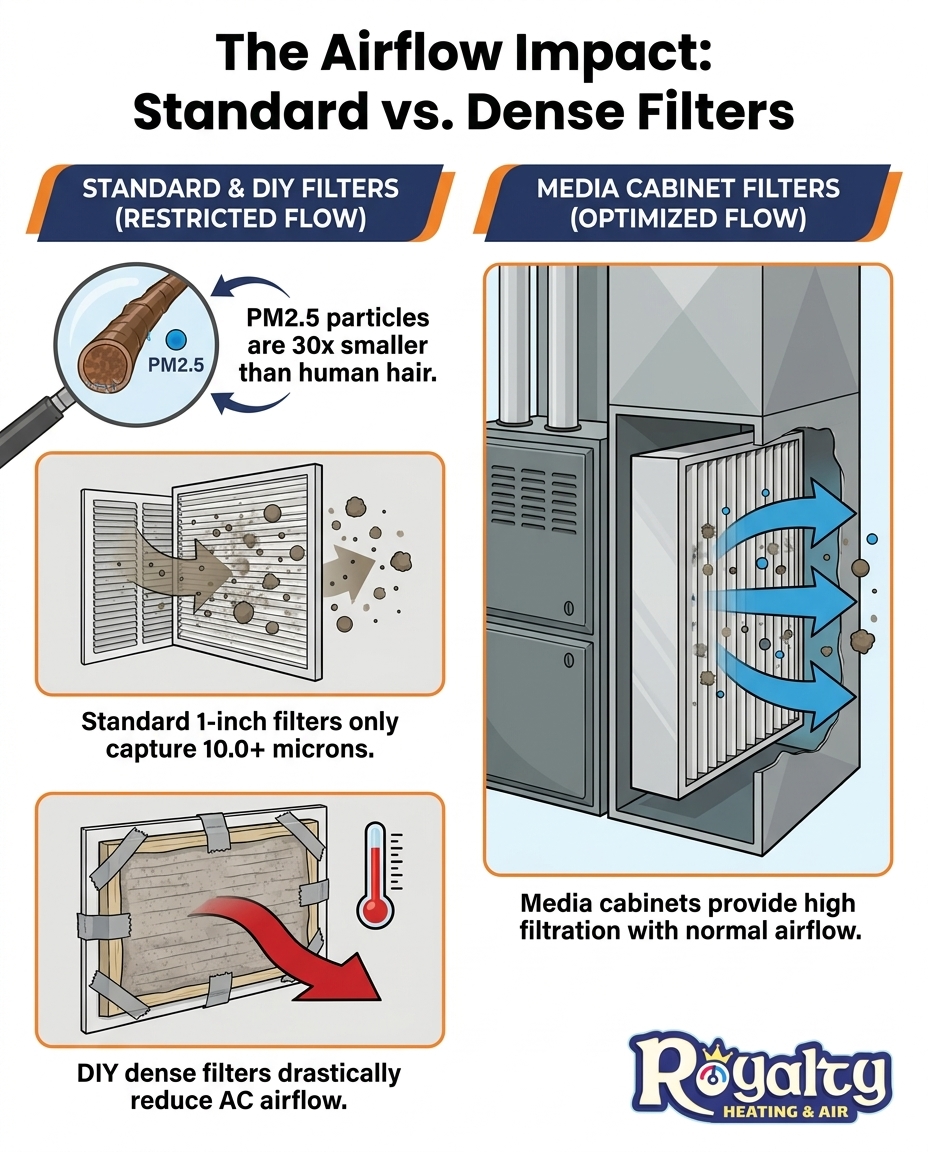
PM2.5 particles from wildfire smoke are roughly 30 times smaller than a single strand of human hair, which is exactly why recovering your home's air quality after the August wildfire smoke peaks requires more than a simple filter change. When late-summer fires burn across Northern California, our team at Royalty Heating & Air sees firsthand how the Sacramento Valley essentially acts as a massive basin. The surrounding geography traps thick smoke and microscopic debris, pushing it directly into local neighborhoods. Homes in Roseville CA end up capturing this fine ash, circulating poor air quality from room to room, and leaving a stubborn campfire smell trapped indoors long after the skies clear.
You are likely facing a frustrating decision right now. Do you just repeatedly swap out clogged standard filters every few days, hoping the air eventually clears up? Or do you invest in specific, airflow-safe upgrades that actually capture the microscopic ash without damaging your cooling system? Understanding how your heating and cooling equipment actually works is the first step to making the right choice for your home.
If you are ready to explore indoor air quality solutions, our team can help you find the right fit for your system.
The Problem: You keep changing your standard air filter, but the indoor air still feels heavy, smells like smoke, and leaves a fine layer of dust on your furniture.
The Cause: Standard 1-inch fiberglass filters are simply not designed to protect human lungs. Their primary job is to protect the internal components of your HVAC system—specifically the blower motor and the evaporator coil—from large debris like pet hair, carpet fibers, and heavy dust. These basic filters are manufactured to capture particles that are 10.0 microns or larger. Because PM2.5 microscopic ash is significantly smaller than 2.5 microns, it easily passes right through the porous fiberglass material.
When this fine ash bypasses the filter, it travels through your ductwork and recirculates directly into your living space. You are essentially breathing the same contaminated air over and over again.
The Solution: You need filtration designed specifically for microscopic threats. The most obvious visual sign that your standard filter is failing against wildfire smoke is a dark, soot-like dust accumulating around your ceiling or floor supply vents. To understand the scale of the problem, look at the difference in particle sizes:
• Human Hair — Average Size (Microns): 70.0 - 100.0 — Standard 1-Inch Filter Capability: Easily Captured
• Pollen & Heavy Dust — Average Size (Microns): 10.0 - 15.0 — Standard 1-Inch Filter Capability: Mostly Captured
• PM2.5 Microscopic Ash — Average Size (Microns): 2.5 or smaller — Standard 1-Inch Filter Capability: Passes Through Completely
Relying on a basic filter during a heavy smoke event is like using a chain-link fence to keep out sand. The physical mechanics simply do not work, which forces homeowners to look for alternative solutions.
When the air inside smells like smoke, the most common reaction is to drive to the hardware store and buy the densest, highest-MERV filter available. While this seems logical, slapping a thick MERV 13 filter into a standard 1-inch slot during the August wildfire peaks is incredibly dangerous for your air conditioner.
You are dealing with a compounding threat. Late-summer heatwaves demand maximum AC cooling power, while the heavy outdoor smoke demands maximum indoor filtration. The physics of HVAC airflow make these two needs conflict. Inserting a highly restrictive filter into a standard slot acts exactly like breathing through a heavy wool blanket. The system has to work twice as hard just to pull the same amount of air.
This restricted airflow leads to a chain reaction of severe mechanical problems:
• Evaporator Coil Freezing: Without enough warm air passing over the indoor coil, the refrigerant drops below freezing. Ice quickly forms over the coils, blocking airflow entirely.
• Compressor Strain: If the coil freezes, liquid refrigerant can flow backward into the outdoor compressor, causing catastrophic failure.
• Motor Burnout: The indoor blower motor will run continuously, overheating as it struggles against the severe pressure drop caused by the dense filter.
When systems are forced to run under this kind of extreme stress, the internal damage can be extensive. Just last late summer, our technicians at Royalty Heating & Air saw exactly what this kind of strain does. We responded to a local call where the system was in bad shape with a nasty, thick buildup of ash suffocating the motor and coils. Our crew had to perform a full system rejuvenation to clean the buildup away, finally making the home comfortable and safe again. To prevent this kind of severe wear, scheduling Roseville AC maintenance ensures your system is properly calibrated to handle demanding conditions.
Many homeowners are baffled when the outdoor Air Quality Index (AQI) finally returns to healthy green levels, yet their living room still smells like a stale campfire. The reason for this lingering odor usually hides right above your ceiling.
During heavy smoke days, thousands of cubic feet of contaminated air are pulled into your home. The microscopic ash that bypasses your standard filter doesn't just stay airborne forever. It eventually settles into the ridges, corners, and bends of your ductwork. Every single time your thermostat calls for cooling and the blower fan turns on, it re-agitates that settled ash, blowing the campfire smell right back into your living space.
Surface cleaning inside the home isn't enough. You can wipe down your countertops, mop your floors, and dust your shelves daily, but if the duct network remains contaminated, you are fighting a losing battle. The only way to permanently eliminate the odor is to physically remove the settled ash from the source.
One Roseville family reached out to our team late last August for a complete check-up because of ongoing air quality concerns just as the kids were heading back to school. After our technicians performed a thorough cleaning of all the ducts and washed the grates, the system's clean airflow was fully restored. Comprehensive duct cleaning uses negative pressure and specialized agitation tools to pull the fine particulate matter completely out of your home. If you notice a persistent smell, investing in professional duct services is often the most effective step toward breathing easy again. Roseville CA homes are especially susceptible to this buildup due to the dry, dusty conditions that often follow regional fires.
If standard filters let the smoke through and DIY dense filters suffocate your AC, what actually works? True recovery requires whole-home indoor air quality (IAQ) solutions that are mechanically designed to handle high-level filtration without restricting vital airflow. As the experts at Royalty Heating & Air who intimately understand the specific toll Northern California's wildfire ash takes on residential systems, our team focuses on proven upgrades rather than generic, temporary fixes.
A media filter cabinet is the professional alternative to cramming a dense filter into a 1-inch slot. These cabinets are installed directly into your ductwork and house filters that are typically 4 to 5 inches thick. Because the filter material is deeply pleated like an accordion, it offers a massive amount of surface area. This increased surface area is the secret to safe filtration: it easily captures PM2.5 microscopic ash while maintaining the proper static pressure your air conditioner needs to breathe. You get hospital-grade filtration without freezing your evaporator coil.
While media cabinets trap physical particles, whole-home air purifiers take an active role in cleaning the air. These systems integrate directly into your existing HVAC setup. Depending on the technology used, they actively neutralize odors, break down volatile organic compounds (VOCs), and destroy microscopic particles as they pass through the ductwork. Beyond just clearing out wildfire smoke, purified air provides significant secondary benefits. Many homeowners report better rest, fewer morning headaches, and reduced allergy flare-ups once a purifier is installed. Adjusting your air purifier settings to improve sleep quality can make a massive difference in your daily comfort during heavy smoke events.
Once the heaviest smoke begins to clear, taking immediate action can prevent long-term damage to your equipment and your health. Follow these actionable steps to safely restore your indoor environment after the August wildfire peaks:
• Check the local AQI before opening windows: Do not rely purely on visual clarity. The sky may look blue, but invisible particulate matter can still be dangerously high. Always verify the numbers before ventilating your house.
• Safely inspect your standard HVAC filter: Turn off your system at the thermostat, pull the filter, and check for dark, heavy ash. If it is visibly clogged, replace it immediately to restore baseline airflow.
• Wipe down hard surfaces with a damp cloth: Dry dusting or sweeping will simply kick the settled ash back into the air. Use a damp microfiber cloth to physically trap and remove the particulate matter from your tables, shelves, and window sills.
• Schedule a professional system evaluation: Have an expert check for coil buildup and test the blower motor. The severe strain of running during peak heat and heavy smoke often causes hidden wear that leads to breakdowns later in the year.
Staying proactive is the best way to protect your investment. Enrolling in comprehensive HVAC maintenance plans ensures your system is regularly evaluated and cleaned after demanding seasonal weather events.
A standard AC system does not filter out wildfire smoke effectively. Basic 1-inch filters are only designed to catch large dust and debris to protect the equipment, not microscopic smoke particles. To actively filter out smoke, you need a specialized media cabinet or a whole-home air purifier integrated into the system.
A MERV 13 rating or higher is generally required to capture the fine PM2.5 particles found in wildfire smoke. However, you should never put a 1-inch MERV 13 filter into a standard slot, as it will severely restrict airflow. High-MERV filtration should only be used in systems equipped with deep, 4-inch or 5-inch media cabinets designed to handle the pressure.
Getting rid of the smell requires removing the physical ash that has settled inside your home and ductwork. Wiping down surfaces with damp cloths, washing fabrics, and investing in professional duct cleaning will eliminate the source of the odor. A whole-home air purifier can then actively neutralize any remaining lingering smells.
If you rely solely on natural ventilation and basic filters, smoke odors can linger indoors for several weeks. With proper whole-home air purifiers and upgraded media filters running continuously, you can often clear the indoor air of smoke and particulates within 24 to 48 hours after the outdoor air quality improves.
Yes, heavy ash buildup can cause severe, lasting damage to an air conditioner. When ash coats the evaporator coil, it acts as an insulator, preventing heat transfer and causing the system to freeze. Over time, this extreme strain can lead to premature compressor failure and burned-out blower motors.
Recovering from heavy seasonal smoke requires a clear understanding of your home's mechanical limits. Standard 1-inch filters will always fail against microscopic ash, and attempting a DIY fix with highly restrictive filters will only put your cooling system at risk of catastrophic failure. True recovery means addressing the problem at the source with solutions designed to protect both your family's health and your equipment's airflow.
By investing in proper IAQ upgrades like media cabinets and whole-home purifiers, you can confidently block out the smoke without suffocating your air conditioner. If you are dealing with lingering odors or poor air quality in Roseville CA, contact our local team at Royalty Heating & Air to evaluate your system's post-wildfire health and find the exact solution your home needs.
