
Services
About
Service Areas


Late summer in Northern California always carries a subtle shift, a gentle drop in evening temperatures that signals the changing season. Right now is the optimal window for scheduling your fall heating tune-up before the Valley fog rolls in and completely alters our local climate. Before the heavy, damp mornings take hold and force your furnace to work overtime, taking proactive steps ensures your equipment is ready for the sudden workload. The transition from dry summer heat to damp autumn mornings happens quickly, and a well-maintained system is your only true defense against waking up to a freezing home.
At Royalty Heating & Air, we've learned firsthand that if you want to ensure your equipment is prepared for the seasonal shift, securing professional heating system services now is the smartest move a homeowner can make.
The specific challenge of our local weather isn't just about dropping temperatures on a thermometer. It is about the incoming heavy moisture that settles into the basin. During the September pre-Tule fog period, the air is still relatively dry, making it easy to forget how biting a damp November morning feels. However, once that dense moisture arrives, it penetrates the walls of your home, requiring your furnace to dry the indoor air while simultaneously heating it. Waiting until the first freezing morning to test your equipment often leads to sudden breakdowns and long waits for a technician.
• Late Summer — Moisture Level: Very Low (Dry) — HVAC System Strain: Minimal (Cooling winding down) — Recommended Action: Schedule preventative maintenance
• Early Fall — Moisture Level: Moderate — HVAC System Strain: Increasing (Short heating cycles) — Recommended Action: Test system and replace filters
• Tule Fog Season — Moisture Level: Extremely High (Damp) — HVAC System Strain: Severe (Heavy, prolonged heating cycles) — Recommended Action: Rely on tuned-up equipment for comfort
Taking action before the weather turns gives you a distinct advantage. By preparing your system while the weather is still mild, you avoid the seasonal rush and guarantee that your home remains a warm, dry sanctuary when the heavy fog inevitably blankets the region.
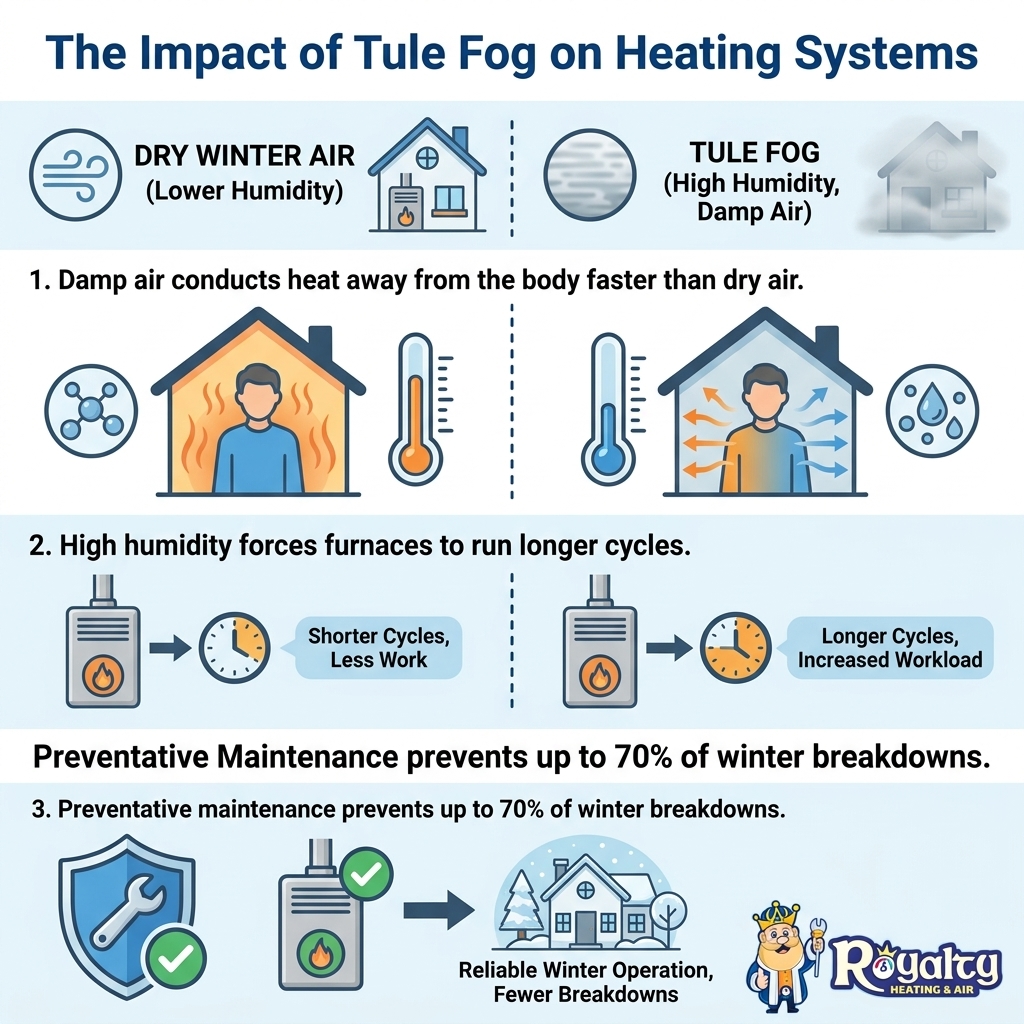
To understand why local winters feel so harsh, you have to look at the science of damp air. Damp air holds significantly more thermal mass than dry air. Because water conducts heat away from the human body much faster than dry air does, a humid 50-degree morning feels drastically colder than a dry 50-degree morning. This specific type of radiation fog creates a bone-chilling effect that taxes both your comfort levels and your heating equipment.
Our team often explains to customers that when your furnace kicks on during a 45-degree morning with near 100% humidity, it faces an immense sudden load. The system cannot just push warm air into the room; it must overcome the heavy, moisture-laden air already inside your home. This heavy, wet workload is entirely different from the dry cold experienced in mountainous or desert regions.
There is a massive difference between ambient temperature and perceived temperature in high humidity. In Roseville and the surrounding Sacramento Valley, the dense fog traps cold moisture near the ground. As this moisture seeps into your house, your furnace must run longer, more intense cycles. It works continuously to dry out the indoor environment before the actual ambient temperature can rise to meet your thermostat setting.
• Thermal conductivity: Moisture in the air pulls heat away from your skin, making you feel colder even when the thermostat reads a normal temperature.
• Extended cycle times: Your furnace has to run longer to combat the heavy air, increasing wear and tear on moving parts.
• Sudden component stress: Going from zero usage in October to heavy, daily usage in November shocks the system, often exposing hidden weaknesses.
• Indoor humidity management: A properly tuned system helps manage indoor moisture, making the warm air feel crisp and comfortable rather than stuffy.
Timing is everything when preparing a home for the changing seasons. There is a brief, highly valuable window between the end of the summer cooling season and the arrival of the first major cold snap. Taking advantage of the September pre-Tule fog period means you can book an appointment at your convenience, rather than scrambling for help when everyone else in town is doing the same.
1. Early September (The Planning Phase): The weather is still warm, and heating is the last thing on most people's minds. This is the exact moment to schedule your fall tune-up, securing a preferred time slot without any wait.
2. Late September (The Transition Phase): Evenings begin to cool down significantly. Technicians start seeing a steady increase in maintenance calls as proactive homeowners get their systems checked.
3. October and November (The Surge Phase): The first freezing fog sets in. Sudden surges in local service calls happen simultaneously across the region. Those who waited often face delayed response times because schedules are entirely booked with emergency repairs.
Waiting until the first freezing morning guarantees a long wait for a technician. Just last year, our dispatchers at Royalty Heating & Air took an urgent call from a local homeowner during a bitter cold snap because their system failed overnight. Fortunately, our team was able to arrive a day earlier than scheduled, saving the family from relying on space heaters and extra blankets for another night. However, relying on emergency availability is a gamble. The true comfort comes from knowing your system is fully prepped and ready before the weather ever turns.
A preventative maintenance visit is not just a quick visual inspection; it is a comprehensive reset for your equipment. Detail-oriented technicians perform specific, vital actions that directly prevent mid-winter breakdowns. When you invest in a comprehensive HVAC maintenance plan, you ensure that every moving part is optimized for the heavy lifting required during damp winter mornings.
First, a technician conducts a thorough inspection of the heat exchanger and venting systems. This step ensures safe operation without carbon monoxide risks, which is critical since your home stays tightly sealed during the winter months. Next, they focus on the calibration of the thermostat to ensure a precise, immediate response to sudden morning temperature drops. Finally, the lubrication of all moving parts reduces the mechanical strain caused by heavy, continuous morning heating cycles.
One of the most important steps in a tune-up is the thorough cleaning of critical components. Over the summer, dust, pet dander, and debris settle on blower motors and indoor coils. This summer dust acts as an insulator, trapping heat where it shouldn't be and restricting proper airflow. Restricted airflow forces the system to work twice as hard to achieve the same temperature, leading to overheating and premature component failure.
During a recent autumn tune-up right here in Roseville, one of our technicians discovered a system in rough shape, suffering from severe buildup on the motor and coils. By performing a complete system rejuvenation and clearing away that suffocating debris, the equipment was restored to safe, highly efficient operation, leaving the home perfectly comfortable. Removing that barrier is essential for allowing your system to breathe and function without unnecessary strain.
While gas furnaces handle the bulk of the heating load for many homes, alternative systems also require specific seasonal care. Every type of equipment interacts with the damp cold differently, and understanding those nuances is key to reliable operation during the September pre-Tule fog window and beyond.
Gas furnaces need their burners cleaned and fuel lines inspected to ensure efficient combustion. However, outdoor units, like heat pumps, face their own unique challenges when blanketed in freezing fog. Because heat pumps extract heat from the outside air, heavy moisture can freeze directly onto the outdoor coils. In our experience working on local Sacramento Valley homes, this makes heat pump maintenance incredibly important before the heavy frost arrives. A technician must verify that the system's defrost cycle is functioning perfectly. If the defrost control board fails, the entire outdoor unit can become encased in a block of ice, halting all heating capabilities.
Dual-fuel systems, which combine a heat pump with a gas furnace backup, also require precise calibration. The crossover point—the exact temperature where the system switches from the heat pump to the gas furnace—must be set correctly to maximize energy efficiency and comfort. Regardless of what type of equipment keeps your home warm, reinforcing its defenses with a pre-season check ensures it operates smoothly when you need it most.
Sometimes, your equipment will try to tell you it is struggling before it completely shuts down. Catching these issues early allows a tune-up to resolve them before they escalate into catastrophic, mid-season failures. If you notice any of these symptoms during your first test-run of the season, it usually means your system requires professional attention.
• Strange odors: A brief dusty smell during the very first cycle is normal as settled dust burns off. However, persistent burning, electrical, or metallic odors indicate serious motor strain or wiring issues that need immediate inspection.
• Unusual operational sounds: A healthy system operates with a smooth, consistent hum. If you hear a furnace making a loud humming noise, grinding, or rattling, it strongly points to a failing blower motor or loose internal components.
• Short-cycling: If the system turns on, runs for only a minute or two, and shuts off rapidly without actually heating the space, it is short-cycling. This is often caused by severe airflow restriction or a faulty flame sensor shutting the system down for safety.
• Uneven heating: Finding that certain rooms remain freezing while others are roasting suggests ductwork issues, failing dampers, or a system that has lost its overall heating capacity.
Our team always reminds homeowners in Roseville and the surrounding Sacramento Valley that paying attention to these early warning signs saves significant stress. A quick professional adjustment in the fall is always preferable to a major component replacement in the dead of winter.
Generic, national HVAC advice often misses the realities of Northern California's specific microclimates. A checklist written for a dry, snowy climate does not fully address the heavy, penetrating moisture we experience here. That is why hiring a team with deep local expertise in Sacramento Valley weather patterns makes a substantial difference in your overall comfort.
Technicians who are intimately familiar with local weather patterns know exactly which components fail most often during heavy fog events. They know to pay extra attention to flame sensors that corrode faster in high humidity and outdoor defrost boards that get overworked by the damp cold. This local knowledge translates directly into proactive care, which prevents up to 70% of unexpected breakdowns.
We recently helped a customer who struggled with a long-standing thermostat issue that prevented their system from responding correctly to temperature drops. Following up after a local home show, one of our friendly and knowledgeable technicians at Royalty Heating & Air was able to definitively solve the communication error, explaining each step of the process clearly. The peace of mind that comes from transparent communication and thorough service prompted the homeowner to sign up for yearly maintenance. Taking care of these issues during the September pre-Tule fog window ensures your system communicates flawlessly when the actual cold arrives.
The true value of a fall heating tune-up is the profound comfort of knowing your home will remain warm, dry, and safe, regardless of what the weather does outside. As the late summer heat fades, the window to act proactively is steadily closing. Do not wait for the heavy moisture to put your equipment to the test.
Homeowners in Roseville and the surrounding Sacramento Valley should reach out to our team at Royalty Heating & Air now to secure a spot on the schedule. Getting ahead of the seasonal rush guarantees that your system is clean, calibrated, and fully prepared to handle the dampest, coldest mornings the Valley has to offer.
Why does high humidity make a house feel colder?
Damp air holds more thermal mass and conducts heat away from your body much faster than dry air. When indoor humidity is high during the winter, the moisture essentially pulls the warmth right off your skin. This forces your heating system to work harder to dry the air before the space actually feels comfortable.
When is the best time to schedule a furnace tune up?
The ideal time to schedule a tune-up is in early fall, specifically during September or October. Booking during this window ensures your system is serviced before the first major cold snap hits. It also allows you to avoid the long wait times that occur when local service schedules fill up with emergency calls.
What is included in a fall heating tune up?
A comprehensive tune-up includes cleaning the blower motor and coils, inspecting the heat exchanger for safety, and calibrating the thermostat. Technicians also lubricate moving parts to reduce friction and check all electrical connections. This step-by-step process ensures the system runs efficiently and safely throughout the winter.
How often should a heating system be serviced?
Your heating system should be professionally serviced at least once a year, ideally just before the heating season begins. Annual maintenance keeps the equipment running at peak efficiency, maintains manufacturer warranties, and catches small problems before they turn into major breakdowns.
How does Tule fog specifically impact HVAC efficiency?
Tule fog creates a dense, heavy moisture that settles around your home, forcing the HVAC system to process very damp, cold air. This heavy workload requires longer heating cycles to achieve the desired indoor temperature. For outdoor units like heat pumps, the freezing fog can also cause rapid ice buildup on the coils, requiring frequent defrost cycles.
Can preventative maintenance actually lower my winter energy bills?
Yes, keeping your system properly maintained directly impacts its energy consumption. When components are clean and well-lubricated, the system uses less energy to push warm air through your home. Removing restrictive dust and ensuring precise thermostat calibration prevents the unit from overworking, which keeps your monthly utility costs manageable.
