
Services
About
Service Areas


September in the Sacramento Valley signals the end of extreme summer heat, but navigating The September Air Quality Shift: Managing Harvest Dust and Pollen Indoors becomes an immediate priority for local homeowners. Almost overnight, you might notice a sudden spike in allergy symptoms, persistent sneezing, and a heavy layer of fine dust coating your furniture faster than you can wipe it away. This sudden environmental change forces a critical decision point for your household: do you continue relying on a standard 1-inch filter that barely makes a dent in the fallout, or do you upgrade to a high-efficiency media cabinet designed to handle heavy seasonal particulate matter?
Most homeowners mistakenly assume their standard HVAC filter is actively cleaning the air they breathe. In reality, basic filters are only designed to protect the equipment itself from large debris. During the intense September harvest season in the Sacramento Valley, that basic defense falls completely short. To build a comprehensive defense against this seasonal fallout, explore our Air Quality solutions and professional Duct Services.
Establishing a comprehensive indoor air quality strategy is the only way to effectively combat the influx of agricultural dust. A proactive approach involves understanding exactly what is entering your home, how it bypasses your current defenses, and what professional upgrades are necessary to breathe easier as we transition into the cooler months.
If you live in Roseville suburban homes bordering agricultural zones, the sudden decline in your home's air quality is not a coincidence. It is the direct result of large-scale environmental and geographic factors colliding during a very specific window of the year. The transition from summer to fall triggers a massive influx of fine particulate matter that standard home defenses simply cannot block.
The Sacramento Valley acts much like a giant topographical bowl. Throughout the late summer and early fall, dry, hot winds sweep across the valley floor, picking up massive amounts of kicked-up soil, dried plant matter, and agricultural byproducts from the ongoing harvest. Because of the valley's bowl-like shape, these airborne contaminants become trapped. Instead of blowing away, the particulate matter settles over suburban neighborhoods. These specific late-summer wind patterns drive fine agricultural dust directly into residential zones, finding every tiny crack, crevice, and unsealed vent in your home.
Not all dust is created equal. The material invading your home during this season is primarily composed of PM10 and PM2.5 particulates. These numbers refer to the microscopic size of the particles—PM10 means particles that are 10 micrometers in diameter, while PM2.5 refers to ultrafine particles that are 2.5 micrometers or smaller.
• PM10 Particulates: This includes heavier agricultural dust, generic pollen, and kicked-up dirt. It settles quickly on surfaces, creating that visible, gritty layer on your tables and floors.
• PM2.5 Particulates: These ultrafine particles are lighter, stay airborne much longer, and bypass standard home defenses with ease. They are small enough to be inhaled deeply into the lungs, triggering severe respiratory irritation.
• Wildfire Smoke: Late summer often brings localized wildfire smoke, which is almost entirely composed of PM2.5, compounding the respiratory strain on your household.
This outdoor environmental shift connects directly to the indoor dust accumulation you are noticing. When the outdoor air is saturated with microscopic harvest debris, your HVAC system pulls that contaminated air inside, recirculating it endlessly if you lack the proper filtration to trap it.
The biggest misconception in home maintenance is the belief that standard filters improve indoor air quality. During the September harvest season in the Sacramento Valley, relying on a basic filter is a recipe for poor respiratory health and eventual equipment failure.
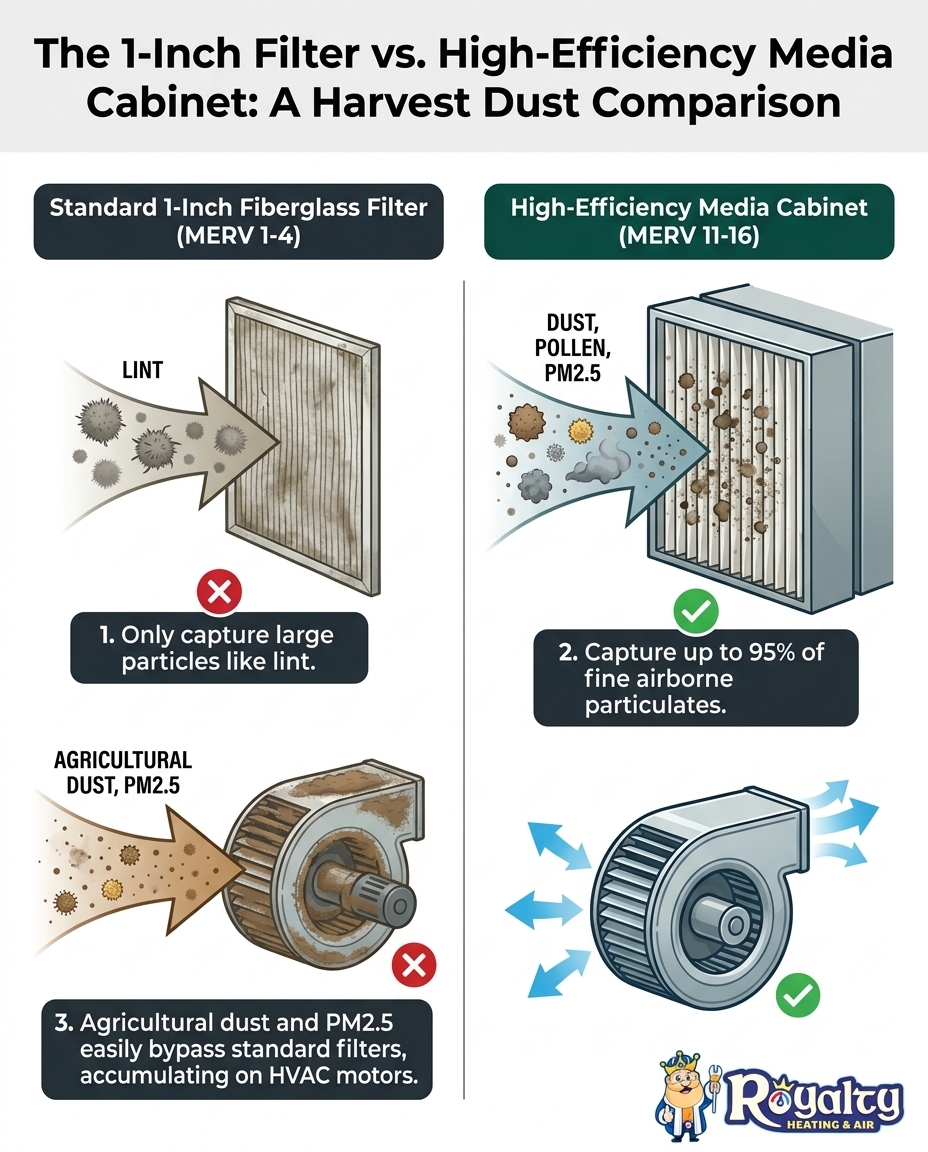
Standard 1-inch fiberglass filters typically carry a rating of MERV 1 through MERV 4. The Minimum Efficiency Reporting Value (MERV) scale measures how effectively a filter traps specific types of particles. A MERV 1-4 filter is essentially a loose mesh designed to catch only the largest airborne objects, such as pet hair, carpet lint, and large dust mites.
The physical gaps in a 1-inch fiberglass media are simply too large to capture fine agricultural dust. PM2.5 and PM10 particulates pass right through the loose weave of a basic filter, traveling into your ductwork and blowing straight back into your living room. These basic filters are designed solely to protect the HVAC blower motor and indoor coils from catastrophic blockage—they do absolutely nothing to protect human lungs from microscopic irritants.
When fine agricultural dust easily passes through 1-inch filters, it doesn't just recirculate through the living space; it also wreaks havoc on the HVAC equipment itself. Over time, that ultrafine dust mixes with normal household moisture, creating a thick, nasty buildup on critical components like the blower motor fan blades and the evaporator coil.
We see this pattern frequently during autumn service calls. In one recent case, a local homeowner scheduled a free heater tune-up before winter arrived. Upon inspection, the technician found significant dirt and harvest dust buildup choking the motor and coils. The system required a full rejuvenation to clean the components, restore proper airflow, and ensure the home was safe and comfortable for the heating season. Allowing particulate bypass to choke your airflow forces your system to work significantly harder, driving up energy consumption and increasing the risk of premature failure.
Even if you upgrade your filter, you might still find your home covered in a fine layer of dirt. This happens because filtration only works on the air that actually passes through the filter. If your ductwork is compromised, contaminated air will bypass your filtration system entirely.
The ductwork running through your home is rarely perfectly airtight, especially in older builds. Unsealed duct joints, disconnected runs, and degraded mastic tape in attics and crawlspaces create a dangerous vacuum effect. When your HVAC blower turns on, it creates negative pressure inside the return ducts. If there are leaks in those unconditioned spaces, the system acts like a giant straw, pulling in unfiltered, dusty air directly from the attic or crawlspace.
This bypassed air circulates agricultural dust, fiberglass insulation particles, and outdoor allergens directly into your home, regardless of the filter you have installed at the air handler. The path of dust from a drafty attic straight to your living room is a primary reason why homes feel impossible to keep clean during the fall.
Addressing duct integrity is a non-negotiable step for removing hidden allergens from indoor air. A professional duct assessment involves inspecting the entire network for gaps, tears, and heavy internal buildup.
The value of visual reports and thorough cleaning cannot be overstated. Recently, a local customer who won a free duct cleaning at a home show scheduled their service for the spring. Our team provided a full duct cleaning service, complete with a detailed visual report and pictures showing exactly what was hiding inside their vents. The thorough, professional cleaning removed years of accumulated debris, proving that what you can't see is often the biggest contributor to poor air quality. Ensuring the duct system is tightly sealed against external particulate matter establishes a closed, clean system that actually responds to filtration upgrades.
The definitive solution for heavy harvest dust in Roseville suburban homes bordering agricultural zones is upgrading to a high-efficiency media cabinet. This is the professional standard for households that want to actively clean the air they breathe rather than just protecting a machine.
High-efficiency media cabinets (typically rated MERV 11 through MERV 16) are the appropriate solution for fine airborne particulates. Unlike flat 1-inch filters, media cabinets are typically 4 to 5 inches thick and feature deeply pleated filter material. This accordion-like design massively increases the surface area of the filter.
The physics of trapping PM2.5 particulates relies on this increased surface area. As air passes through the dense pleats, the filter captures up to 95% of fine agricultural dust, pollen, and even some microscopic smoke particles, pulling them out of circulation permanently.
• Thickness — Standard 1-Inch Filter: 1 Inch — High-Efficiency Media Cabinet: 4 to 5 Inches
• MERV Rating — Standard 1-Inch Filter: MERV 1 - MERV 4 — High-Efficiency Media Cabinet: MERV 11 - MERV 16
• Target Particulates — Standard 1-Inch Filter: Lint, pet hair, large dust mites — High-Efficiency Media Cabinet: Agricultural dust, PM2.5, pollen, smoke
• Airflow Restriction — Standard 1-Inch Filter: Low (but clogs very quickly) — High-Efficiency Media Cabinet: Low (due to massive pleated surface area)
• Lifespan — Standard 1-Inch Filter: 30 to 90 Days — High-Efficiency Media Cabinet: 6 to 12 Months
A common mistake homeowners make is trying to force a high-MERV 1-inch filter into a standard slot. You cannot simply shove a MERV 16 filter into a 1-inch rack without severely restricting the system's airflow. A dense 1-inch filter acts like a brick wall, choking the blower motor, causing the system to overheat, and potentially freezing the evaporator coil.
Retrofitting a system with a media cabinet requires a licensed professional to ensure proper static pressure and airflow. As local experts who understand the unique harvest-season IAQ challenges in the valley, we know exactly how to specifically retrofit existing systems with media cabinets to combat heavy dust without damaging your HVAC equipment. This upgrade provides long-term health benefits for your family and significant equipment protection for your system.
As the intense heat of summer fades, your HVAC system undergoes a critical transition. Moving from heavy late-summer AC usage to early fall heating preparation requires proactive maintenance to clear out the late-summer dust before the heavy heating season begins.
• Clear Out Harvest Accumulation: The dust that bypassed your filter during September is currently sitting on your blower motor and interior cabinet. A pre-heating-season tune-up clears this debris out before the furnace ignites for the first time.
• Inspect the Heat Exchanger: Before relying on your furnace, a professional must verify that the heat exchanger is intact and free of restrictive dirt buildup, ensuring safe and efficient combustion.
• Verify Airflow and Static Pressure: Clearing coils and checking airflow now prevents sudden breakdowns when temperatures drop below freezing. A choked system will short-cycle, leaving you cold.
• Calibrate the Thermostat: Transitioning to heating mode often reveals calibration issues. Ensuring your thermostat accurately reads the indoor temperature prevents energy waste.
A clean, well-maintained system operates more efficiently and distributes cleaner air throughout the home. Scheduling AC Maintenance Roseville and comprehensive fall tune-ups ensures your equipment is fully prepped for the seasonal shift.
September marks the peak of harvest season for major Sacramento Valley crops, generating massive amounts of localized fine particulate matter. As combines and tractors kick up soil and plant material, dry late-summer winds carry this agricultural dust directly into suburban neighborhoods. If your home lacks proper filtration, this dust settles indoors, triggering severe respiratory irritation and sudden allergy spikes.
The most effective way to filter agricultural dust is by upgrading your HVAC system to accommodate a high-efficiency media cabinet. These 4- to 5-inch thick pleated filters offer a massive surface area that captures up to 95% of fine airborne particulates without restricting airflow. Supplementing this with professional duct sealing ensures that unfiltered dusty air isn't being pulled in from your attic.
Yes, professional duct cleaning plays a significant role in reducing fall allergy symptoms. Over time, pollen, agricultural dust, and pet dander accumulate inside your ductwork, creating a reservoir of irritants that blow into your living space every time the fan turns on. Removing this buildup eliminates the internal source of contamination, allowing your filtration system to work more effectively.
For heavy dust and pollen, a media filter rated between MERV 11 and MERV 16 is the professional standard. These filters are specifically designed to trap microscopic PM2.5 particulates, fine agricultural dust, and pollen spores. However, they require a dedicated media cabinet installed by a professional to ensure your system maintains proper static pressure and airflow.
Your house becomes exceptionally dusty in September because the local topography traps agricultural kickoff and dry winds push it into residential zones. Furthermore, if your ductwork has small leaks in the attic or crawlspace, the system creates a vacuum effect that pulls this outdoor dust directly inside, bypassing your standard filter entirely.
No, standard 1-inch fiberglass filters (MERV 1-4) cannot capture ultrafine PM2.5 particulates. They are designed with a loose physical mesh intended only to catch large debris like lint and hair to protect the HVAC blower motor. Fine agricultural dust will pass straight through a 1-inch filter and recirculate back into your breathing air.
The sudden shift in outdoor air quality during the September harvest season in the Sacramento Valley doesn't have to dictate your indoor comfort. When dry winds push fine agricultural dust into suburban homes, standard 1-inch filters simply fall short, leaving your family to breathe in the fallout while your HVAC equipment suffers under the strain of particulate buildup.
You have the power to stop this seasonal invasion. By upgrading to a high-efficiency media cabinet and ensuring your ductwork is properly sealed, you can effectively capture fine agricultural dust without restricting your system's airflow. Don't wait for the dust to settle inside your lungs and your furnace. Schedule a professional inspection today to address your specific harvest dust challenges and secure a clean, healthy home before winter arrives.
