
Services
About
Service Areas


Signs your ac needs repair are often easy to miss — until your home turns into a sauna on a hot Roseville afternoon. A little warm air here, a strange sound there, a power bill that seems higher than it should be. These small clues add up fast, and ignoring them can turn a simple fix into a costly breakdown.
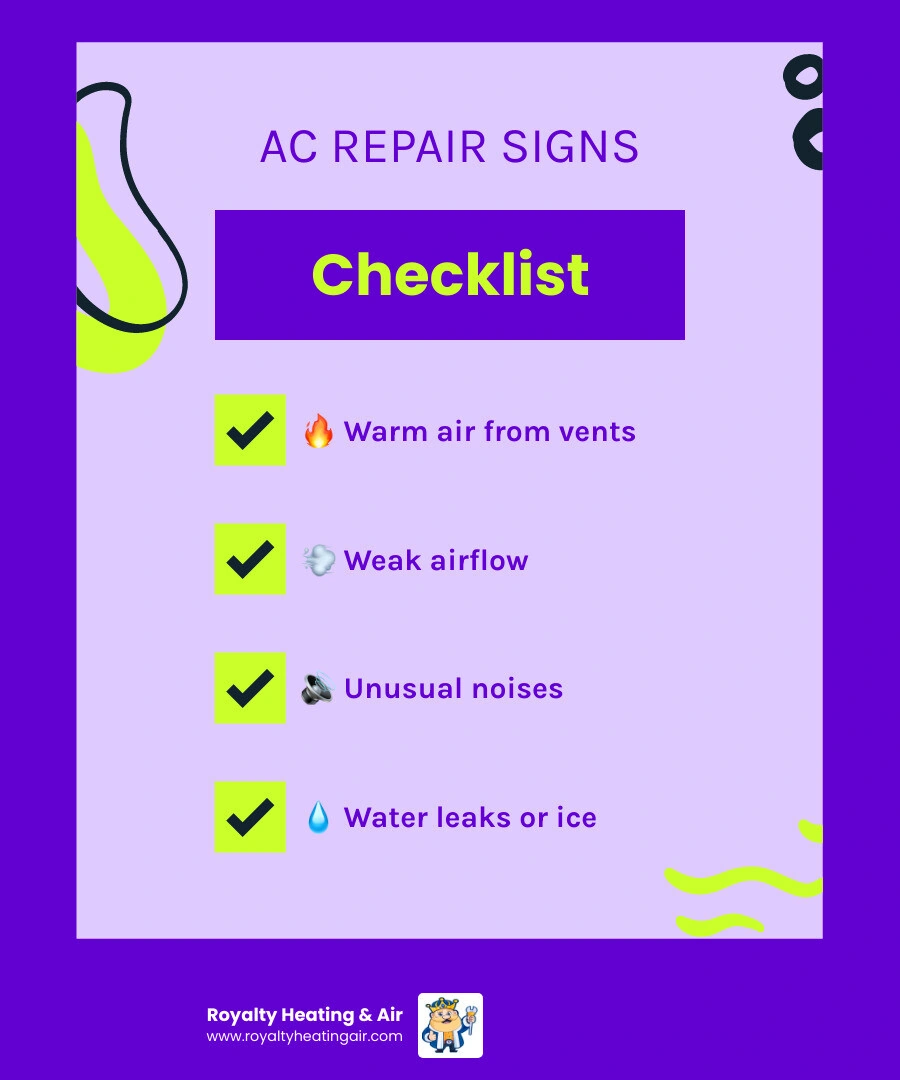
Here's a quick look at the most common warning signs:
• Warm or lukewarm air blowing from vents — possible compressor failure or low refrigerant
• Weak airflow — often caused by a clogged filter, blocked ducts, or a failing blower motor
• Unusual noises — grinding, rattling, squealing, or banging are never normal
• Foul or musty odors — can signal mold growth or burnt-out wiring
• Frequent on/off cycling (short cycling) — points to thermostat issues, low refrigerant, or an oversized unit
• Rising energy bills — AC working harder than it should due to worn or dirty components
• Water leaks or ice buildup — clogged drain lines, frozen coils, or refrigerant issues
• High indoor humidity — your AC should be pulling moisture from the air; if it's not, something's wrong
• Uneven cooling — some rooms too hot, others too cold
With summer approaching in April 2026, now is the best time to catch these problems early — before the heat hits full force and a small repair turns into an emergency call.
Living in the Roseville area, we know that when the sun starts beating down, your air conditioner isn't just a luxury—it’s a lifeline. But how do you know if your system is just "tired" or if it’s actually crying out for help? Recognizing the signs your ac needs repair early on can save you from the stress of a total system failure during a heatwave.
If you feel lukewarm air coming out of your supply registers, the first thing you should do is check the thermostat. Ensure it's set to "cool" and that the temperature is lower than the current room temperature. If the settings are correct and you're still feeling the heat, you might be dealing with a compressor issue or low refrigerant levels. You can dive deeper into this specific problem in our guide on Why is AC Blowing Warm Air.
Does it feel like your AC is barely breathing? Poor airflow is a major red flag. This often happens because air cannot move through the system efficiently. Common culprits include a heavily clogged air filter, blocked ductwork, or a failing blower motor. To understand the mechanics behind this, check out our article on What Causes AC to Blow Weak Air.
According to the U.S. Energy Information Administration, air conditioning typically accounts for 12-27% of monthly power bills. However, if you notice a sudden spike in your April 2026 utility statement without a change in your usage habits, your AC is likely losing efficiency. Even a 10% drop in efficiency can cause costs to soar as the system works overtime to compensate for a failing part.
In Loomis and Rocklin, we deal with our fair share of dry heat, but your AC still plays a vital role in regulating indoor moisture. If your skin feels "sticky" or you notice fogging on your windows, your AC isn't dehumidifying properly.
• Indoor Humidity — Normal AC Operation: 30% - 50% — Sign of Repair Need: Over 60% (Sticky/Muggy)
• Window Surface — Normal AC Operation: Clear — Sign of Repair Need: Foggy or Condensation
• Air Quality — Normal AC Operation: Crisp and Fresh — Sign of Repair Need: Heavy or Musty
Beyond the basics, there are sensory clues—things you see, hear, or smell—that indicate your system is struggling.
Your air conditioner should operate with a steady, low-level hum. If you start hearing "heavy metal" sounds, it’s time to pay attention. For instance, find out Why AC Unit is Making Banging Noises, which often points to a loose internal component or a broken mount. Hissing or bubbling might indicate a refrigerant leak, while screeching usually suggests a belt or bearing issue.
If your vents are blowing smells that remind you of a locker room, you likely have mold or mildew growth on your evaporator coils. Conversely, a sharp, "burning" smell is an emergency—this usually indicates that wiring has burnt out or a motor is overheating.
Your AC should run long enough to reach the desired temperature and then take a break. If it’s constantly turning on and off every few minutes, it’s "short cycling." This places immense stress on the compressor and can lead to a premature death for your unit. Learn more about Why AC Unit is Short Cycling to see if your thermostat or refrigerant levels are to blame.
While it’s normal for an AC to produce some condensation, you should never see puddles of water inside your home. This is often caused by Troubleshooting AC Condensate Drain Line Clogs. If the water can't exit the house, it backs up and leaks.
Worse yet, if you see ice forming on the copper lines or the outdoor unit, don't ignore it. This usually happens when the system is Freezing Up due to restricted airflow or a refrigerant leak. Turn the system off immediately to let it thaw before calling us for help with How to Fix AC That Leaking Water Inside Home.
To fix the problem, we first have to understand what’s happening "under the hood."
The compressor is the heart of your AC. If it fails, the system cannot move refrigerant to cool your home. Watch for Warning Signs AC Compressor is Failing, such as the outdoor unit making a clicking sound but failing to start. Similarly, the fan motor is essential for moving air; if it’s sluggish, you’ll need to check the Signs AC Fan Motor Needs Attention.
Often, the fix is simpler than a whole new motor. The capacitor acts like a giant battery that gives the motor the "kick" it needs to start. If your AC hums but doesn't start, refer to our AC Capacitor Replacement Guide.
Sometimes the "brain" of the system is the culprit. If your thermostat is miscalibrated or has dead batteries, it can't tell the AC what to do. Our Thermostat Troubleshooting Guide can help you determine if you just need a quick reset or a new smart thermostat.
It’s tempting to ignore a small rattle or a slightly higher bill, but the risks are significant:
• Major Breakdowns: Small issues like a loose screw can vibrate and destroy expensive components.
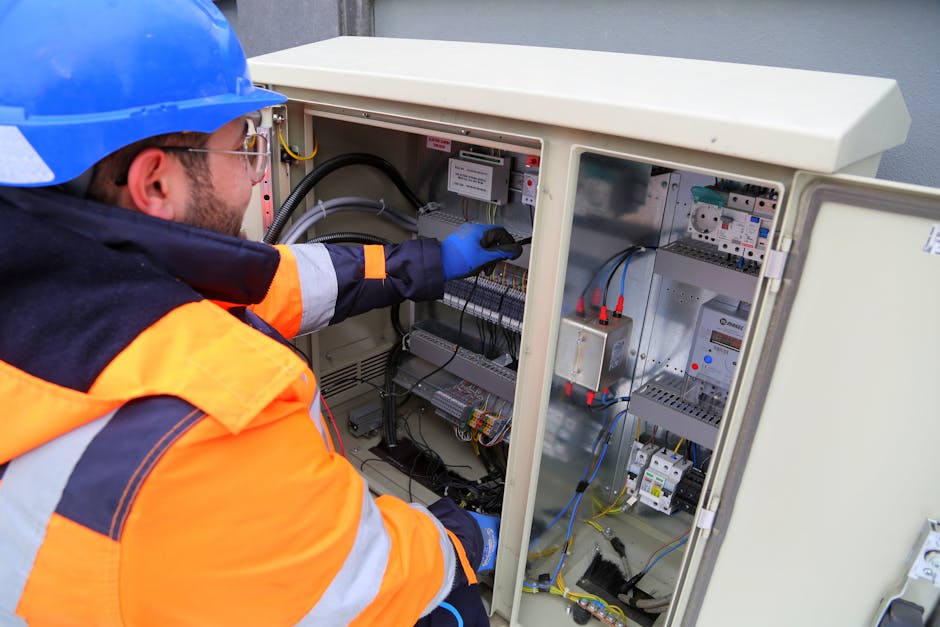
• Safety Hazards: Electrical issues can lead to fire hazards, especially When AC Circuit Breaker Keeps Tripping.
• Poor Air Quality: A neglected AC circulates dust, allergens, and mold spores throughout your Granite Bay home.
Before you pick up the phone, there are a few things you can check yourself.
• Filter Maintenance: Changing a dirty filter can save 5-15% on energy usage. Check our AC Filter Replacement tips to see how often you should swap yours.
• Thermostat Settings: Ensure it’s set to "Cool" and "Auto" rather than "On" (which keeps the fan running even when not cooling).
• Power Supply: Check your circuit breaker and the batteries in your thermostat.
• Clear Debris: Ensure leaves, twigs, and dirt aren't crowding your outdoor unit.
While homeowners can handle filters, most other signs your ac needs repair require a pro. Handling refrigerant is regulated by the EPA and requires specialized tools and certification. If you're in Roseville, our AC Repair Roseville CA Guide explains why professional diagnostics are safer and more cost-effective in the long run. Whether it's complex electrical repairs or sealing ductwork, we have the AC Repair Loomis CA Tips to get the job done right.
Think of a tune-up like an oil change for your car—it’s proactive. A repair is when something has already broken.
• Tune-Up: Includes coil cleaning, checking refrigerant levels, and tightening connections. See our AC Maintenance Plan Complete Guide.
• Repair: Replacing a burnt-out motor or fixing a leak. For those in Lincoln, our AC Service Lincoln CA Complete Guide covers what to expect during a repair visit.
As your system hits that 10-15 year lifespan, you’ll eventually face the "Repair vs. Replace" dilemma.
We often recommend the $5,000 Rule: multiply the age of the unit by the repair cost. If the total is more than $5,000, it’s usually smarter to invest in a new system. Additionally, older units using R-22 refrigerant (Freon) are becoming increasingly expensive to service because R-22 has been phased out for environmental reasons. Upgrading to a modern, high-efficiency unit can slash your energy bills and provide better comfort. For more details, see our AC Unit Replacement Complete Guide.
This is one of the most common signs your ac needs repair. It usually boils down to a dirty air filter, a thermostat set incorrectly, or a more serious issue like Why AC Unit is Not Cooling Properly due to a failing compressor or low refrigerant.
We recommend professional service at least once a year, ideally in the early spring before the heat hits. Regular maintenance is the best way to prevent emergency breakdowns. Residents can follow our AC Maintenance Rocklin CA Guide for a seasonal checklist.
A grinding noise is usually the sound of metal-on-metal. This often means the motor bearings are worn out. If you hear this, shut the system down immediately to prevent the motor from seizing up entirely. You can learn more about the causes here: Why AC is Making a Grinding Noise.
Don't let a failing air conditioner ruin your summer. By keeping an eye out for these signs your ac needs repair, you can stay ahead of the heat and keep your home comfortable all season long. Whether you're in Roseville, Rocklin, or Granite Bay, our team is here to help.
At Royalty Heating & Air, we aren't just HVAC experts; we are members of your community. We are proud partners with the MackAttack Foundation, where we support foster babies and sponsor family adoptions. When you choose us, you're supporting a business that gives back to local families.
Schedule your professional AC service today and experience the Royalty difference!
