
Services
About
Service Areas


Are you constantly adjusting your thermostat because your home feels sticky and uncomfortable, even though the cooling system is actively running? At Royalty Heating & Air, our technicians frequently hear from customers stuck in this exact situation. Evaluating a Single-Stage vs Variable-Speed AC for Managing Sacramento Valley Humidity Swings is often the missing piece of the puzzle when you want true indoor comfort. It is a frustrating cycle we see all the time: the outdoor temperature finally drops in the evening, your air conditioner kicks on to cool the house, but instead of feeling crisp and refreshing, the indoor air feels heavy, damp, and clammy. This specific discomfort is a concrete problem for homeowners trying to manage indoor humidity during sudden weather shifts, particularly when evening temperatures drop but moisture levels spike.
If you are looking to upgrade your home's cooling technology, learning more about modern Air Conditioning solutions is the best place to start. The decision point for many local residents comes down to deciding whether the continuous dehumidification of a variable-speed AC system is worth the investment over a standard single-stage unit. During July peak summer and those notoriously muggy delta breeze days, standard cooling systems often struggle to keep up with the changing atmospheric conditions. By understanding how different types of air conditioning compressors handle moisture, you can make an informed choice that keeps your living space comfortable regardless of what the weather is doing outside.
To understand why your home feels uncomfortable on certain evenings, we have to look at the unique weather patterns of Roseville and the greater Sacramento Valley. In our years of optimizing cooling systems across the region, our team has learned that you cannot treat our climate like a standard dry-heat zone. During the peak of summer, our region is famous for intense, triple-digit dry heat. Throughout the afternoon, your air conditioner works hard simply to lower the indoor temperature, battling the sheer thermal load of the sun beating down on your roof and walls. Under these dry conditions, a standard cooling system performs exactly as expected, blowing cold air until the thermostat reaches your desired setpoint.
However, a pattern we see often is the challenge that arises when the evening marine layer intrusion—commonly known as the delta breeze—rolls in. While this breeze provides welcome relief from the blistering daytime heat, it unfortunately brings a massive influx of unwanted moisture indoors. The outdoor temperature might drop from 100 degrees down to 75 degrees, but the relative humidity skyrockets. This sudden shift completely changes the type of work your air conditioner needs to do to keep you comfortable.
If you are considering an AC installation in Roseville, it is critical to understand the difference between sensible heat and latent heat. Sensible heat is the temperature you can feel and measure with a standard thermometer. Latent heat, on the other hand, refers to the thermal energy stored within the moisture in the air. Simply dropping the temperature on a thermostat does not equate to true comfort if the air remains saturated with latent heat. When the air is full of moisture, your sweat cannot evaporate, leaving you feeling sticky and warm even if the room is technically cooled to 72 degrees. Managing this latent heat is the real secret to achieving a crisp, comfortable home environment.
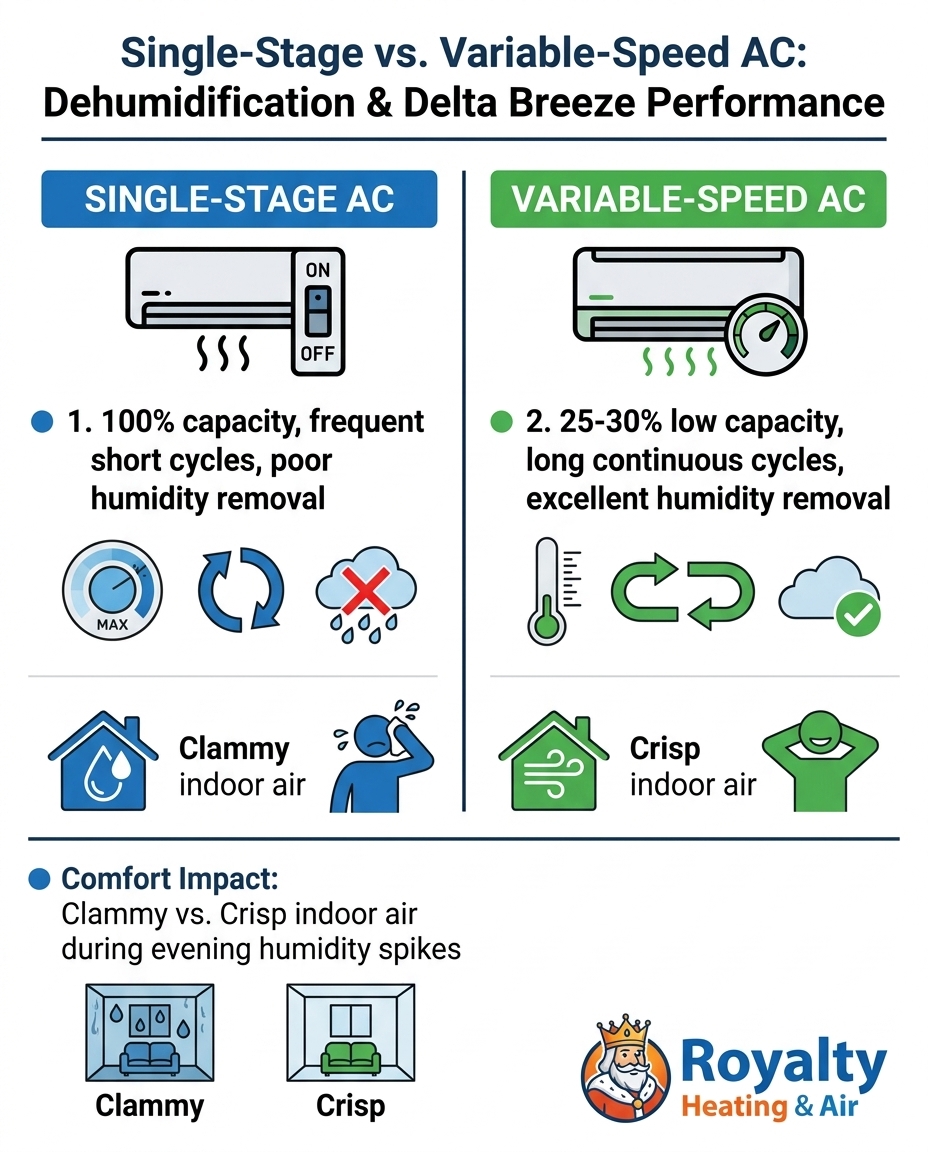
When our technicians are out in the field, we typically see the vast majority of older homes equipped with traditional single-stage air conditioning systems. The fundamental mechanic of a single-stage unit is that its compressor only has one speed: 100 percent capacity. When your thermostat senses that the house is too warm, it sends a signal to the AC, and the system turns on at full blast. It runs at maximum power until the target temperature is reached, and then it shuts off entirely. There is no middle ground, no low gear, and no ability to adjust to the specific cooling load of the moment.
This all-or-nothing approach becomes a significant problem during July peak summer and muggy delta breeze days. When the outdoor temperature drops in the evening, your home does not need a massive blast of cold air to reach the thermostat's setpoint. The single-stage AC turns on, pumps a massive volume of cold air into the house, and satisfies the thermostat in a matter of minutes. This rapid on-and-off behavior is known as "short-cycling."
The problem with short-cycling:
• Inadequate moisture removal: An air conditioner removes humidity by passing warm indoor air over a freezing cold evaporator coil, causing the moisture to condense and drain away. This process takes time. If the system only runs for ten minutes before shutting off, it cools the air but leaves all the humidity behind.
• Stagnant air: When the system shuts off quickly, air circulation stops, allowing the remaining moisture to settle and create that dreaded clammy feeling.
• Uneven temperatures: Short blasts of cold air often fail to reach the furthest rooms in the house, leaving some areas freezing and others warm and sticky.
Beyond the lack of comfort, frequent on-and-off cycling puts tremendous stress on your HVAC equipment. The most energy-intensive and strenuous part of an air conditioner's operation is the startup phase. A system that constantly turns on and off draws more electricity and wears out components—like capacitors and contactors—much faster than a system that runs steadily. Over time, this erratic operation can lead to a premature need for AC repair services, as the constant mechanical stress takes its toll on the compressor.
We recommend variable-speed technology for these situations because it actively solves the clammy air problem by changing how the compressor operates. Instead of being limited to just 100 percent or zero percent, a variable-speed (or inverter-driven) compressor can modulate its output in precise increments. These advanced systems can operate at capacities as low as 25 to 30 percent, adapting continuously to the exact cooling and dehumidification needs of your home in real-time.
When the evening humidity rolls across Roseville and the greater Sacramento Valley, a variable-speed system handles the changing weather with a completely different strategy. Here is how the dehumidification process works step-by-step:
1. Low-Speed Operation: The system detects that the temperature is relatively mild but the humidity is high. It powers on at a very low capacity, perhaps just 30 percent.
2. Extended Coil Contact: Because it is running at a low speed, the blower fan moves air gently and slowly over the indoor evaporator coil. This extended contact time allows maximum condensation to form on the coil, wringing moisture out of the air like a sponge.
3. Continuous Circulation: The system runs for long, uninterrupted cycles. Instead of blasting the house with cold air and shutting off, it provides a steady, gentle flow of conditioned air, constantly pulling humidity out of the environment without overcooling the rooms.
4. Precise Comfort: By eliminating the blast-and-shut-off cycle, the indoor temperature remains perfectly stable, usually staying within half a degree of your thermostat setting while keeping the air feeling crisp and dry.
The advantages of this technology extend beyond just moisture control. Because the system spends most of its time operating at lower speeds, it is significantly quieter than a traditional unit. You won't hear the loud clunk of the compressor kicking on or the rush of air through the vents. Furthermore, running at low speeds reduces the static pressure inside your ductwork. If you have ever heard your AC making a high-pitched whistling sound, it is often due to a single-stage system forcing too much air through restrictive ducts. Variable-speed systems alleviate this strain, protecting your ductwork and providing a more peaceful home environment.
To clearly see how these two technologies stack up against each other during July peak summer and muggy delta breeze days, it helps to look at a direct, side-by-side comparison. The table below outlines the critical differences in how each system handles the specific challenges of our local climate.
• Moisture Removal (Dehumidification) — Single-Stage AC Systems: Poor during cool/humid conditions due to short run times. — Variable-Speed AC Systems: Excellent; continuous extraction pulls moisture steadily.
• Cycle Lengths — Single-Stage AC Systems: Short, frequent cycles (blasts of cold air then shuts off). — Variable-Speed AC Systems: Long, low-energy cycles (runs continuously at low capacity).
• Energy Consumption During Humidity Spikes — Single-Stage AC Systems: High startup energy required for frequent on/off cycling. — Variable-Speed AC Systems: Highly efficient; uses minimal power to maintain low speeds.
• Indoor Temperature Consistency — Single-Stage AC Systems: Noticeable temperature swings of 2 to 4 degrees. — Variable-Speed AC Systems: Precise comfort; stays within 0.5 degrees of setpoint.
• Overall Comfort Feeling — Single-Stage AC Systems: Often leaves the home feeling clammy and sticky in the evening. — Variable-Speed AC Systems: Keeps the indoor air feeling crisp, dry, and perfectly balanced.
A single-stage system is best suited for consistently hot, dry climates where rapid temperature reduction is the only goal. Because the technology is older and simpler, these units typically come with a lower upfront equipment cost. However, they are highly prone to leaving the indoor air feeling sticky when ambient outdoor temperatures drop but humidity remains high. If your primary goal is basic cooling and you are less sensitive to indoor humidity levels, a single-stage unit provides reliable, straightforward performance.
Variable-speed systems are designed to adapt to changing weather patterns automatically. By maximizing latent heat (moisture) removal, they solve the specific comfort challenges created by sudden weather shifts. While they do require a higher initial investment, the long-term efficiency, reduced wear and tear, and vastly superior comfort make them highly desirable for homeowners who want precise control over their indoor environment. Keep in mind that federal tax credits and local utility incentive programs may apply to qualifying high-efficiency installations, so we always advise our clients to verify current programs with their utility provider or a tax professional.
Deciding whether the premium for variable-speed technology makes sense for your specific household requires evaluating a few distinct factors. Not every home needs top-tier technology, but homes that are highly sensitive to humidity, or homeowners looking for advanced energy efficiency, benefit the most from this upgrade. If you constantly find yourself dissatisfied with how your home feels in the evenings, or if you have specific indoor air quality concerns, the continuous air circulation provided by a variable-speed unit is often the perfect solution.
It is also worth noting that there are alternative high-efficiency solutions that offer similar variable-speed benefits. Modern heat pump systems, for example, frequently utilize inverter-driven compressors to provide both exceptional summer dehumidification and efficient cooling. The key is finding a comprehensive approach to your home's thermal envelope.
Recently, our team at Royalty Heating & Air worked with a local homeowner who reached out needing an AC unit replacement, but they also recognized that their home struggled with overall airflow and heat retention. By replacing the outdated AC unit and simultaneously installing a whole house fan and upgraded insulation, all of their comfort needs were met professionally. This holistic approach ensures that the mechanical equipment isn't fighting a losing battle against a poorly insulated house.
Ultimately, the success of any high-efficiency system relies on a professional, proper installation. Leveraging Royalty Heating & Air's local expertise means you partner with a company that provides honest, tailored comparisons. A good HVAC partner ensures homeowners in Roseville and the greater Sacramento Valley invest in the right comfort solutions without overspending on unnecessary features. Proper sizing, meticulous ductwork evaluation, and correct airflow settings are mandatory to ensure the system actually delivers on its dehumidification promises.
True indoor comfort requires more than just a powerful fan and a cold coil; it requires managing both the intense heat of the afternoon and the sudden humidity swings of the evening. Whether you choose a dependable single-stage unit or a highly adaptable variable-speed system, the right choice depends entirely on your specific comfort goals, your home's unique layout, and your long-term efficiency expectations.
Living in Roseville and the greater Sacramento Valley means dealing with unique weather patterns that demand thoughtful cooling solutions. If you are tired of a clammy, sticky home and want to explore how modern air conditioning technology can transform your indoor environment, we encourage you to schedule a professional assessment with our team to find the perfect fit for your home.
Does a variable speed AC remove more humidity?
Yes, a variable-speed AC removes significantly more humidity than a standard unit. Because the compressor can run at lower speeds, it operates for longer, continuous cycles. This extended run time allows the indoor coil to constantly extract moisture from the air without dropping the temperature too low, resulting in a drier, more comfortable home.
Is variable speed AC worth it in California?
Variable-speed AC is often highly worth it in California, particularly in regions that experience sudden humidity shifts alongside high heat. The technology adapts seamlessly to changing conditions, providing superior comfort during muggy evenings while maximizing energy efficiency during blistering hot afternoons.
Why does my house feel clammy with the AC on?
Your house feels clammy because your AC is satisfying the thermostat's temperature setting before it has time to remove the moisture from the air. This usually happens due to short-cycling, which is common with oversized units or single-stage systems operating during mild but humid weather.
What is the disadvantage of a variable speed AC?
The primary disadvantage of a variable-speed AC is the higher initial equipment and installation investment compared to a basic single-stage unit. Additionally, because the technology is more advanced and relies on complex electronic controls, repairs can sometimes require specialized diagnostics and replacement parts.
How does the delta breeze affect indoor air quality and AC performance?
The delta breeze affects indoor air quality by rapidly introducing cooler, moisture-laden air into the environment. This sudden influx of humidity forces standard AC systems to short-cycle, which halts air circulation, reduces filtration, and leaves the indoor air feeling stagnant and sticky.
