
Services
About
Service Areas


Is your air conditioner actually failing, or is it just struggling to breathe? When weighing a Standard AC Tune-Up vs Deep Coil Cleaning: Which Do You Actually Need?, the answer usually comes down to airflow and heat transfer. At Royalty Heating & Air, a pattern we see often by the time the August late-summer cooling season arrives is that an outdoor condenser unit has likely been running for hundreds of hours. It has pulled countless cubic feet of air through its aluminum fins, and along with that air comes dust, pollen, and environmental debris. Eventually, the system starts to lose its cooling power, running longer cycles while the house still feels uncomfortably warm.
Before assuming you need a major repair or an entirely new unit, it is crucial to understand the difference between routine maintenance and restorative cleaning. Determining whether your system requires a basic check or a heavy-duty chemical wash empowers you to make the right choice for your home and your budget. For comprehensive guidance on keeping your system running efficiently, explore our Air Conditioning services.
The core problem: When an air conditioner cannot release heat outdoors because its coils are insulated by grime, the entire system works harder, consumes more electricity, and accelerates mechanical wear. Understanding the exact condition of your condenser coils prevents you from overpaying for unnecessary restorative services while ensuring your equipment gets the exact level of care required to survive the remainder of the season.
A standard maintenance visit is designed for systems that are generally in good health and have been serviced regularly. The goal is calibration, preventative care, and minor adjustments to keep efficiency high. For example, one local homeowner recently reached out to our team as the back-to-school transition began because their system was not running optimally after a demanding summer. Instead of a major overhaul, our technicians were able to get the system running like new simply by performing a comprehensive baseline tune-up. This level of service focuses on overall system health rather than aggressive restorative work.
If you are scheduling routine AC maintenance in Roseville, the process involves a thorough inspection of both the indoor and outdoor units. The technician evaluates the mechanical and electrical components to ensure everything operates within the manufacturer's specifications.
During a standard tune-up, the primary focus is on the electrical and mechanical baseline of the equipment. This includes several precise measurements:
• Testing electrical components: Technicians measure the microfarads on the dual run capacitor to ensure it can deliver the necessary jolt of energy to start the compressor and fan motor. A weak capacitor is a leading cause of sudden breakdowns.
• Checking contactors and relays: Inspecting for pitting or burn marks on the electrical contactors prevents electrical shorts.
• Verifying refrigerant levels: Checking the subcooling and superheat measurements confirms that the system has the exact amount of refrigerant required for optimal heat transfer.
• Thermostat communication: Ensuring the thermostat accurately reads the indoor temperature and signals the equipment without delay.
The cleaning portion of a standard tune-up is gentle and preventative. Because a typical system in Roseville CA has likely accumulated a light layer of surface dust, our technicians use a soft-bristle brush to clear away loose leaves, spider webs, and cottonwood seeds from the outdoor unit. Following the brushing, a gentle water rinse—using standard hose pressure without heavy chemicals—washes away the unattached dirt. This is usually more than enough to restore optimal airflow for a system that receives annual care.
While a standard tune-up is preventative, a deep chemical coil cleaning is a restorative service. It is reserved for systems that have been neglected for years or have operated in extreme conditions where dirt has bypassed the surface and compacted deep inside the condenser fins. For instance, another local homeowner took advantage of our end-of-season tune-up special only for our team to discover their system had significant, hardened buildup on the motor and coils. Our technician had to perform a full system rejuvenation using specialized cleaners to break down the grime, ultimately ensuring the home was comfortable and safe for the remainder of the late-summer heatwave.
By the peak of the August late-summer cooling season, compacted dirt acts like a heavy wool blanket wrapped around your air conditioner. When standard brushing cannot dislodge this baked-on layer, professional intervention is mandatory.
Deep cleaning requires specialized, commercial-grade chemical agents that are strictly designed for HVAC applications. These are not products you can buy at a local hardware store, and they require a licensed professional to apply them safely.
1. Application of the foaming agent: The technician applies a specialized alkaline or acid-based coil cleaner directly to the aluminum fins.
2. Chemical expansion: The chemical reacts with the compacted dirt, foaming up and expanding. This expansion physically pushes deeply embedded grime, grease, and oxidation out from the microscopic gaps between the delicate fins.
3. Dwell time: The solution sits for a specific period to break down stubborn organic matter and baked-on dust.
4. Neutralization and rinsing: The technician thoroughly rinses the coils to remove all traces of the chemical. Leaving residual cleaner on the coils can corrode the aluminum, which is why this process must be handled by an expert.
The immediate impact of a deep chemical wash is profound. Air conditioners do not actually "create" cold air; they absorb heat from inside your home and release it outdoors through the condenser coils. When the insulating layer of grime is chemically removed, the system can properly reject that heat. Homeowners typically notice that their cooling cycle times drop significantly, the air coming from the vents feels colder, and the outdoor unit operates much more quietly once it can finally breathe.
The environment directly dictates the type of buildup your air conditioner experiences. In humid, coastal climates, HVAC technicians primarily battle biological growth—mold, mildew, and algae—that thrives on the damp coils. However, in our years serving the Central Valley and Roseville CA, the Royalty Heating & Air team has tackled an entirely different set of environmental challenges.
The Mediterranean climate effect: Our region is characterized by hot, dry summers with very little precipitation. Months of running in this dry heat means the outdoor condenser acts like a giant vacuum for airborne particulate matter. Agricultural dust, dry pollen, vehicle exhaust particulates, and loose dirt are constantly pulled into the fins.
Because the unit runs for such extended periods during the peak summer months, the immense heat generated by the compressor literally bakes this dry dust onto the aluminum coils. Over time, cumulative runtime exacerbates the buildup. What starts as a light dusting in June becomes a hard, suffocating crust by late August. This specific type of baked-on, dry dirt is highly resistant to a simple water rinse, which is often the deciding factor in why a chemical wash becomes necessary in our specific climate.
You do not have to guess what your system needs. The equipment usually provides clear, observable symptoms that indicate whether it is merely fatigued from the August late-summer cooling season or severely suffocated by compacted grime. Use the following diagnostic criteria to understand your system's current condition.
• Visual Inspection (Outdoor Unit) — Signs a Standard Tune-Up is Sufficient: Dirt on the exterior fins easily brushes away with a finger; metal is mostly visible. — Red Flags Requiring a Deep Chemical Wash: Dirt is caked on, filling the microscopic gaps between the aluminum fins. The metal looks matted.
• Airflow Temperature — Signs a Standard Tune-Up is Sufficient: The air blowing out the top of the condenser feels warm and steady. — Red Flags Requiring a Deep Chemical Wash: The air blowing out the top feels excessively hot, or airflow is noticeably restricted.
• Cooling Cycle Length — Signs a Standard Tune-Up is Sufficient: The system runs in normal 15-20 minute cycles and maintains the thermostat setting. — Red Flags Requiring a Deep Chemical Wash: The outdoor unit runs constantly, but the indoor temperature never reaches the set point.
• System Stability — Signs a Standard Tune-Up is Sufficient: The air conditioner operates smoothly without sudden stops. — Red Flags Requiring a Deep Chemical Wash: The system occasionally trips the electrical breaker or shuts down entirely due to thermal overload.
• Energy Consumption — Signs a Standard Tune-Up is Sufficient: Utility bills align with normal summer usage expectations. — Red Flags Requiring a Deep Chemical Wash: A sudden, unexplained spike in electrical costs compared to the same month last year.
If your system is keeping up with the heat, operating in normal cycles, and the dirt on the outside unit looks like a light layer of lint, a standard maintenance visit is all you need. The technician will verify the electrical draw, rinse the surface dust, and clear the condensate drain to ensure the system finishes the season strong.
If your system exhibits the red flags in the right-hand column, the compressor is likely overheating. When the coils are blocked, the heat has nowhere to go, causing the internal pressure of the refrigerant to skyrocket. This triggers the internal thermal limits, which is a primary reason why your AC might be shutting down unexpectedly during the hottest part of the day.
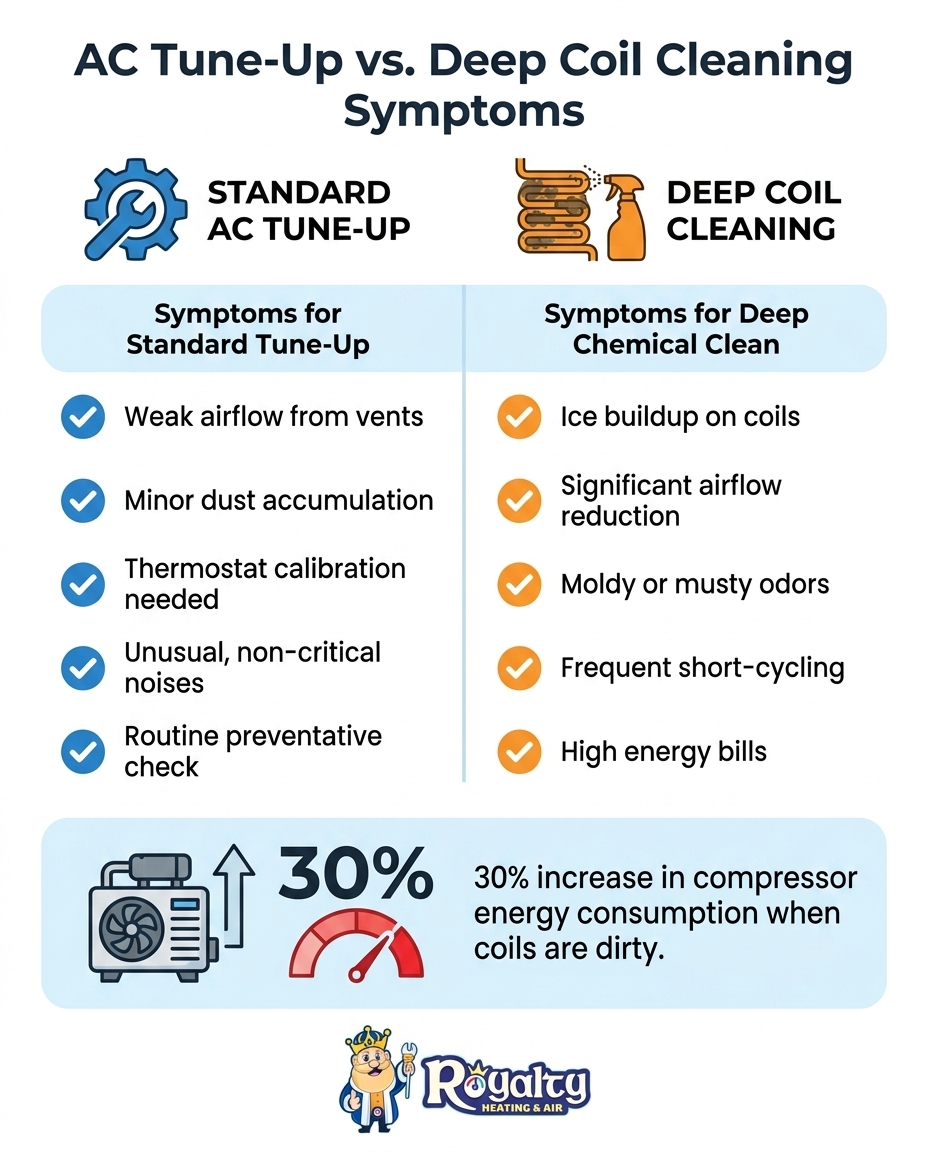
In our experience, ignoring severe coil buildup is one of the most expensive mistakes a homeowner can make. When the condenser fins are choked with Roseville CA dust, the physics of the refrigeration cycle break down. According to data from the U.S. Department of Energy, dirty condenser coils can increase compressor energy consumption by up to 30%. Because the system cannot properly reject heat, it must run significantly longer to achieve the same amount of cooling inside the house.
Accelerated mechanical wear: This continuous, strained operation forces the compressor—the heart of your air conditioning system—to work under immense pressure and extreme temperatures. The compressor relies on the cool refrigerant returning from the house to keep its own internal motor from overheating. When the heat transfer process is disrupted by dirty coils, the returning refrigerant is too warm, causing the compressor oil to break down and lose its lubricating properties.
Over time, this sustained stress significantly reduces the overall lifespan of the HVAC system. What could have been resolved with a restorative coil cleaning eventually leads to premature component failure, burnt wiring, and dead capacitors. Prolonged operation in this state almost inevitably results in a total system breakdown, requiring emergency AC repair at the most inconvenient time possible.
You should never have to guess if a heavy-duty chemical wash is truly necessary. A reputable HVAC technician relies on transparent diagnostics to show you exactly what is happening inside your equipment. When evaluating your system during the demanding August late-summer cooling season, a professional will check the static pressure, measure the electrical amp draw of the compressor, and visually inspect the depth of the dirt on the coils.
At Royalty Heating & Air, our approach is built on transparent diagnostics. We believe in showing the homeowner the data. If the amp draw is normal and the dirt is superficial, we will tell you that a standard tune-up is perfectly sufficient. We ensure homeowners only pay for a deep coil cleaning when the data proves it is genuinely needed to protect the equipment. This commitment to honesty prevents mandatory upsells and builds long-term trust.
When you schedule AC maintenance in Rocklin or surrounding areas, you are partnering with technicians who prioritize the longevity of your system over a quick sale. Transparent service means you get a clear explanation of your system's health, photographic evidence of any severe buildup, and a no-pressure recommendation on the best path forward.
The short answer is yes, but it is a light, preventative cleaning. A standard tune-up includes brushing away loose debris, leaves, and surface dust from the outdoor condenser unit, followed by a gentle water rinse. It does not include the application of expanding chemical foams required to push out deeply compacted, baked-on grime.
Visual inspection and system performance are your best indicators. If you look closely at the outdoor unit and see that the tiny gaps between the aluminum fins are completely blocked by a mat of dirt, the coils need cleaning. Operationally, if your system is running constantly but the house isn't cooling down, or if the unit is tripping the circuit breaker, suffocated coils are a highly likely culprit.
In dry, dusty environments like Roseville CA, coils should be inspected at least once a year. Because our region experiences long, hot summers with significant airborne particulate matter, a preventative rinse is recommended annually. A deep chemical clean is usually only required every few years, depending on how close the unit is to dirt yards, high-traffic roads, or agricultural areas.
Dirty condenser coils trap heat inside the system, destroying its efficiency. The air conditioner loses its ability to release absorbed heat outdoors, which forces the compressor to run longer and hotter. This leads to a spike in energy consumption, diminished cooling capacity inside the home, and accelerated wear and tear that can ultimately cause the compressor to fail prematurely.
No, we strongly advise that chemical coil cleaning should only be performed by a licensed HVAC professional. The foaming agents used are highly caustic and require precise mixing, application, and thorough neutralization. If the chemicals are not rinsed properly, they will corrode and eat away the delicate aluminum fins, permanently ruining the condenser unit.
Understanding the difference between a Standard AC Tune-Up vs Deep Coil Cleaning: Which Do You Actually Need? ultimately comes down to observing your system's symptoms. If your equipment is keeping the house comfortable but just has a light dusting of debris, a routine performance check will keep it running smoothly. However, if the August late-summer cooling season has left your condenser choked with compacted dirt, running constantly without cooling the house, a restorative chemical wash is the only way to save the compressor from premature failure.
You do not have to make this evaluation alone. Professional, transparent diagnostics from our team can pinpoint exactly how much airflow your system is losing and whether heavy-duty cleaning is justified. By relying on clear, symptom-based criteria, you can confidently address your system's needs without feeling upsold, ensuring your home remains cool and comfortable for the rest of the year.
