
Services
About
Service Areas


According to Department of Energy data, roof surface temperatures can exceed ambient air temperatures by 40 to 50 degrees Fahrenheit when exposed to direct sunlight. If you are researching Handling Sun-Baked AC Units on South-Facing Roofs in Lincoln, you already know that the intense dry heat of the Sacramento Valley is unforgiving on exterior equipment. At Royalty Heating & Air, our team sees firsthand how the late August afternoon heat forces your home's cooling system to fight an uphill battle against extreme environmental conditions. To keep your home comfortable and safe as the kids head back to school, you need comprehensive air conditioning services that go beyond basic filter changes, as well as prompt AC repair in Lincoln when the system inevitably struggles under the thermal load.
The core issue is that Lincoln homes with south-facing roof exposures face a compounding environmental challenge. During consecutive days of 100-plus degree weather, the roofing materials—whether dark asphalt shingles, tile, or membrane—absorb massive amounts of solar radiation. Because the nighttime temperatures during a heatwave often do not drop low enough for a sufficient duration, the roof never fully cools down. The next day's sun simply adds more heat to an already superheated surface.
For homeowners with rooftop package units, this creates a critical decision point. You cannot simply hope the equipment survives another brutal summer. You must decide whether to invest in strategic thermal mitigation, upgrade to a more resilient system built for extreme ambient conditions, or relocate the unit entirely. Standard maintenance checklists designed for shaded, ground-level systems are simply not enough for this specific regional edge case. Surviving the Placer County summer requires understanding the mechanics of thermal overload and taking proactive steps to protect your investment.
The reason south-facing roofs present such a unique challenge in this microclimate comes down to the physics of solar radiation. In the northern hemisphere, south-facing surfaces receive the maximum angle of intense afternoon solar radiation. This is exactly when ambient air temperatures are peaking, creating a double-impact event for any mechanical equipment mounted on that surface.
When our technicians climb onto a Lincoln roof during a late-summer heatwave, we immediately feel the compounding effect your rooftop package unit experiences. The ambient air heat combined with the radiant heat baking off the roof creates an extreme microclimate immediately surrounding the HVAC unit. An air conditioner cools your home by absorbing indoor heat and exhausting it outside. To exhaust that heat successfully, the outside air must be cooler than the hot refrigerant passing through the outdoor condenser coil. When the microclimate around the unit reaches 140 or 150 degrees, that crucial temperature difference shrinks, drastically reducing the system's ability to reject heat and dropping overall cooling efficiency to dangerous levels.
To fully grasp why your AC condenser struggles, you have to define the difference between ambient temperature and radiant temperature.
• Ambient Temperature: This is the weather report. It is the temperature of the air measured in the shade, away from direct sunlight and reflective surfaces.
• Radiant Temperature: This is the actual heat radiating off a physical surface—in this case, your roof. It is the direct result of solar energy being absorbed and re-emitted as heat.
The thermal trap: Your AC condenser pulls in surrounding air to cool its internal coils. If the ambient air is 105 degrees, the system is already working hard. But if the air it pulls in is being superheated by a 150-degree roof surface directly below it, the condenser is essentially trying to cool itself with an oven breeze. The heat transfer process stalls, and the internal components begin to bake.
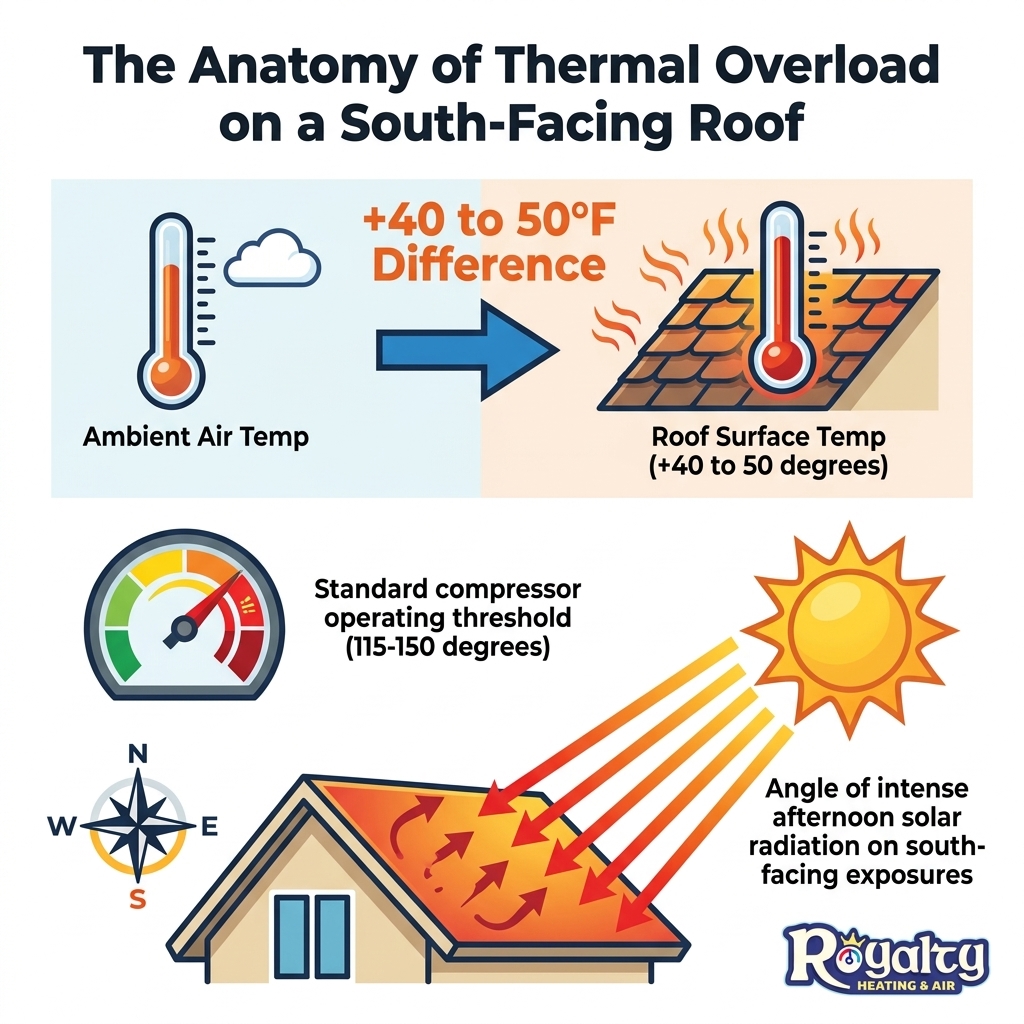
When the internal temperatures of your air conditioner climb too high, the system relies on built-in safety mechanisms to prevent catastrophic failure. The most critical of these is the thermal overload switch. This component is designed specifically to protect the compressor—the expensive heart of your cooling system—from melting down under extreme stress.
Manufacturer specifications for standard HVAC units often set ambient operating thresholds around 115 to 150 degrees Fahrenheit. While a 115-degree day might seem rare on a standard weather app, a south-facing roof easily exceeds that threshold by noon. When the internal temperature of the compressor casing hits this limit, the thermal overload switch breaks the electrical circuit, instantly shutting down the compressor. If you find yourself wondering why your AC compressor won't start during the hottest part of the day, thermal overload is often the primary culprit.
A pattern we see often during the hot back-to-school transition is a system that runs fine in the morning but suddenly shuts down, blows warm air, or trips the circuit breaker at the electrical panel during peak afternoon heat. Important warning: Never attempt to manually reset, bypass, or tamper with a thermal overload switch. This is a vital safety device that handles high voltage. Bypassing it will almost certainly destroy your compressor and poses a severe electrical hazard. Diagnostics of this nature require a licensed professional.
The compressor safety switch monitors the internal temperature of the compressor motor windings. As the unit struggles to reject heat into the superheated rooftop air, the compressor has to work harder, drawing more electrical amperage. This increased amp draw generates even more internal heat.
Repeatedly tripping this safety switch degrades the lifespan of the compressor. Every time the system reaches the point of thermal overload, the internal oils that lubricate the compressor begin to break down and acidify. Over time, this acid eats away at the motor windings, eventually leading to a complete, irreversible burnout. Ignoring a unit that constantly trips in the late August afternoon heat is a fast track to a premature system replacement.
In our years of servicing Placer County homes, we frequently meet homeowners who read general HVAC maintenance advice and assume it applies equally to all systems. However, there is a massive distinction between ground-level split systems and fully exposed rooftop package units. Ground-level condensers often benefit from natural yard shade provided by trees, fences, or the shadow of the house itself. Furthermore, the ground—especially if surrounded by grass or mulch—does not reflect and retain radiant heat the way a sprawling expanse of asphalt shingles does.
Rooftop package units face a completely different reality. These systems house all major components—the compressor, the condenser coil, the evaporator coil, and the blower motor—inside a single metal box that sits fully exposed, baking in the sun from dawn until dusk.
The unique vulnerabilities of package units include:
• Zero natural shade: They sit at the highest point of the property, taking the brunt of direct solar radiation all day.
• Metal heat retention: The heavy metal casing of the package unit itself absorbs solar heat, transferring that thermal energy directly into the internal compartments where the sensitive electronics and motors live.
• Compounded airflow restrictions: Because they sit on the roof, they are highly susceptible to gathering wind-blown debris, leaves, and dust, which choke off the exact airflow they desperately need to cool down.
Because of these factors, standard ground-level maintenance rules fall short. A rooftop unit on a south-facing exposure requires aggressive, specialized strategies from experienced professionals to survive the Placer County summer.
When relocating the unit isn't immediately feasible, the first professional mitigation option to evaluate is the installation of strategic shade structures. By blocking direct solar radiation from hitting the metal casing of the unit and the immediate roofing surface around it, you can significantly lower the radiant temperature of the microclimate.
However, shading a rooftop unit is not a simple weekend project. The critical danger of DIY shading is that obstructing the unit's exhaust fan or restricting its intake airflow will cause worse overheating than the sun itself. If the hot air blown out of the top of the unit is trapped by a low-hanging shade sail, it will be sucked right back into the intake coils, creating a localized heat loop that will trip the thermal overload switch in minutes.
The professional shading process involves specific steps:
1. Assessing clearance requirements: Any shade structure must maintain manufacturer-specified vertical and horizontal clearances. This typically means several feet of unobstructed vertical space above the exhaust fan.
2. Designing for airflow: Professionals design structures that block the southern sun angle while remaining completely open on the sides to allow prevailing breezes to carry away the exhausted heat.
3. Material selection: The structure must be built from materials that do not trap heat or create a greenhouse effect, and it must be securely anchored to withstand high rooftop winds without damaging the roof membrane.
4. Load calculation: Ensuring the roof structure can handle the additional weight and wind-shear load of an awning or screen.
When a system is already fighting a 150-degree radiant microclimate, it needs every millimeter of its condenser coil to be operating at peak efficiency. Dirt, dust, pollen, and smog act as a highly effective insulating blanket. When this grime coats the aluminum fins of the condenser coil, it traps heat inside the system, preventing the refrigerant from cooling down.
A system rejuvenation that thoroughly cleans the motor and coils restores the unit's ability to reject heat. This is not a simple hose-down; it requires chemical coil cleaners that foam up and push embedded debris out from deep within the fins, followed by a careful straightening of any bent fins to maximize airflow.
Just last August, as local families were prepping for the back-to-school transition, our team at Royalty Heating & Air responded to a homeowner whose system was in exceptionally bad shape. Our technician found significant dirt buildup on both the motor and the coils, severely restricting the unit's performance. By performing a deep system rejuvenation to clean the motor and coils, the technician was able to restore proper airflow. The outcome was a comfortable home and a family safe from the cascading failures that severe buildup can cause. Regular AC maintenance is the most cost-effective way to ensure your system survives the toughest weeks of summer without unexpected breakdowns.
For some Lincoln homes with south-facing roof exposures, mitigation strategies like shading and cleaning are only temporary bandages. If your system is older, undersized, or simply not built for the extreme temperatures of the Sacramento Valley, you will eventually face the ultimate decision point: upgrading the unit or relocating it entirely.
As your local experts, the team at Royalty Heating & Air specializes in diagnosing complex thermal edge cases in Placer County. We move beyond basic part replacement to offer strategic system mitigation designed specifically for our unique climate. When a standard system repeatedly fails under thermal overload, we help homeowners evaluate long-term, permanent solutions.
Upgrading to high-ambient equipment:
In our experience, we often recommend upgrading to high-ambient equipment over temporary fixes because standard systems simply aren't built for these extremes. Manufacturers produce high-ambient-rated package units designed specifically for desert-like conditions. These systems feature larger condenser coils, higher-capacity fan motors, and heavy-duty compressors engineered to operate safely even when ambient temperatures soar past 120 degrees. While the initial investment is higher, these units will not shut down when you need them most.
The most definitive solution to south-facing roof exposure is to remove the unit from that environment entirely. Relocating the HVAC system to a north-facing roof, or transitioning from a rooftop package unit to a ground-level split system positioned in a shaded side yard, eliminates the radiant heat problem at its source.
When weighing this option, you must balance the upfront disruption of relocating ductwork and electrical lines against the long-term benefits. Moving the unit eliminates afternoon breakdowns, extends the lifespan of the equipment by years, and drastically improves daily energy efficiency. A professional load calculation and site assessment are mandatory to determine the feasibility of a relocation project. Furthermore, when upgrading to high-efficiency systems during a relocation, generic federal tax credits or local utility rebates may apply to qualifying equipment, helping to offset the overall investment. Always consult with your utility provider or a tax professional to verify current program eligibility.
Your rooftop AC trips the breaker because extreme heat causes the compressor to draw too much electrical current. When the roof surface temperature spikes, the system struggles to reject heat, which forces the motor to work harder. This excessive amp draw triggers the circuit breaker to prevent electrical fires. It can also trigger the internal thermal overload switch to protect the compressor from melting down.
Yes, shading your rooftop AC unit can significantly lower the radiant heat it absorbs, but it must be done professionally. A poorly designed shade structure can trap the hot air exhausting from the top of the unit, forcing the system to breathe in its own superheated air. Any shade structure must maintain strict vertical and horizontal clearances to ensure proper airflow and heat dissipation.
Direct sunlight heats up the metal casing of the package unit and drastically raises the temperature of the air immediately surrounding it. Because a package unit houses all components—including the sensitive compressor and condenser coils—in one box, this solar radiation compounds the internal heat. This makes it incredibly difficult for the system to cool the refrigerant, leading to a drop in efficiency and potential thermal overload.
Most standard AC compressors are designed with a maximum ambient operating threshold between 115 and 150 degrees Fahrenheit. Once the internal temperature of the compressor casing exceeds this limit, the built-in thermal safety switch will trip to shut the system down. On a south-facing roof in direct sunlight, the radiant heat can easily push the microclimate past these safe operating limits.
No, you should never attempt to manually reset or bypass a thermal overloaded compressor yourself. The thermal overload switch is a critical safety device dealing with high-voltage electricity. If the switch has tripped, the compressor needs time to cool down naturally, and the underlying cause of the overheating must be diagnosed by a licensed HVAC professional to prevent catastrophic equipment failure.
While gently rinsing a condenser coil can remove dirt and temporarily lower the coil temperature, hosing down a rooftop unit is not a safe or permanent solution for thermal overload. Spraying cold water on an overheating, high-voltage electrical appliance can cause internal components to crack from thermal shock or create severe electrical hazards. Deep cleaning should be left to professionals using proper coil-cleaning solutions.
Surviving the late-summer heat requires more than just crossing your fingers and hoping your rooftop package unit holds up through another afternoon heatwave. When you are dealing with the extreme radiant heat of a south-facing roof in the Sacramento Valley, standard maintenance is not enough. You need strategic thermal mitigation to protect your equipment and keep your home comfortable.
Whether the right path forward involves professional shading, a deep chemical coil cleaning, upgrading to a high-ambient system, or relocating the unit entirely, acting proactively is essential. Do not wait until the system suffers a permanent compressor burnout. Schedule a professional diagnostic with our local experts who understand Placer County's unique thermal challenges, and secure reliable AC repair in Lincoln before the next major heatwave hits.
