
Services
About
Service Areas


Closing vents in unused guest rooms or offices doesn't save electricity—in fact, our team at Royalty Heating & Air constantly reminds homeowners that learning the truth about closing vents in unused rooms to save energy is the first step toward protecting your home from costly repairs. Many homeowners logically assume that if they block off the air to an empty room, the system will redirect that cooling power to the living room or simply work less. Unfortunately, this well-intentioned habit creates a concrete problem: it inadvertently causes severe mechanical strain on your entire heating and cooling system.
You are faced with a crucial decision point: do you keep those vents closed in an attempt to lower your utility bills, or do you open them to protect the blower motor and maintain the proper airflow balance your system requires? The reality is that modern HVAC equipment is not designed to operate with restricted airflow. Especially during the grueling August late-summer cooling season, when we see local equipment already running at peak capacity, shutting off vents is one of the fastest ways to cause a breakdown.
If you want to ensure your system operates efficiently without unnecessary strain, maintaining open pathways is essential. For more information on keeping your home's airflow perfectly balanced, you can explore our professional duct services to optimize your home's performance.
To understand why blocking a vent is harmful, it helps to look at how modern heating systems and air conditioners actually work. Your HVAC system operates as a closed breathing loop. It does not pull fresh air from outside; instead, it pulls the existing air from inside your home, conditions it, and pushes it back out. For this loop to function safely and efficiently, the amount of air being pulled in (return air) must perfectly match the amount of air being pushed out (supply air).
When engineers and technicians design an HVAC system for a home, they calculate the precise Cubic Feet per Minute (CFM) of airflow required to heat or cool the square footage. The blower motor is calibrated to push that exact CFM through the ductwork. If you close a vent, the system does not magically know it should produce less air. It continues to generate the exact same CFM, but now it has fewer pathways to distribute that air. This disruption throws off the entire calculation, leading to increased static pressure inside the ductwork.
The relationship between the supply vents (which blow air into the room) and the return vents (which suck air back to the unit) is delicate. When you close supply vents in a bedroom, the return vent in the hallway is still trying to pull the same volume of air back to the unit. This creates a vacuum effect. The system becomes starved for air on one side and over-pressurized on the other.
• All Vents Open — Airflow Balance: Perfectly matched supply and return — Internal Pressure: Normal operating range — Overall Efficiency: Maximum efficiency and comfort
• Vents Closed — Airflow Balance: Disrupted (vacuum effect created) — Internal Pressure: High (dangerous strain on motor) — Overall Efficiency: Wasted energy and reduced cooling
As the table illustrates, keeping the loop open is the only way to maintain the balance your equipment was built to handle.
When you block a vent, the air that was supposed to enter the room has nowhere to go. It backs up into the ductwork, creating a phenomenon known as increased static pressure. You can think of static pressure like blowing air through a drinking straw. If you pinch the end of the straw, you have to blow much harder to force the same amount of air through. When you close vents, you are essentially pinching the straw on your HVAC system.
This increased static pressure forces the blower motor to work significantly harder to overcome the artificial resistance. Because the motor is straining against this pressure, it draws more electrical current. Ultimately, this leads to higher electricity consumption, completely negating any perceived energy savings you hoped to achieve by closing the vent in the first place.
As the air pressure builds up behind a closed vent, it has to find an escape route. Most residential ductwork is not perfectly airtight. The intense pressure forces the conditioned air out through tiny leaks, seams, and joints in the ducts. Instead of cooling your home, you end up pumping expensive, conditioned air straight into your hot attic or crawlspace.
During a recent late-summer installation of a new AC unit here in Roseville, the importance of clear pathways became highly evident to our installation team. We prioritized a thorough duct cleaning alongside the new equipment to ensure optimal airflow and efficiency. A flawless installation relies heavily on clean, unobstructed ductwork because any blockage—whether from dust buildup or intentionally closed vents—artificially spikes the pressure and degrades the system's efficiency from day one.
Restricting airflow doesn't just waste energy; it triggers a dangerous sequence of mechanical failures. During Roseville's hot late-summer extremes, our technicians see HVAC systems already running at maximum capacity. The intense heat means your equipment is working overtime to keep the house comfortable. When you restrict the airflow during these extreme temperatures, you push the system into failure much faster than you would in a milder climate.
The first major component to suffer is the evaporator coil. This coil sits inside your indoor unit and is filled with highly chilled refrigerant. Its job is to absorb heat from the air blowing over it. When you close vents and reduce the airflow, there isn't enough warm air moving over the coil to keep the refrigerant's temperature regulated.
Without sufficient warm air, the thermodynamic process breaks down. The condensation that naturally forms on the coil drops below freezing and turns into a solid block of ice. Once the coil freezes, the cooling process stops completely, leaving your house hot while the system runs endlessly.
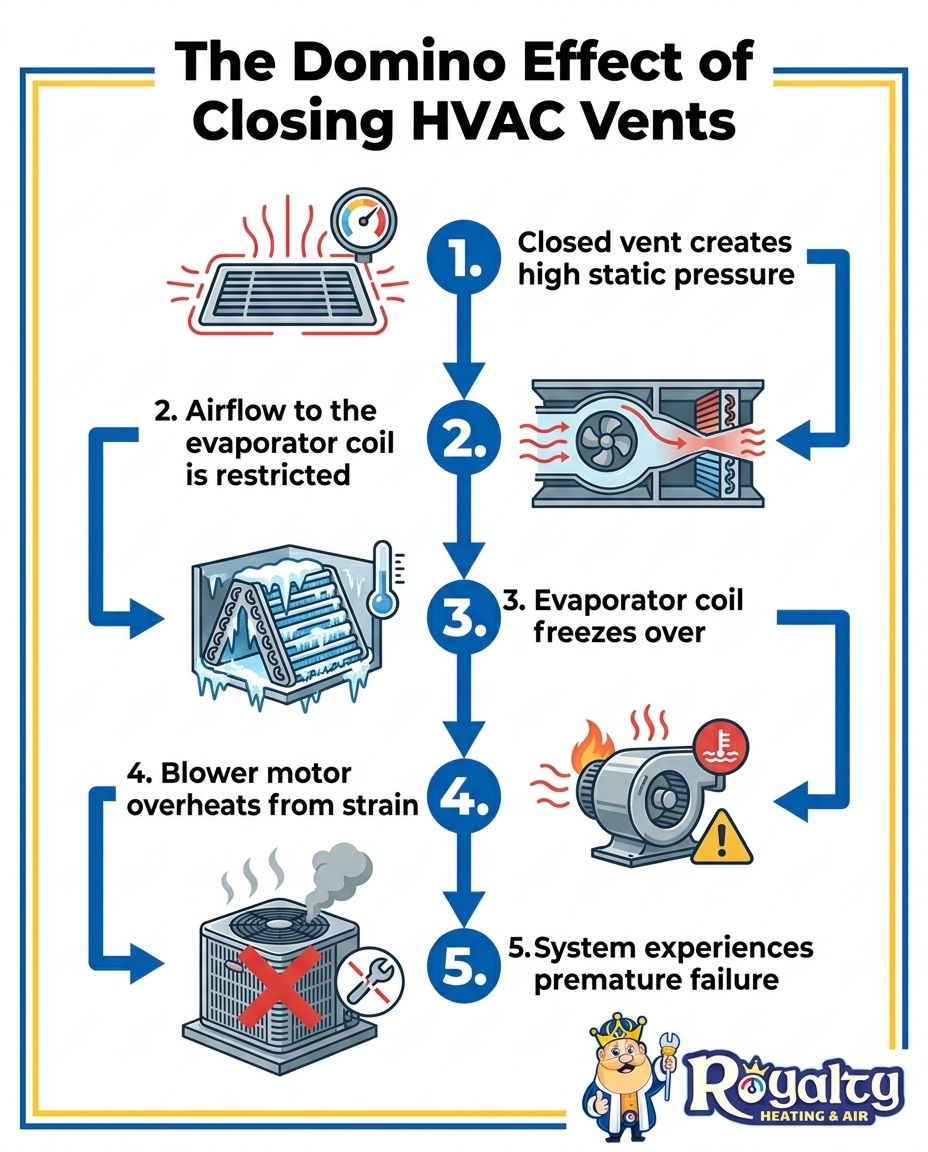
Here is the exact domino effect that occurs when you try this energy-saving hack during the August late-summer cooling season:
1. Airflow is restricted: Closed vents trap air in the ducts, dropping the volume of air moving through the system.
2. The coil freezes: Deprived of warm return air, the evaporator coil drops in temperature until it encases itself in ice.
3. The motor overheats: The blower motor strains against the blocked vents and the ice-covered coil, drawing excessive amperage.
4. Components degrade: The chronic overheating wears down the motor bearings and electrical capacitors.
5. Total failure: The blower motor burns out entirely, requiring a costly AC repair in Roseville at the worst possible time.
Because the damage happens inside the ductwork and the air handler, you might not notice the problem immediately. However, your HVAC system will give you warning signs when it is struggling with increased static pressure. Knowing what to listen and look for can save you from a catastrophic breakdown.
If you notice weak airflow coming from the vents that are still open, do not make the mistake of closing more vents to "force" the air out. Weak airflow is often a sign that the pressure imbalance has already caused duct leakage or that the coil is beginning to freeze over.
Pay close attention to these common auditory and physical symptoms:
• Loud humming noises: A struggling blower motor will often emit a loud, electrical hum as it tries to force air through restricted ducts. If you hear this, you may need to look into why your furnace blower motor making a loud humming noise is failing to push air.
• Whistling sounds at the vent: High pressure forcing air through the tiny gaps in a closed vent louver creates a distinct, high-pitched whistle.
• Unusually hot equipment casing: If the metal cabinet housing your indoor unit feels excessively hot to the touch, the motor is likely overheating.
• Short cycling: The system turns on and off rapidly because it is overheating and shutting down on a safety limit switch.
If you observe any of these signs, the best course of action is to open all the vents in your home immediately and monitor the system. If the noises persist, it is time to call a professional for diagnostics before the motor burns out completely.
At Royalty Heating & Air, working with our expert technicians means getting advice based on real-world diagnostics, not just guesswork. In the field, our team regularly diagnoses premature system failures that trace directly back to restricted airflow. When a system fails because of closed vents, the internal damage is often extensive.
The strain of increased static pressure exacerbates the buildup of dust and debris on critical components. When the motor is working harder and running hotter, it attracts more particulate matter, which bakes onto the motor housing and the evaporator coils. This creates an insulating layer of grime that further traps heat and restricts airflow, accelerating the path to failure.
For example, during a recent end-of-season cooling tune-up, our technicians discovered a system in remarkably bad shape, suffering from severe buildup on both the motor and the coils. This kind of heavy degradation is a pattern we see often, accelerated by restricted airflow. By performing a complete system rejuvenation to clean the motor and coils, the equipment was restored so the home remained comfortable and safe.
There is a stark difference between performing routine seasonal maintenance and repairing the deep mechanical damage caused by intentional airflow restriction. Professional system rejuvenations frequently uncover worn bearings, blown capacitors, and leaking ducts that stem directly from a homeowner's attempt to save energy by shutting doors and vents.
If closing vents is off the table, how can you actually lower your utility costs during the demanding August late-summer cooling season? Fortunately, there are several safe, scientifically sound methods to reduce your energy consumption without putting your air conditioning equipment at risk.
The key is to manage the heat entering your home and to optimize how the system operates as a whole, rather than trying to micromanage individual rooms through the ductwork. Keeping all your vents open actually optimizes the system's runtime and efficiency, allowing it to cool the house quickly and shut off, rather than running endlessly against high pressure.
Consider implementing this checklist of safe energy-saving alternatives:
• Upgrade to a smart thermostat: A smart thermostat learns your schedule and adjusts the temperature automatically, saving energy when you aren't home without restricting airflow.
• Install thermal window treatments: Blocking solar heat gain with blackout curtains or reflective blinds prevents the house from warming up, reducing the workload on your AC.
• Improve attic insulation: Keeping the conditioned air inside your living space and the radiant heat out of your ceiling is one of the most effective ways to lower bills.
• Invest in HVAC zoning: If you truly want individual room control, a professional zoning system uses specialized dampers and a variable-speed motor to safely direct air without causing dangerous pressure spikes.
• Run ceiling fans: Fans create a wind-chill effect on your skin, allowing you to set the thermostat a few degrees higher while feeling just as comfortable.
No, closing vents does not save money. It actually increases static pressure inside your ductwork, which forces the blower motor to work much harder to move air. This extra strain causes the system to consume more electricity, ultimately leading to higher utility bills and expensive mechanical repairs.
Yes, it is highly damaging to close air vents in unused rooms. Modern HVAC systems operate as a balanced loop based on a specific Cubic Feet per Minute (CFM) calculation. Blocking a vent disrupts this balance, creating a vacuum effect that strains the equipment and forces conditioned air out of leaks in the ductwork.
Your AC freezes because closing vents restricts the flow of warm return air over the indoor evaporator coil. Without enough warm air to absorb the cooling energy, the temperature of the refrigerant drops below freezing, turning the natural condensation on the coil into a solid block of ice.
While a small amount of air might redirect, the primary result is a massive pressure imbalance. Instead of effectively cooling the rest of the house, the increased static pressure forces air out through tiny seams and gaps in your ductwork, wasting your conditioned air in the attic or crawlspace.
Standard residential HVAC systems are not designed to accommodate closed vents. The safest practice is to keep 100% of your supply and return vents fully open and unobstructed by furniture or rugs to ensure the blower motor operates within its intended pressure range.
HVAC static pressure is the measurement of resistance to airflow within your ductwork. It matters because high static pressure acts like a clogged artery for your system; it chokes off the air supply, causes the blower motor to overheat, and is a leading cause of premature equipment failure.
Ultimately, the truth about closing vents in unused rooms to save energy is that it is a costly myth. A clear, scientific understanding of how your system breathes is the best way to prevent unnecessary mechanical strain. By recognizing the dangers of increased static pressure, especially during the heavy workloads of the August late-summer cooling season, you can make smarter choices for your home.
Keeping all your vents open is the easiest, most effective way to protect your blower motor and maintain proper airflow balance. Instead of relying on damaging hacks, utilize safe alternatives like smart thermostats and improved insulation to lower your bills. If you suspect your system has already suffered from restricted airflow, reach out to our team at Royalty Heating & Air to optimize your equipment's efficiency and restore your peace of mind.
