
Services
About
Service Areas


A common misconception is that if your air conditioning filter is covered in a thick layer of dog hair when you pull it out, it must be successfully cleaning the air in your home. In reality, choosing between washable vs pleated AC filters for homes with high pet dander requires understanding that capturing visible hair is only half the battle. If you share your home with multiple dogs, you are likely familiar with the frustration of rapidly clogging filters and the persistent, lingering odors that indicate poor indoor air quality.
This challenge peaks during late August and the end-of-summer cooling season. During these intense heatwaves, your AC system runs constantly, circulating massive volumes of air—and heavy amounts of pet dander—through your ductwork every single hour. Homeowners are often forced into a difficult decision point: do you prioritize the sheer convenience of a reusable washable filter, or do you rely on the superior capture efficiency of a disposable pleated filter?
The core conflict:
• Convenience: Washable filters eliminate the need for monthly trips to the hardware store.
• Efficiency: Pleated filters trap the microscopic allergens that washable options leave behind.
• HVAC Health: Both options interact differently with your system's required airflow, especially when loaded with shedding fur.
Finding the right balance is critical not just for the air you breathe, but for the survival of your cooling equipment during the hottest weeks of the year.
To make an informed choice about your filtration strategy, you must first separate the visible shedding from the invisible allergens. The physical differences between pet hair and pet dander dictate exactly how a filter performs under pressure.
Pet hair is large, heavy, and highly visible. Because of its size, almost any filter medium—even cheap fiberglass weaves—can trap it successfully. However, because dog hair is so dense, it quickly forms a thick blanket across the surface of your filter. This blanket acts as a physical wall, blocking incoming air and forcing your HVAC system to work significantly harder to cool your home.
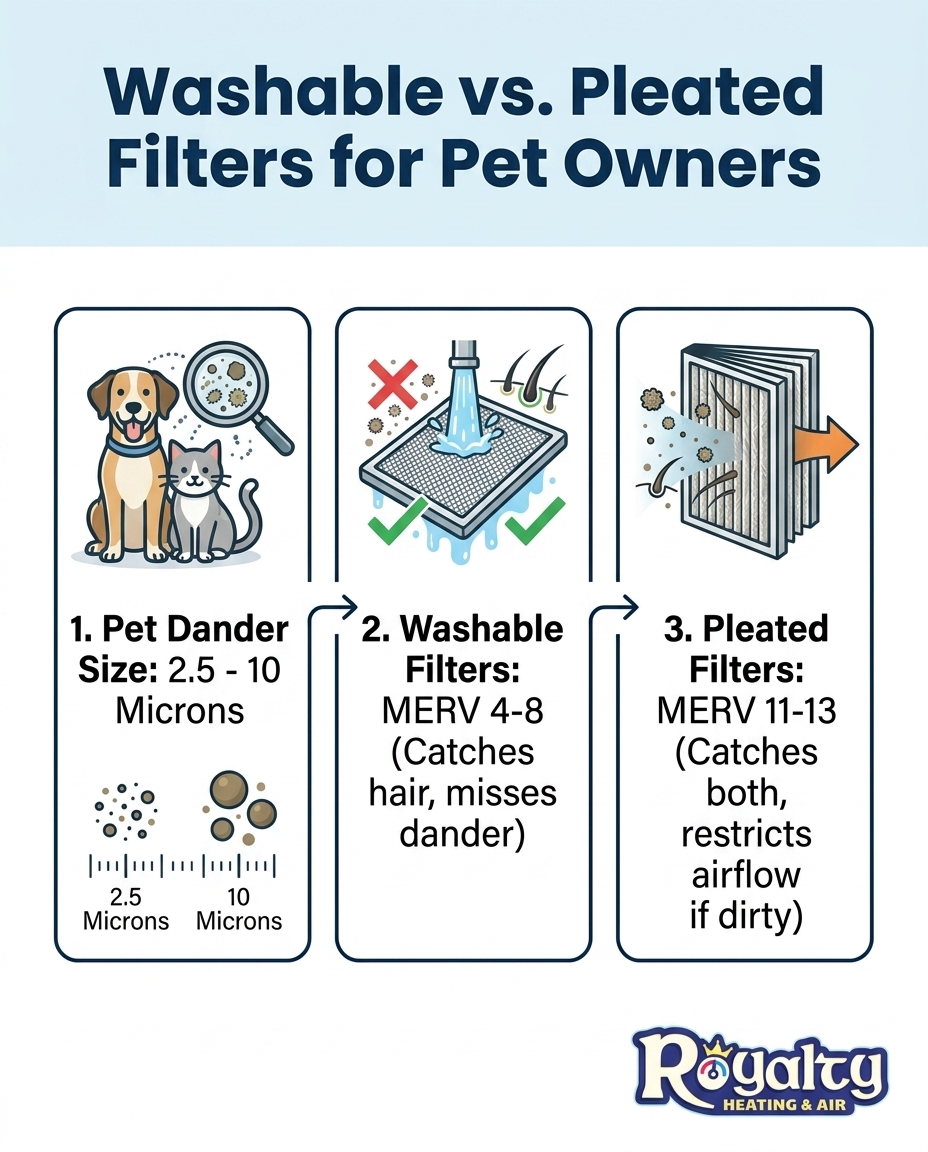
Pet dander is a completely different challenge. Dander consists of microscopic flakes of dead skin shed by dogs, cats, and other animals. These particles typically range from 2.5 to 10 microns in size. To put that into perspective, a single grain of sand is roughly 90 microns across. Because dander is so light and microscopic, it remains airborne much longer than heavy hair, circulating through your HVAC system multiple times a day.
Why this matters right now:
• Heatwave concentration: End-of-summer heat waves force families indoors. Windows stay tightly closed, trapping and concentrating these microscopic particles inside your living spaces.
• System fatigue: As the cooling season drags on, your system processes millions of cubic feet of air, pulling heavy dander loads directly into the blower compartment.
If your filter is only catching the heavy hair, the microscopic dander is blowing right past it, settling into your ductwork and recirculating into your lungs. Managing this invisible threat is a core component of proper AC maintenance in Roseville, where keeping indoor air clean is a year-round necessity.
Washable AC filters, often referred to as reusable electrostatic filters, are highly appealing to multiple-dog households. Instead of buying a new filter every few weeks, you simply remove the unit, hose it off, let it dry, and slide it back into place.
These filters work by generating a mild electrostatic charge as air passes through the woven media. This static electricity acts like a magnet, pulling dust and heavy pet hair out of the airstream. The environmental benefits of keeping disposable filters out of landfills, combined with the sheer convenience of always having a filter on hand, make washable options very popular.
However, washable filters have distinct performance limits. Most reusable filters max out at a MERV (Minimum Efficiency Reporting Value) rating between 4 and 8.
The drawbacks of MERV 4-8 washable filters:
• Excellent for hair, poor for dander: While a MERV 4-8 rating is fantastic for trapping heavy dog hair and large dust bunnies, it misses the vast majority of fine pet dander measuring under 10 microns.
• Climate challenges: Roseville's dry summer climate naturally increases airborne particulate matter. A low-MERV washable filter might let too much of this fine outdoor dust and indoor dander pass directly through to your coils.
• Downtime during washing: Washing these filters requires them to be completely, 100% dry before reinstallation to prevent mold growth inside your dark, damp ductwork. On a 100-degree day in late August, leaving your AC turned off while you wait for a filter to air-dry in the sun is incredibly uncomfortable.
For homes prioritizing allergen removal, the electrostatic limits of a washable filter often fall short of expectations.
Pleated AC filters take a completely different mechanical approach to cleaning your air. Instead of relying on a flat woven surface and static electricity, these filters use a folded (pleated) synthetic media.
The pleats dramatically increase the total surface area of the filter. If you were to pull the pleats flat, the material would be several times larger than the cardboard frame. This expanded surface area allows the filter to trap significantly smaller particles without immediately blocking the flow of air.
Because of this dense media, pleated filters can easily achieve MERV ratings of 11 to 13. This is the exact range recommended by ASHRAE (The American Society of Heating, Refrigerating and Air-Conditioning Engineers) for capturing fine pet dander, pollen, and microscopic allergens.
The benefits of high-MERV pleated filters:
• Active dander removal: A MERV 11-13 filter actively pulls microscopic flakes of skin out of the air, significantly improving indoor air quality and reducing allergy symptoms.
• Ductwork protection: By stopping fine particulates at the return grate, pleated filters prevent dander from settling deep inside your system, which directly impacts how pet dander affects your home's ductwork over time.
The downside for dog owners:
In a home with multiple dogs, a high-MERV pleated filter will fill up extremely fast. The same dense media that successfully traps microscopic dander will also catch every single dog hair. Within just a few weeks, that expanded surface area can become completely impacted, demanding frequent monitoring, purchasing, and replacement to keep the system breathing.
The conversation around filters usually stops at air quality, but there is a critical mechanical danger that many homeowners miss: the threat of severe airflow restriction.
Your HVAC system is designed to operate within a specific range of static pressure. Static pressure is simply the resistance to airflow within the duct system. When you combine a dense, high-MERV pleated filter with the heavy shedding of a multi-dog household, you create a massive wall of resistance.
As the filter loads up with pet hair and dander, the blower motor has to work twice as hard to pull the necessary volume of air through the choked media.
When airflow drops too low, the consequences are severe and rapid:
• Frozen evaporator coils: Warm indoor air must flow continuously over the indoor evaporator coil to prevent the condensation from freezing. A clogged filter starves the coil of this warm air, leading to a solid block of ice.
• Overworked blower motors: The blower motor will draw higher electrical amps as it struggles against the resistance, eventually overheating and burning out prematurely.
• Compressor failure: The outdoor compressor relies on proper indoor airflow to complete the refrigeration cycle. Severe restriction can cause liquid refrigerant to flood back to the compressor, destroying the most expensive part of your system.
A typical pattern we see often at Royalty Heating & Air is the end-of-summer breakdown. During peak late August cooling, an overworked, choked AC is at its absolute highest risk for failure. Ignoring a clogged pleated filter is far more dangerous to the equipment than using a lower-MERV washable filter. In fact, one local homeowner called for a fall check-up after a long cooling season, and we found a nasty buildup of hair and dust severely coating the blower motor and coils. A full system rejuvenation was required to clear the buildup and ensure the home was comfortable and safe before winter arrived.
Balancing filtration with proper airflow is the single best way to avoid emergency AC repair services during a heatwave.
To help clarify the decision, here is an objective breakdown of how washable and pleated filters perform across the most important metrics for multiple-dog households.
• Dander Capture — Washable Filters (MERV 4-8): Poor to Fair (Misses microscopic particles) — Pleated Filters (MERV 11-13): Excellent (Traps particles as small as 2.5 microns)
• Hair Capture — Washable Filters (MERV 4-8): Excellent (Easily traps heavy shedding) — Pleated Filters (MERV 11-13): Excellent (But heavy shedding causes rapid clogging)
• Airflow When Clean — Washable Filters (MERV 4-8): Good (Less dense media allows easy airflow) — Pleated Filters (MERV 11-13): Moderate to Restrictive (Depends on MERV rating and system strength)
• Maintenance Frequency — Washable Filters (MERV 4-8): Monthly washing (Requires complete air-drying) — Pleated Filters (MERV 11-13): Replacement every 30-60 days in high-shedding homes
The final verdict for homes with multiple dogs is a matter of prioritization. Pleated filters in the MERV 11-13 range are absolutely necessary if your goal is capturing microscopic dander and improving indoor air quality. However, they demand rigorous, uncompromising replacement schedules to protect the AC equipment from airflow restriction.
If you cannot commit to checking and changing a pleated filter every 30 days during the summer, a washable filter is mechanically safer for the system, even though it sacrifices allergen capture.
For homeowners who want the best of both worlds, a hybrid approach is often the smartest path forward. This might involve:
• Frequent standard replacements: Using standard pleated filters but changing them every 3-4 weeks religiously during peak Roseville heatwaves.
• Whole-home media cabinets: Upgrading your HVAC system to accommodate a 4-inch or 5-inch thick media filter. These massive pleated filters have an enormous surface area, allowing them to capture high amounts of dander without restricting airflow, often lasting 3 to 6 months even with dogs in the house.
It is also vital to prioritize overall home health and proper duct hygiene. Keeping the broader HVAC system clean reduces the burden on the AC filter itself. Recently, during a winter service call, a homeowner asked for an informative walkthrough regarding their home health and filtration setup. By providing patient, educational service focused purely on air quality rather than a sales pitch, we helped them establish a sustainable filter routine that worked for their specific pets and equipment.
Monitoring your system's performance and investing in professional duct services ensures that whatever filter you choose, it has a clean foundation to work from.
No, most washable filters are not highly effective at capturing pet dander. Washable electrostatic filters typically achieve a MERV rating of 4 to 8, which is excellent for trapping large particles like visible hair and heavy dust. However, microscopic pet dander ranges from 2.5 to 10 microns, allowing it to easily pass through the less dense media of a washable filter and recirculate back into your home.
MERV 11 to 13 is recommended by ASHRAE for capturing fine pet dander and allergens effectively. Filters in this range are dense enough to trap microscopic skin flakes, pollen, and bacteria. However, it is crucial to ensure your specific HVAC blower motor is powerful enough to handle the increased airflow resistance that comes with a MERV 13 filter.
Yes, higher MERV filters have denser media, which inherently creates more resistance for your blower motor. When combined with heavy pet hair from multiple dogs, this dense media can severely restrict airflow if not changed frequently. Restricted airflow forces the system to work harder, driving up energy bills and increasing the risk of mechanical breakdowns.
During peak cooling months, homes with multiple dogs may need to replace 1-inch pleated filters every 30 days to prevent severe airflow restriction. While filter packaging often advertises a 90-day lifespan, heavy shedding and late-summer AC runtimes cut that lifespan drastically. Checking the filter every three weeks is the safest habit for dog owners.
Yes, a filter choked with pet hair and dander restricts warm indoor air from flowing over the indoor evaporator coil. Without that constant flow of warm air, the normal condensation on the coil drops below freezing, causing a solid block of ice to form. A frozen coil will stop your system from cooling entirely and can cause severe damage to the compressor.
Every home's ductwork, AC capacity, and pet situation is entirely unique. What works perfectly for a single-dog household in the spring might completely choke a multi-dog household's AC unit during the peak of a late August heatwave.
Balancing necessary airflow with superior allergen capture doesn't have to be a frustrating guessing game. If you are tired of constantly swapping out clogged filters or dealing with lingering pet odors, it is time to look at the broader picture of your home's air quality. We encourage you to consult a local expert who can evaluate your specific ductwork and blower capacity to recommend the safest, most effective filtration strategy for your family and your pets.
