
Services
About
Service Areas


You step outside on a scorching afternoon, expecting to hear the familiar, steady whir of your cooling equipment, but instead, you are greeted by an alarming sound. If you are trying to figure out what that buzzing noise near your outdoor AC unit actually means, you are certainly not alone. That harsh, unnatural sound is a clear distress signal from your cooling equipment. When you rely heavily on your system to keep your home comfortable, hearing a sudden, loud buzz from the outdoor condenser immediately creates anxiety about a potential breakdown.
The most important step you can take right now is determining whether that noise represents an electrical issue or a mechanical struggle. Identifying the sound's specific acoustic signature dictates the immediate safety steps you must take to prevent catastrophic compressor failure. By the time we reach August late-summer end-of-season wear, outdoor units have endured hundreds of hours of operation, making these sudden noises incredibly common. This guide will help translate these technical acoustics into plain language, allowing you to understand the problem without requiring you to perform any dangerous DIY electrical work.
To learn more about how your entire air conditioning system operates and why these components work together, it helps to understand the baseline of a healthy cooling cycle.
Your outdoor condensing unit bears the absolute brunt of thermal strain during prolonged heatwaves. It sits outside in the direct sun, tasked with releasing all the heat absorbed from inside your home. With summer temperatures regularly exceeding 90 to 100+ degrees for consecutive days in Roseville CA, your outdoor unit is forced to run under maximum load just to maintain a basic level of indoor comfort. This relentless workload accelerates the degradation of internal parts.
This phenomenon is known as end-of-season wear. By the time August arrives, your air conditioner has accumulated hundreds of run-time hours. This continuous operation leads to material fatigue in both the electrical relays and the mechanical moving parts. The extreme ambient temperatures literally bake the electrical components inside the metal casing, while the constant spinning strains the fan motors. Because of this compounding stress, late summer is historically the peak time for component failure.
Common factors driving this seasonal wear include:
• Thermal expansion: Metal components expand and contract continuously as the unit cycles on and off in the heat, loosening connections over time.
• Constant vibration: Hundreds of hours of vibration take a toll on the mounting brackets and internal wiring of the condenser.
• Dust and debris buildup: Summer winds blow dirt into the condenser fins, forcing the system to work harder and run hotter than normal.
• Electrical fatigue: High temperatures reduce the efficiency of electrical components, causing them to draw more amperage and degrade faster.
If your system starts making noise late in the season, rest assured that this wear and tear is a predictable outcome of heavy seasonal use. It is a common symptom of a specific failing part, not necessarily a sign that your entire system is completely ruined.
When you hear a buzzing noise, the first diagnostic step is listening closely to the type of sound it is making. Just as you might differentiate between a squeaky floorboard and a rattling window, you can decode the noise coming from your condenser. Sound is the very first clue to uncovering the root cause of the problem. While you might investigate bubbling or gurgling sounds from your AC indoors when dealing with a refrigerant issue, outdoor buzzing almost always points to an electrical or mechanical fault.
• Electrical Chatter — Description of the Sound: Harsh, rapid, crackling buzz (like a large bug zapper). — Likely Component Issue: Failing electrical contactor or loose high-voltage wiring. — Visual Clue: Fan may or may not be spinning; sound is erratic.
• Mechanical Hum — Description of the Sound: Deep, steady, vibrating drone (like a stalled motor). — Likely Component Issue: Seized fan motor or failing dual run capacitor. — Visual Clue: Fan blades are completely still or twitching slightly.
Electrical chatter is a distinct, harsh, and rapid buzzing sound. It almost sounds like crackling electricity or a very loud, aggressive bug zapper. This noise indicates a struggling electrical component, most often an erratic, sharp arcing of electricity or a failing magnetic coil trying to hold a switch closed. You may hear this sharp buzzing sound even if the fan blades are not currently spinning. It is the sound of electricity failing to bridge a gap smoothly.
In contrast, a mechanical hum is a lower-pitched, steady vibration. It sounds exactly like a motor that is receiving full power but physically cannot turn. Think of a heavy drone or a deep, vibrating hum that shakes the casing slightly. This sound represents a mechanical struggle inside the metal casing of the condenser. Almost always, this deep hum is accompanied by the outdoor fan blades remaining completely still, trapped in place while the motor tries desperately to force them to rotate.
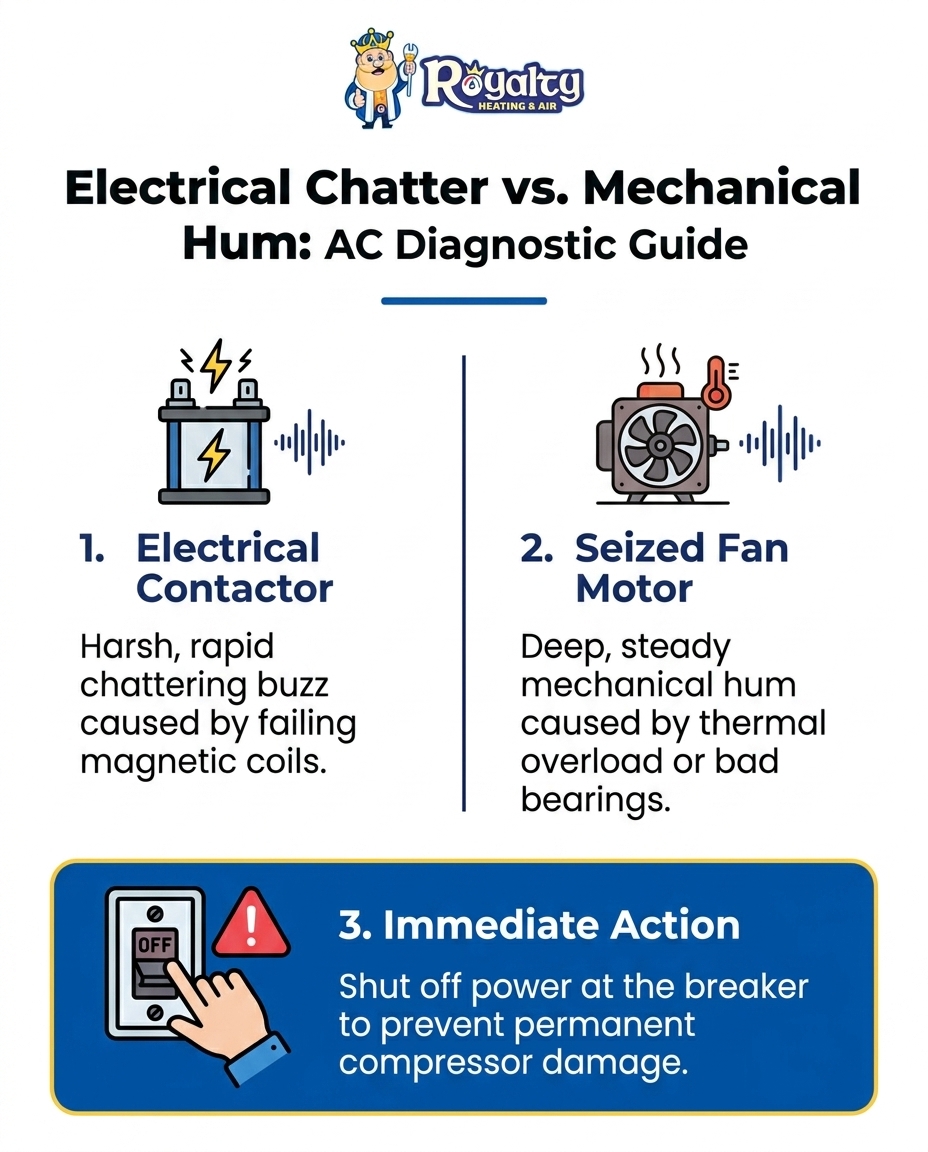
One of the most frequent culprits behind a loud buzzing noise is a small but vital component called the electrical contactor. In plain, non-technical terms, the contactor is essentially a heavy-duty switch that controls the flow of high-voltage power to your compressor and outdoor fan. When your indoor thermostat calls for cooling, it sends a low-voltage signal to the outdoor unit. This signal energizes a magnetic coil inside the contactor, which pulls a set of metal contacts closed, allowing the high-voltage electricity to power up the system.
Over time, especially during the intense heat of a Roseville CA summer, that magnetic coil degrades. The metal contacts also become pitted and burned from the constant arcing of electricity every time the system turns on and off. When the magnet becomes too weak to pull the contacts closed completely and hold them tightly, the contacts begin to bounce rapidly.
The problem: The buzzing or "chattering" you hear is the physical sound of those metal contacts rapidly bouncing back and forth, or the sound of high-voltage electricity arcing across a gap that should be tightly closed.
The cause: Months of heavy thermal strain and accumulated electrical cycles weaken the coil, preventing a solid connection.
The solution: The contactor must be replaced by a licensed professional. You must strictly avoid attempting to inspect, clean, or replace the contactor independently. This component handles dangerous, lethal levels of high-voltage electricity. Touching the wrong wire or attempting a DIY fix can result in severe injury or worse. Always leave contactor replacements to trained technicians.
If the sound you hear is a deep mechanical hum rather than a sharp electrical crackle, you are likely dealing with the second major cause of buzzing: a seized condenser fan motor or a failing dual run capacitor. The dual run capacitor acts like a powerful battery that stores energy to give the fan motor the massive jolt it needs to start spinning. If the capacitor fails due to August late-summer end-of-season wear, the motor receives power but lacks the torque to start. It just sits there and hums.
Alternatively, the bearings inside the fan motor itself may have seized up from heat, friction, and age. The motor is trying to turn, generating that deep vibrating hum, but the blades are locked in place. This scenario poses a severe and immediate risk to your entire air conditioning system.
The condenser fan plays a critical role in exhausting heat away from the compressor. As the compressor pumps hot refrigerant through the outdoor coils, the fan pulls cooler ambient air across those coils to dissipate the heat. If the fan motor is seized and the blades are not spinning, but the compressor continues to run, the heat has nowhere to go. The system will rapidly experience severe thermal overload.
Running a compressor without a working fan is one of the fastest ways to destroy a cooling system. The extreme heat buildup can melt internal wiring and cause permanent, catastrophic damage to the compressor—which is the heart of your system and the most expensive part to replace. If you hear a deep hum and notice the fan isn't moving, you must act immediately.
When you hear a loud buzzing noise from your outdoor unit, your immediate priority is safety and damage prevention. Whether the issue is a failing electrical contactor or a seized fan motor, allowing the system to continue running will only cause further damage. Taking swift action can mean the difference between a simple part replacement and a catastrophic compressor failure in Roseville CA.
Follow these clear, safe steps immediately upon hearing the buzzing noise:
1. Turn off the system at the thermostat: Go inside your home and switch your thermostat from "Cool" to "Off." This stops the low-voltage signal from asking the outdoor unit to run.
2. Locate the outdoor electrical disconnect box: Find the small metal box mounted on the exterior wall of your home, usually located within a few feet of the outdoor AC unit.
3. Cut the power at the disconnect: Open the lid of the disconnect box and either flip the switch to the "Off" position or pull out the disconnect block entirely, depending on the model.
4. Flip the main breaker (if necessary): If you cannot find or safely operate the outdoor disconnect box, go to your home's main electrical panel. Locate the breaker labeled "AC" or "Condenser" and flip it to the "Off" position. Ensure power is completely cut to the unit.
Shutting off the power is the single most effective way to prevent permanent thermal damage to the compressor while you wait for professional help.
Strict safety warnings: Under no circumstances should you open the condenser panel to look inside. Do not touch any electrical components, wiring, or capacitors. Furthermore, do not try to manually push the fan blades with a stick or your fingers to get them spinning. If the motor suddenly engages, it can cause severe physical injury.
Once the power is safely shut off, professional intervention is the only safe and cost-effective way to resolve the buzzing. True HVAC experts do not just guess at the problem; they rely on specific acoustic signatures and precise multimeter testing to pinpoint the exact failing component. By measuring the microfarads of a capacitor, the voltage drop across a contactor, and the amperage draw of a motor, a professional can identify exactly where the system is failing.
This level of accurate diagnostic expertise is crucial because it prevents you from paying for unnecessary part replacements. For example, an untrained eye might assume a humming motor means the entire motor needs replacement, when in reality, only a small dual run capacitor has failed. Accurate diagnostics ensure you only fix what is actually broken, empowering you with the truth about your system's health.
Having a technician explain the process brings immense peace of mind. One homeowner reached out for a tune-up service in the fall, and our technician Chris explained each step of the tune-up process, ensuring they understood exactly how their system's components were weathering the seasons. This transparency ensures you know exactly what went wrong and how it will be resolved.
Routine check-ups are the best defense against these sudden August late-summer end-of-season wear failures. During routine AC maintenance, a technician can identify weak contactors or struggling motors long before they fail completely during a heatwave. Proactive care catches the microscopic pitting on a contactor or the slight drop in a capacitor's charge before it turns into a loud, alarming buzz.
Why is my outdoor AC making a buzzing noise?
Your outdoor AC is making a buzzing noise because an electrical or mechanical component is failing. Most commonly, this is caused by a worn-out electrical contactor struggling to stay closed, or a seized condenser fan motor trying to turn. The intense heat of summer accelerates the wear and tear on these specific parts, leading to loud chattering or deep humming sounds.
Should I turn off my AC if it is buzzing outside?
Yes, you should turn off your AC immediately if it is buzzing outside. Continuing to run a buzzing condenser can lead to severe electrical arcing or catastrophic thermal damage to the compressor. Shut off the system at the thermostat first, and then flip the breaker at your electrical panel to completely cut the power until a professional can inspect it.
What does a bad AC contactor sound like?
A bad AC contactor sounds like a harsh, rapid, crackling buzz or an electrical chatter. It often mimics the sound of a large bug zapper or electricity sparking rapidly. This noise occurs because the magnetic coil inside the contactor has weakened, causing the metal contacts to bounce and arc instead of forming a solid, quiet connection.
Can a bad capacitor cause a buzzing sound?
Yes, a bad capacitor can absolutely cause a buzzing sound. When the dual run capacitor fails, it cannot provide the necessary surge of energy to start the condenser fan motor or the compressor. As a result, the motor receives power but cannot spin, resulting in a deep, vibrating mechanical hum that sounds like a stalled engine.
Is it safe to run my AC if the outside fan isn't spinning?
No, it is never safe to run your AC if the outside fan isn't spinning. The fan is responsible for pulling air across the coils to exhaust the intense heat generated by the compressor. If the fan stops but the compressor keeps running, the heat is trapped inside, which will quickly cause the compressor to overheat and suffer permanent, irreversible damage.
Ultimately, figuring out what that buzzing noise near your outdoor AC unit actually means comes down to recognizing it as an urgent warning sign of electrical or mechanical fatigue. While it is not a reason to panic if handled quickly, shutting off the power immediately is the best way to protect your investment from August late-summer end-of-season wear. Rely on professional diagnostics to safely resolve the issue, and you can confidently schedule your AC repair in Roseville to restore reliable, quiet comfort to your home.
