
Services
About
Service Areas


When an HVAC failure is a true emergency comes down to one core question: does the problem put your family's health, your home's safety, or your property at immediate risk? If the answer is yes, you need to act now — not tomorrow morning.
Here are the situations that qualify as a true HVAC emergency:
• Extreme heat with no cooling — Outdoor temps at or above 90°F, especially with infants, elderly, or medically vulnerable people in the home
• Freezing temperatures with no heat — Outdoor temps at or below 40°F, risking hypothermia and burst pipes within 8–12 hours
• Smell of rotten eggs or sulfur — Possible gas leak; evacuate immediately and call your gas utility from outside
• Carbon monoxide detector alarm — Evacuate now and call 911 from outside the home
• Burning smell or visible sparks — Shut off the system at the breaker; potential electrical fire risk
• Active water leak from the unit — Can cause structural damage, mold, and ceiling collapse within hours
• Ice buildup on refrigerant lines — Indicates airflow or refrigerant problems that can destroy the compressor if ignored
• System short cycling repeatedly — Creates extreme electrical stress and accelerates component failure fast
If none of those apply, there's a good chance your issue can wait until regular business hours — and we'll cover how to tell the difference throughout this guide.
For Roseville homeowners, the stakes are real. Summer temperatures regularly push into the 90s, and cold snaps can drop overnight temps into the 20s and 30s. A home without cooling can reach dangerous indoor temperatures within just a few hours on a hot day. And a heating failure during a cold snap puts your pipes — and your family — at serious risk.
The good news? About 40% of HVAC emergency calls turn out to be simple fixes like a tripped breaker or a dead thermostat battery. Knowing the difference between a true crisis and a minor issue can save you stress, money, and a midnight phone call.
When we talk about an HVAC emergency in Placer County, we aren't just talking about being a little sweaty or needing an extra sweater. A true emergency is defined by three pillars: immediate health risk, safety hazards, and property protection.
In our experience serving communities like Loomis and Granite Bay, we’ve seen how quickly a minor mechanical glitch can spiral into a major household crisis. If your indoor temperature has climbed past 85°F in the summer or dropped below 50°F in the winter, the environment is no longer just uncomfortable—it’s becoming unsafe. This is especially true for vulnerable occupants, such as infants whose bodies can’t regulate temperature well, or elderly residents with heart or respiratory conditions.
If you find yourself in a situation where the air is thick, the walls are sweating, or the air smells like it’s burning, you are likely in the middle of a scenario where you need our Emergency HVAC Repair Roseville CA Guide to help you navigate the next steps.
In the Roseville and Rocklin areas, summer heat is relentless. We often follow the "90-degree rule." When outdoor temperatures hit 90°F or higher, a home without air conditioning can reach triple digits indoors within just a few hours. This creates a high risk for heatstroke and severe dehydration.
High humidity, which we sometimes see during our April and May transitions, makes it even harder for the body to cool itself. If your AC fails during a heat advisory, don't try to "tough it out." This is a primary example of when an HVAC failure is a true emergency. For a deep dive into handling these scorching situations, check out our Emergency AC Rocklin Ultimate Guide.
While we love our California sunshine, winter nights in Lincoln and Rocklin can be brutal. We use the "40-degree rule" for heating. If the outdoor temperature is 40°F or lower and your furnace quits, your home’s "thermal envelope"—the ability to hold onto heat—will likely fail within 8 to 12 hours.
Once the heat is gone, the risk isn't just to your comfort; it’s to your plumbing. Frozen pipes can lead to thousands of dollars in water damage if they burst. If you have a newborn or an elderly family member, a cold house is a medical emergency. For those cold Placer County nights, our Emergency Heating Service Roseville Guide is an essential resource.
Some emergencies have nothing to do with the temperature and everything to do with the air you are breathing. These are the most serious types of calls we receive because they involve immediate life-safety threats.
Natural gas is naturally odorless, but utility companies add a chemical called mercaptan to give it a distinct "rotten egg" or sulfur smell. If you smell this in your home, especially near your furnace, treat it as an explosion risk.
Immediate Actions:
1. Do not flip any light switches or use your phone inside (sparks can ignite gas).
2. Evacuate everyone, including pets, immediately.
3. Call 911 and your gas utility company from a safe distance outside.
4. Only after the authorities have cleared the scene should you call for an Emergency Furnace Replacement Roseville Guide.
Carbon monoxide (CO) is even more dangerous because it is the "silent killer"—colorless, odorless, and tasteless. Faulty gas furnaces are a leading source of CO leaks. If your CO detector goes off, or if your family experiences sudden headaches, dizziness, or nausea, get out immediately. We provide more safety details in our Rocklin Emergency Heating Service Tips.
HVAC systems pull more electricity than almost any other appliance in your home. If you notice acrid, burning plastic smells, see visible sparks, or hear a loud buzzing sound from your electrical panel, your system is communicating a fire risk.
A repeatedly tripping circuit breaker is a safety feature doing its job. If you reset the breaker once and it trips again immediately, do not try a third time. This indicates a short circuit or a grounded compressor. Forcing it to run can lead to melted wiring or an electrical fire. In these cases, we often recommend a professional inspection, as detailed in our Rocklin Emergency Furnace Install Guide.
Sometimes an emergency isn't about a fire or a freeze—it’s about water. Your HVAC system manages a lot of moisture, and when those systems fail, your home’s structural integrity is at risk.
It sounds like a contradiction, but your AC can actually freeze solid in the middle of a 100-degree Roseville afternoon. This usually happens due to severely restricted airflow (like a filthy filter) or a refrigerant leak.
If you see ice on the outdoor copper lines or the indoor evaporator coil, shut the system off immediately. Running a frozen system can lead to "slugging" the compressor—essentially trying to compress a liquid instead of a gas—which destroys the most expensive part of your unit. You might also hear a hissing sound, which signals a refrigerant leak. Since refrigerant is a chemical hazard, this requires an EPA-certified technician. Learn more about these heat pump specific issues in our Rocklin Emergency Heat Pump Replacement Guide.
Your air conditioner or high-efficiency furnace produces "condensate"—water that is pulled out of the air. Normally, this drains away safely. However, if the drain line clogs, that water has to go somewhere.
If you see water dripping from your ceiling or pooling around your indoor unit, your secondary drain pan is likely overflowing. This can lead to collapsed drywall and expensive mold growth within just 24 to 48 hours. We recommend using a wet-vac to clear standing water if it's safe to do so, while you wait for a technician. For those using modern systems in Roseville, see our Emergency Heat Pump in Roseville CA guide or our Emergency Heat Pump Rocklin CA Guide for drainage troubleshooting.
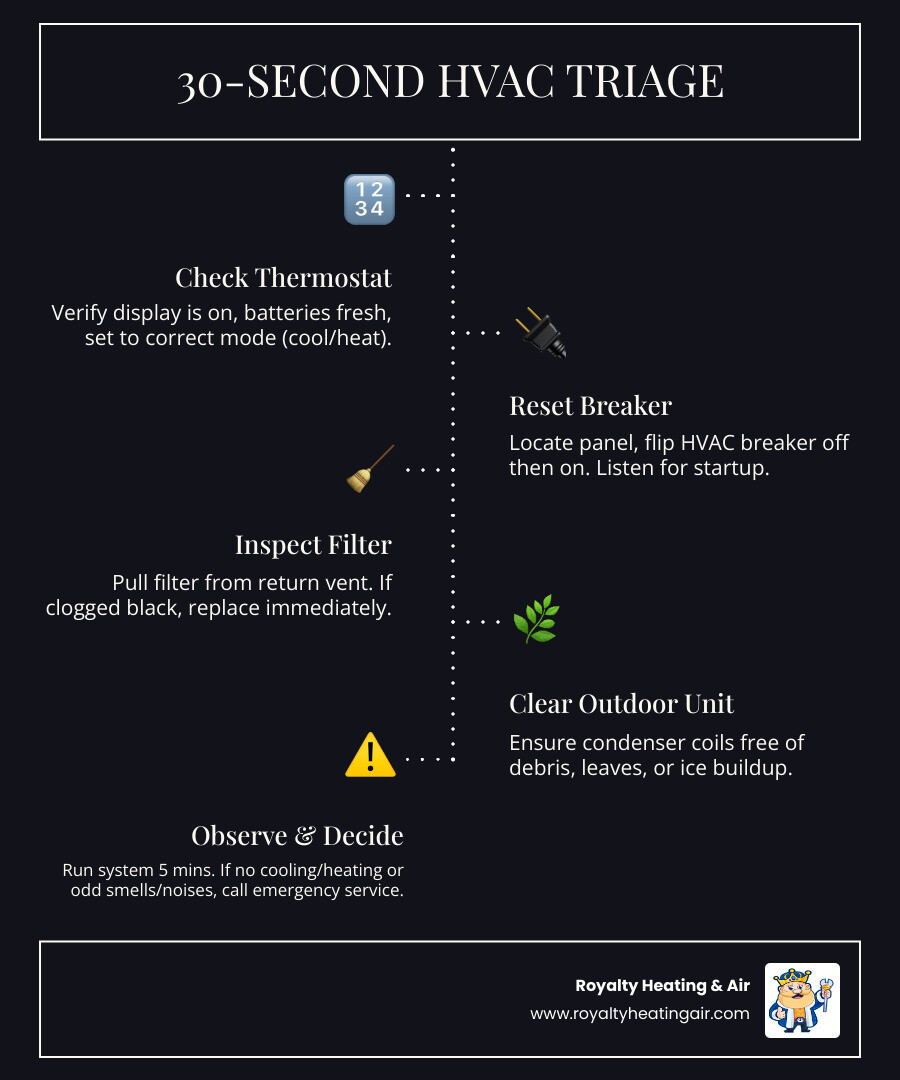
Before you make that emergency call, we always recommend a quick "30-second triage." You'd be surprised how many "emergencies" are solved by simply replacing a $5 battery or flipping a switch.
• Rotten Egg Smell — Emergency?: YES — Immediate Action: Evacuate, call 911/Utility
• Burning Smell/Sparks — Emergency?: YES — Immediate Action: Shut off breaker, call Pros
• Water Pouring from Ceiling — Emergency?: YES — Immediate Action: Shut off system, use wet-vac
• No Heat (Outdoor Temp 35°F) — Emergency?: YES — Immediate Action: Check thermostat, then call Pros
• No AC (Outdoor Temp 75°F) — Emergency?: NO — Immediate Action: Open windows, call in morning
• Uneven Room Temps — Emergency?: NO — Immediate Action: Check vents and air filter
• Minor Rattling Sound — Emergency?: NO — Immediate Action: Schedule regular service
Not every failure requires a midnight visit. If the weather is mild (between 60°F and 75°F), a system failure is an inconvenience, but not usually an emergency.
• Uneven temperatures: If one room is 72°F and another is 75°F, it's a comfort issue, likely caused by ductwork or insulation problems.
• Minor noises: A small rattle or a occasional "pop" when the ducts expand is normal.
• Thermostat glitches: If the screen is blank, try new batteries first.
• Dirty filters: A system struggling due to a dirty filter can often wait until the morning for a replacement.
If you are in Roseville and need a quick response that doesn't necessarily require an emergency dispatch, our Same-Day Heating Service Roseville CA Guide can help you decide.
The best way to handle an HVAC emergency is to never have one in the first place. Statistics show that homeowners with regular maintenance plans are 50% less likely to experience an emergency breakdown.
During a seasonal tune-up, we look for the "hidden" problems that usually cause 10:00 PM failures: frayed wires, failing capacitors, and cracked heat exchangers. A well-maintained system can last 15–20 years, whereas a neglected one might fail before its tenth birthday. For Roseville residents, we offer comprehensive 24-Hour Furnace Maintenance Roseville Guide and 24-Hour Heating Roseville CA Guide resources to keep your system in peak shape.
The top three are rotten eggs (gas leak), burning plastic/electrical (wiring failure), and acrid smoke. A "dirty sock" smell usually points to biological growth or mold, which is a health concern but usually not an immediate "get out now" emergency. However, if you detect chemical fumes that smell like ether, you likely have a significant refrigerant leak that needs immediate attention.
Most homes in Placer County will lose their safe "thermal mass" within 8 to 12 hours. After this point, the indoor temperature will drop rapidly toward the outdoor temperature. This is when the risk of burst pipes becomes critical. We recommend opening cabinet doors under sinks and letting faucets drip slightly to keep water moving through your pipes until help arrives.
If the noise is violent—like metal screaming or loud, rhythmic banging—yes, it is an emergency. This usually indicates that the blower wheel or fan blade has come loose or is broken. If you keep running the system, that loose part can fly off and destroy the entire internal cabinet, turning a simple repair into a total system replacement. Shut it down immediately to prevent secondary damage.
At Royalty Heating & Air, we understand that your home is your sanctuary. When your comfort is threatened, it’s stressful, but when your safety is at risk, it’s a crisis. We are proud to serve the Roseville, Rocklin, Loomis, Lincoln, and Granite Bay communities with expert diagnostics and rapid emergency response.
Beyond fixing air conditioners and furnaces, we believe in supporting the families that make our community great. That’s why we partner with the MackAttack Foundation, supporting foster babies and sponsoring family adoptions. When you choose us, you aren't just getting a technician; you're supporting a business that cares about the future of our local children.
Whether it’s a scorching July afternoon or a freezing January night, don't wait until a problem becomes a disaster. Trust your gut—if the system feels unsafe or the temperature is reaching dangerous levels, give us a call.

