
Services
About
Service Areas


If you find yourself wondering, "why does my furnace smell like burning dust when I turn it on?" during that first chilly morning of early fall, you certainly aren't alone. In fact, our team at Royalty Heating & Air fields dozens of frantic calls about this exact issue every September. You walk to the thermostat, switch the system from cooling to heating, and wait for that comforting rush of warm air. Instead, within minutes, a distinct, dry, burning odor begins pouring out of your supply vents and filling your living room. It is an unsettling moment that immediately triggers a wave of anxiety for any homeowner. Your first instinct is likely to panic, wondering if something inside the ductwork has caught fire or if the appliance itself is melting down.
Here is the short answer: in the vast majority of cases we see in the field, this initial smell is a completely normal, harmless part of the seasonal transition. However, knowing the difference between a routine seasonal burn-off and a genuine electrical emergency is critical for the safety of your home. You are faced with an immediate decision point: do you let the system run its course to clear out the odor, or do you shut it down at the breaker before permanent damage occurs? When you need professional heating services to evaluate a questionable system, our experienced technicians at Royalty Heating & Air are here to help.
This guide will walk you through exactly what is happening inside your heating equipment, how to categorize the specific odors you are smelling, and precisely how long you should wait before taking action. By understanding the mechanics behind this common autumn phenomenon, you can approach the start of heating season with confidence rather than fear.
To understand why your heating system produces such a strong odor on day one, you have to look at what it has been doing for the past six months: absolutely nothing. While your air conditioner was working overtime to keep you cool, the heating components of your HVAC system were sitting completely dormant in the dark. During this extended period of inactivity, airborne particulates naturally settle on the internal surfaces of the unit.
This is especially true in Roseville CA. In our years of servicing local HVAC systems, we've noticed that our long, dry summer climate significantly increases the amount of airborne dust, pollen, and particulate matter circulating through the air compared to more humid regions. Even with an air filter in place, microscopic debris inevitably finds its way into the cabinet. Over the course of the summer, a fine layer of household dust, pet dander, microscopic fabric fibers, and lint coats the internal mechanisms.
The solution to preventing severe buildup often lies in comprehensive care. For example, we recently helped a local homeowner who needed a new furnace and AC unit installed, and our process included a thorough duct cleaning alongside the installation. This dual approach ensured flawless airflow and efficiency from day one, preventing years of accumulated debris from causing persistent odors or airflow restrictions. Regular upkeep, such as scheduling routine furnace maintenance with our team, goes a long way in minimizing this settling process.
The heat exchanger is the heart of your furnace. It is a series of metal coils or tubes that are heated by the combustion of gas (or by electrical elements in a heat pump/electric furnace). As the blower motor pushes air over this extremely hot metal surface, the air absorbs the heat and carries it into your living spaces.
Because the heat exchanger must reach very high operating temperatures to warm your home effectively, its surface gets incredibly hot within seconds of ignition. When the system fires up for the first time in the fall, that thin layer of settled summer dust is instantly subjected to intense heat. The dust does not just get warm; it is literally incinerated on contact. The physical reaction of these microscopic particles flashing into ash is what creates that distinct, dry, singed-lint smell that travels through your ductwork. It is a natural, unavoidable process that we see with virtually every forced-air heating system that has been idle for months.
Once you understand that the smell is simply dust burning off the heat exchanger, the next logical question is how long you have to endure it. Having clear, anxiety-reducing timeline expectations can help you monitor the situation calmly.
Based on hundreds of fall tune-ups, here is our standard dissipation timeline:
• 0 to 15 Minutes: This is when the odor will be at its absolute strongest. The system has just ignited, the heat exchanger is reaching peak temperature, and the bulk of the settled dust is burning off simultaneously. You will likely smell it in every room that has a supply register.
• 15 to 30 Minutes: The standard baseline for a normal dust burn-off. By the half-hour mark, the smell should begin to fade significantly. The initial layer of debris has been cleared, and only residual odors are cycling through the home.
• 1 to 2 Hours: In homes with heavier dust accumulation—perhaps due to multiple pets, recent remodeling, or a skipped filter change—it may take up to two hours of continuous operation for the smell to completely dissipate.
During this initial burn-off period, we highly advise opening a few windows slightly. Creating a cross-breeze will help ventilate the home, pushing the stagnant, dusty air outside and replacing it with fresh outdoor air. You can also turn on ceiling fans to help circulate the air more efficiently.
The Hard Limit: If the smell persists continuously beyond two hours of operation, or if it suddenly grows stronger instead of fading, you have crossed the threshold from normal operation into abnormal territory. At this point, the system should be shut off immediately to prevent potential overheating or mechanical failure.
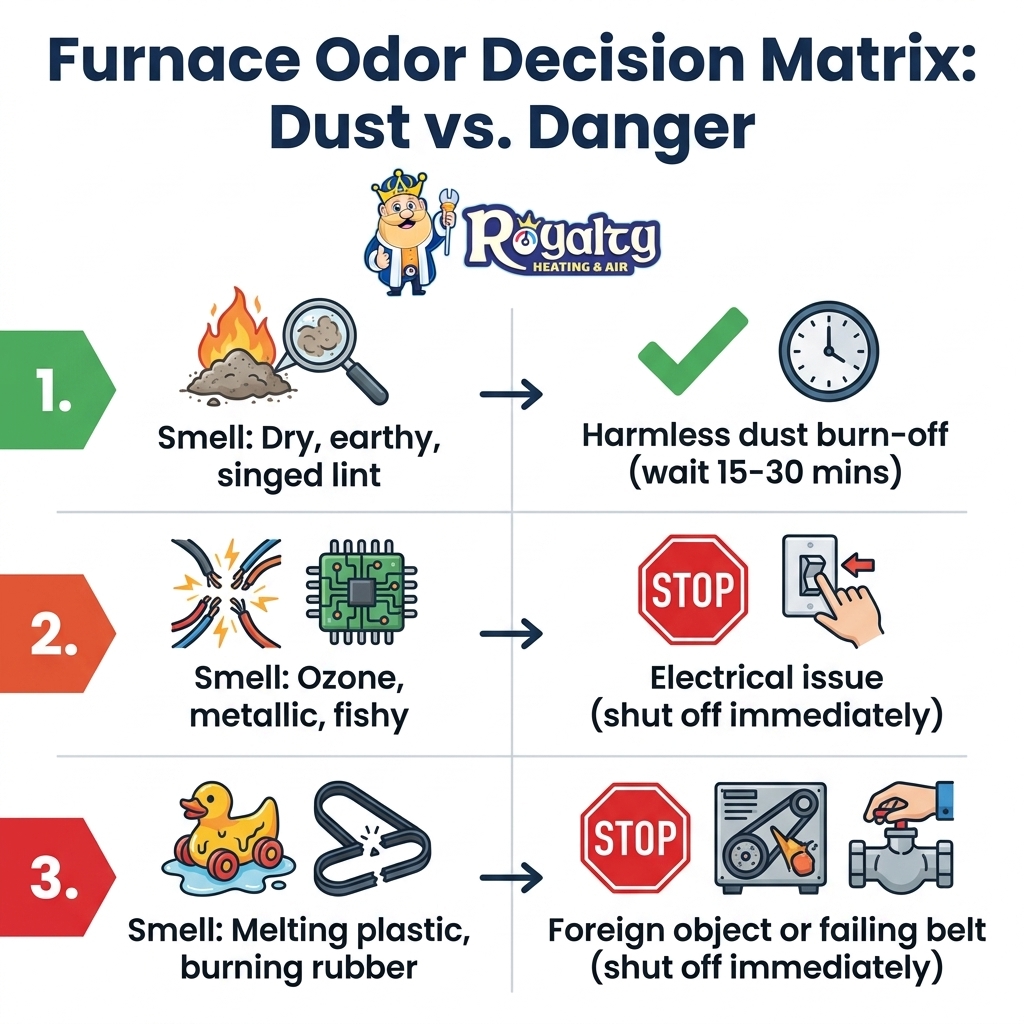
Not all burning smells are created equal. While burning dust is harmless, other odors are massive red flags indicating that your system is experiencing a critical failure. Using a strict, sense-based decision matrix can help you confidently evaluate the safety of your furnace.
• Burning Dust — Description of Smell: Dry, earthy, similar to singed hair, toasted lint, or warm dirt. — Likely Cause: Normal incineration of settled summer debris on the heat exchanger. — Required Action: Wait 15 to 30 minutes. Open windows to ventilate.
• Electrical / Ozone — Description of Smell: Sharp, metallic, fishy, or reminiscent of an overheated power tool. — Likely Cause: Failing blower motor, frayed wiring, or a blown capacitor. — Required Action: Shut down the system immediately at the thermostat.
• Melting Plastic — Description of Smell: Acrid, harsh, chemical smell like burning rubber or melting Tupperware. — Likely Cause: Foreign object in the ductwork, melted wire casing, or a failing belt. — Required Action: Shut down immediately. Do not run the system.
• Rotten Eggs — Description of Smell: Distinct sulfur or rotten egg stench. — Likely Cause: Natural gas leak (the gas company adds a chemical called mercaptan to make it smell). — Required Action: Evacuate the home immediately and call the gas company.
If you detect an electrical, plastic, or rotten egg smell, do not wait to see if it clears up. These are undeniable red flags. Other critical warning signs include visible smoke coming from the vents, loud popping or banging noises, or the smell of burning wiring.
To safely secure your home, start by turning the thermostat to the "OFF" position. If the blower motor continues to run or the smell intensifies, locate your home's main electrical panel and flip the dedicated breaker for the HVAC system to the off position. If you have a gas furnace and suspect a gas leak, leave the house immediately and call your utility provider from outside.
The severity of the initial burn-off smell is directly tied to the overall air quality inside your home. If you consistently experience a harsh, overwhelming odor every single fall, it is likely an indicator that your indoor air has a high concentration of airborne particulates.
Homes with higher levels of pet dander, uncaptured pollen, and general household dust will naturally experience a much stronger burn-off odor. Every time the AC runs during the summer, it pulls this air through the return ducts. If your filtration is subpar, a large percentage of those particles bypass the filter and settle directly onto the heating components.
This is why we always remind our customers to change their air filter right before the first fall startup. If you turn on the heater with a clogged, dirty filter from the summer, the system will struggle to pull in enough air, causing it to run hotter than normal. Worse, it will pull loose dust from that dirty filter straight into the combustion chamber, exacerbating the burning smell. We highly recommend exploring upgraded indoor air quality solutions—such as high-MERV pleated filters, UV germicidal lights, or whole-home air purifiers. These upgrades drastically minimize the amount of particulate matter that settles in your system during the off-season, leading to a much cleaner, odor-free startup.
If you have waited past the two-hour maximum window and the dry dust smell has not faded, or if you immediately identified a dangerous electrical or plastic odor, it is time to take action. Ignoring persistent odors or hoping they will eventually resolve on their own is a recipe for a costly mechanical breakdown or a serious safety hazard.
1. Verify the Odor Type: Confirm whether the smell is a lingering dusty scent or if it has transitioned into a harsh, chemical, or electrical odor.
2. Power Down the Unit: Turn the thermostat off. If the system continues to push air or the smell persists, shut off the breaker to cut power entirely.
3. Check the Filter: Ensure the filter isn't completely impacted with dirt, which can cause the system to overheat and trigger safety shutoffs.
4. Call for Professional Diagnostics: Do not attempt to open the cabinet and clean the heat exchanger yourself.
When you call a professional, they don't just guess at the problem. When our trained technicians arrive, we perform a comprehensive diagnostic visit. We inspect the blower motor for overheating, test the electrical connections and capacitors with a multimeter, and visually inspect the heat exchanger for cracks or severe debris buildup. Sometimes, strange odors are accompanied by physical symptoms. For instance, a pattern we see often is when a homeowner notices the smell alongside a mechanical struggle, realizing their furnace is making a loud humming noise, which strongly points to a seized blower motor rather than just dusty coils.
Royalty Heating & Air offers fast, reliable diagnostics to give homeowners peace of mind when they aren't sure if a burning smell is harmless or a true hazard. Responsiveness matters when the weather turns. We recently had a customer reach out during a cold weather snap needing urgent heating service; our technician was able to come out a day earlier than scheduled, saving the family from spending an extra night relying on space heaters and extra blankets. That level of prompt attention is exactly what you need when you are unsure if your equipment is safe to operate.
Yes, if it is the first time turning it on after summer, a burning smell is completely normal. It is simply burning off settled dust that has accumulated on the heat exchanger over the past several months. The odor is a natural byproduct of the high temperatures required to warm your home. As long as the smell is dry and dusty, rather than electrical or chemical, it is not a cause for immediate concern.
Typically, we see the burning dust smell last between 15 to 30 minutes after initial startup. In larger homes, or in houses with significant pet dander and dust accumulation, it can take up to one to two hours of continuous operation for the odor to fully clear the ductwork. If the smell persists beyond the two-hour mark, you should turn the system off and schedule an inspection to ensure there isn't a deeper mechanical issue.
Standard household dust burning off the heat exchanger is not a fire hazard; it is a controlled incineration of microscopic particles. However, severe neglect can be dangerous. If a system is completely choked with dirt, or if a heavily clogged air filter restricts airflow, the unit can overheat. Modern systems have high-limit safety switches to shut the unit down if it gets too hot, but maintaining a clean system is the best way to prevent safety risks.
A bad furnace issue smells like melting plastic, burning rubber, electrical ozone, or rotten eggs, which is starkly different from the dry smell of singed dust. An electrical or ozone smell usually indicates a failing blower motor or frying wires, while a plastic smell points to a foreign object in the ductwork or a failing belt. A rotten egg smell is the signature warning sign of a dangerous natural gas leak, requiring immediate evacuation.
Yes, we always recommend cracking a few windows for the first 30 minutes to help ventilate the harmless dust odor out of your home much faster. Creating a cross-breeze pushes the stagnant, incinerated-dust air outside and replaces it with fresh air. You can also run ceiling fans to help circulate the airflow, making the temporary smell much more tolerable as the system clears itself out.
Transitioning into the colder months should bring comfort, not anxiety. While that sudden burning dust smell on the first chilly morning can be alarming, it is almost always a normal, temporary reaction as your system wakes up from its summer hibernation. By knowing what to smell for and understanding the standard 15-to-30-minute timeline, you can safely monitor your equipment as it clears out the off-season debris.
However, your peace of mind is paramount. If you ever feel uncertain about an odor, or if a smell persists longer than it should, the safest route is always to shut the system down. Scheduling a professional inspection and tune-up with our team ensures that your equipment is clean, mechanically sound, and completely safe to operate. Start your winter right by ensuring your system is ready to deliver reliable, odor-free warmth all season long.
