
Services
About
Service Areas


Your high-efficiency system is running constantly, yet the master suite still feels uncomfortably warm—a frustrating reality our team at Royalty Heating & Air sees frequently. This perfectly illustrates why Granite Bay homes often need upgraded ductwork for modern heat pumps. When a homeowner upgrades to a top-tier, variable-speed system but attaches it to the restrictive, older ductwork typical of the area, the new equipment physically cannot breathe. The resulting airflow bottleneck chokes the system, preventing it from delivering the premium comfort you expect. This disconnect between modern machinery and legacy infrastructure becomes painfully obvious when the late summer (August) cooling load hits its peak, forcing systems to work at maximum capacity just to maintain a baseline temperature as kids head back to school.
Before you finalize plans for your home comfort upgrade, understanding the specific airflow requirements of modern heat pumps is critical to ensure your system performs exactly as intended. In our experience, the primary decision point for many local homeowners is no longer just which equipment to select, but whether to pair a basic equipment swap with the necessary duct sizing modifications required for true high-efficiency performance.
To understand the root of this airflow restriction, our technicians often look back at the construction boom that shaped the local landscape. Many of the Granite Bay older custom homes built during the 1980s and 1990s feature stunning architectural details, vaulted ceilings, and complex floor plans. However, the original HVAC systems hidden behind those beautiful walls were designed for a completely different era of heating and cooling technology.
When these properties were constructed, standard single-stage air conditioners and high-heat gas furnaces were the norm. These legacy systems operated on a simple on-and-off premise, blasting short, intense bursts of highly conditioned air through the home before shutting down. Because the air was delivered at extreme temperatures, the physical ductwork did not need to be particularly large to change the temperature of a room quickly. Today, securing professional upgraded ductwork services is often the only way to adapt these older architectural designs to the continuous, high-volume circulation required by modern technology.
The historical standards for residential HVAC design prioritized fitting ductwork into tight, hidden spaces over maximizing airflow volume. Builders frequently squeezed narrow duct runs through complex rooflines, tight soffits, and between custom structural beams.
• Narrow branch lines: Original duct branches were often sized at just four to six inches in diameter, which was sufficient for older, low-volume furnaces but highly restrictive today.
• Undersized return grilles: Older custom homes frequently feature a single, centrally located return air grille that simply cannot pull enough air to satisfy a modern variable-speed blower.
• Sharp directional turns: To accommodate custom architectural features, legacy ductwork often includes hard 90-degree angles that create severe turbulence and disrupt smooth airflow.
Modern climate control has shifted away from the intermittent, noisy blasting of the past. Today's variable-speed systems are designed to run almost continuously at lower speeds, circulating a massive volume of moderately conditioned air to maintain a perfectly even temperature while constantly filtering and dehumidifying the space.
When you force a high-volume, variable-speed blower to push air through narrow, legacy ducts, the physical restriction creates immense backpressure. The system simply cannot move the required volume of air through the small pipes, resulting in weak airflow at the vents and uneven temperatures across the home.
• Airflow Strategy — 1990s Legacy HVAC Design: Short, intense bursts of extreme temperature air. — Modern Variable-Speed Heat Pump: Continuous, steady circulation of moderately conditioned air.
• Duct Size Requirement — 1990s Legacy HVAC Design: Smaller diameter pipes designed for low total volume. — Modern Variable-Speed Heat Pump: Larger diameter trunks and branches for high-volume flow.
• Return Air Needs — 1990s Legacy HVAC Design: Minimal; often satisfied by a single central hallway return. — Modern Variable-Speed Heat Pump: Extensive; requires multiple large returns to prevent choking.
• Operational Speed — 1990s Legacy HVAC Design: Single-stage (100% on or 100% off). — Modern Variable-Speed Heat Pump: Variable-speed (modulating from 30% to 100% capacity).
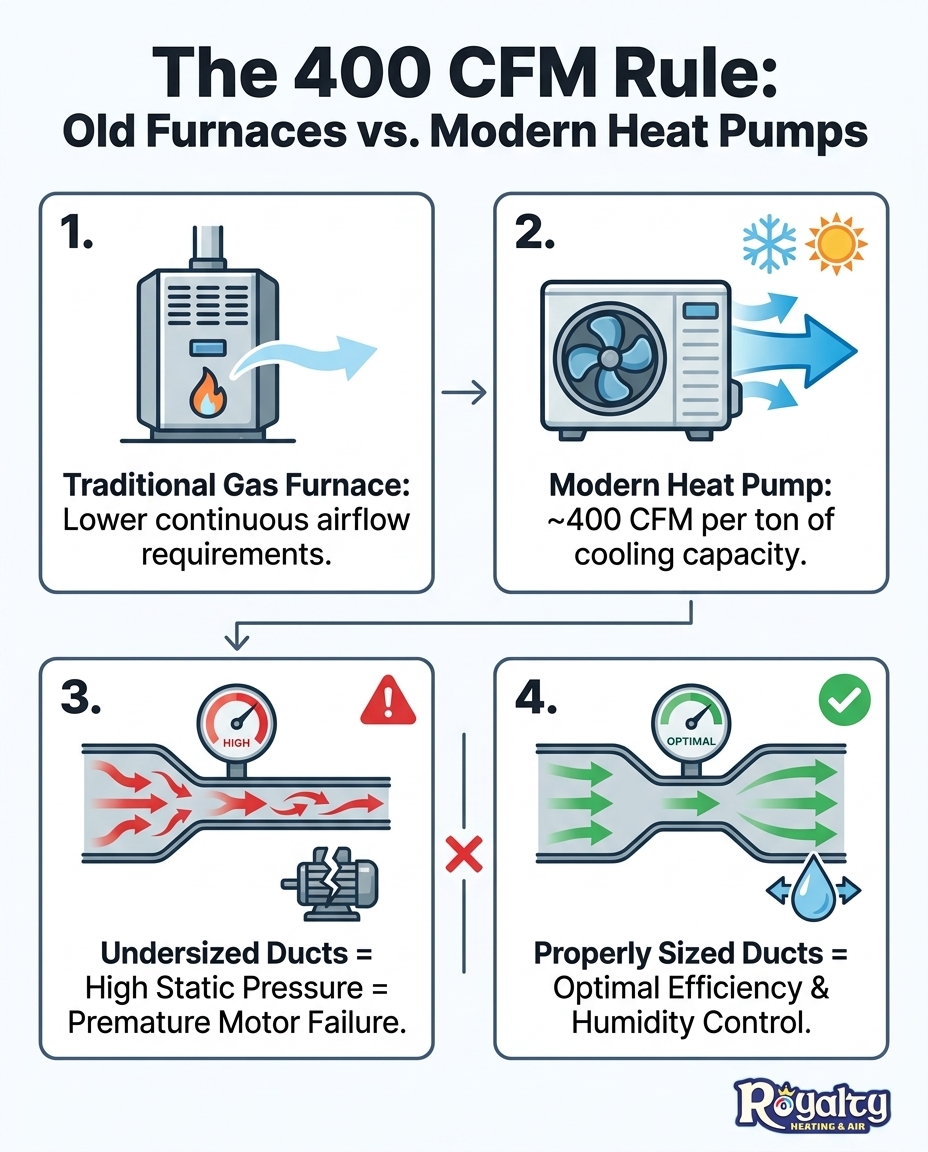
The incompatibility between older custom homes and new technology comes down to a strict mathematical requirement known in the HVAC industry as the 400 CFM rule. CFM stands for Cubic Feet per Minute, and it measures the volume of air moving through your ductwork. For a modern heat pump to operate correctly, transfer heat efficiently, and prevent the indoor coil from freezing, it generally requires about 400 CFM of airflow for every ton of cooling capacity.
Older traditional gas furnaces often required significantly less airflow—sometimes as low as 130 to 150 CFM per 10,000 BTUs of heat. Because the Granite Bay older custom homes were built around these lower airflow requirements, their duct systems are physically too small to handle the 400 CFM per ton demanded by a new high-efficiency heat pump. When the Royalty Heating & Air team evaluates a home for a system upgrade, we rely on strict ACCA Manual D calculations to measure the existing ductwork's capacity and determine exactly how much modification is required to hit that crucial 400 CFM target.
Variable-speed technology is the driving force behind the incredible energy efficiency ratings of modern systems. Instead of turning on at full blast and shutting off abruptly, a variable-speed blower motor ramps up slowly and adjusts its speed based on the exact real-time needs of the house.
The volume requirement: To achieve this high level of efficiency, the blower must be able to move a large, constant volume of air without fighting against the walls of the ductwork. If the duct diameters are too small, the variable-speed motor has to work much harder to push the air, completely negating the energy savings you anticipated when upgrading the equipment.
In residential HVAC, static pressure is the measurement of resistance within your ductwork. You can think of static pressure exactly like high blood pressure for your heating and cooling system. When a powerful modern blower tries to force 400 CFM per ton through a duct system designed for half that amount, the pressure inside the ducts skyrockets.
• Increased noise levels: High static pressure causes air to whistle aggressively through grilles and vents, turning a supposedly whisper-quiet system into a noisy nuisance.
• Uneven air distribution: The air takes the path of least resistance, meaning rooms closest to the indoor unit get over-conditioned while distant bedrooms receive barely a trickle of air.
• Motor burnout: Modern Electronically Commutated Motors (ECM) are programmed to maintain their target airflow. If they sense high static pressure, they will automatically spin faster and harder to overcome the resistance, eventually overheating and failing prematurely.
The hidden flaws in an undersized duct system might go unnoticed during the mild temperatures of spring, but they become impossible to ignore as the back-to-school season approaches and the severe late summer (August) cooling load arrives. As outdoor temperatures spike into the triple digits, your home's thermal envelope absorbs massive amounts of heat. To combat this, your variable-speed system receives the signal to ramp up to its absolute maximum capacity.
This is the exact moment the system demands maximum airflow. If the ductwork is undersized, the system experiences a severe bottleneck. It desperately tries to pull in enough warm air from the house to cool it down, but the narrow return ducts act like a pinched straw. Our local customers often wonder why your mini split AC keeps shutting down or why their central heat pump runs for hours without moving the thermostat a single degree. The answer is almost always airflow restriction. The equipment is generating the cooling capacity, but the ductwork is preventing that capacity from actually reaching your living spaces.
When a modern system cannot pull enough return air during an August afternoon heat spike, the entire refrigeration cycle falls out of balance. The indoor evaporator coil gets incredibly cold, but because there isn't enough warm household air blowing across it to absorb that cooling energy, the system begins to choke.
The loss of humidity control: One of the primary functions of a high-efficiency air conditioning cycle is latent cooling—the removal of humidity from the indoor air. When airflow bottlenecks cause the system to choke, the coil can freeze, and the system loses its ability to properly dehumidify the home. The result is an indoor environment that feels clammy, sticky, and uncomfortable, even if the system has been running all afternoon. The hot spots in distant bedrooms become more pronounced, and the system experiences unnecessary wear and tear right when you need it most.
Upgrading to a high-efficiency variable-speed heat pump is a significant investment in your home's comfort and energy future. However, attaching that premium equipment to inadequate ductwork is like putting bicycle tires on a sports car—you will never experience the performance you paid for, and you will likely cause severe damage to the machine in the process.
In our years servicing the Roseville and Granite Bay areas, we've found that the financial risks of ignoring ductwork sizing extend far beyond just higher monthly energy bills. When a modern blower motor is forced to push against extreme static pressure to satisfy the late summer cooling load, the internal components are pushed past their design limits. This constant strain leads to premature failure of the blower motor, the compressor, and the electronic control boards.
Modern ECM blower motors are highly sophisticated pieces of technology. Unlike older motors that simply ran at one speed regardless of resistance, ECMs are programmed to deliver a specific CFM of airflow. If undersized ducts create resistance, the ECM will automatically increase its RPMs to force the air through.
While this programming is great for maintaining comfort in properly sized systems, it is disastrous in undersized ductwork. The motor will run at maximum RPMs constantly, consuming massive amounts of electricity and generating excessive internal heat. This chronic overheating drastically shortens the lifespan of the motor, turning an investment meant to last over a decade into a recurring repair nightmare.
Manufacturers of premium HVAC equipment are very clear about the operating conditions required for their systems. Every high-efficiency unit comes with specific engineering guidelines dictating the maximum allowable total external static pressure (TESP).
• Voided warranties: If a compressor or blower motor fails and a technician determines the cause was operating the system outside of the manufacturer's static pressure specifications due to undersized ducts, the manufacturer can legally void the warranty claim.
• Lost energy efficiency: A system rated for high SEER2 efficiency will operate at a fraction of that efficiency if it is suffocating for air. The energy savings you anticipated will never materialize.
• Incentive compliance: While generic federal tax credits and local utility rebates may apply to qualifying high-efficiency installations, achieving the required efficiency ratings to actually benefit from the new technology demands a properly sized air distribution system. (Always verify current programs with your utility provider or a tax professional.)
One of the most common reasons homeowners hesitate to address airflow issues is the fear that ductwork upgrades will ruin the carefully crafted aesthetic of their property. The idea of tearing into vaulted ceilings, custom drywall, or intricate woodwork is understandably daunting. However, optimizing airflow in Granite Bay older custom homes does not mean dismantling the house.
As local experts at Royalty Heating & Air who frequently work with Granite Bay custom home architecture, we understand that preserving the visual integrity of your high-end property is just as important as achieving perfect indoor comfort. Our experienced professionals navigate the unique obstacles of custom architecture by using advanced diagnostic tools to pinpoint exact bottlenecks, allowing for targeted, minimally invasive modifications rather than wholesale demolition.
The retrofit process begins with a comprehensive, data-driven assessment of your current duct system. During a thorough duct assessment—like one our team performed for a local homeowner preparing for the late-summer heat—we provide a full diagnostic report complete with interior duct pictures, revealing exactly where the bottlenecks are hiding without having to open a single wall.
Strategic modifications: Often, the most severe airflow restrictions are located right at the equipment itself. By strategically expanding the main supply trunk line in the attic or upsizing the primary return air drop near the indoor unit, our professionals can drastically reduce static pressure across the entire system. When you partner with our experts for your system installation in Granite Bay, you ensure that every modification is executed flawlessly, optimizing your new heat pump's performance while treating your custom home with the utmost respect.
The short answer we give homeowners is that it depends entirely on the size and condition of the existing ducts. If your original ductwork was sized generously and remains in good condition, it may support a modern system. However, most older custom homes were built with narrow ducts designed for high-heat gas furnaces, which physically cannot handle the high-volume continuous airflow required by modern heat pumps without modifications.
You may not need entirely new ductwork, but strategic upgrades are highly likely. A professional must perform an ACCA Manual D calculation to measure your current static pressure and airflow capacity. In many cases, expanding the main trunk lines, adding larger return air drops, or resizing specific branch runs is enough to safely support the new equipment without replacing the entire network.
If you notice weak airflow at the vents during peak late-summer heat, that usually means your variable-speed system is trying to push maximum air volume through undersized ducts. The physical restriction creates a bottleneck, causing high static pressure inside the ducts while delivering very little air to the rooms. This restriction prevents the system from properly cooling and dehumidifying your home.
Static pressure is the measurement of resistance against the airflow within your ductwork. Think of it like high blood pressure for your heating and cooling system. When a powerful blower motor tries to force a large volume of air through narrow, restrictive ducts, the static pressure spikes, causing the motor to overwork, overheat, and eventually fail prematurely.
Common signs of undersized ductwork our technicians look for include excessively noisy air vents, a whistling sound when the system runs, uneven temperatures between different rooms, and a system that runs constantly without reaching the target temperature. Additionally, if your system struggles to remove indoor humidity during hot weather, restricted airflow is a highly probable culprit.
Yes, absolutely. A high-efficiency heat pump can only deliver its rated energy savings if it can breathe properly. By upgrading restrictive ductwork, you lower the static pressure, allowing the variable-speed blower motor to move air effortlessly. This reduces the electrical consumption of the motor and allows the refrigeration cycle to operate at peak efficiency.
Understanding why Granite Bay homes often need upgraded ductwork for modern heat pumps is the crucial step in transforming a frustrating climate control situation into the seamless comfort you deserve. By addressing the hidden airflow bottlenecks in your older custom home, you ensure your high-efficiency system operates quietly, evenly, and efficiently for years to come—providing a clear, regionally specific solution that perfectly protects your equipment investment.
