
Services
About
Service Areas


How hot dry valley affects filter replacement frequency comes down to one core problem: the standard 90-day guideline printed on your filter package was never designed for Sacramento Valley conditions.
Most manufacturer schedules assume moderate temperatures, mild humidity, and typical household dust. The Sacramento Valley delivers something else entirely — triple-digit summer heat, bone-dry air, abrasive crystalline silica from local soils, agricultural dust from almond harvests, and wildfire smoke that can roll in within hours. Under these conditions, a filter rated for 90 days can become clogged and restrictive in as little as 30 days.
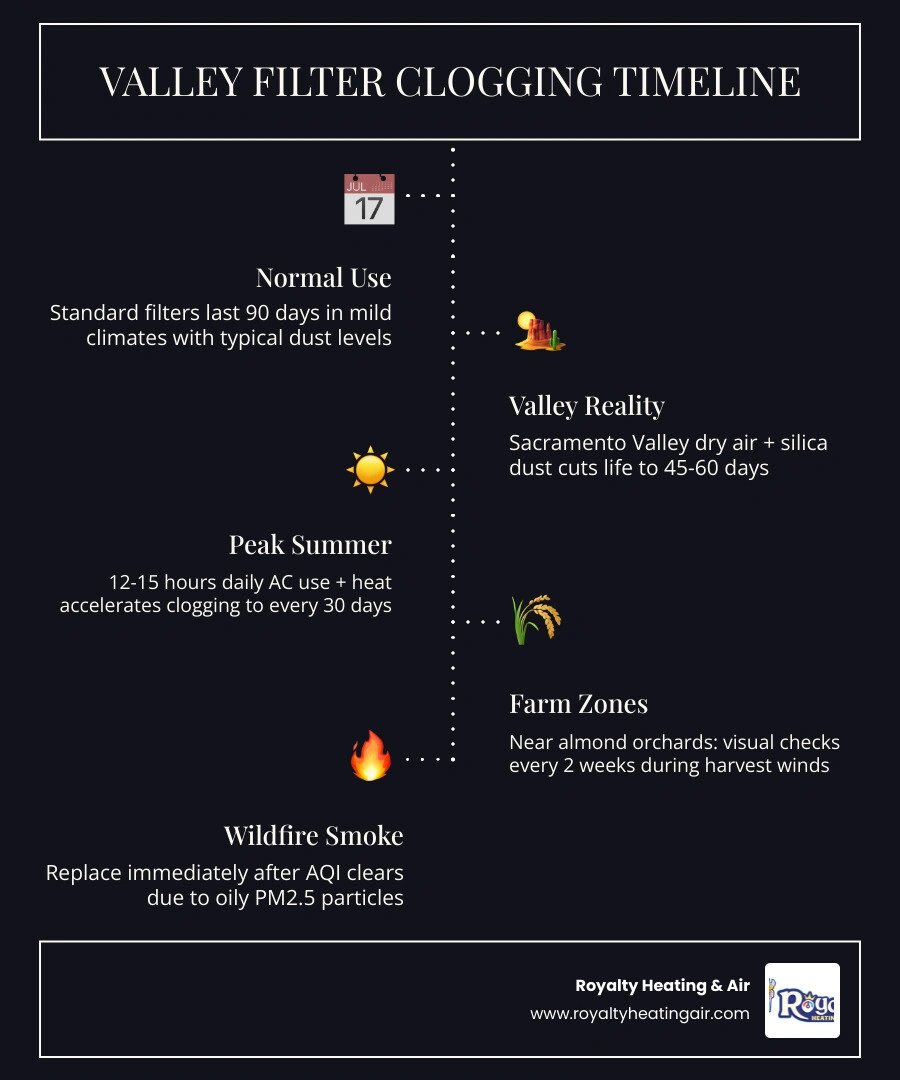
Here is a quick answer to how valley conditions change your replacement timeline:
• Normal household use — Standard Guideline: Every 90 days — Sacramento Valley Reality: Every 45-60 days
• Peak summer (AC running 12-15 hrs/day) — Standard Guideline: Every 90 days — Sacramento Valley Reality: Every 30 days
• Near agricultural fields or orchards — Standard Guideline: Every 90 days — Sacramento Valley Reality: Every 2 weeks (visual check)
• During or after wildfire smoke event — Standard Guideline: Every 90 days — Sacramento Valley Reality: Immediately after AQI clears
• Spring high-wind season — Standard Guideline: Every 90 days — Sacramento Valley Reality: Every 30 days minimum
When a clogged filter forces your system to strain, the consequences go beyond discomfort. Just 1/16th of an inch of dust on your evaporator coil can reduce system efficiency by more than 20%. During a July heat wave when your AC is already running nearly all day, that kind of efficiency loss adds up fast — and puts serious stress on components not designed for the load.
This guide walks through exactly why valley air is uniquely hard on filters, what warning signs to watch for, and how to build a replacement schedule that actually matches where you live.
The standard 90-day rule is a baseline designed for average climates, but the Sacramento Valley is far from average. When we look at communities like Roseville, Rocklin, and Lincoln, we see a high-particulate environment that rapidly overwhelms basic filters.
The primary culprit is the sheer volume of airborne particulate matter. In a dry, low-humidity climate, dust particles do not settle quickly. Instead, they remain suspended in the air, drifting until they are drawn directly into your home’s return vents.
Additionally, dry air influences the physics of dust collection. In humid climates, moisture bonds to dust particles, making them heavy so they fall to the ground. In our arid valley summers, dry air allows microscopic dust particles to carry a static charge. This static charge causes them to cling to surfaces, bond aggressively to filter fibers, and quickly form a dense, air-blocking sheet across the face of your filter.
Furthermore, local valley dust is not just soft household lint. It is heavily composed of crystalline silica and other abrasive soil minerals. If you delay your AC Filter Replacement, this abrasive dust can eventually bypass the filter altogether, accelerating wear on your system's blower motor and fan blades.
To understand how hot dry valley affects filter replacement frequency, we have to look at the soil mineralogy and atmospheric conditions of Northern California. The soils surrounding Loomis, Lincoln, and Granite Bay are rich in fine silts, clays, and crystalline silica. When dry winds sweep across the valley floor, they kick up these microscopic mineral fragments. Crystalline silica is incredibly hard and sharp on a microscopic scale, behaving like fine sandpaper when drawn into an HVAC system.
Adding to this is the phenomenon of atmospheric stability during our hot summer afternoons. As valley temperatures climb past 100°F, a layer of warm air can trap cooler, dust-laden air close to the ground. This atmospheric inversion prevents particulates from dispersing upward. Instead, they remain concentrated right at the breathing and intake level of your home.
As of June 2026, climate trends show that our dry seasons are starting earlier and lasting longer, extending the window of high-particulate exposure. Because these dry, static-charged silica particles stay suspended in the air longer, your HVAC filter is subjected to a continuous stream of heavy mineral dust that clogs the media weeks ahead of standard schedules.
In the Sacramento Valley, filter maintenance is not a set-it-and-forget-it chore. Our climate is marked by distinct seasonal shifts, each bringing a unique set of airborne contaminants that demand a flexible maintenance approach. Following a rigid calendar schedule without adjusting for these triggers is one of the most common bad habits that harm indoor air quality.
In the spring, strong delta breezes and north winds carry heavy loads of oak, pine, and grass pollens. These organic particles are relatively large but highly sticky, quickly coating filter fibers. Homeowners should refer to our Spring Air Filter Replacement Guide to prepare their systems for this initial seasonal surge.
As spring transitions into the dry heat of summer, the sheer runtime of your air conditioner increases the volume of air—and dust—passing through the filter. By the time late summer and autumn arrive, agricultural harvesting and wildfire risks introduce entirely new levels of heavy particulate matter.
If you live in or near agricultural zones in Lincoln or rural Roseville, harvest season is a major factor in how often you need to replace your filter. The regional almond harvest, which peaks in late summer, involves shaking trees and sweeping the dry orchard floors. This process releases massive plumes of fine, chemically reactive agricultural dust. This dust is highly concentrated with organic matter and soil minerals that can quickly cake over a pleated filter, turning it gray or brown in a matter of days.
Wildfire smoke presents an even more severe, acute challenge. Wildfire emissions contain extremely high concentrations of PM2.5—particulate matter that is 2.5 microns or smaller (for perspective, a human hair is about 70 microns wide). These microscopic particles are not just dry dust; they are composed of sticky, oily soot, ash, and chemical byproducts from burning vegetation and structures.
This oily residue bonds to filter fibers and creates a dense, non-porous barrier that chokes airflow. Because these particles carry strong, persistent odors, running a smoke-saturated filter will recirculate burnt smells throughout your home. After any major wildfire smoke event, replacing your air filter immediately is a critical step in our recommended steps to improve IAQ at home.
To protect your system from premature wear and maintain healthy indoor air, you must adjust your filter maintenance schedule to match our local valley climate. A standard three-month replacement cycle simply cannot keep up with the demands of a hot, dry summer.
During peak cooling periods in July and August, when outdoor temperatures regularly climb into the triple digits, residential AC systems often run for 12 to 15 hours a day. This massive increase in runtime means your filter is processing thousands of cubic feet of dusty air every single hour.
During these high-demand months, checking your filter every 30 days is essential. If you have pets, live near active construction, or are adjacent to open fields, you may need to replace the filter every 30 days as well. Keeping a clean filter in place is one of the easiest and most effective ways to learn how to extend the life of your AC in extreme heat.
Choosing the right filter is a balancing act between capturing fine valley dust and maintaining healthy system airflow. Minimum Efficiency Reporting Value (MERV) ratings range from 1 to 20, but not all ratings are safe for standard residential systems.
• MERV 1 to 4: These basic fiberglass filters are designed primarily to catch large lint and protect the HVAC equipment itself, but they do almost nothing to stop fine silica dust or pollen.
• MERV 8 to 11: This is the optimal sweet spot for Sacramento Valley homes. Pleated synthetic filters in this range capture a high percentage of fine dust, mold spores, and pollen without creating excessive static pressure.
• MERV 13 and Higher: While highly efficient at capturing microscopic particles, these dense filters can severely restrict airflow in standard residential systems. The increased airflow resistance forces the blower motor to work harder, which can lead to overheated components, frozen evaporator coils, and spiked energy bills.
For standard residential systems, we highly recommend using a pleated MERV 8 or MERV 11 filter and changing it more frequently, rather than installing a highly restrictive MERV 13+ filter. Always check your system manual or consult a professional to ensure your equipment can handle the static pressure of your chosen filter.
Because filter clogging happens gradually, it is easy to miss the early warning signs until your system begins to struggle. Fortunately, there are several physical and performance indicators that tell you a filter has reached its limit.
The most reliable DIY diagnostic is the light test. To perform this, turn off your HVAC system, slide the filter out, and hold it up to a bright light source or a window. If the light cannot pass through the filter media, air cannot pass through it easily either, and it is time for a replacement.
Other common warning signs include:
• Weak Airflow: If you notice the air blowing from your supply registers feels noticeably weaker than usual, a clogged filter is often the primary bottleneck.
• Uneven Cooling: When airflow is restricted, your system struggles to distribute conditioned air evenly, leading to hot spots in rooms furthest from the indoor unit.
• Increased Dusting: If you find yourself dusting your furniture more frequently, or if you notice a fine layer of gray powder settling on surfaces shortly after cleaning, your filter may be overloaded and letting dust bypass the frame.
Ignoring these early signs can lead to deeper system issues, including dust accumulating within the ductwork itself. Understanding how dirty ducts affect your HVAC performance highlights why keeping a clean filter in place is your first line of defense.
When a filter is completely loaded with fine valley dust, the system's blower motor continues to pull air, creating high negative pressure. This pressure can cause the filter frame to bend or buckle, allowing unfiltered, dusty air to bypass the filter entirely.
Once bypass occurs, fine silica and silt particles travel straight into your ductwork and indoor HVAC components. You can spot this by looking for gritty supply registers. If you run your finger along the slats of your ceiling or wall vents and feel a rough, sandpaper-like grit, silica dust is actively bypassing your filtration system.
Inside the indoor unit, this dry dust meets the damp, cold surface of the evaporator coil during the cooling cycle. The moisture from condensation mixes with the silica and silt, baking it into a dense, muddy sludge. This sludge insulates the coil, blocks heat transfer, and can eventually freeze the system.
If you notice these gritty deposits, it is highly likely that dust has settled deep within your air distribution system. Reading up on the signs your ductwork needs professional cleaning can help you determine if the issue has progressed beyond a simple filter swap. To prevent this, keeping up with proper duct cleaning frequency for valley homes and knowing how often should you clean vents can save you from costly system repairs.
During the peak agricultural harvest season (typically late August through October), we recommend performing a visual inspection of your air filter every 15 days, especially if you live in agricultural zones or near almond orchards in Lincoln or rural Roseville.
The heavy, fine dust kicked up by harvesting equipment can clog a standard pleated filter twice as fast as normal household dust. If the filter media appears solid gray or brown, or if you can no longer see the white backing material of the pleats, replace it immediately.
In almost all cases, no. True HEPA (High-Efficiency Particulate Air) filters are extremely thick and dense, designed to capture 99.97% of particles down to 0.3 microns. Because they present immense airflow resistance, standard residential blower motors are not powerful enough to push air through them.
Forcing a standard residential system to run with a HEPA filter can quickly cause the blower motor to burn out or cause the evaporator coils to freeze. For highly effective filtration that remains safe for residential equipment, a high-quality MERV 11 pleated synthetic filter is the best alternative. For a comprehensive approach to indoor air, you can also explore our room by room guide to better IAQ.
Yes. Wildfire smoke contains microscopic, oily soot and ash particles that quickly saturate filter media, choking system airflow and trapping strong, smoky odors.
You should monitor your filter during active smoke events, but the most important step is to replace the filter immediately after the outdoor Air Quality Index (AQI) returns to healthy levels. This ensures that the trapped, smelly, and hazardous smoke particles are completely removed from your home's air circulation system.
Managing how hot dry valley affects filter replacement frequency is one of the most practical ways to protect your home's comfort, maintain energy efficiency, and extend the lifespan of your cooling system. Our unique Placer County climate—filled with abrasive silica dust, seasonal harvest winds, and summer heat waves—demands a proactive approach to filtration that standard manufacturer guidelines simply do not account for.
At Royalty Heating & Air, we are proud to provide expert HVAC maintenance, installation, and indoor air quality services across Roseville, Rocklin, Lincoln, Loomis, and Granite Bay. Beyond keeping your home cool and clean, we are deeply committed to our local community. Through our proud partnership with the MackAttack Foundation, we actively support foster babies and sponsor family adoptions, ensuring that our work brings warmth and comfort to families in need.
If you want to ensure your home's air is clean, safe, and perfectly filtered, explore our professional indoor air quality services in Rocklin. Schedule your seasonal system maintenance or filter consultation with us today, and breathe easier knowing your home is in expert hands.

