
Services
About
Service Areas


How long does an ac last in the sacramento valley is one of the most common questions homeowners ask — and for good reason. Here's a quick answer:
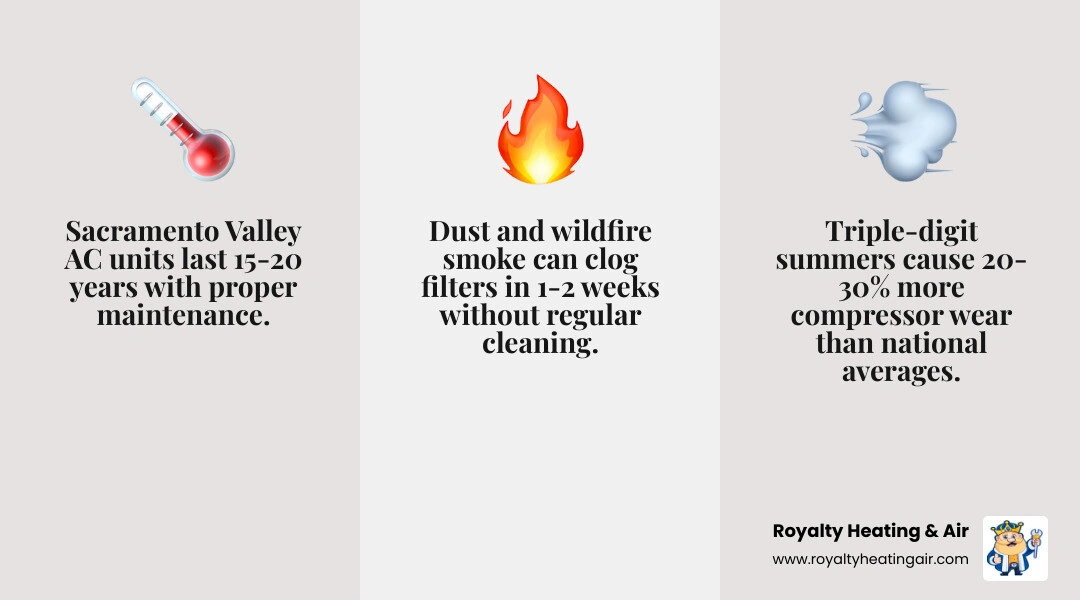
• Central Air Conditioner — Typical Lifespan in Sacramento Valley: 15 to 20 years (with proper maintenance)
• Ductless Mini-Split — Typical Lifespan in Sacramento Valley: 15 to 20 years
• Heat Pump — Typical Lifespan in Sacramento Valley: 15 to 25 years
• Window Unit — Typical Lifespan in Sacramento Valley: 8 to 10 years
• Portable AC — Typical Lifespan in Sacramento Valley: 5 to 10 years
Sacramento summers are no joke. Temperatures regularly climb past 100°F for weeks at a stretch, and your AC runs almost non-stop from late spring through September. That kind of demand puts far more strain on cooling systems than what most national averages account for.
In milder climates, a central AC might coast to its 20-year mark without much drama. Here in the Sacramento Valley, the same unit is working harder, longer, and under more stress — from triple-digit heat to agricultural dust and wildfire smoke clogging up filters almost overnight.
The good news is that with the right care, many Sacramento homeowners do reach that 15-to-20-year mark. The key is understanding what works against your system — and staying ahead of it.
When we talk about the lifespan of an air conditioner in our neck of the woods, we have to look at the technology under the hood. In many Sacramento homes, a new central AC can last 15 to 20 years with proper care. This is a significant improvement over older systems, which were often expected to retire after just 10 to 15 years.
Why the jump in longevity? Modern units are built to handle the "heavy lifting" of a Central Valley summer more gracefully. Newer compressors are designed to handle load changes more smoothly, which reduces the mechanical wear and tear that used to kill older units during a July heatwave.
However, the type of system you have matters. For example, ductless mini-splits in Central California generally have a lifespan of 15 to 20 years, often outlasting traditional systems because they don't suffer from ductwork air leaks and they cycle much more quietly. Central air-source heat pumps usually last around 15 years, but in a well-insulated home with a perfect maintenance record, they can stretch to 20 or even 25 years.
If you are curious about the specifics of a full system overhaul, check out our AC Unit Replacement Complete Guide.
One of the biggest factors in how long does an ac last in the sacramento valley is the quality of the installation. We often say that the most important day in the life of an AC is the day it’s installed. If the unit is oversized, it will "short-cycle" (turn on and off too frequently), which puts massive stress on the components. If it’s undersized, it will run forever and still never cool the house. Proper sizing and professional installation according to current SEER2 standards (the new minimum efficiency standard in California) are non-negotiable for a long-lived system.
If you’re wondering if your current unit is already past its prime, our guide on How Old is Too Old for an HVAC System can help you determine if you’re living on borrowed time.
The Sacramento Valley has a unique climate profile that acts like a "stress test" for mechanical equipment. While we all love the Delta Breeze for the evening relief it brings, it often arrives after the sun has already spent ten hours beating down on your outdoor condenser.
We also deal with environmental factors that homeowners in the Bay Area or the Sierras don't have to worry about. Agricultural dust from the surrounding valley and particulate matter from wildfire smoke can coat your AC’s internal components in a layer of "valley grime" that acts like an insulating blanket—trapping heat inside the machine where it doesn't belong.
When these conditions take hold, you might find your AC Not Cooling as it should. This is usually the first sign that the environment is winning the battle against your equipment.
• Average Lifespan — Impact on Central AC: 15-20 Years — Impact on Window Units: 8-10 Years
• Repairability — Impact on Central AC: High (Modular parts) — Impact on Window Units: Low (Often disposable)
• Efficiency — Impact on Central AC: High (SEER2 rated) — Impact on Window Units: Low
• Climate Resilience — Impact on Central AC: High (Built for extremes) — Impact on Window Units: Moderate
To keep your system running through these challenges, proactive care is essential. For residents in our service areas, we recommend following the Ultimate HVAC Maintenance Granite Bay CA checklist to ensure your system is ready for the "triple-digit gauntlet."
Dust is the silent killer of HVAC systems in Loomis, Lincoln, and Rocklin. Because we are surrounded by farmland and construction, our air is naturally heavier with particulates. When your air filter gets clogged with this dust, your fan motor has to work twice as hard to pull air through. This leads to overheating and premature motor failure.
In the Sacramento Valley, we recommend checking your filters every 30 days during the peak cooling season. If you live near a dusty road or open field, you might even need to change them monthly. Neglecting this can shave years off your system's life. For more expert tips, see our AC Maintenance Experts Loomis CA Guide.
Without maintenance, a system that should have lasted 20 years might "give up the ghost" at year 12. Lack of service leads to:
• Refrigerant leaks: Which cause the compressor to overheat.
• Frozen coils: Usually caused by restricted airflow or low refrigerant.
• Electrical failure: Heat-stressed capacitors are the #1 cause of emergency calls in Roseville during a heatwave.
Scheduling a professional tune-up at least once a year (ideally in the spring) is the best way to catch these issues before they become terminal. Our AC Service Granite Bay CA Complete Guide explains exactly what a professional technician looks for to keep your unit healthy.
Eventually, every AC reaches a "tipping point" where it costs more to keep it alive than it does to replace it. To help our neighbors make this decision, we use a couple of industry "rules of thumb":
1. The 50% Rule: If a single repair costs more than 50% of the price of a new system, it’s time to replace.
2. The 5000 Rule: Multiply the age of the unit by the cost of the repair. If the total exceeds $5,000, replacement is usually the smarter financial move. (For example, a $600 repair on a 10-year-old unit is $6,000—suggesting it's time to look at new options).
Another major factor in May 2026 is the R-22 refrigerant phase-out. If your unit was built before 2010, it likely uses R-22 (Freon), which is now phased out and incredibly expensive to source. A simple leak in an R-22 system can now cost thousands to fix, making replacement the only logical choice.
If you find yourself constantly calling for an AC Repair Granite Bay CA Complete Guide, it’s a sign that your system’s "medical record" is getting too long. While you're thinking about the AC, don't forget that your furnace often shares the same blower motor and ductwork. Our Annual Furnace Maintenance Guide can help you keep the other half of your HVAC system in top shape.
The R-22 phase-out means that the chemical your older AC uses to cool the air is no longer being produced. While recycled R-22 is available, the scarcity has driven prices sky-high. If a 15-year-old unit develops a refrigerant leak, the cost of the "recharge" combined with the age of the components usually makes a new, eco-friendly R-410A or R-32 system a much better investment.
Yes! Homeowners in the Sacramento area often have access to rebates through SMUD or other local utility programs. These incentives are designed to encourage the installation of high-efficiency units that take the strain off our local power grid. When you combine these rebates with the 40% to 50% savings you’ll see on your energy bill by moving from an old 8-SEER unit to a modern 16+ SEER2 unit, the system often pays for itself over time.
Ductless systems are the "marathon runners" of the HVAC world. Because they don't have to push air through yards of dusty, leaky ductwork, they operate with much less static pressure. They also use variable-speed technology to maintain a steady temperature rather than constantly "crashing" on and off. This reduced mechanical stress typically leads to a longer, more reliable lifespan in our hot valley climate.
At Royalty Heating & Air, we know that your air conditioner is the most important appliance in your home during a Sacramento summer. Our mission is to help you get every possible year of service out of your unit through expert maintenance and honest advice.
We are proud to serve the communities of Loomis, Rocklin, Roseville, Lincoln, and Granite Bay. But our commitment to our neighbors goes beyond HVAC. Through our partnership with the MackAttack Foundation, we support foster babies and sponsor local family adoptions. When you choose us, you're not just getting a cool home; you're supporting a business that cares deeply about the families in our community.
If you’re worried about your system’s performance or want to plan for a future upgrade, reach out to us for Expert Air Conditioning Services in Sacramento. We’ll help you beat the buzzkill of the valley heat and keep your family comfortable for years to come.
