
Services
About
Service Areas


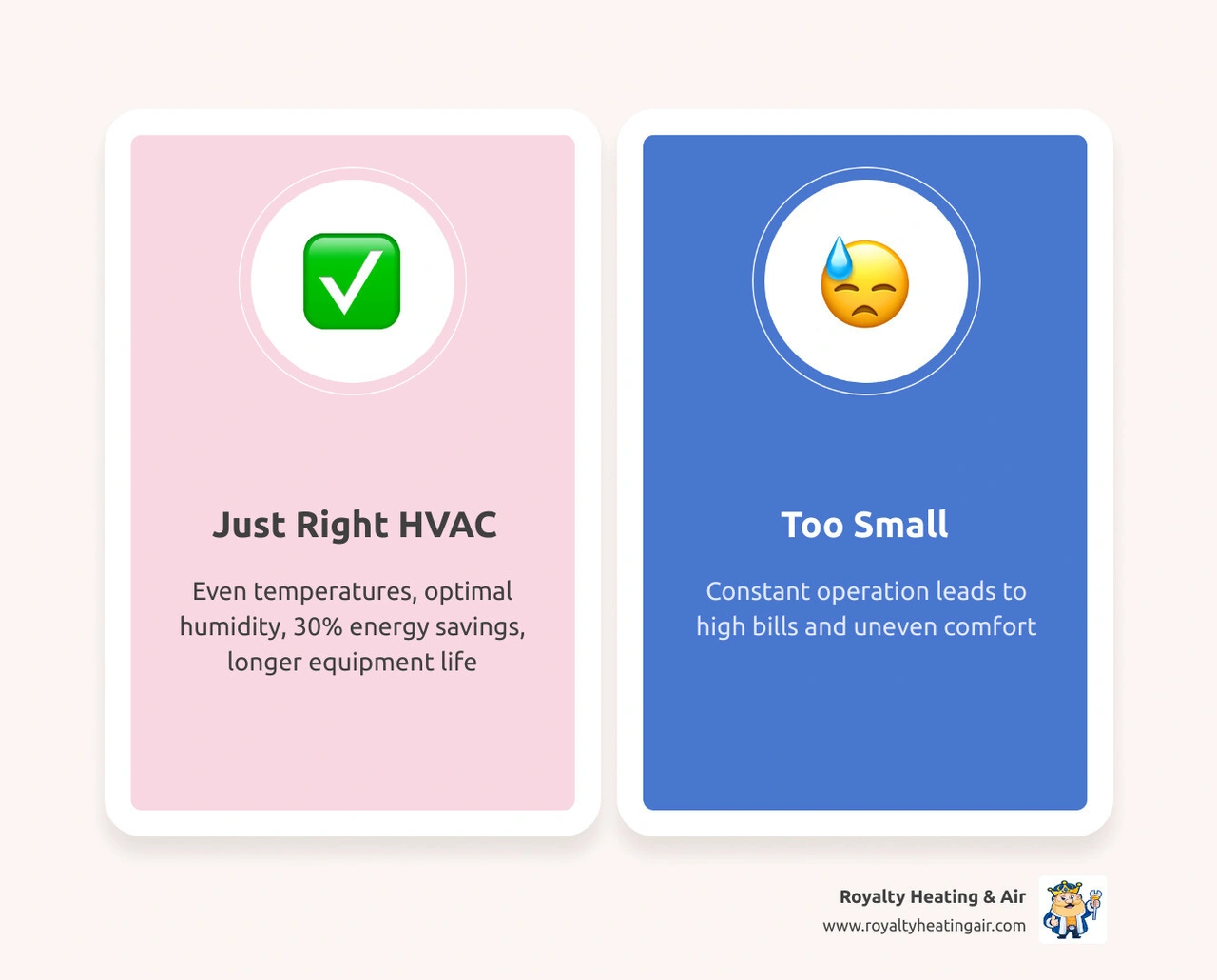
How proper hvac sizing affects comfort and efficiency comes down to one core idea: a system that doesn't match your home's actual heating and cooling needs will struggle — no matter how new, expensive, or high-tech it is. If your system is too large, it blasts air for a few minutes and shuts off before finishing the job. Too small, and it runs nonstop trying to keep up. Either way, you lose on comfort, energy bills, and equipment life.
Here's a quick summary of how sizing impacts your home:
• Temperature consistency - A correctly sized system maintains even temperatures throughout your home without dramatic swings between cycles
• Humidity control - Proper sizing allows full dehumidification cycles, preventing that sticky, clammy feeling even when the thermostat reads 72°F
• Energy efficiency - A right-sized unit can use up to 30% less energy than an oversized one by avoiding the massive power draws of constant startup cycles
• Equipment lifespan - Correct sizing prevents short cycling and overwork, both of which can cut a system's lifespan by up to 50%
• Indoor air quality - Longer, complete run cycles mean more air passes through your filters, improving what your family breathes
More than half of U.S. homes have HVAC systems that are either too big or too small. That's not a minor inconvenience — it's a daily drain on your comfort and your wallet. For homeowners in Roseville, where summers regularly push triple digits and winters bring their own demands, getting the size right isn't optional. It's everything.
When we talk about HVAC "size," we aren't talking about how many inches wide the outdoor unit is. In heating and cooling, size refers to capacity—the ability of the system to move heat into or out of your home. To understand how proper hvac sizing affects comfort and efficiency, we first have to speak the language of the industry: BTUs and Tonnage.
A BTU (British Thermal Unit) is a measure of heat energy. Specifically, it’s the amount of energy needed to raise the temperature of one pound of water by one degree Fahrenheit. In cooling terms, it's how much heat the AC removes. Tonnage is simply a larger unit of measurement; one "ton" of air conditioning capacity equals 12,000 BTUs per hour. This term actually dates back to the days when people used literal tons of ice to cool buildings!
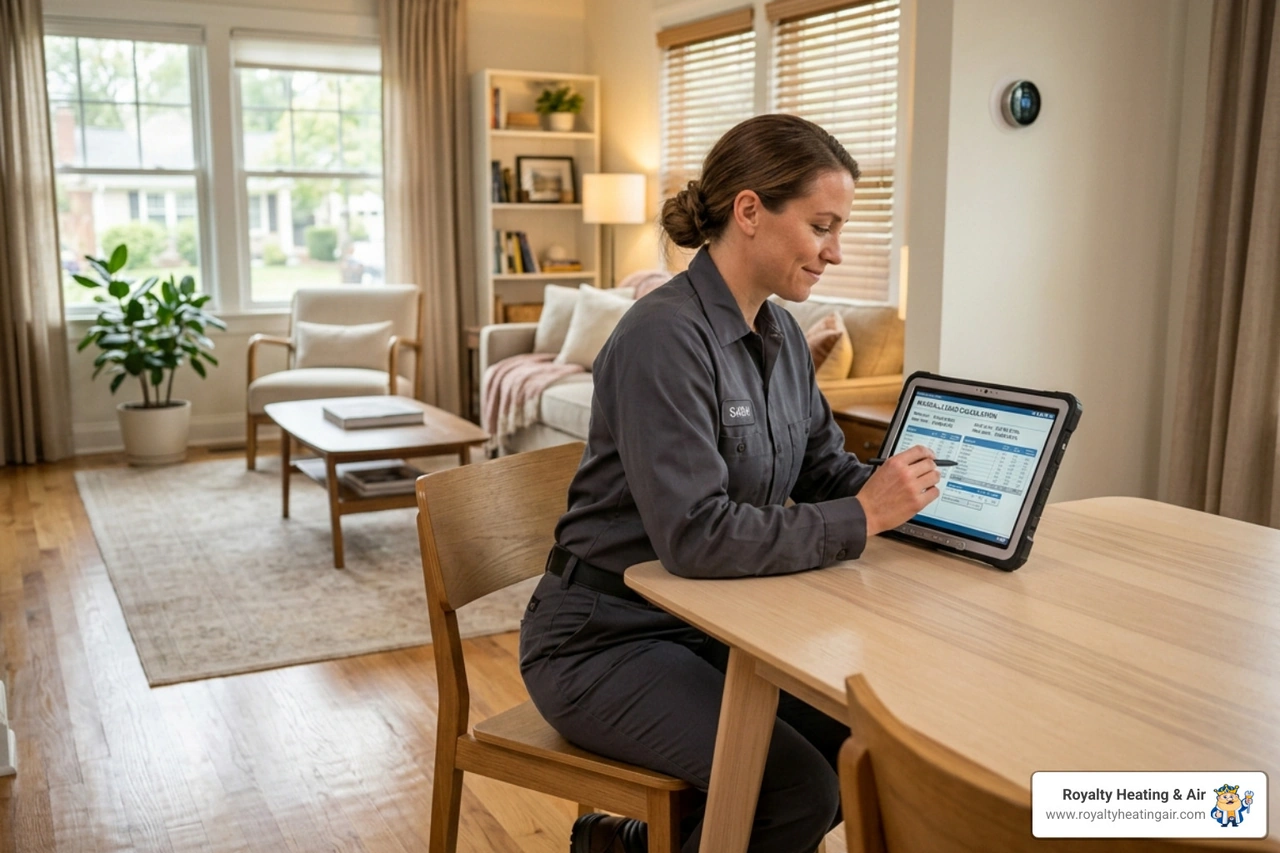
In May 2026, we no longer guess at these numbers. The industry standard for determining the perfect fit is the Manual J load calculation. Developed by the Air Conditioning Contractors of America (ACCA), this is a scientific protocol that accounts for every variable in your home. Relying on a HVAC System Evaluation that utilizes Manual J is the only way to ensure your new system isn't a "risky gamble."
• 1,000 – 1,200 — Estimated Capacity (Tons): 2.0 Tons — Estimated Capacity (BTUs): 24,000 BTUs
• 1,200 – 1,500 — Estimated Capacity (Tons): 2.5 Tons — Estimated Capacity (BTUs): 30,000 BTUs
• 1,500 – 1,800 — Estimated Capacity (Tons): 3.0 Tons — Estimated Capacity (BTUs): 36,000 BTUs
• 1,800 – 2,200 — Estimated Capacity (Tons): 3.5 Tons — Estimated Capacity (BTUs): 42,000 BTUs
• 2,200 – 2,500 — Estimated Capacity (Tons): 4.0 Tons — Estimated Capacity (BTUs): 48,000 BTUs
Many contractors still use a "rule of thumb," such as one ton of cooling for every 500 square feet. This is a dangerous oversimplification. Two homes in Granite Bay might both be 2,000 square feet, but if one has vaulted ceilings and the other has standard eight-foot ceilings, the volume of air that needs to be cooled is vastly different.
The "building envelope"—the physical barrier between your conditioned air and the outdoors—is unique to every house. Factors that change your sizing needs include:
• Insulation R-values: Better insulation allows for a smaller, more efficient unit.
• Window Orientation: Large south-facing windows in a Rocklin home act like giant heaters during the day.
• Air Infiltration: How "leaky" is the house? Drafty older homes require more capacity than airtight modern builds.
• Ceiling Height: Cooling a room with 12-foot ceilings takes significantly more energy than a standard room.
Ignoring these details often leads to homeowners needing HVAC Upgrades Granite Bay Tips much sooner than expected because their original system was never matched to the home's actual thermal load.
In the Sacramento Valley, we don't size systems for the "average" day; we size them for the "design temperature." This is the temperature that our region stays at or below for 99% of the year. When Roseville hits 105°F in July, your AC needs to have enough "muscle" to keep up without running 24/7. However, if we size it only for that rare 110°F peak, it will be drastically oversized for the rest of the summer.
Proper sizing finds the balance between peak demand and daily efficiency. This is why Spring AC and HVAC Maintenance for the Sacramento Area is so critical; it ensures that even a perfectly sized unit is clean and capable of hitting those design targets when the heatwave finally arrives.
If you notice your air conditioner kicking on, blowing a gale of freezing air for five minutes, and then abruptly shutting off, you are likely dealing with an oversized system. This phenomenon is called short cycling. To a homeowner, it might seem like the unit is "powerful," but in reality, it's a recipe for disaster.
Oversized systems are a major source of energy waste. Think of it like driving a car in heavy stop-and-go traffic; you use far more gas than you would at a steady highway speed. Every time your AC starts up, it draws a massive amount of electricity. If it does this four or five times an hour instead of running one long, efficient cycle, your utility bills will skyrocket. Furthermore, this constant starting and stopping creates immense mechanical strain. To keep your system healthy, Ultimate HVAC Maintenance Granite Bay CA is required to catch the wear and tear that short cycling leaves behind.
Short cycling doesn't just hurt your wallet; it ruins your comfort. Because the unit shuts off so quickly, the air near the thermostat might reach the target temperature, but the air in the back bedrooms stays warm. This leads to temperature swings of 3-5°F between cycles, leaving you constantly reaching for the thermostat.
The mechanical consequences are even worse. The startup phase is when the most damage occurs to the compressor—the "heart" of your system. Frequent starts can cut an HVAC system’s lifespan by up to 50%. We believe in the How the Royalty Treatment Philosophy Improves Your Service approach, which means we prioritize the long-term health of your equipment by ensuring it never has to endure the brutal cycle of an oversized installation.
One of the most overlooked jobs of an air conditioner is dehumidification. As air passes over the cold evaporator coils, moisture condenses and is drained away. However, it takes about 10 to 15 minutes of continuous running for the coils to get cold enough to start effectively removing humidity.
If your system is oversized and only runs for seven minutes, it never removes the moisture. You end up with "clammy air"—it’s 72°F, but you feel sticky and uncomfortable. High humidity isn't just a comfort issue; it's an indoor air quality (IAQ) risk that can lead to mold growth and dust mite infestations. A properly sized unit runs long enough to scrub the moisture from the air and pull that air through your high-efficiency filters, keeping your family healthier.
On the flip side, an undersized system is like a small engine trying to pull a massive trailer up a steep hill. It might eventually get there, but it’s going to struggle every inch of the way. In Lincoln or Loomis, an undersized unit will run for hours on end without ever reaching the temperature you set on the thermostat.
Common signs of an undersized unit include:
• Constant Operation: The system never shuts off, even during mild evenings.
• Uneven Temperatures: You might see variances of up to 10°F between different rooms or floors.
• High Utility Bills: Because the unit is always "on," it consumes a staggering amount of total kilowatt-hours.
We often recommend HVAC Maintenance Plans Tips Homeowners can use to identify these issues early. If your system is constantly running but your home still feels like a sauna, sizing is likely the culprit.
When a system is sized correctly, it reaches a "steady-state" of operation. Modern variable-speed compressors are the gold standard here. Unlike older "single-stage" units that are either 100% on or 100% off, variable-speed systems can dial their output up or down.
When sized correctly, these advanced systems can boost efficiency by up to 40%. They run at a low, quiet speed for most of the day, maintaining a perfect temperature within half a degree of your setting. This prevents the 10°F swings often seen with undersized units. A properly sized unit can use up to 30% less energy than an improperly fitted one, simply because it stays in its "sweet spot" of operation. If you find yourself wondering How Old is Too Old for an HVAC System, consider that a newer, correctly sized unit could pay for itself in energy savings alone.
An undersized unit is under constant stress. The blower motor is forced to run at maximum RPM for hours, and the compressor never gets a break to cool down. This leads to:
1. Blower Motor Burnout: The fan simply gives up after months of non-stop work.
2. Heat Exchanger Cracks: In the winter, an undersized furnace can overheat and develop dangerous cracks, potentially leaking carbon monoxide.
3. Frequent Emergency Repairs: Parts that should last 15 years start failing after five.
The most common red flags are short cycling (turning on/off every few minutes), high indoor humidity, and inconsistent temperatures between rooms. If your energy bills are rising despite regular maintenance, or if the unit is excessively noisy because it's struggling to push air through a system not designed for its capacity, you likely have a sizing mismatch.
Unfortunately, no. A high SEER (Seasonal Energy Efficiency Ratio) rating tells you how efficient the unit is when it's running under ideal conditions. If a 20-SEER unit is the wrong size, it will still short cycle or run constantly, negating the advanced technology. Sizing is the foundation; efficiency ratings are the "bonus" on top of that foundation.
You don't need to check it every year, but you should definitely request a HVAC System Evaluation if you have made significant changes to your home. This includes:
• Adding a room or finishing a basement.
• Replacing old single-pane windows with modern energy-efficient ones.
• Adding new insulation to your attic or walls.
• Upgrading to a "cool roof" or changing your roofing material.
At Royalty Heating & Air, we know that your home is your sanctuary. Whether you are in Roseville, Rocklin, or Lincoln, you deserve a system that fits your life perfectly. We don't believe in "rule of thumb" guesses; we believe in the science of comfort. Our expert technicians are dedicated to providing the "Royalty Treatment," ensuring every installation is backed by precise load calculations and a commitment to your long-term satisfaction.
We are also proud to be more than just an HVAC company. Our partnership with the MackAttack Foundation allows us to support foster babies and sponsor family adoptions, turning every service call into an opportunity to give back to our local community. When you choose us, you aren't just getting a perfectly sized HVAC system—you're supporting a business that cares about the families in our neighborhood.
Ensure your home has the perfect fit with professional HVAC services and experience the difference that proper sizing makes. Contact us today to schedule your evaluation!
