
Services
About
Service Areas


How sacramento area climate affects your hvac system is one of the most important things to understand as a homeowner in this region — because Sacramento's weather is genuinely tough on heating and cooling equipment.
Here's a quick breakdown of the main ways local climate stresses your HVAC:
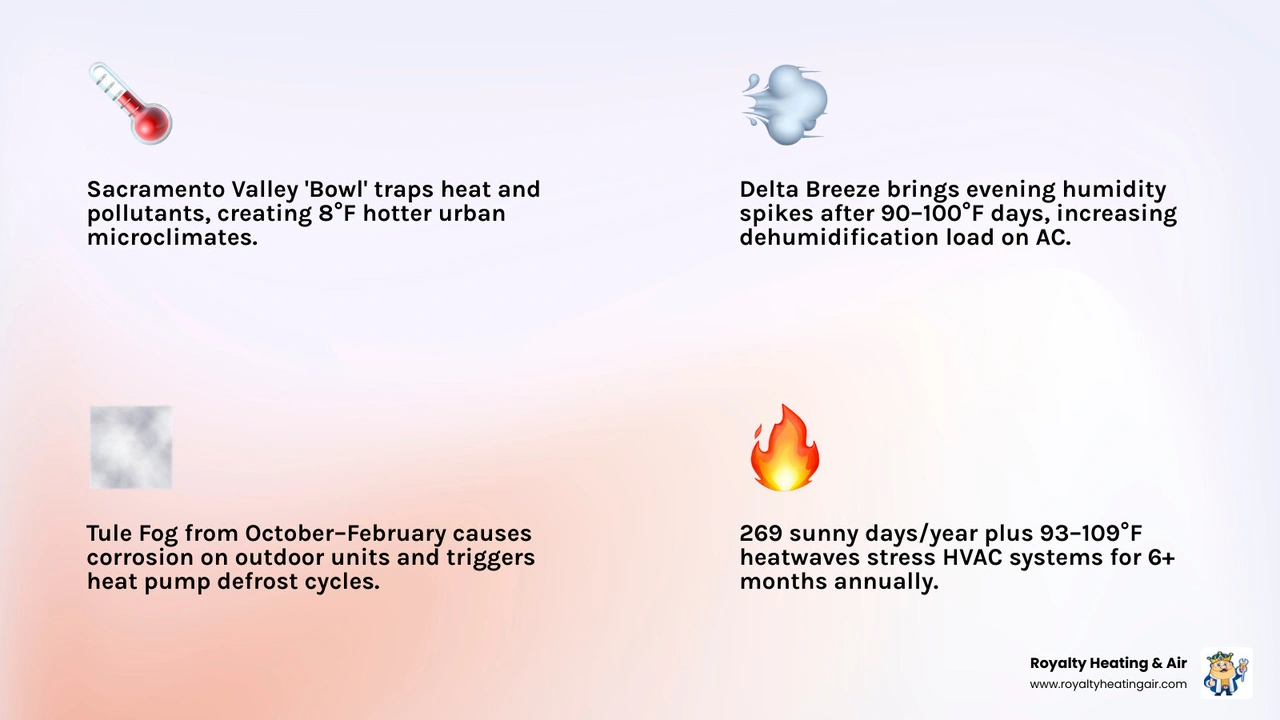
• Triple-digit summer heat — Temps regularly hit 93–109°F, pushing most AC systems to their physical limits
• The 20-degree cooling rule — Standard residential AC units can only cool about 20°F below outdoor temps, meaning 80°F+ indoors during extreme heat waves is often normal, not a failure
• Delta Breeze humidity shifts — When inland temps hit 90–100°F, a moist marine breeze rolls in and forces your system to work harder on dehumidification instead of just cooling
• Tule fog in winter — Ground-hugging moisture from October through February can corrode outdoor components, clog filters, and cause heat pumps to run exhausting defrost cycles
• Wildfire smoke and valley smog — Poor air quality clogs filters fast and degrades indoor air, especially in the Sacramento Valley's "bowl" geography that traps pollutants
• Urban heat island effect — Downtown Sacramento can run up to 8°F hotter than surrounding areas, increasing cooling demand significantly
Sacramento sees 269 sunny days a year and summers that stretch from late spring well into fall. That's a long time to run your AC — and a long time for wear and tear to build up. Add in the valley's unique meteorological quirks like the Delta Breeze and Tule fog, and you have a climate that doesn't just stress HVAC systems seasonally — it challenges them year-round.
If you've ever wondered why your house still feels warm when the AC is running, or why your energy bills spike every July, the answer almost always comes back to how this valley's climate interacts with your equipment.
In May 2026, as we look back at recent weather patterns, it is clear that Sacramento summers are not getting any milder. With record highs hitting 109°F, your air conditioner is essentially running a marathon every single day. Most residential HVAC systems are designed with a "design temperature" of approximately 95°F. When the mercury climbs past 100°F, the system enters a state of mechanical strain.
One of the most common calls we get during a heatwave is from homeowners worried that their house is 78°F or 80°F even though the AC is running. This is often due to the 20-degree cooling rule. In the HVAC world, this is a physical limitation: most systems are designed to drop the indoor temperature about 20 degrees lower than the outdoor air. If it is 105°F in Roseville, a perfectly functioning AC might only be able to keep your living room at 85°F.
This extreme heat leads to "short cycling," where the system turns on and off rapidly, or worse, runs 24/7 without a break. This constant operation accelerates the wear on your compressor and fan motors. To ensure your system is ready for these spikes, we always recommend Spring AC and HVAC Maintenance for the Sacramento Area to check refrigerant levels and clean the coils before the first 90-degree day.
To help your system survive the valley heat, we recommend a "sweet spot" thermostat setting of 78°F when you are home. While many residents prefer 71°F, every degree you lower the thermostat below 78°F can increase your energy usage by up to 6%.
A smarter strategy is pre-cooling. Because of Time-of-Use (TOU) utility rates from providers like SMUD, electricity is much more expensive in the late afternoon. We suggest "super-cooling" your home to 70–72°F in the early morning hours when it’s still cool outside. Then, around 4:00 p.m., raise the thermostat to 78°F or 80°F. Your home will act like a thermal battery, staying comfortable while your AC takes a much-needed break during the hottest part of the day.
Don't forget the low-tech helpers:
• Ceiling Fans: Ensure they rotate counterclockwise in the summer to push air down.
• Window Treatments: Closing blackout curtains on south-facing windows can reduce solar heat gain by up to 30%.
• Attic Heat: On a 100°F day, your attic can reach 130°F to 150°F, radiating heat through your ceiling like a giant toaster. Proper insulation is the only way to stop this.
Sacramento’s climate isn’t just about the heat; it’s about the moisture shifts. The Delta Breeze is a local legend—a cool, moist sea breeze that moves through the Carquinez Strait to provide relief at night. However, while it feels great on your skin, it introduces a spike in humidity. This shifts your HVAC's job from "sensible cooling" (lowering the temperature) to "latent cooling" (removing moisture). If your system isn't maintained, this extra humidity can lead to frozen evaporator coils, even when it’s hot outside!
In the winter, we deal with Tule fog. This ground-hugging moisture settles between October and February, often after the first heavy rains. For residents in Sacramento CA, this fog is more than a driving hazard. The moisture can physically corrode outdoor HVAC components and settle on the coils of heat pumps.
When moisture on the coils freezes during a chilly Sacramento night, your heat pump has to enter a "defrost cycle." This is perfectly normal, but if the fog is persistent, the system may defrost so frequently that it causes excessive wear on the reversing valve and compressor.
The geography of the Sacramento Valley is often described as a "bowl." While the mountains are beautiful, they trap pollutants, smog, and unfortunately, wildfire smoke. During wildfire season, the air is filled with PM2.5—tiny particulates that can bypass standard "builder-grade" filters.
This is where how sacramento area climate affects your hvac system becomes an indoor health issue. Smoke doesn't just make it hard to breathe; it coats your HVAC's internal components in fine ash and soot. We’ve seen filters that usually last three months get completely clogged in just two weeks during a major smoke event.
Another factor is the Urban Heat Island effect. If you live in downtown Sacramento, the asphalt and concrete soak up heat all day and radiate it back at night. This can make downtown up to 8°F hotter than more rural areas like Loomis or Lincoln. Because the temperature never truly "recovers" at night in the city, downtown HVAC systems often have a shorter lifespan due to the lack of downtime.
To combat this, we recommend Whole House Air Filtration Sacramento and Indoor Air Quality Services Roseville. Upgrading your filtration is the best way to protect both your lungs and your equipment.
During peak summer or wildfire season, a 30-day filter check is non-negotiable. A dirty filter is like trying to breathe through a straw while running a marathon; it forces the blower motor to work twice as hard, leading to premature failure.
For the best protection, we suggest:
• MERV 13 Filters: These are the industry standard for capturing smoke particles.
• HVAC Air Purification: Systems like the iWave or HALO-LED can actively neutralize pollutants in the air stream. Check out our guide on HVAC Air Purification for more details.
• Year-Round Vigilance: Keeping your Healthy Home Air clean is a 365-day job, which is why we offer Indoor Air Quality Services Lincoln to keep your family safe.
As of 2026, California has moved toward even stricter efficiency standards. The minimum SEER2 rating for new split systems is now 14.3. However, if you want to take advantage of federal tax credits, you’ll likely need a system rated at 17 SEER2 or higher.
• Cooling Efficiency — Traditional Central AC: High (Up to 20+ SEER2) — Modern Heat Pump: High (Up to 20+ SEER2)
• Heating Method — Traditional Central AC: Gas Furnace (Combustion) — Modern Heat Pump: Electricity (Heat Transfer)
• Sacramento Suitability — Traditional Central AC: Good for extreme heat — Modern Heat Pump: Excellent for mild winters
• Environmental Impact — Traditional Central AC: Higher (Carbon emissions) — Modern Heat Pump: Lower (All-electric)
• Lifespan — Traditional Central AC: 15–20 Years — Modern Heat Pump: 15–20 Years
Heat pumps are particularly effective for the Sacramento climate. Because our winters are relatively mild (rarely dropping below freezing for long), a heat pump can move heat from the outside air into your home much more efficiently than a furnace can create it.
However, no matter how efficient your unit is, it can't overcome a poor "thermal envelope." If your attic insulation is thin or old, that 150°F attic heat will leak straight into your living space. We always check the insulation levels during our consultations because even the best AC can't win a fight against a house that isn't sealed.
Even within a 20-mile radius, HVAC needs can vary. Sacramento often feels "stickier" because of the Delta Breeze's humidity, whereas Roseville and Rocklin tend to experience a drier, more intense heat.
In newer developments in West Roseville or Lincoln, homes are built to be very airtight. While this is great for efficiency, it can actually trap heat and stale air inside. This is why many of our clients in these areas opt for whole-house fans. These fans allow you to flush out the hot air in the evening and pull in the cool night air, giving your AC a break.
For older homes in areas like East Sacramento or Granite Bay, we often perform Manual J Load Calculations. This is a scientific way of sizing an HVAC system based on square footage, window orientation, and insulation levels. You don't want a system that is too small (it won't keep up) or too large (it will short cycle and leave the air humid).
Whether you need Indoor Air Quality Services Granite Bay or Indoor Air Quality Services Loomis, understanding these microclimates is the key to lasting comfort.
The Department of Energy and local utilities like SMUD recommend 78°F while you are at home. If you find this too warm, using ceiling fans can make the room feel 4 degrees cooler. When you are away, set it to 85°F to prevent the house from "heat soaking," which makes it much harder to cool down later.
Yes, it is perfectly safe. In fact, running the system can help manage the indoor humidity caused by the fog. However, keep an eye on your outdoor unit; if you see ice building up on the coils, turn the system off and call a professional, as this indicates a defrost issue or airflow restriction.
During an active smoke event, you should check your filter every 2 to 4 weeks. If the filter looks gray, fuzzy, or dark, replace it immediately. Using a high-quality MERV 13 filter is the best way to keep those fine smoke particles out of your lungs.
At Royalty Heating & Air, we live and work in this climate, so we know exactly what your system is up against. Whether it’s the 105-degree afternoons in Rocklin or the damp, foggy mornings in Lincoln, our team is trained to provide solutions that actually last.
We aren't just about fixing air conditioners; we are about supporting our community. We are proud partners with the MackAttack Foundation, where we help support foster babies and sponsor family adoptions. When you choose us for your HVAC needs, you’re also helping local families grow and thrive.
From seasonal tune-ups that improve efficiency by up to 30% to installing the latest energy-efficient heat pumps, we are here to ensure your home remains a sanctuary. If your system is struggling to keep up with the Sacramento heat, don't wait for a total breakdown.
Ready to beat the valley heat? Contact Royalty Heating & Air today for expert HVAC service in Roseville, Rocklin, Lincoln, Loomis, and Granite Bay!
