
Services
About
Service Areas


Is a high efficiency furnace worth the extra cost? For many homeowners in Roseville, Rocklin, Lincoln, Granite Bay, and Loomis who plan to stay in their home for several years, yes, it often is. But the honest answer depends on a few key factors: where you live, how long you'll stay, and how much your current heating system affects comfort and energy use.
Here's a quick breakdown to answer the core question:
• Colder winter usage, staying 5+ years — High-Efficiency Worth It?: Yes - strong long-term value
• Moderate climate, staying 5+ years — High-Efficiency Worth It?: Likely yes - slower payoff in energy savings
• Mild climate or moving within 2-3 years — High-Efficiency Worth It?: Probably not
• Large older home with poor insulation — High-Efficiency Worth It?: Yes - efficiency gains can be more noticeable
• Tight budget or limited installation options — High-Efficiency Worth It?: Standard may be the better fit
Heating can account for a large share of a typical home's energy use. A standard furnace operates at 80% AFUE, meaning some of the fuel used for heating is lost through the venting process. High-efficiency models usually run between 90% and 97% AFUE, pulling more usable heat from the same fuel.
That difference can add up over time. It also comes with added installation considerations, venting changes, and ongoing maintenance needs. This guide walks through the real-world pros and cons, comfort benefits, maintenance factors, and available incentives so you can make a confident decision for your home.
For many homeowners in Roseville, Rocklin, Lincoln, Granite Bay, and Loomis, the answer is often yes, but not automatically. Furnace decisions are a little like buying hiking boots: the best choice depends on where you are going and how long you plan to use them.
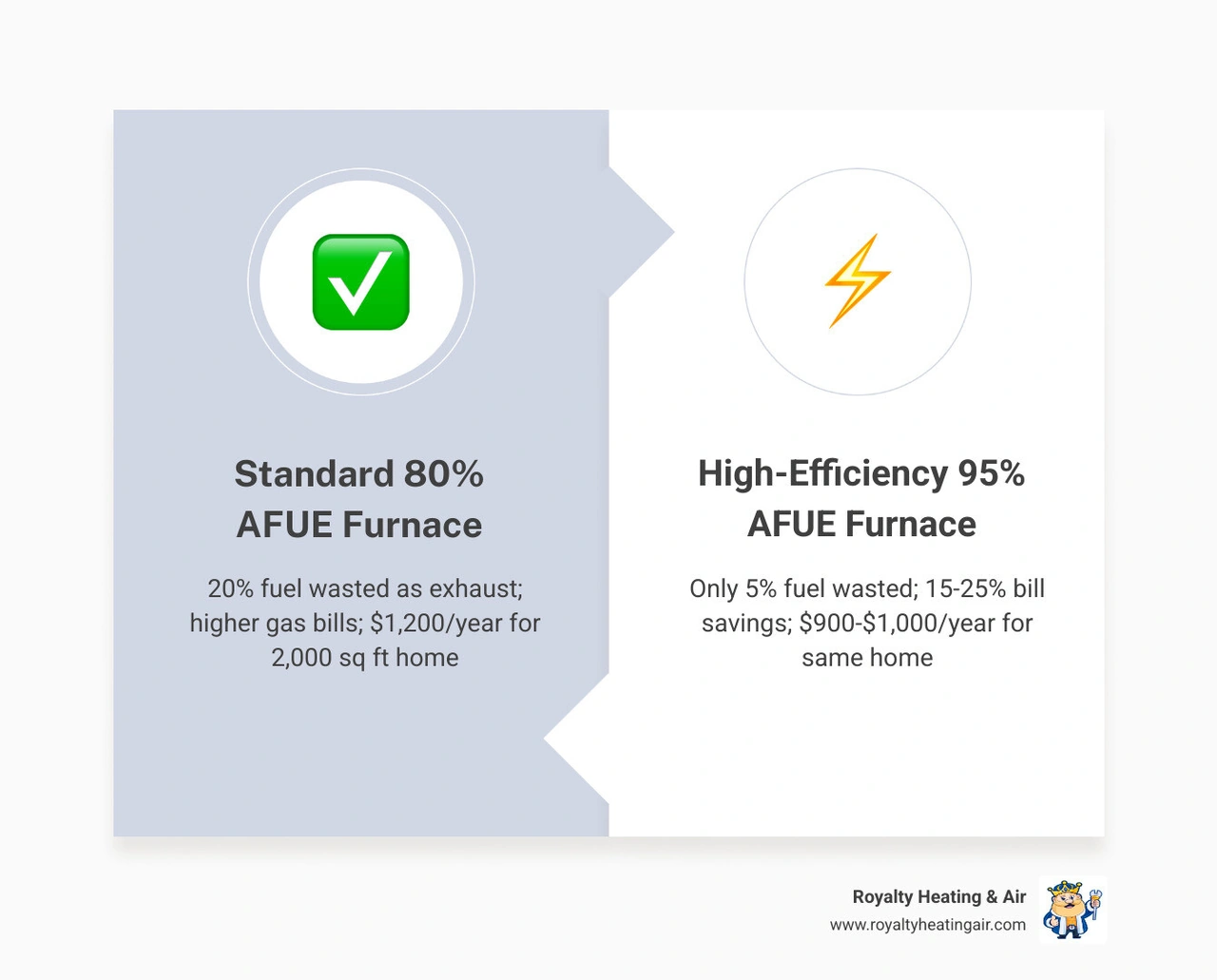
A high-efficiency furnace can reduce fuel waste, improve comfort, and lower heating bills over time. Research consistently shows that moving from an 80% AFUE furnace to a 95% AFUE model can reduce gas use significantly for the same heat output. In practical terms, a 95% furnace delivers 95 cents of heat from every fuel dollar, while an 80% furnace delivers only 80 cents.
That said, the savings depend on several things:
• How often your furnace runs
• The size of your home
• How well your home is insulated and air sealed
• Your thermostat habits
• Local fuel costs
• How long you plan to stay in the house
A standard gas furnace is usually around 80% AFUE. It burns fuel, creates heat, and vents hotter exhaust gases out of a metal flue. It gets the job done, but it leaves a meaningful amount of heat behind.
A high-efficiency furnace usually falls in the 90% to 97% AFUE range. The big difference is that it captures more heat from the combustion process before that heat escapes.
Key differences include:
• A secondary heat exchanger that extracts additional heat from exhaust gases
• Sealed combustion, which typically brings combustion air from outside rather than from inside your home
• PVC venting instead of a traditional metal flue in many systems
• A condensate drain, because the cooler exhaust creates moisture that must be removed
In short, standard furnaces waste more heat. High-efficiency furnaces are designed to squeeze more usable warmth from the same amount of gas.
AFUE stands for Annual Fuel Utilization Efficiency. It sounds technical, but the concept is simple: it tells you how much of your fuel becomes usable heat over a typical heating season.
Here is the plain-English version:
• 80% AFUE = 80% of the fuel becomes heat, 20% is wasted
• 95% AFUE = 95% of the fuel becomes heat, 5% is wasted
So when homeowners ask us about efficiency, AFUE is usually the first number we explain. It is not a promise of exact real-world savings, because real homes have duct losses, insulation issues, and thermostat differences. But it is still the most useful starting point for comparing furnaces.
This is where the answer usually becomes clearer.
If you expect to stay in your home for many years, a high-efficiency furnace is often easier to justify because you have more time to benefit from lower fuel use, possible tax credits, and available utility incentives. Research shows the payback window is often in the range of several years, depending on usage and home conditions.
It tends to make the most sense when:
• Your current furnace is older
• Your furnace runs a lot during winter
• Your home is medium to large
• You plan to stay put for 5 years or more
• You want better comfort, not just lower gas use
If you are already thinking about replacement, our Best Furnace Replacement Roseville Guide can help you think through the next steps.
Savings are real, but they are not one-size-fits-all. Two homes on the same street can see different results because one is drafty and oversized while the other is well insulated and properly sealed.
Research suggests that upgrading from an 80% furnace to a 95% model can reduce fuel use in homes with regular winter heating demand. In some cases, homeowners may notice meaningful seasonal savings over the life of the system, especially when the furnace runs often and the home is properly matched to the equipment.
Here is a simple comparison:
• Typical AFUE — Standard Furnace: Around 80% — High-Efficiency Furnace: Around 90% to 97%
• Fuel waste — Standard Furnace: Higher — High-Efficiency Furnace: Lower
• Venting — Standard Furnace: Metal flue — High-Efficiency Furnace: Often PVC
• Condensate drain — Standard Furnace: Not typically needed — High-Efficiency Furnace: Usually required
• Comfort features — Standard Furnace: Basic on many models — High-Efficiency Furnace: Often more advanced
• Best fit — Standard Furnace: Lower usage homes, simpler installs — High-Efficiency Furnace: Long-term efficiency and comfort goals
Climate matters because runtime matters.
In colder climates, the furnace runs longer and more often. The more it runs, the more opportunities a high-efficiency model has to reduce wasted fuel. In milder climates, the furnace may not run enough for the upgrade to feel as beneficial from an energy perspective.
For service areas in and around Roseville, winters are milder than in many northern states, but homeowners still rely on their furnace during colder nights and seasonal cold stretches. In these conditions, high efficiency can still make sense, especially in larger homes or homes with older insulation.
Generally:
• Colder, longer heating seasons improve long-term value
• Mild winters can slow the benefit you feel from higher efficiency
• Shoulder seasons reduce annual heating demand because the system runs less
So, is a high efficiency furnace worth the extra cost in a milder part of Northern California? Often yes, but comfort improvements may matter just as much as efficiency.
The furnace itself is only part of the equation. Your home decides the rest.
Important variables include:
• Natural gas rates
• Square footage
• Ceiling height
• Window quality
• Attic insulation
• Air leaks around doors and windows
• Duct leakage
For example, a larger home usually heats more air and tends to use more fuel. Poor insulation can also make the difference between standard and high-efficiency equipment more noticeable because the system runs more often.
That said, pairing a furnace upgrade with improvements like duct sealing or attic insulation usually delivers the best results. If your home leaks heat easily, even a high-quality furnace has to work harder than it should.
Sometimes the simpler option is the smarter one.
A standard-efficiency furnace may be the better fit when:
• You plan to move soon
• Your home has venting limitations that make high-efficiency installation difficult
• The furnace will see limited use
• Your attic or installation area presents condensate or freezing concerns
• You want a lower-complexity system
This is especially true when a home would require major modifications for PVC venting or condensate drainage. In some attic applications, condensate management deserves extra attention to help avoid cold-weather issues.
If your current system is acting up and you are not sure whether repair or replacement makes more sense, our Furnace Replacement Roseville CA Ultimate Guide is a helpful next read.
Efficiency ratings get the headlines, but comfort features often make the biggest day-to-day difference. This is the part homeowners notice when they stop dealing with rooms that feel too cold in one area and too warm in another.
A single-stage furnace has one setting: full output. It turns on, heats quickly, and shuts off. That can work well in some homes, but it often creates bigger temperature swings.
A two-stage furnace has two heating levels:
• Low fire for milder conditions
• High fire for colder demand
A modulating furnace goes even further by adjusting output more precisely across a range. Instead of cycling hard on and off, it can run longer at lower levels.
Benefits include:
• More even temperatures
• Fewer hot and cold spots
• Reduced short cycling
• Quieter starts and stops
• Better overall comfort
Variable-speed blowers use ECM technology to adjust airflow more precisely. Rather than always running at one fixed speed, they ramp up or down based on what your home actually needs.
That helps with:
• Quieter airflow
• Better temperature consistency
• Improved filter performance through longer, gentler circulation
• Reduced dust movement
• Better humidity support during cooling season
• Improved airflow matching
This is one of the most useful upgrades in modern HVAC. A variable-speed system often feels more comfortable even when the thermostat setting stays the same.
For a deeper look at blower performance, see furnace blower motor information.
A high AFUE number does not fix a poor installation.
Even the best furnace can underperform if it is:
• Improperly sized
• Connected to leaky or poorly designed ductwork
• Installed with incorrect venting
• Paired with poor thermostat placement
• Not commissioned correctly after installation
Oversized furnaces can short cycle. Undersized ones may run constantly. Both can hurt comfort, efficiency, and equipment life.
That is why professional sizing and installation matter so much. If you are researching replacement options in Roseville and nearby areas, this furnace installation guide covers key installation factors in more detail.
High-efficiency furnaces offer real benefits, but they are not magic boxes that run forever without attention. Like any high-performing equipment, they do best with proper upkeep.
Lower gas waste is the obvious win, but it is not the only one.
Other advantages can include:
• More consistent indoor temperatures
• Quieter operation
• Cleaner combustion with sealed systems
• Better airflow when paired with variable-speed components
• Potential resale appeal
• Lower overall fuel consumption
Many homeowners choose high-efficiency equipment as much for comfort as for efficiency. If your current furnace is loud at startup or leaves certain rooms uncomfortable, a newer system may feel like a noticeable upgrade.
There are also trade-offs.
Potential downsides include:
• More complex installation requirements
• Condensate drainage needs
• Additional electronic components that may require service
• Pressure switches and sensors that need proper maintenance
• Possible attic concerns if drainage or venting is not handled correctly
Because these systems pull more heat from exhaust gases, they create condensation. That moisture must be drained away properly. If the drain line clogs or installation is sloppy, performance issues can follow.
This does not make high-efficiency furnaces unreliable. It just means details matter more.
A well-maintained high-efficiency furnace commonly lasts around 15 to 20 years. Actual lifespan depends on usage, installation quality, maintenance, and whether the system is correctly sized for the home.
Routine maintenance usually includes:
• Changing filters regularly
• Annual inspection and tune-up
• Checking the condensate drain and trap
• Cleaning flame sensors
• Inspecting the heat exchanger
• Testing pressure switches and safety controls
• Evaluating blower performance
Annual maintenance is especially important on higher-efficiency systems because small issues like a blocked drain or dirty sensor can affect operation faster than many homeowners expect.
For maintenance help, see home furnace maintenance tips and annual furnace inspection guidance. If you want to understand specific component concerns, these resources on the Furnace Heat Exchanger and Furnace Blowing Cold Air are also useful.
Timing matters. Replacing a furnace before it fully fails gives you more time to compare options, check eligibility for incentives, and avoid rushed decisions during a cold snap.
As of 2025, qualifying high-efficiency gas furnaces may be eligible for a federal tax credit of up to $600 under the Inflation Reduction Act. Eligibility depends on the specific model and efficiency requirements, so documentation matters.
A few smart reminders:
• Verify that the model qualifies before installation
• Save manufacturer documentation and your invoice
• Ask about utility incentives that may apply locally
• Keep tax records for filing purposes
Programs can change, and availability can vary, so it is wise to confirm current details before moving forward.
Sometimes the real question is not efficiency. It is whether your current furnace is on borrowed time.
Common replacement signs include:
• Frequent breakdowns
• Uneven heating
• Rising energy use
• Strange noises at startup
• Ignition problems
• A cracked heat exchanger
• Declining reliability during cold weather
If these sound familiar, start with signs it is time for furnace replacement or furnace not igniting help.
We usually recommend looking at the whole picture, not just the latest repair.
Use these checkpoints:
• Is the furnace near the end of its expected lifespan?
• Has it needed multiple repairs recently?
• Are comfort problems getting worse?
• Is efficiency likely much lower than newer equipment?
• Are there safety concerns?
• Do you plan to stay in the home long enough to benefit from an upgrade?
If your furnace still has good life left, repair may be the practical move. If problems are piling up, replacement is often the better long-term decision.
For more guidance, visit furnace repair Roseville guide and furnace replacement planning guide.
No. Savings depend on your climate, how much you heat your home, how efficient your current furnace is, and how long you plan to stay. Homes with heavier heating demand usually see the best return.
Often both. Many high-efficiency systems include features like two-stage or modulating heat and variable-speed blowers, which can reduce temperature swings, improve airflow, and run more quietly.
Not always without modifications. High-efficiency systems often require PVC venting, proper condensate drainage, and enough space for correct installation. A professional assessment is the best way to know what will work in your home.
So, is a high efficiency furnace worth the extra cost? In many homes, yes, especially when you plan to stay put, want better comfort, and use your furnace enough to benefit from the efficiency gains. But the best answer depends on your climate, your home's insulation and ductwork, your current furnace condition, and your willingness to keep up with regular maintenance.
For homeowners in Roseville, Rocklin, Lincoln, Granite Bay, and Loomis, the smartest move is to look at the full picture, not just the efficiency label. The furnace should fit the house, the venting setup, and your long-term plans.
If you are weighing repair versus replacement or want help choosing the right heating system, Royalty Heating & Air is here to help with trusted local service and a people-first approach. Learn more in our Best Furnace Replacement Roseville Guide to explore your options.
Royalty Heating & Air proudly serves local homeowners with professional heating installation, repair, and maintenance while supporting families through its partnership with the MackAttack Foundation. Better home comfort can also help make a difference in the community.

