
Services
About
Service Areas


A common myth we encounter at Royalty Heating & Air is that every home must upgrade to a Wi-Fi-enabled device to achieve maximum energy efficiency. If you find yourself researching Smart Thermostats vs Programmable Models: Are the Energy Savings Real?, you might assume the high-tech option automatically guarantees lower utility bills. The reality our technicians see every day is that simply installing a new gadget on your wall does not reduce your energy consumption on its own. Actual energy savings depend entirely on your household habits, your daily routine, and how well the device is configured to manage your specific heating and cooling load.
As the September pre-heating transition approaches, many of our Roseville customers face a clear decision point: choosing whether to stick with a reliable programmable model or upgrade to a smart system during a pre-fall HVAC tune-up. Both technologies offer distinct advantages, but understanding which one aligns with your lifestyle is the key to minimizing energy waste. If you are scheduling an evaluation of your air conditioning systems or planning an AC installation in Roseville, this transparent, hype-free comparison from our team will help you determine which thermostat truly makes sense for your typical suburban routine.
To make an informed decision, you must first understand how these two distinct technologies operate. While both are designed to regulate your indoor climate, their approaches to automation and user interaction are fundamentally different.
Programmable thermostats are devices that rely entirely on manual scheduling. They operate on rigid time blocks, allowing you to set specific temperatures for different times of the day and days of the week. You tell the system exactly what to do and when to do it. If your schedule changes unexpectedly, the thermostat will continue to follow its programmed instructions until you manually intervene.
Smart thermostats, on the other hand, are Wi-Fi-enabled devices that actively learn from your behavior. They use advanced learning algorithms, motion sensors, and geofencing to dynamically adjust the temperature based on whether you are home or away. Rather than relying solely on a rigid schedule, a smart thermostat adapts to your lifestyle over time, making micro-adjustments to optimize efficiency without sacrificing comfort.
The EPA's Energy Star program evaluates both types of devices, noting that while certified smart thermostats can yield measurable savings on heating and cooling, those savings are heavily dependent on baseline user behavior. The primary difference always boils down to automation versus manual input. In our experience working in Roseville suburban homes, either device can perform exceptionally well—if used correctly.
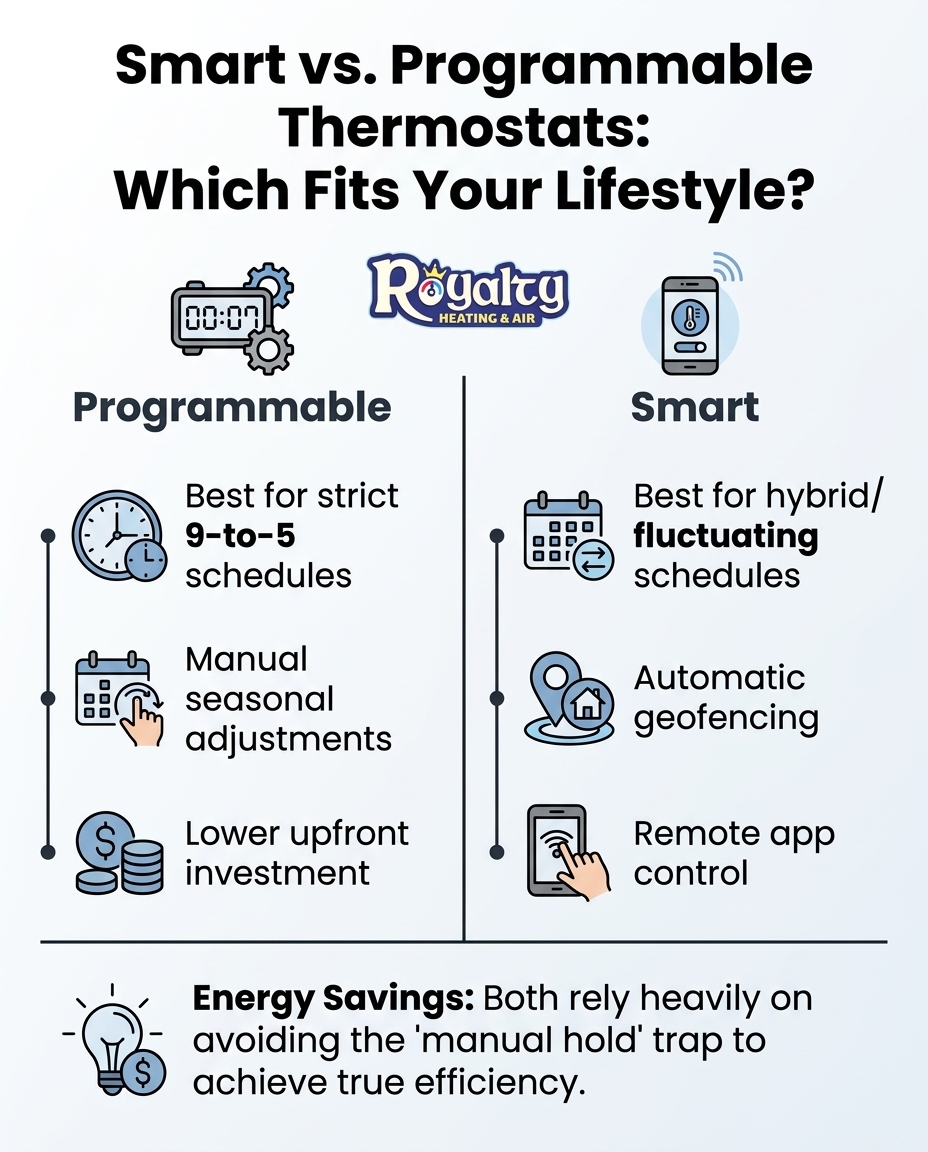
• Scheduling Method — Programmable Thermostats: Manual entry of fixed time blocks — Smart Thermostats: Dynamic learning and automatic adjustments
• Remote Access — Programmable Thermostats: None (adjustments made at the wall unit) — Smart Thermostats: Full control via smartphone applications
• Upfront Investment — Programmable Thermostats: Generally lower initial cost — Smart Thermostats: Higher initial cost, potential utility rebates
• Ideal User Profile — Programmable Thermostats: Strict, predictable daily routines — Smart Thermostats: Fluctuating schedules and hybrid workers
• Efficiency Driver — Programmable Thermostats: Sticking strictly to the programmed schedule — Smart Thermostats: Geofencing and occupancy sensors
One of the most important pieces of advice our team at Royalty Heating & Air can offer is this: we never want homeowners overspending on technology if it will not yield a true return on investment for their specific lifestyle. Families with highly predictable work and school schedules can achieve near-identical energy efficiency with a properly set programmable model.
If your household empties out at 7:30 AM every weekday and fills back up at 5:15 PM, a programmable thermostat handles that routine flawlessly. Investing in a learning algorithm to figure out a schedule that never changes is often an unnecessary expense. The system's overall efficiency is dictated by the equipment itself and the airflow within the home, not just the interface on the wall. For example, during a recent winter project our team completed involving a new furnace and AC unit installation in a local home, we focused heavily on thorough duct cleaning to ensure flawless installation, optimal airflow, and peak efficiency. Once the mechanical baseline was perfected, a standard programmable thermostat was more than capable of managing the home's predictable heating needs.
During your next routine AC maintenance or pre-fall tune-up, have one of our professionals thoroughly check your system and walk you through the programming steps of your current device. The ultimate goal is achieving consistent comfort and efficiency, not just owning the latest gadget on the market.
To get the most out of a programmable model in Roseville suburban homes, you must configure it to match your actual routine. Here is how we recommend optimizing the setup:
• Set distinct time blocks: Program specific temperature shifts for waking up, leaving for the day, returning home, and going to sleep.
• Use appropriate setbacks: Adjust the temperature by 7 to 10 degrees from its normal setting for the 8 hours a day you are away from home.
• Avoid micro-adjustments: Once the schedule is set, let it run its course. Constantly overriding the programming defeats the purpose of the device.
• Plan for the weekends: Ensure your weekend schedule reflects your actual time spent at home, as it usually differs significantly from the weekday routine.
While programmable models are excellent for strict routines, there are specific scenarios where a smart thermostat provides a clear and measurable advantage. If your household operates on a dynamic, ever-changing schedule, a learning thermostat can bridge the gap between comfort and efficiency.
Ideal candidates for smart technology include hybrid workers who spend irregular days at the office, families with older children who come and go at varying hours, and large homes that utilize multiple zoning systems. In these environments, a rigid programmable schedule often leads to heating or cooling an empty house, which wastes significant energy.
One of the most powerful features of a smart thermostat is geofencing. This technology links the thermostat to the GPS location of the smartphones in your household. When the system detects that the last person has left the designated home radius, it automatically shifts into an energy-saving away mode. As soon as the first person breaches that radius on their way back, the system kicks on, ensuring the house is perfectly comfortable by the time they walk through the door.
Additionally, remote access allows users to monitor their system's performance in real time. You can receive alerts for sudden temperature drops, dirty filters, or unusual humidity levels. Catching these anomalies early through an app notification can often prevent minor issues from escalating into major breakdowns that require extensive AC repair services.
It is also worth noting that upgrading to energy-efficient smart technology is often incentivized. Various utility providers offer generic rebates and incentive programs for smart thermostat adoption, though homeowners must always verify current local programs and eligibility requirements directly with their utility company before making a purchase.
In our years servicing the Central Valley, we've seen how the transition from summer to fall presents a unique set of challenges for your HVAC system. With summer temperatures regularly exceeding 100°F and lingering into September, the local climate demands robust cooling. However, as early fall sets in, those intense, lingering hot days are suddenly followed by surprisingly chilly nights.
This rapid fluctuation requires precise thermostat management to handle the fast temperature drops without overworking the equipment. A well-optimized thermostat—whether smart or programmable—prevents the HVAC system from short-cycling during these unpredictable shoulder seasons. Short-cycling occurs when the system turns on and off rapidly because the indoor temperature is hovering too close to the set point, causing unnecessary wear and tear on the compressor and blower motor.
Smart thermostats excel during this specific September pre-heating transition because they can pull local weather data from the internet. By anticipating a sharp drop in overnight temperatures, a smart model can preemptively adjust the heating cycle, ensuring a smooth transition without a sudden, aggressive spike in energy usage. A programmable model can achieve a similar result, but it requires the homeowner to manually shift the scheduling blocks as the seasons change.
Making this transition smoothly before the first real frost hits is critical for protecting your equipment and maintaining indoor comfort. Waiting until the dead of winter to test your heating schedule often leads to uncomfortable nights and emergency service calls.
Regardless of which technology you have mounted on your wall, human behavior remains the biggest variable in energy efficiency. The Department of Energy has repeatedly found that many programmable thermostat users completely negate their potential energy savings by manually overriding their carefully planned schedules—a pattern we see often in our service calls.
The "manual hold" trap occurs when homeowners feel a slight chill or a bit of warmth and immediately walk over to the thermostat to bump the temperature up or down by several degrees, pressing the "hold" button to lock it in. This forces the system to abandon its efficient programming and work harder to reach the new, often extreme, set point.
Here is why micromanaging the temperature dial decreases efficiency:
• HVAC systems do not have varying speeds of output: Dropping the thermostat to 65°F does not cool the house any faster than dropping it to 72°F; it simply forces the unit to run longer.
• Constant overrides disrupt the recovery period: Systems are designed to gradually return to a comfortable temperature. Interrupting this phase causes energy spikes.
• It masks underlying performance issues: If you constantly feel the need to adjust the thermostat, the problem might not be the temperature setting, but rather poor insulation, leaky ducts, or failing equipment.
Persistent thermostat issues are often a frustrating mix of user error and underlying system faults that require a professional diagnostic. For example, in one instance this past spring, one of our homeowners struggled with a long-standing thermostat problem that seemed impossible to program correctly. A thorough assessment by our own knowledgeable technician, Clayton, revealed that the issue required professional resolution rather than just a schedule tweak. Once our team fixed the underlying problem, the homeowner signed up for a maintenance agreement to ensure ongoing reliability.
If you find yourself constantly fighting with your settings, it is time to investigate why your thermostat isn't working as expected. Trusting your programmed schedules rather than constantly pressing the hold button is the most effective way to manage your utility usage in Roseville suburban homes.
Ultimately, the best thermostat for your home is the one that aligns seamlessly with your daily habits and behavioral routines. If your family operates on a predictable, rigid schedule, a properly programmed standard model will deliver all the efficiency you need without the premium price tag. However, if your life is dynamic, your schedule fluctuates, and you value the convenience of remote monitoring, a smart thermostat is a worthwhile investment that pays dividends in both comfort and energy management.
The September pre-heating transition is the ideal time to make this decision. Do not wait until the first freezing night to discover that your current scheduling strategy is failing. By evaluating your household's actual needs now, you can optimize your system, prevent unnecessary wear and tear, and set yourself up for a comfortable, efficient winter.
Take the time to assess your current setup before the heating season is in full swing. Consult with our local experts at Royalty Heating & Air for a comprehensive system evaluation, and make the upgrade or optimization choice that truly fits your lifestyle.
Do smart thermostats actually save energy?
Yes, but the savings depend heavily on your baseline habits. If you currently leave your heating and cooling running at full capacity while you are away, a smart thermostat will generate significant savings by automatically dialing back the usage. However, if you already meticulously manage a programmable schedule, the additional energy savings from upgrading to a smart model may be minimal.
What is the difference between a smart and programmable thermostat?
The primary difference is how the schedule is managed and adjusted. A programmable thermostat requires you to manually input rigid time blocks for temperature changes, which it follows blindly. A smart thermostat connects to Wi-Fi, uses sensors and geofencing to detect when you are home, and actively learns your preferences to adjust the schedule automatically.
Is it worth upgrading to a smart thermostat?
It is worth upgrading if your household has an unpredictable schedule or if you frequently forget to adjust the temperature before leaving the house. The convenience of remote access via a smartphone app and the potential for utility rebates make it an attractive option for dynamic lifestyles. If your routine never changes, a standard programmable model may suffice.
Can a smart thermostat ruin your HVAC?
A properly installed smart thermostat will not ruin your HVAC system, but an incorrect installation certainly can cause issues. If the device is incompatible with your specific heating and cooling equipment, or if it is wired incorrectly without the proper voltage, it can lead to short-cycling or damage to the control board. Always consult a professional to ensure compatibility.
Should I upgrade my thermostat before winter?
Early fall is the best time to upgrade or optimize your thermostat. Addressing your system controls before the heavy heating season begins ensures that your furnace or heat pump will operate efficiently during the first major temperature drop. It also gives you time to learn the new interface before extreme weather arrives.
Do I need a C-wire to install a new thermostat?
Most modern smart thermostats require a C-wire (common wire) to provide continuous power to the Wi-Fi radio and digital display. While some models claim to work without one by using a power-stealing method, this can sometimes cause the HVAC system to behave erratically. An HVAC technician from our team can easily determine if your current wiring supports a smart upgrade or if an adapter is needed.
