
Services
About
Service Areas


When you turn on the heat and feel cold air blowing, you might find yourself asking, is my thermostat broken or is the furnace ignitor failing? It is incredibly frustrating to switch your system over during the September pre-heating season, expecting immediate warmth, only to be met with confusing mechanical sounds and stubbornly cold vents. You can hear the system trying to work, but the result is nothing but a chilly house.
Many homeowners immediately assume the entire furnace is broken, but our team at Royalty Heating & Air often finds the issue boils down to a single communication failure or a stalled startup sequence. By simply listening to the noises your system makes when it tries to start, you can often determine whether the wall control is failing to send the right signals or the internal mechanical ignition sequence is failing to light the burners. Accurate diagnostics matter because guessing the problem usually leads to wasted time and unnecessary stress.
If you need immediate help, our team provides comprehensive professional HVAC services, including expert heating system repair to get your Roseville home warm again.
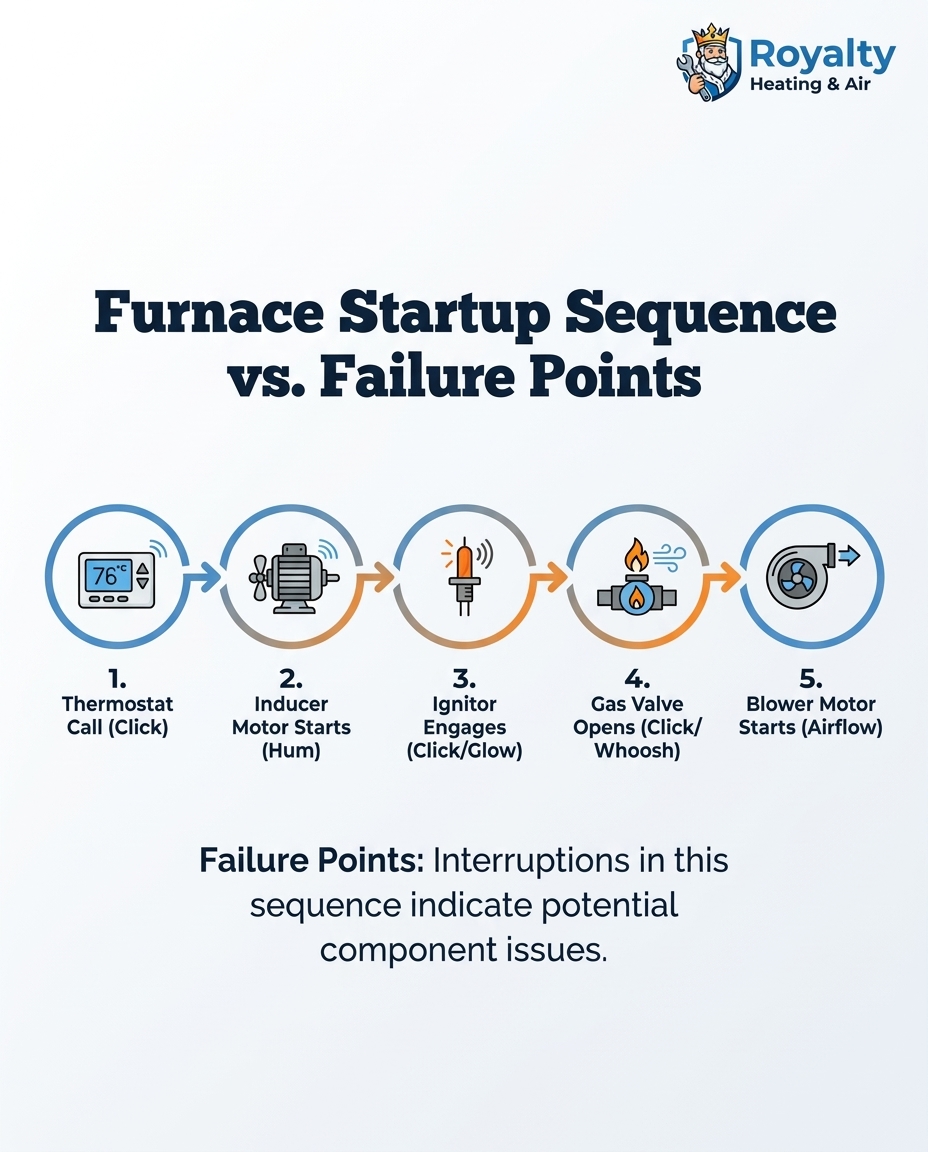
When our technicians inspect a heating system, we check that modern gas furnaces follow a strict, built-in safety sequence of operation every single time the thermostat calls for heat. If any step in this sequence fails, the furnace will intentionally shut down to protect your home from unburned gas or dangerous exhaust fumes. Knowing this exact sequence helps you pinpoint the exact moment of failure.
1. The initial click: The sequence begins when the room temperature drops below your set point. The thermostat clicks, sending a low-voltage electrical signal to the furnace control board.
2. The inducer motor hum: Almost immediately after the thermostat clicks, you should hear a small motor start humming near the furnace. This is the draft inducer motor. Its job is to clear out any leftover combustion gases from the heat exchanger and ensure the exhaust flue is clear before any gas is released.
1. The pressure switch verification: As the inducer motor runs, a small safety device called a pressure switch verifies that air is flowing safely through the exhaust pipe. If the airflow is good, the switch closes and tells the control board to proceed.
2. The ignitor engages: Next, you will hear the sequence of inducer motor start followed by ignitor click. Depending on your system, a hot surface ignitor will begin to glow bright orange, or a spark ignitor will begin making a rapid ticking sound.
3. The gas valve opens: Once the ignitor is ready, the gas valve clicks open. You will hear a distinct "whoosh" sound as the gas meets the ignitor and lights the main burners.
4. The main blower starts: Finally, after the burners have warmed up the heat exchanger for about 30 to 60 seconds, the large main blower motor kicks on, pushing warm air through your home's ductwork.
When a thermostat goes bad, the symptoms usually point to a total lack of communication between the wall unit and the furnace control board. Often, the system is completely unresponsive. You might adjust the temperature setting upwards, but absolutely nothing happens. Alternatively, the thermostat itself might make a faint click, but no furnace components start up in the basement, attic, or utility closet.
Blank screens vs. faulty relays: A completely blank digital screen is usually the simplest fix—it often just means the batteries are dead. However, if the screen is on and shows that the system is in "Heat" mode, but the furnace remains silent, our technicians frequently discover a faulty internal relay. The thermostat is trying to close the circuit, but the electrical switch inside is worn out.
The golden rule of thermostat diagnostics: If the thermostat clicks but you do not hear the inducer motor start at the furnace, the issue is almost certainly a communication or low-voltage power problem. The sequence is failing at step one.
Long-standing thermostat issues can cause immense frustration, but they are often resolved quickly by a professional replacing or rewiring the unit. For instance, one Roseville homeowner reached out to us with a long-standing problem with their thermostat that caused their heating to run erratically. After scheduling service following a local home show, our technician Clayton came out, solved the thermostat issue permanently, and helped them sign up for routine maintenance. If you suspect your wall control is the culprit, learning how to troubleshoot a thermostat that isn't working is a great first step.
If the wall control is working properly, the startup sequence will begin normally, but it will stall halfway through. This scenario is incredibly common in the homes we service: the inducer motor runs normally, but the furnace never produces heat. If you hear the inducer motor run, followed by a click from the control board, but you never hear the "whoosh" of gas igniting, the ignitor is a primary suspect.
In our years of repairing heating systems, we've found that modern hot surface ignitors are highly fragile components. Made of silicon carbide, they act much like the filament in an old-fashioned incandescent light bulb, glowing bright orange to reach ignition temperatures. Over time, they can fail from natural wear and tear. When they crack or burn out, they stop glowing, preventing the gas valve from opening for safety.
Spark ignitors operate differently but present similar auditory clues. A spark ignitor will produce a rapid, rhythmic ticking sound as it tries to light the gas. If it ticks continuously but the gas never lights, or if it fails to tick at all when it should, the ignition sequence has failed.
• Initial Sound — Likely Thermostat Issue: Silence, or a single click at the wall. — Likely Ignitor Issue: Humming from the inducer motor.
• Inducer Motor Activity — Likely Thermostat Issue: Does not turn on at all. — Likely Ignitor Issue: Runs normally for 30-60 seconds.
• Blower Motor Activity — Likely Thermostat Issue: Stays completely off. — Likely Ignitor Issue: May run eventually, but blows cold air.
• Ignition Sound — Likely Thermostat Issue: Never reaches this stage. — Likely Ignitor Issue: No "whoosh" of gas igniting.
At Royalty Heating & Air, we always warn our customers against dangerous DIY teardowns. When a furnace fails to produce heat, it is tempting to grab a screwdriver, open the front panel, and look for a glowing hot surface ignitor. While visual confirmation is a common diagnostic step for professionals, opening the furnace cabinet exposes homeowners to significant dangers. The interior of a gas furnace houses high-voltage wiring (typically 120 volts) and highly delicate components.
The risks of touching an ignitor: Even if the power is off, you should never touch a hot surface ignitor with your bare hands. The microscopic oils from human skin transfer to the silicon carbide material. When the ignitor heats up during the next cycle, those oils create intense hot spots that cause the material to crack and fail prematurely.
Listening to the startup sequence provides more than enough information to know when a professional is needed. You do not need to see the sequence of inducer motor start followed by ignitor click; you just need to listen for it. Once the sequence stalls at the ignition stage, the only safe next step is to schedule a diagnostic visit with a licensed technician who can safely test the high-voltage components.
One of the most common pitfalls of DIY heating repair we see in Roseville is guessing the problem and buying unneeded parts. Homeowners frequently assume their thermostat is broken because the house is cold, so they purchase and install a brand-new wall unit—only to find the furnace still won't turn on. The true issue might have been a faulty furnace control board, a tripped safety limit switch, or a burned-out ignitor.
This is where our team's professional troubleshooting makes all the difference. Expert diagnostic accuracy pinpoints the exact cause of ignition failures, preventing unnecessary parts replacement and restoring heat quickly. Licensed technicians do not guess; they use digital multimeters and specialized tools to test the exact voltage at each step of the sequence. They verify whether 24 volts are leaving the thermostat, and whether 120 volts are reaching the ignitor harness.
A knowledgeable Royalty Heating & Air technician will explain each step of the diagnostic process, giving you complete confidence in the repair. For example, one customer recently reached out in the autumn because their heating system simply wasn't running like new. By performing a thorough professional diagnostic, our technician was able to get the system running perfectly again, providing excellent, on-time service. Pinpointing the exact cause restores heat much faster and prevents recurring breakdowns throughout the winter.
Ignition failures rarely happen out of nowhere; they often lie dormant over the summer months. Because the heating side of your HVAC system sits idle while the air conditioner runs, a cracked ignitor from the end of last winter won't make itself known until you try to turn the heat on again. This is why testing your system during the September pre-heating season is so crucial.
As locals, we know early fall in the Sacramento Valley brings chilly, foggy mornings where overnight temperatures can drop into the 40s and 50s, making early detection of furnace issues essential. You do not want to discover an ignition failure on the first freezing night of the year when HVAC companies are booked solid with emergency calls.
Proactive testing: We highly recommend turning your thermostat to "Heat" on a mild afternoon in early autumn. Listen closely to the startup sequence. Addressing these auditory warning signs proactively allows you to schedule a repair on your own terms. Furthermore, enrolling in a preventative maintenance plan ensures these delicate components are professionally tested, cleaned, and verified before the heavy heating season even begins. A well-maintained system can also help you stay compliant if you plan to utilize generally applicable energy rebates or utility incentive programs down the line.
Yes, our technicians frequently hear a click from the control board attempting to send power to the ignitor. The control board uses an internal relay to send voltage to the ignition component, and that relay makes a distinct clicking sound. However, if the ignitor is bad, the sequence stops right there. The component will not glow or spark, and the gas valve will remain firmly shut to prevent unburned gas from filling the combustion chamber.
Listen for the inducer motor to start and run for 30 to 60 seconds without any further action. The sequence of inducer motor start followed by ignitor click is your primary auditory clue. If the draft inducer motor hums steadily, but you never hear the distinct "whoosh" of burner ignition, the ignitor or the flame sensor is likely the culprit. Relying on sound keeps you safe from high-voltage components while still providing accurate diagnostic clues.
The inducer fan runs to clear dangerous gases before the ignition sequence is allowed to proceed. If the ignition sequence fails midway through, the main blower motor may still kick on a few minutes later as a safety precaution to cool the unit down. Because the burners never lit, this main blower will simply circulate unheated, room-temperature air through your ductwork, making it feel like the furnace is blowing cold air.
The system may become completely unresponsive, fail to reach the set temperature, or short-cycle rapidly. When the internal relays inside the wall control fail, they can no longer send the low-voltage signal to the furnace control board. You will typically not hear the furnace inducer motor start at all if the thermostat fails to send this initial call for heat.
Generally no; weak batteries usually cause a blank screen or a complete failure to initiate the startup sequence. If your inducer motor is running continuously without the furnace ever igniting, the problem is almost always located inside the furnace itself. A continuously running inducer motor points to a tripped safety limit switch, a stuck pressure switch, or a malfunctioning furnace control board, rather than a thermostat power issue.
In our experience working on furnaces across Roseville, most hot surface ignitors last between 3 to 5 years depending on usage and cycling frequency. They are made of fragile materials that expand and contract rapidly with extreme heat, making them highly susceptible to cracking over time. They are considered a normal wear-and-tear component that requires periodic professional replacement to keep your heating system running reliably.
Listening to your furnace is the absolute best first step in diagnosing a no-heat situation during the September pre-heating season. By paying attention to the initial clicks, hums, and the sequence of inducer motor start followed by ignitor click, you can gather vital clues about why your home is still cold.
However, guessing between a broken thermostat and a failed ignitor often leads to wasted time, unnecessary frustration, and money spent on the wrong parts. Once you have listened to the system and identified where the startup sequence is stalling, the safest and most effective next step is to call in the experts at Royalty Heating & Air. Rely on our professional technicians to safely test the electrical components, accurately pinpoint the failure, and restore your home's comfort.
