
Services
About
Service Areas


Are you wondering why your thermostat reads 72 but the house feels like 78? You check the screen on the wall, and the digital display confidently reports a perfectly cool temperature. Yet, as you sit in your living room, you are sweating, the air feels heavy, and the air conditioner seems to be running constantly without making a dent in the heat. It is incredibly frustrating to feel like your own HVAC system is playing tricks on you. At Royalty Heating & Air, our team hears this exact complaint from Roseville homeowners every late summer.
When you experience this specific gap between a 72°F air temp vs. 78°F perceived comfort, it is natural to assume that a sensor is broken or the system is failing. However, in our experience, the short answer is that your thermostat is probably telling the exact truth—but only about the small pocket of air immediately surrounding it. It is completely blind to the heat radiating from the walls, the sunlight pouring through the glass, and the stagnant air trapped in the corners of your home. Resolving this discrepancy requires a deeper look at how your house handles heat, which goes beyond standard air conditioning services to address the entire building envelope.
The air conditioner's job is to remove heat and humidity from the air, but human comfort relies on much more than just the temperature of the breeze coming out of the vents. To understand why your house feels so uncomfortable while the thermostat insists everything is fine, we have to look at the physics of how heat moves through your home.
To solve the mystery of the hot house and the cool thermostat, you need to understand two distinct scientific concepts: ambient air temperature and mean radiant temperature.
Ambient air temperature is simply the measurement of the air itself. This is the only thing a standard wall-mounted thermostat measures. If the air passing over its internal sensor is 72 degrees, it will stop calling for cooling, assuming its job is done.
Mean radiant temperature, on the other hand, is the measure of the heat emitted from the solid surfaces surrounding you. Every object in your home—the ceiling beneath a hot attic, a sun-baked wall, the living room windows, and even the sofa—absorbs heat and radiates it back into the room. Human thermal comfort is dictated up to 50% by mean radiant temperature. That means if the walls and windows are radiating heat at 85 degrees, a 72-degree ambient air temperature will still leave you feeling like you are sitting in a 78-degree room.
Top reasons for this temperature discrepancy include:
• Radiant heat gain: Solar energy baking the exterior of your home and transferring heat through the building materials.
• Mean radiant temperature: Hot indoor surfaces emitting infrared heat directly onto your skin, completely skewing how the ambient air feels.
• Poor insulation: Inadequate thermal barriers allowing the attic or exterior heat to easily penetrate the ceiling and walls.
• Airflow issues: Stagnant pockets of air in specific rooms that never properly mix with the conditioned air from the vents.
Understanding these physical principles is the first step toward improving your overall indoor air quality and home comfort. When you balance both the air temperature and the surface temperatures, you finally achieve that crisp, comfortable environment you expect.
• Ambient Air Temperature — What It Measures: The actual temperature of the invisible air in the room. — Impact on Human Comfort: Accounts for roughly 50% of how warm or cool you feel. — How It Is Managed: HVAC cooling cycles, ventilation, and air conditioning.
• Mean Radiant Temperature — What It Measures: The infrared heat radiating from solid surfaces (walls, glass, roof). — Impact on Human Comfort: Accounts for the other 50% of your perceived comfort level. — How It Is Managed: Insulation, window shading, thermal barriers, and building envelope.
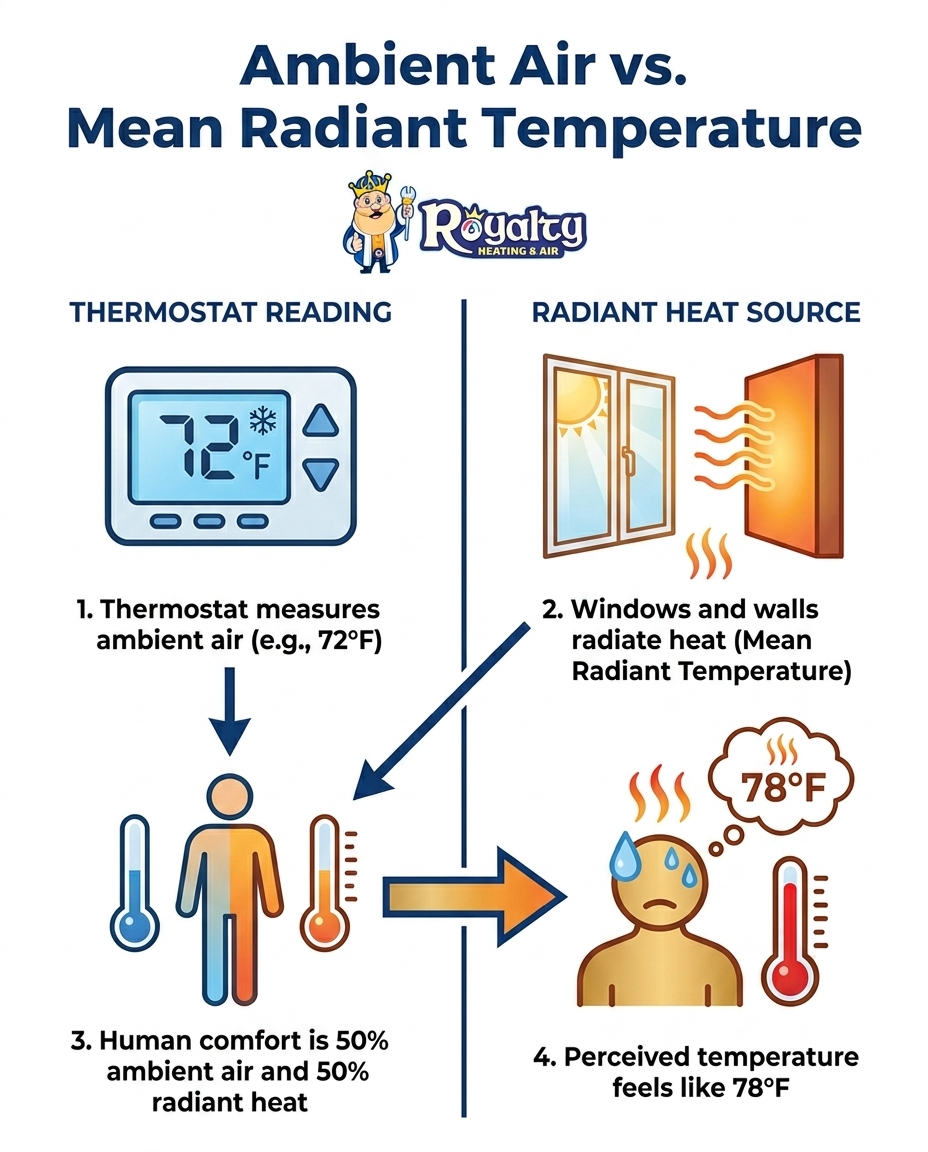
The physics of radiant heat become brutally apparent depending on where you live and the time of year. With Roseville's dry, intense summer climate, radiant heat from sun-baked exterior walls and roofs is a primary driver of indoor discomfort. This is true even when your AC equipment is operating flawlessly and cooling the air effectively.
In our years of cooling Roseville homes, we consistently see this problem peak during late-summer August afternoons. Just as families are navigating the back-to-school transition, the sun's angle shifts lower in the sky. Instead of beating down solely on the roof, the intense afternoon sun begins to shine directly into west-facing windows and against west-facing exterior walls for hours at a time.
Standard double-pane windows without proper exterior shading or low-emissivity (Low-E) coatings act almost like magnifying glasses. They allow massive amounts of solar radiation to pass directly into the living space. Once that light hits your dark hardwood floors, your area rugs, or your furniture, it turns into heat. Those objects absorb the thermal energy and slowly release it into the room.
When sunlight pours through a west-facing window, the floor and furniture can easily reach temperatures exceeding 90 degrees. You now have a massive, warm surface area actively radiating heat onto your body. The air conditioner is pushing 55-degree air out of the vents to cool the ambient air, but that cool breeze is easily overwhelmed by the sheer volume of radiant heat coming from the floor and walls.
The thermostat, safely tucked away in an interior hallway that sees no direct sunlight, registers the cool ambient air and shuts the system off. Meanwhile, anyone sitting in the west-facing living room is left sweltering in the radiant heat trap.
Homeowners often assume a broken sensor is to blame when the house feels uncomfortably hot despite a low setting. It is the most logical conclusion: if the screen says one thing and your body says another, the screen must be broken. However, a thermostat reading a cool temperature is usually highly accurate for the specific spot where it is mounted.
Thermostats are typically installed in interior hallways, near return air grilles, and away from direct sunlight or exterior doors. This placement is intentional so the sensor gets an average reading of the home's air without being tricked by a drafty door or a hot sunbeam. But this creates a microclimate. The hallway is heavily shaded, centrally located, and completely protected from the radiant heat baking the perimeter of the house. The thermostat is doing its job perfectly for that specific hallway, creating a false sense of the home's overall temperature.
That said, actual equipment failures do happen. Our Royalty Heating & Air technicians recently helped a local homeowner who experienced a long-standing issue where their thermostat was genuinely failing to read the home's temperature correctly. We came out, thoroughly addressed the wiring and sensor calibration, and finally resolved the erratic cycling, leading the homeowner to secure a long-term maintenance agreement with us. If you suspect an actual hardware failure, troubleshooting a thermostat that isn't working is a critical next step.
Before you replace the unit on the wall, you can easily test its accuracy. Take a secondary digital thermometer—like a basic weather station monitor or an indoor temperature gauge—and tape it to the wall right next to your thermostat. Leave it there for about twenty minutes.
If the secondary thermometer reads 72 degrees and the thermostat reads 72 degrees, your thermostat is working perfectly. The discomfort you feel in the living room is due to radiant heat, poor insulation, or airflow imbalances. If, however, the secondary thermometer reads 78 degrees while the thermostat stubbornly insists it is 72, you likely have a failing sensor, a bad wire, or an uncalibrated unit that requires professional replacement.
Even if you manage the radiant heat from the sun, mechanical airflow issues can easily cause specific rooms to feel significantly hotter than the thermostat setting. Roseville homes with west-facing windows already face a thermal battle, but if the cool air from the AC cannot actually reach those rooms, the battle is lost before it begins.
Airflow degrades over time due to a variety of maintenance and ductwork issues. When filters become clogged with dust and pet dander, the blower motor has to work twice as hard to push a fraction of the air. This means the rooms closest to the indoor unit get plenty of cooling, while the rooms at the far end of the house receive barely a trickle of conditioned air.
Another major culprit is leaky ductwork. Over time, the seams in your attic ducts can separate, or the flexible material can tear. When this happens, you end up pumping perfectly conditioned, expensive cool air directly into your 130-degree attic. The air that finally makes it to your living space is weak and lacks the volume needed to overcome the heat of the room.
The typical progression of airflow degradation looks like this:
1. Filter restriction: A dirty filter chokes off the return air, starving the system of the volume it needs to operate.
2. Motor strain: The blower motor works harder, generating excess heat and reducing overall efficiency.
3. Component buildup: Dirt bypasses the filter and coats the evaporator coil and blower wheel, severely restricting heat transfer.
4. Airflow collapse: The distant rooms in the house stop receiving adequate airflow, causing localized temperature spikes.
Routine maintenance is essential to prevent this. During a recent late-summer checkup, our crew found a customer's HVAC system in bad shape with heavy buildup on the motor and coils after a long season of heavy use. A technician performed a full system rejuvenation to clean the internal components. The result was restored airflow, a comfortable home, and a clear baseline for when the aging system might eventually need replacement. If you suspect your air isn't reaching its destination, professional ductwork inspection and sealing is the most effective way to restore balance.
When the living room feels like a sauna, the most natural human reaction is to walk over to the hallway thermostat and push the temperature down to 68, 65, or even lower. If 72 isn't working, surely 68 will fix it, right? Unfortunately, this is a trap that wastes massive amounts of energy and drastically shortens the lifespan of your equipment.
As we frequently remind our customers, dropping the thermostat setting does not make the air coming out of the vents any colder. An air conditioner only has one speed of cooling: on. It typically supplies air that is 15 to 20 degrees cooler than the air it pulls in. When you lower the thermostat setting, you are simply telling the compressor to run for a longer period of time.
If the root cause of your discomfort is massive radiant heat gain through a sun-baked window on late-summer August afternoons, running the AC longer is a losing battle. The equipment will run constantly, driving up your utility bills and putting immense wear and tear on the compressor, but it will never fully overcome the heat radiating from the walls and floors. You are using an ambient air solution to fight a radiant heat problem.
Instead of stressing the mechanical system, the solution lies in addressing the building envelope. Adding heavy blackout curtains, installing solar shades, upgrading attic insulation, and ensuring proper attic ventilation will stop the heat from entering the living space in the first place. This requires expert whole-home comfort diagnostics that look beyond just the HVAC unit to identify insulation, radiant heat, and airflow issues, rather than just pushing a standard AC unit repair.
Your house feels hotter because the thermostat only measures the ambient air temperature directly around it, completely ignoring radiant heat. Solid surfaces like sun-baked windows, warm ceilings, and hot exterior walls radiate infrared heat into the room. Because human comfort is dictated largely by these surface temperatures, a room with hot walls will feel uncomfortable even if the air itself is cooled to the target temperature.
Yes, a thermostat can occasionally read the temperature incorrectly if it has a failing internal sensor, a dying battery, or a buildup of dust inside the casing. However, it is much more common for the thermostat to be perfectly accurate for its specific location, usually a shaded, centrally located hallway. It simply cannot sense the extreme heat in the distant, sun-exposed rooms of your home.
If your thermostat is completely unresponsive, it may have a blown fuse, tripped breaker, dead batteries, or a severed communication wire connecting it to the HVAC equipment. If the screen is on but the system won't start, the thermostat might be improperly calibrated or facing a software glitch. Testing it with a secondary thermometer can help determine if the unit itself has failed.
The quick fix is to clean the inside of the thermostat carefully with a soft brush to remove dust from the sensor, and replace the batteries if applicable. If it still reads incorrectly compared to a secondary digital thermometer, you may need to access the calibration settings in the thermostat's menu to adjust the baseline. If calibration fails, the unit will need to be replaced by a professional.
Mean radiant temperature dictates up to 50% of your perceived thermal comfort by measuring the heat emitted from the physical objects around you. If you are surrounded by hot exterior walls and unshaded windows, your body absorbs that radiating heat. This makes you feel sweaty and uncomfortable regardless of how much cold air the vents are blowing into the room.
No, lowering the thermostat setting will not cool down hot walls faster; it only forces your air conditioner to run longer. The AC system removes heat from the air, but it takes a tremendous amount of time and energy to pull deep-seated radiant heat out of solid building materials. Shading the walls and windows from the outside is the only effective way to stop them from heating up.
True indoor comfort is a delicate, precise balance of ambient air temperature, radiant heat management, and proper airflow distribution. When these elements are out of sync, you end up fighting your thermostat, wasting energy, and stressing your equipment for a level of comfort you never actually achieve. Simply lowering the temperature setting on the wall is a temporary band-aid that ignores the structural and environmental realities of your home.
Instead of guessing whether your equipment is failing or your ductwork is leaking, it is time to seek professional whole-home diagnostics. At Royalty Heating & Air, our expert evaluation can pinpoint exactly where the heat is entering, why the air isn't mixing properly, and what specific steps will bridge the gap between the number on the screen and how you actually feel. If you are tired of sweating in your own living room, schedule AC repair in Roseville to evaluate both your cooling equipment and your home's unique comfort profile today.
