
Services
About
Service Areas


When should you replace your AC in the Valley is one of the most important questions you can ask as a homeowner — especially here, where summer heat doesn't just make you uncomfortable, it puts real stress on your cooling system day after day.
Here's a quick answer:
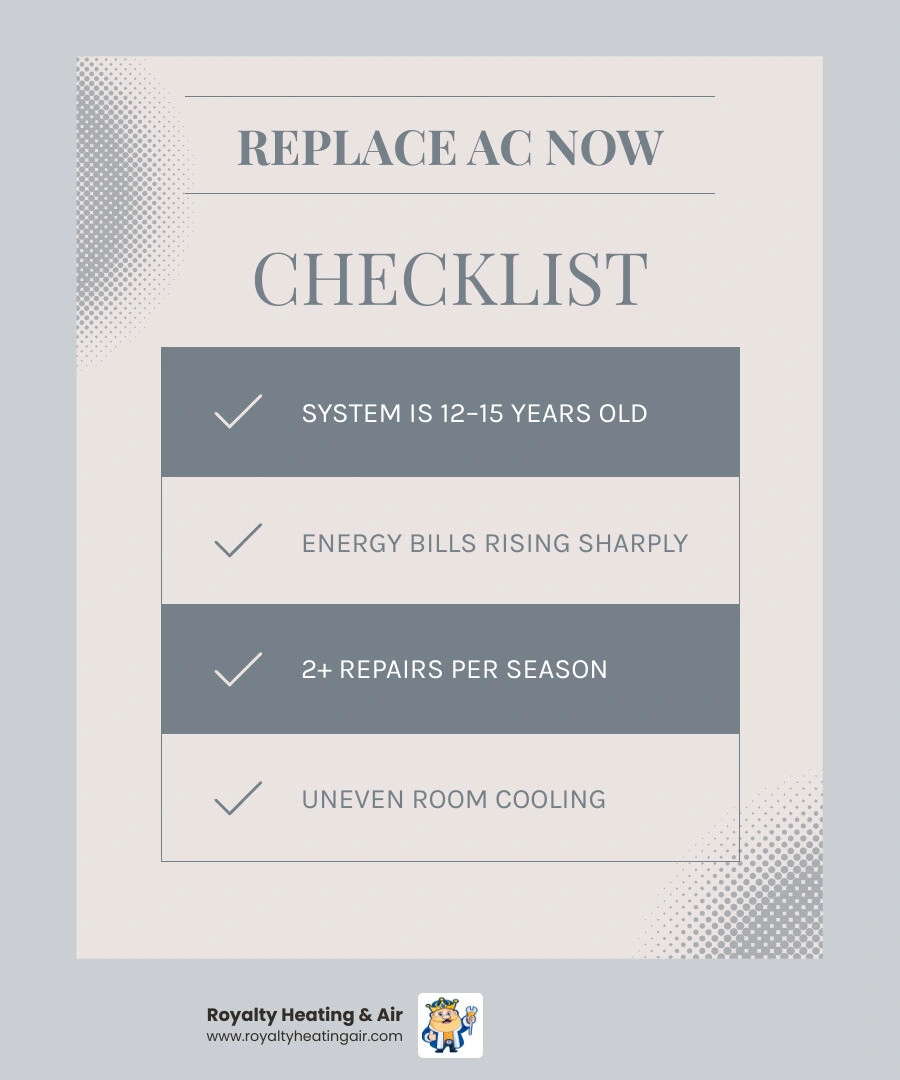
You should replace your AC in the Valley if any of these apply:
• Your system is 12–15 years old (or older)
• Your energy bills keep climbing without any change in how you use your AC
• You've needed repairs two or more times in a single season
• Your home has uneven cooling or rooms that just won't cool down
• Your system uses R-22 refrigerant (phased out in 2020)
• A repair estimate triggers the $5,000 Rule (age × repair cost exceeds $5,000)
• Repair costs exceed 50% of the price of a new system
In Sacramento Valley summers, where temperatures regularly climb into the triple digits, your AC isn't running a few months a year — it's running hard for most of the year. That kind of workload accelerates wear, shortens lifespan, and quietly drives up your energy bills long before the system finally quits on you.
The tricky part? Most systems don't fail dramatically. They slow down gradually. Efficiency drops. Rooms stop cooling evenly. Repair bills start stacking up. By the time the system gives out completely, you've often already spent more than a new system would have cost — and you're scrambling to replace it in the middle of a heat wave.
This guide walks you through the clearest warning signs that your AC is ready for retirement, the financial rules that make the repair-vs-replace decision easier, and what to look for when choosing a new system built for Valley conditions.
Living in places like Roseville, Rocklin, or Lincoln means your air conditioner is the MVP of your home. However, even the most reliable MVP eventually needs to retire. While the national average lifespan for a central air unit is often cited at 15 to 20 years, the reality in the Sacramento Valley is a bit different. Because our units run for eight or nine months out of the year and face intense triple-digit peaks, most systems here have a functional lifespan of 12 to 15 years.
If your unit was installed before 2012, it has already survived over a decade of brutal California summers. At this stage, the internal components — specifically the compressor and the fan motor — begin to experience significant mechanical fatigue. Knowing how old is too old for an HVAC system is the first step in avoiding a total system failure during a July heatwave. When a system reaches this age, its runtime increases because it can no longer cool as efficiently as it once did, leading to a cycle of overwork that eventually leads to a breakdown.
Efficiency isn't just a buzzword; it’s the difference between a reasonable utility bill and a monthly shock. One of the most common signs that you should consider a replacement is a steady, unexplained climb in your energy costs. If you are using your AC the same amount as last year but your bill has jumped by 20% or more, your system is likely struggling to keep up.
Another major red flag is short cycling. This happens when your AC turns on and off rapidly without ever completing a full cooling cycle. Not only does this leave your home feeling humid, but it also places immense strain on the electrical components. Understanding why your AC unit is short cycling can help you realize that the "fix" might actually be a full upgrade. If you find yourself calling for repairs more than twice in a single season, you aren't just fixing a machine; you're patching a sinking ship. Our AC unit replacement complete guide details how these frequent breakdowns are often the final warning before a total compressor failure.
An air conditioner's job is twofold: lowering the temperature and removing moisture from the air. If you notice that some rooms feel like an ice box while others are sweltering, your system's blower or ductwork may be failing. Inconsistent temperatures are a classic sign of an aging system that can no longer distribute air effectively.
Furthermore, keep an ear out for strange noises. Grinding, squealing, or banging sounds often mean that internal bearings are shot or the compressor is nearing its end. Recognizing the warning signs an AC compressor is failing is vital because the compressor is essentially the "heart" of the system — and replacing it is often nearly as expensive as a new unit.
Poor air quality is another indicator. Older units often struggle with filtration, leading to excessive dust or even musty odors. If your family is experiencing increased allergy symptoms indoors, it may be time to look into a modern AC installation in Roseville, CA that features advanced filtration and humidity control.
When faced with a major repair bill, many homeowners in Rocklin and Granite Bay wonder if it's worth the investment. To make this decision easier, we recommend using two industry-standard benchmarks: the $5,000 Rule and the 50% Rule.
The $5,000 Rule is simple math: multiply the age of your unit by the cost of the repair. If the total exceeds $5,000, replacement is usually the smarter financial move. For example, if you have a 12-year-old unit facing a $500 repair, that equals $6,000 — a clear indicator that your money is better spent on an upgrade.
The 50% Rule suggests that if a single repair costs more than half the price of a new system, you should replace it regardless of the age. This is especially true for older homes where AC replacement in Rocklin, CA can offer immediate relief through lower monthly operating costs.
• Upfront Cost — Repairing an Old Unit: Lower — Replacing with a New System: Higher
• Monthly Bills — Repairing an Old Unit: High (and rising) — Replacing with a New System: 20% - 40% Lower
• Reliability — Repairing an Old Unit: Uncertain — Replacing with a New System: Guaranteed with Warranty
• Refrigerant — Repairing an Old Unit: Expensive (R-22) — Replacing with a New System: Modern & Affordable
• Home Value — Repairing an Old Unit: No Change — Replacing with a New System: Increases
One of the most significant factors in the "when should you replace your ac in the valley" debate is the type of refrigerant your system uses. If your unit was manufactured before 2010, it likely uses R-22 (commonly known as Freon). As of 2020, the EPA has completely phased out the production and import of R-22.
What does this mean for you? It means that if your old unit develops a leak, the cost to "recharge" it is astronomical because the remaining supply of R-22 is extremely limited. For many homeowners, a single refrigerant leak in an R-22 system is the "death knell" that makes AC replacement in Folsom the only logical choice.
Modern systems use eco-friendly refrigerants and adhere to the new SEER2 standards (Seasonal Energy Efficiency Ratio). As of 2023, new regulations require higher efficiency levels for all residential units. Upgrading to a high-SEER2 system doesn't just help the environment; it qualifies you for significant federal tax credits and local utility rebates. If you are considering an AC replacement in Lincoln, these financial incentives can significantly offset the initial investment.
While replacement is inevitable, you can delay the "retirement" of your current system through diligent care. In the Valley, biannual tune-ups are essential. A spring visit ensures your system is ready for the first 100-degree day, while a fall checkup prepares it for the heating season.
During a professional maintenance visit, we focus on:
• Coil Cleaning: Dusty coils force the system to work harder to dissipate heat.
• Airflow Optimization: Ensuring your blower motor is operating at peak performance.
• Ductwork Integrity: Leaky ducts can waste up to 30% of your cooled air before it even reaches your living room.
• Electrical Inspections: Tightening connections to prevent short circuits and component failure.
Regular air conditioning maintenance is the best way to extend the life of your equipment. However, if your technician consistently finds new issues during every visit, it’s a sign that maintenance is no longer enough. For residents seeking AC replacement in Granite Bay, CA, a proactive approach is always better than an emergency replacement in the middle of August.
The best time to replace your unit is during the "shoulder seasons" — typically spring (March-April) or autumn (October-November). During these months, demand for HVAC services is lower, meaning you can often schedule your installation more quickly and avoid the "emergency" pricing and long wait times that occur when everyone's system fails during the first major heatwave. Planning an AC replacement in Loomis, CA during the off-season ensures your home is comfortable before the temperatures spike.
Homeowners who switch from an old 10-SEER unit to a modern 16-SEER or higher system typically see a 20% to 40% reduction in their monthly cooling costs. Modern units utilize variable-speed compressor technology, which allows the system to adjust its output to the exact needs of your home rather than simply running at 100% power all the time. This precision cooling is a game-changer for AC replacement in Orangevale, CA, where summer bills can otherwise be daunting.
Yes! Under current federal guidelines (such as the 25C tax credit), homeowners can claim up to $2,000 annually for heat pump installations or up to $600 for high-efficiency central AC units that meet Energy Star requirements. When you combine these federal incentives with local utility rebates in areas like Carmichael, the transition to a new system becomes much more affordable. If you are looking into AC replacement in Carmichael, CA, be sure to ask about the latest qualifying models for 2026.
Deciding when should you replace your ac in the valley doesn't have to be a stressful experience. By watching for the warning signs — rising bills, frequent repairs, and aging components — you can make an informed choice that protects your home's comfort and your wallet.
At Royalty Heating & Air, we are proud to be the trusted HVAC experts for Roseville and the surrounding communities. Our commitment to excellence goes beyond just fixing air conditioning systems. We are deeply rooted in our community through our partnership with the MackAttack Foundation, where we proudly support foster babies and sponsor family adoptions. When you choose us, you’re not just getting a cooler home; you’re supporting a business that believes in giving back to the families that make our Valley a great place to live.
If your AC is showing signs of retirement, don't wait for the next triple-digit forecast. Reach out to us today for a professional evaluation and let us help you find the perfect high-efficiency solution for your home.
