
Services
About
Service Areas


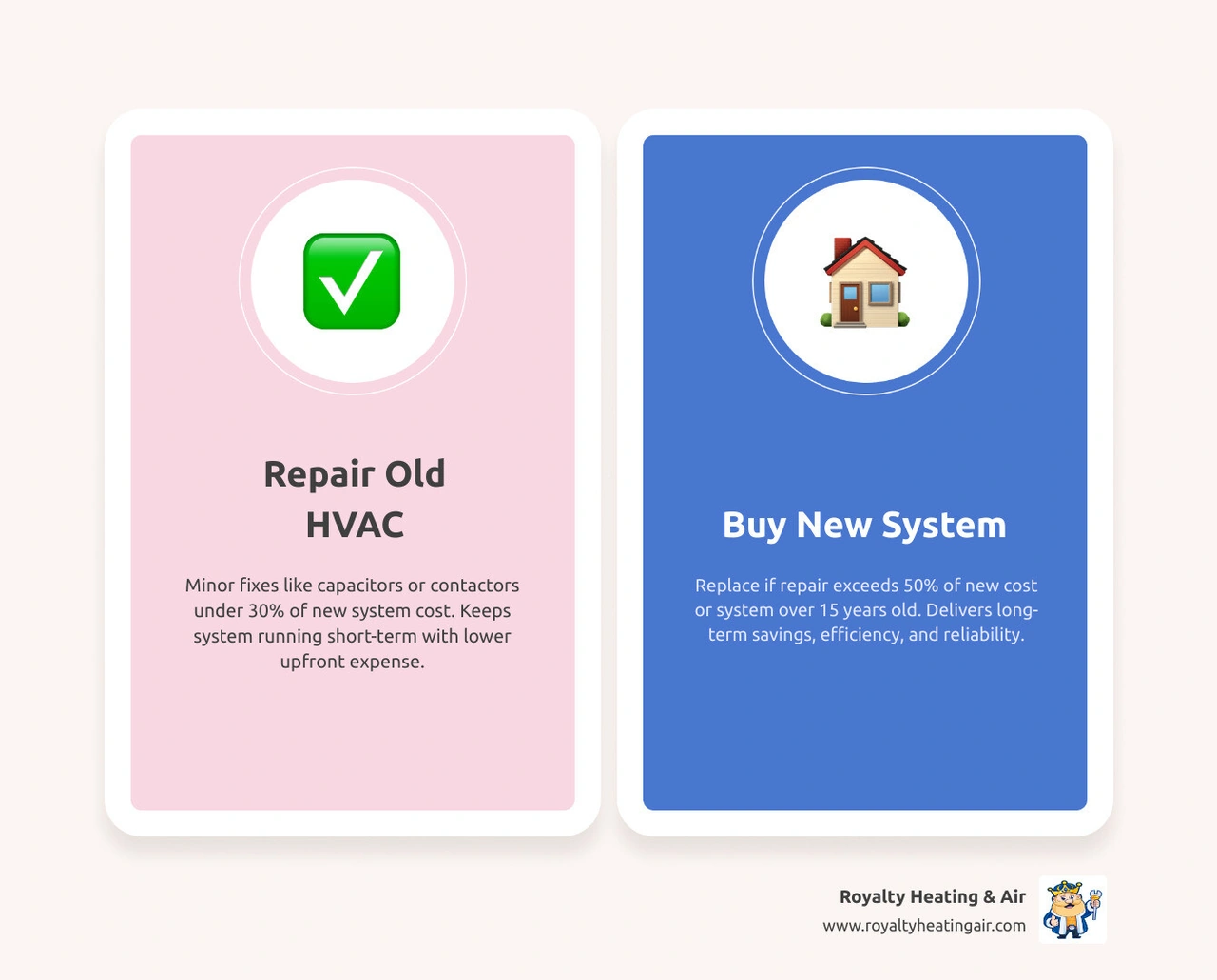
When weighing the cost of repairing old hvac vs buying new system, the short answer is this: if your repair quote exceeds 50% of what a new system costs — or if your system is over 15 years old — replacement is almost always the smarter financial move. Here's a quick breakdown:
• System under 10 years old, minor repair — Recommended Action: Repair
• Repair cost under 30% of new system price — Recommended Action: Repair
• System 10–15 years old, moderate repair — Recommended Action: Evaluate with $5,000 Rule
• Repair cost exceeds 50% of new system price — Recommended Action: Replace
• System over 15 years old, major component failure — Recommended Action: Replace
• System uses R-22 refrigerant — Recommended Action: Replace
Most homeowners face this decision at the worst possible moment — when the AC goes quiet during a summer heat wave or the furnace stops working on a cold January night. There's real pressure to just fix it fast and move on. But making a snap call based on the immediate repair bill can mean throwing good money at a system that's already in decline.
The truth is, the decision between repairing and replacing your HVAC system comes down to more than just two price tags. System age, repair history, refrigerant type, and long-term energy costs all play a role. Understanding how these factors interact can save Roseville homeowners thousands of dollars over the next five to ten years.
This guide walks you through exactly how to make that call — with real math, clear rules, and no guesswork.
When we visit homes in Rocklin or Loomis, we often see homeowners struggling with the emotional side of a breakdown. It’s frustrating when a major appliance fails. To help remove the guesswork, we use two industry-standard "rules of thumb" that help clarify the financial path forward.
The first is the 50% Rule. This is straightforward: if a single repair estimate is equal to or more than 50% of the cost of a brand-new installation, the money is better spent on a replacement. Investing half the value of a new system into an old one is like putting a new transmission into a car with 250,000 miles—it doesn't address the wear and tear on all the other aging parts.
The second is the $5,000 Rule. This is a favorite among financial planners because it accounts for the chronological age of the equipment. We multiply the age of the unit by the repair estimate. If the resulting number is greater than $5,000, we generally recommend moving toward a new system.
For instance, if you have a 12-year-old unit needing a $500 repair, the math is $6,000. Since that’s over the $5,000 threshold, it might be time to start planning for an upgrade. Conversely, a 5-year-old unit with the same $500 repair equals $2,500, making the repair a very safe bet. Understanding How Old Is Too Old for an HVAC System is the first step in applying these rules correctly.
The "tipping point" is the moment where the cost of repairing old hvac vs buying new system shifts from a "fix" to a "replace." In our experience serving the Granite Bay area, systems often enter a "terminal decline" phase between years 12 and 15.
During this window, the economic viability of repairs drops significantly. Even small repairs start to add up. If you've had two or more service calls in the last 24 months, you are likely in the "repair spiral." This is where the cumulative cost of minor fixes quickly approaches the cost of a down payment on a modern, high-efficiency unit. You can explore more about these thresholds in our AC Unit Replacement Guide 2025.
As we move through 2026, the technology gap between old and new systems has never been wider. An older system isn't just "old"; it's often fundamentally less efficient than even the base-model units available today. When evaluating the cost of repairing old hvac vs buying new system, you have to look beyond the immediate invoice and consider the "hidden costs" of keeping an aging unit on life support.
These hidden costs include:
• Rising Utility Bills: As components wear down, they draw more electricity to provide the same amount of cooling or heating.
• Part Obsolescence: For systems older than 15 years, finding replacement motors or control boards can become difficult and expensive.
• The "Emergency Premium": Replacing a system in a panic during a heatwave often means you can't take advantage of seasonal promotions or carefully compare models.
For a deeper dive into what a modern installation looks like, check our Furnace Replacement Cost Estimate 2025.
There are certain "deal-breaker" failures where we almost always advise against repair, regardless of age. These are often related to safety or the core mechanical integrity of the unit.
1. Cracked Heat Exchanger: This is a major safety trigger. A crack in the heat exchanger can allow carbon monoxide to leak into your home’s air supply. Because this component is the "heart" of your furnace, the labor to replace it is extensive. In almost every case, a cracked heat exchanger signals the end of a furnace's life.
2. Seized Compressor: The compressor is the most expensive part of your AC. If it fails out of warranty on a system older than 10 years, the cost of repairing old hvac vs buying new system heavily favors replacement.
3. Terminal Decline: If your system is "short-cycling" (turning on and off constantly) and repairs haven't fixed the issue, it usually points to a system-wide failure that a single part won't solve.
For Roseville residents, our Furnace Replacement Roseville CA Ultimate Guide provides a comprehensive look at these critical triggers.
Not every breakdown is a catastrophe. Many common HVAC issues are actually quite simple to resolve and are well worth the investment, even on a system that is 10 or 12 years old.
• Capacitors and Contactors: These are electrical "wear items," similar to tires on a car. Replacing them is routine maintenance and can get a system back up and running quickly.
• Clogged Condensate Lines: If your AC is leaking water, it’s usually just a simple drainage issue that doesn't require a new system.
• Thermostat Issues: Sometimes the "broken" AC is actually just a faulty thermostat or a dead battery.
If your system is relatively young and the repair is minor, we’ll always recommend the fix. You can find more about these smaller service options on our AC Replacement Roseville CA page.
One of the biggest factors in the cost of repairing old hvac vs buying new system is the type of refrigerant your unit uses. If your system was installed before 2010, there is a high chance it uses R-22 (commonly known as Freon).
The EPA phased out the production and import of R-22 in 2020. By May 2026, the remaining supply is extremely limited and incredibly expensive. If an R-22 system develops a leak, the cost to "top it off" can be astronomical. Furthermore, fixing the leak itself often requires replacing the evaporator coil, which is a major expense. Investing in a repair for an R-22 unit is often described as "throwing money into a sinking ship."
Modern systems use much safer, more efficient refrigerants and adhere to SEER2 (Seasonal Energy Efficiency Ratio) standards. These units are designed to provide better cooling with significantly less power. If you are considering a switch to a more versatile system, our Heat Pump Replacement Roseville CA guide explains how modern heat pumps handle both heating and cooling efficiently.
Modern HVAC technology has moved far beyond the simple "on/off" systems of the past. Today’s high-efficiency units feature:
• Variable-Speed Compressors: Instead of running at 100% or 0%, these units adjust their speed to match the exact cooling needs of your home. This leads to incredibly stable temperatures and lower bills.
• Inverter Technology: This allows for quieter operation and better humidity control, which is essential during our dry California summers.
• Smart Integration: Modern systems communicate directly with smart thermostats to optimize energy usage based on your schedule and even the weather forecast in Lincoln.
For residents in Lincoln, we recommend checking out the Best Furnace Replacement Guide Lincoln CA for more on these tech upgrades.
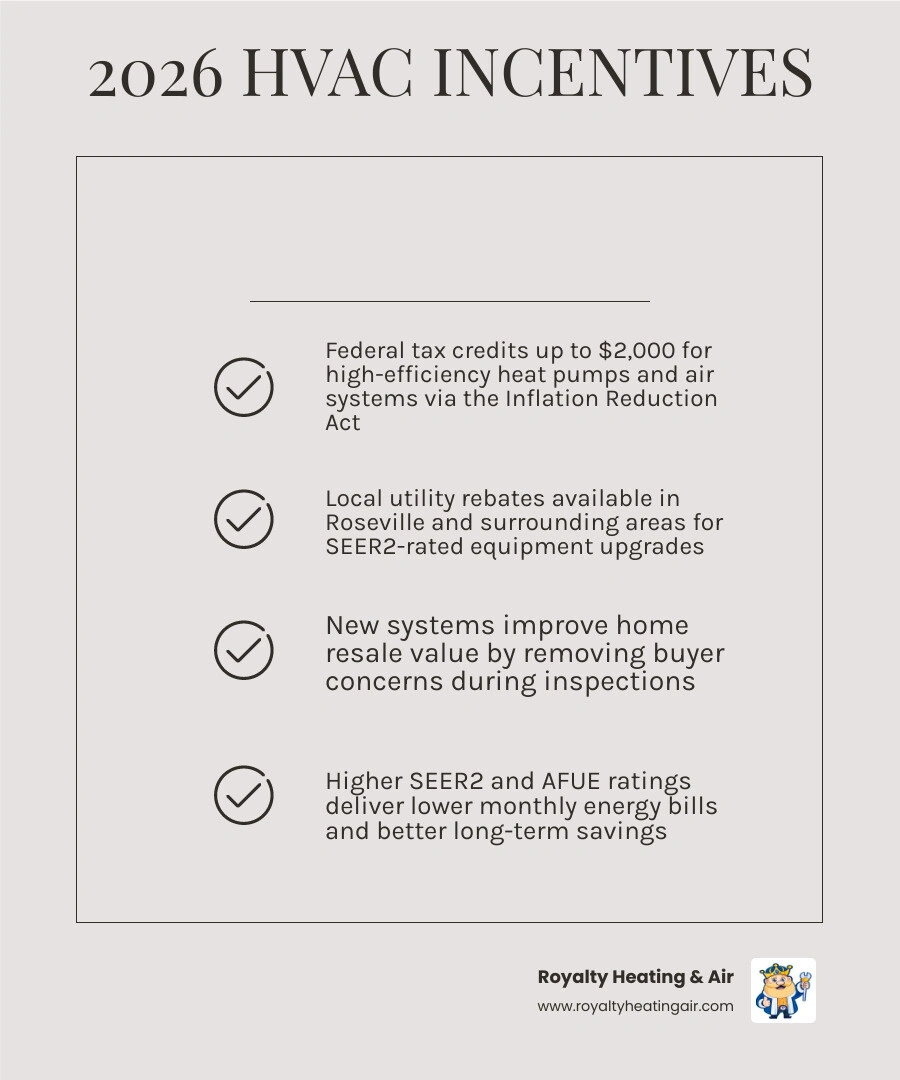
While a new system is a significant investment, 2026 is an excellent year to buy because of the various financial incentives available. The Inflation Reduction Act has provided substantial federal tax credits for homeowners who choose Energy Star-certified heat pumps and high-efficiency central air systems. These credits can often offset a large portion of the upgrade cost.
Additionally, local utility providers in Roseville and the surrounding areas often offer rebates for moving to higher SEER2-rated equipment. Beyond the immediate savings, a new HVAC system adds significant resale value to your home. When a home inspector sees a brand-new, high-efficiency system, it removes a major "question mark" for potential buyers, often leading to a smoother closing process.
In Rocklin, homeowners are seeing great returns on these upgrades. See our Furnace Replacement Rocklin CA Guide for more details on local value.
Homeowners who upgrade from an old SEER 10 unit to a modern SEER2 16 or 18 system can realistically see a reduction in their cooling-related energy consumption by 20% to 40%. When you combine this with a high-AFUE furnace (95% or higher), the year-round savings are substantial. Over the 15-year lifespan of a new system, these savings often pay for a large chunk of the initial installation.
The primary risk is "unplanned downtime." Older systems are statistically much more likely to fail during extreme weather when HVAC companies are at their busiest. There is also the risk of "systemic decline," where a failing blower motor puts extra strain on the capacitor and compressor, leading to a chain reaction of expensive breaks. Finally, older systems often struggle with indoor air quality, as aging ductwork and failing seals can allow dust and allergens to circulate more freely.
In most cases, yes. Your furnace and AC share the same blower motor and ductwork system. When you replace them together, you ensure that the components are a "matched set," which is required to achieve the advertised SEER2 efficiency ratings. It also saves you money on labor, as our technicians only have to "open up" the system once. It’s the best way to ensure long-term reliability for your entire home.
Deciding between the cost of repairing old hvac vs buying new system doesn't have to be a headache. By using the $5,000 rule and looking at the long-term efficiency gains, the right choice usually becomes clear. At Royalty Heating & Air, we are proud to serve our neighbors in Roseville, Rocklin, Lincoln, Loomis, and Granite Bay with honest, expert advice.
We believe in more than just fixing air conditioners; we believe in supporting our community. Through our partnership with the MackAttack Foundation, a portion of our work goes toward supporting foster babies and sponsoring family adoptions. When you choose us, you're not just getting a comfortable home—you're helping us make a difference in a child's life.
Ready to see which option is best for your home? Contact Royalty Heating & Air today to schedule a professional evaluation.

