
Services
About
Service Areas


Are you weighing the pros and cons of repairing an R-22 AC vs upgrading to a heat pump when the compressor fails on the hottest day of the year? A sudden air conditioning breakdown during a 100-degree heatwave creates an immediate comfort and safety crisis for your household. You need relief fast, but rushing into a major purchase can easily lead to long-term regret. When a technician diagnoses a dead compressor on an older, obsolete system, you find yourself standing at a critical crossroads. You must decide whether to patch a dying unit or invest in modern, high-efficiency cooling technology. The ultimate goal is to make a calm, financially sound choice rather than a panicked emergency purchase. To help you navigate this stressful situation, exploring heat pump systems provides a clear, objective path forward.
The reality of a peak summer breakdown: During peak summer, with 100°F+ heatwaves beating down on your roof, your home absorbs thermal energy rapidly. Without a functioning air conditioner, indoor temperatures can reach dangerous levels within hours. This urgency often pushes homeowners to authorize whatever repair will get the cold air flowing fastest. However, a compressor is not a minor part like a capacitor or a contactor. It is the most critical and expensive component of your entire system.
Making the right choice requires stepping back and looking at the big picture. You need to evaluate the age of your current equipment, the availability of the refrigerant it uses, and the long-term impact on your monthly utility bills. By understanding the mechanics of your cooling system and the shifting landscape of HVAC technology, you can protect your home, your comfort, and your budget.
To make an informed decision, you first need to understand what the compressor actually does. The compressor acts as the heart of your cooling system. Located in the outdoor unit, its job is to pressurize the refrigerant gas, raising its temperature so that the heat absorbed from inside your home can be released into the outdoor air. Without a working compressor, the refrigerant stops circulating, and the cooling cycle completely halts.
Diagnosing and replacing a compressor requires specialized tools, advanced training, and a licensed professional. Technicians must safely recover any remaining refrigerant, unbraze the old compressor, weld in a new one, pull a deep vacuum on the system, and recharge it precisely. This is a complex, labor-intensive process—never attempt DIY diagnostics or repairs on a sealed refrigerant circuit.
The situation becomes far more complicated if your system uses R-22 refrigerant. The Environmental Protection Agency (EPA) officially banned the production and import of R-22 in 2020 due to its severe ozone-depleting properties. Because only reclaimed or previously stockpiled R-22 is legally available today, maintaining and recharging these older systems has become increasingly difficult and highly expensive. If you are considering AC replacement in Roseville, the R-22 phase-out is usually the primary driving factor.
Compressors are durable, but they do not last forever. Several factors contribute to a sudden failure, especially in older equipment:
• Years of mechanical wear and tear: Like a car engine with high mileage, the internal moving parts of a compressor eventually degrade and seize up.
• Chronic refrigerant leaks: If your system has been running low on R-22, the compressor has to work twice as hard to cool the house, leading to fatal overheating.
• Electrical issues: Power surges or failing capacitors can cause the compressor motor to short out or burn up internally.
• Extreme outdoor temperatures: During a prolonged Roseville CA heatwave, older units are forced to run continuously without a break, accelerating component failure and pushing aging parts past their breaking point.
When you are sweltering in the heat, paying for a repair might seem like the fastest way to restore your comfort. However, choosing to fix an obsolete system carries significant financial and practical risks. The immediate hurdle is the refrigerant itself. Sourcing reclaimed R-22 refrigerant carries a steep premium due to extreme market scarcity. Every time an older system requires service that involves opening the refrigerant lines—like a compressor replacement—you have to pay for that increasingly rare chemical.
Furthermore, a major repair on obsolete equipment is often a temporary stop-gap rather than a permanent solution. Homeowners must carefully weigh the upfront repair cost against the high likelihood of another breakdown in the near future. If you invest heavily in a dying system today, you might find yourself calling for professional AC repair services again before the summer is over.
Installing a brand-new compressor into a 15-year-old air conditioner creates a severe imbalance in the system. HVAC professionals refer to this as the "domino effect." Here is how the process usually unfolds:
1. The new heart, the old veins: The new compressor pumps refrigerant at maximum pressure and efficiency. However, the existing indoor evaporator coil and outdoor condenser coil are still old, weakened, and corroded.
2. System strain: The older components struggle to handle the restored pressure from the new compressor.
3. The next failure: Often, the indoor coil will develop a blowout leak shortly after the compressor is replaced, releasing that expensive R-22 refrigerant into the atmosphere.
4. Wasted investment: You are now forced to replace the coil and buy more R-22, quickly exceeding the cost of a full system upgrade.
Additionally, warranties on replacement parts for obsolete systems are often heavily limited. You might get a one-year warranty on the compressor itself, but the rest of the aging system remains completely unprotected.
If repairing the old R-22 unit is a risky gamble, the alternative is upgrading to modern technology. Heat pumps have revolutionized residential HVAC, providing exceptionally high-efficiency cooling by transferring heat out of the home rather than generating cold air. They utilize modern, environmentally friendly refrigerants that are widely available, highly efficient, and cost-effective to service.
Many homeowners mistakenly believe heat pumps are only for heating. In reality, a heat pump is simply an air conditioner that can reverse its cycle. During the summer, it operates exactly like a traditional central AC, absorbing heat from your indoor air and dumping it outside. Upgrading provides a massive dual benefit: powerful summer cooling and energy-efficient heating when the seasons finally change.
The local climate plays a massive role in this performance. The hot, dry summer climate in Roseville CA is absolutely ideal for air-source heat pumps. Air conditioners consume a significant amount of energy dehumidifying the air (removing latent heat). Because the local climate lacks the oppressive humidity of the coast or the South, a heat pump can dedicate almost all of its energy to sensible cooling—dropping the actual temperature of the room. This allows the system to cool your home rapidly without struggling against high moisture levels. To dive deeper into how this technology compares to older units, evaluating heat pumps vs. central AC is an excellent next step.
Modern heat pumps offer exceptionally high SEER2 (Seasonal Energy Efficiency Ratio) ratings compared to outdated R-22 central air units. The SEER2 rating measures how efficiently a cooling system operates over an entire season.
• Lower monthly utility bills: A higher SEER2 rating translates directly to less electricity consumed. Moving from an old 10-SEER R-22 unit to a modern 16-SEER2 or 18-SEER2 heat pump drastically reduces the power drawn from the grid.
• Performance under heavy load: Compare the operational efficiency of a new heat pump under heavy load versus a struggling older unit. A new system features modern scroll compressors and variable-speed fan motors that adjust their output to match your home's exact cooling needs, rather than blasting at 100% capacity all the time.
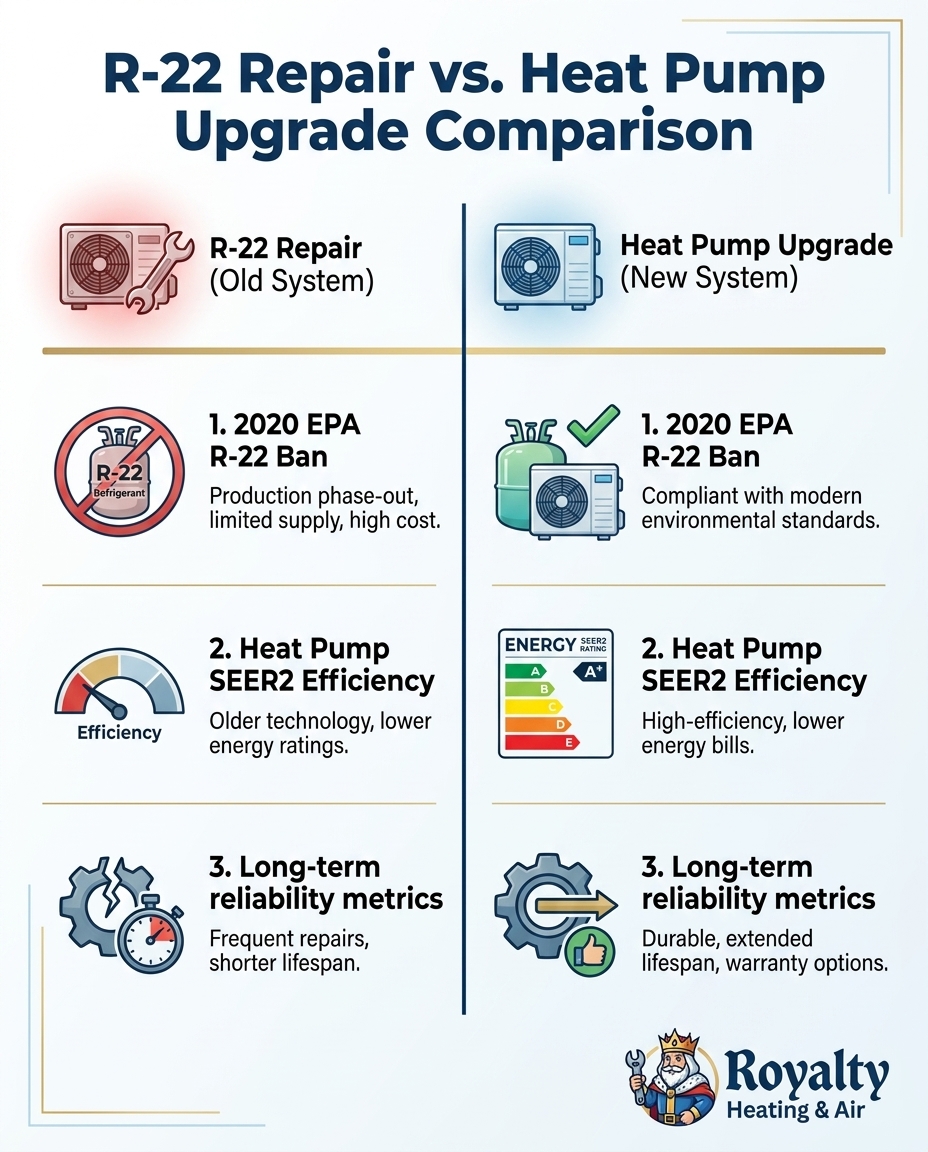
When you are sweating through peak summer (100°F+ heatwaves), you need a clear, objective way to evaluate your choices. The table below breaks down the practical and financial realities of both options.
• Upfront Investment — Repairing Obsolete R-22 System: Requires a significant immediate layout for the compressor and rare R-22 refrigerant, with no added value to the home. — Upgrading to a Modern Heat Pump: Requires a larger initial investment, but secures a brand-new, high-efficiency system for the next 15+ years.
• Refrigerant Availability — Repairing Obsolete R-22 System: R-22 is banned from production. Supplies are extremely scarce, and future recharges will be incredibly difficult to source. — Upgrading to a Modern Heat Pump: Uses modern, eco-friendly refrigerants (like R-410A or R-454B) that are abundant, affordable, and fully supported.
• Monthly Energy Consumption — Repairing Obsolete R-22 System: Old components draw excessive electricity. Utility bills remain high, especially as the system loses capacity. — Upgrading to a Modern Heat Pump: High SEER2 ratings drastically reduce electricity usage, yielding noticeable savings on monthly summer utility bills.
• Reliability & Warranty — Repairing Obsolete R-22 System: Only the new compressor has a short warranty. The rest of the aging system can break down at any moment. — Upgrading to a Modern Heat Pump: Comes with a comprehensive 10-year manufacturer warranty covering all internal parts, providing total peace of mind.
Facing a major HVAC decision during an unexpected emergency is inherently stressful. The key is to rely on objective criteria rather than succumbing to urgency. One of the most effective ways to gauge your situation is by applying the "5,000 Rule." To use this industry-standard formula, simply multiply the age of your current air conditioning equipment by the estimated cost of the repair. If the resulting number exceeds 5,000, the repair is no longer a sound financial investment, and a full system replacement is the smarter choice. This rule helps you weigh the risk objectively without getting bogged down in specific price tags.
You must also factor in the peace of mind that comes with a comprehensive manufacturer warranty on a new system. When you upgrade to a heat pump, you are protected against major component failures for up to a decade. With an R-22 repair, you are entirely on your own the moment the next aging part gives out. Working with a company that provides honest, transparent guidance from local experts ensures that your long-term comfort and budget take priority over pushy sales tactics.
One local homeowner recently reached out when they needed an AC unit replacement along with a whole house fan installation. Because they received transparent, pressure-free guidance, they were able to upgrade their entire setup—including new insulation—while ensuring all their comfort needs were met professionally. This is the standard of care you should expect. Furthermore, exploring flexible HVAC financing options can make a full system replacement highly manageable, allowing you to secure reliable cooling immediately while spreading the investment over time.
The short answer is usually no, especially if the system uses R-22 refrigerant. Replacing a compressor is a major, labor-intensive repair that leaves the rest of your aging system vulnerable to immediate failure. When you factor in the extreme scarcity of R-22 and the likelihood of the indoor coil failing next, investing that money into a new, high-efficiency system offers much better long-term value.
You cannot put modern refrigerants like R-410A directly into an R-22 system. Modern refrigerants operate at much higher pressures, and the older compressor, coils, and copper lines will rupture under the strain. While there are some "drop-in" replacement refrigerants available, they often reduce the system's cooling capacity and efficiency, making them a poor choice during peak summer (100°F+ heatwaves).
Yes, heat pumps provide exceptional cooling performance in extreme heat. During the summer, a heat pump functions exactly like a high-end central air conditioner, absorbing indoor heat and expelling it outside. In dry climates, they are incredibly efficient because they can dedicate all their energy to lowering the temperature rather than fighting heavy indoor humidity.
R-22 refrigerant is already banned from production and import as of 2020. The only supplies currently available are reclaimed from older systems or pulled from dwindling stockpiles. As these limited reserves continue to shrink, the cost to recharge an R-22 system will only continue to climb until it is completely unavailable.
Most homeowners notice a significant drop in their monthly energy consumption after upgrading. Modern heat pumps feature high SEER2 ratings, variable-speed motors, and advanced scroll compressors that use far less electricity than an aging, struggling R-22 unit. Over time, these monthly utility savings help offset the initial investment of the new system.
Do not let a mid-summer compressor failure force you into a bad financial decision that you will regret next season. Whether you need an objective assessment of your current R-22 unit or a detailed quote for a high-efficiency heat pump upgrade, expert help is available right here in Roseville CA. Reach out today to discuss your options, secure your home's comfort, and ensure your family stays cool for years to come.
